
◆ Business & Management
HR9413 People, Management and Organisations: how do you analyse it?
HR9413 is a first-year core module at Newcastle Business School, Northumbria University, and it is where many students first meet a subject that refuses to give them a right answer. The module treats conflict between organisational functions as part of normal life, not something organisations are supposed to avoid, and it treats structure the way Mintzberg (1979) does: as a set of trade-offs, not a blueprint. The answers below focus on the shift first-year students find hardest here.

◆ Question 1 / 7 · The module
What is HR9413 People, Management and Organisations about?
Direct answer: HR9413 is a core Year One module worth 20 credits, roughly 200 hours of study, on Northumbria's BA (Hons) Business Management and related Newcastle Business School programmes. It examines the foundations of organisations, management and people, focusing on how people and work are organised. It looks at relationships, both co-operation and conflict, between organisational functions.
Evidence: Two phrases in the module description do a lot of work. "How people and work are organised" signals that the unit of analysis is the organisation's structure and practices, not the individual personality. And "co-operation and conflict" signals that tension between functions is treated as structural and normal, not as a failure of nice behaviour. Together they tell you the module is sociological in temper rather than motivational, the same framing Buchanan and Huczynski (2019) use to distinguish organisational behaviour from management self-help.
Example: A Vietnamese student at Northumbria told her MAAS mentor she expected HR9413 to be "about how to be a good manager". Her mentor pointed at the phrase about conflict between organisational functions. The module was not going to teach her to be liked. It was going to teach her why a sales department and a finance department, each optimising for a different Mintzberg (1979) coordinating mechanism, can both behave rationally and still obstruct each other.
◆ Question 2 / 7 · Assessment
What kind of assessment should you expect?
Direct answer: Confirm the exact assessment components, weightings and deadlines for your cohort on the module's page in your own eLearning Portal, since Northumbria reissues briefs each academic year and the same module code can run with different assessment patterns across programme variants. What you can plan for regardless is the analytical demand: a first-year organisational behaviour module of this type, worth 20 credits like most others in the year, asks you to apply a named concept to an organisational situation and explain what the concept reveals that common sense does not.
Evidence: The module's stated aim, developing understanding of how organisational sustainability might be enhanced through awareness of workplace behaviour and attitudes, is an applied aim. It points at a task where you take something observable, a behaviour, an attitude, a way of organising work, and connect it to an organisational outcome. That connection is what any assessment on this module will be testing, the same applied test Mintzberg (1979) sets for structural analysis: does naming the mechanism explain an outcome the description alone could not.
Example: A student asked his mentor what he should revise. His mentor suggested a different preparation: for each concept in the module, write one sentence naming a real workplace situation it would explain. The student had a part-time job and found he could do this for most concepts. That exercise turned out to be far better preparation than re-reading lecture slides, because it rehearsed the exact move the assessment required, the same theory-to-instance move Herzberg (1959) demonstrates when he applies his own findings to real workplace redesign.
◆ Question 3 / 7 · Marking
What does the marking reward in a module like this?
Direct answer: Explanation over description, and structure over personality, the distinction Mintzberg (1979) draws between analysing a structure and merely drawing its chart. The weakest first-year answers describe what happened in a workplace and then attach a theory name to it. The stronger ones use the theory to explain something the description alone left unexplained, usually by shifting attention from what individuals are like to how the work is organised around them.
Evidence: The module frames conflict as arising between organisational functions, which is a structural claim, close to how Mintzberg (1979) treats conflict between coordinating mechanisms rather than between the individuals operating them. An answer that explains a conflict by saying the manager was difficult has offered a personality account where the module offered a structural one. An answer that explains the same conflict by noting the two functions were measured on incompatible targets is using the module's own logic.
Example: A MAAS mentor read a student's draft about a workplace disagreement. Every explanation ran through character: one colleague was lazy, another was controlling. She asked what each person was rewarded for. Once the student described the two incentive systems, the same events read as a predictable structural clash Herzberg (1959) would recognise, and the analysis stopped being gossip.
◆ Question 4 / 7 · Concepts
Which concepts should you actually use?
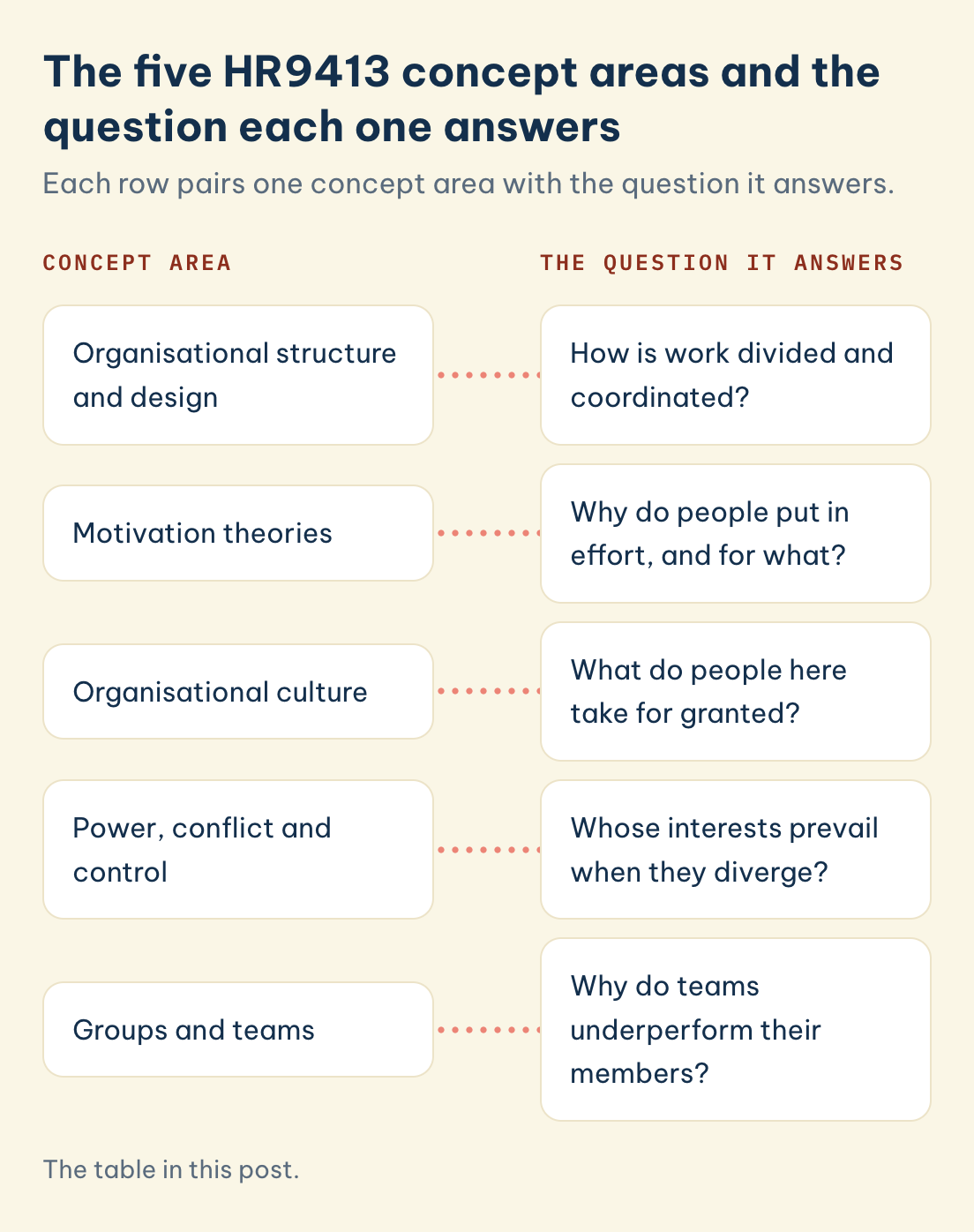
Direct answer: A small number, 2 to 3 concepts applied precisely rather than 6 mentioned in passing, tends to score better. Modules of this type draw on a recognisable core, close to the one Buchanan and Huczynski (2019) organise their standard UK organisational behaviour textbook around, and the useful discipline is knowing which question each concept answers rather than which chapter it came from.
The five HR9413 concept areas and the question each one answers
Each row pairs one concept area with the question it answers.
Concept area
The question it answers
Organisational structure and design
How is work divided and coordinated?
Motivation theories
Why do people put in effort, and for what?
Organisational culture
What do people here take for granted?
Power, conflict and control
Whose interests prevail when they diverge?
Groups and teams
Why do teams underperform their members?
Save this figure
| Concept area | The question it answers | The first-year trap |
|---|---|---|
| Organisational structure and design | How is work divided and coordinated? | Describing the org chart instead of its consequences |
| Motivation theories | Why do people put in effort, and for what? | Treating Maslow as a fact rather than a contested model |
| Organisational culture | What do people here take for granted? | Confusing culture with the values statement on the website |
| Power, conflict and control | Whose interests prevail when they diverge? | Avoiding the topic because it feels negative |
| Groups and teams | Why do teams underperform their members? | Assuming teamwork is always the solution |
Evidence: Edgar and Peter Schein (2017) distinguished three levels of organisational culture, visible artefacts, espoused beliefs and values, and underlying basic assumptions, and argued that only the deepest level really explains behaviour. That distinction is precisely what protects you from the commonest culture answer, which quotes a company's published values and calls it the culture. Hofstede (1980) made a related point at national rather than organisational level, showing that even employees inside the same multinational carried measurably different assumptions depending on which country they worked in, which is a useful caution against treating culture as uniform across a whole organisation. Mintzberg (1979) similarly gave structure an analytical vocabulary rather than a descriptive one, naming five coordinating mechanisms, mutual adjustment, direct supervision, and standardisation of work, outputs and skills, and treating the choice between them as a decision with consequences rather than a default.
For the groups and teams row specifically, Belbin (1981) offered a related structural explanation for why teams underperform: not personality clashes but a missing role, since a team stacked with similar strengths and no one covering the gaps tends to fail in predictable ways.
Example: A student wrote that her case company "has a strong culture of innovation" and cited its careers page. Her mentor asked what employees there took for granted without being told. Following Edgar and Peter Schein's (2017) method, she interviewed a friend who worked there and learned that people assumed you did not question a senior engineer's design. That assumption, invisible on the careers page, explained more about the company's actual innovation record than the slogan did.
◆ Question 5 / 7 · Structure
How should you structure an HR9413 answer?
Direct answer: Lead with the puzzle, not with the theory. A structure that works for most applied organisational behaviour tasks: (1) state the organisational situation and, crucially, what is puzzling about it, briefly; (2) show why the obvious explanation is insufficient; (3) introduce the concept that does better and define it precisely; (4) apply it to the situation in detail, this is the longest part; (5) state what the concept still does not explain; (6) conclude on the implication for how the organisation could be managed differently.
Evidence: The module's aim points at organisational sustainability being enhanced through awareness of behaviour and attitudes, which makes step six part of the task rather than an optional flourish. Analysis that stops at explanation has not yet reached the module's stated purpose, the same implication-for-practice step Herzberg (1959) built into his own motivation research.
Example: A student's essay introduced four theories in its first 400 words and then described a workplace for the remaining 600. His mentor had him delete three theories and open instead with a single sentence: staff turnover was highest in the best-paid team. Starting from something that needed explaining forced the rest of the essay to do explanatory work, the puzzle-first structure Belbin (1981) also uses when introducing a team failure before naming the missing role.
◆ Question 6 / 7 · Common mistakes
What are the most common mistakes in first-year organisational behaviour?
Direct answer: A small set of habits accounts for most lost marks.
| Mistake | Why it costs marks | The fix |
|---|---|---|
| Personality explanations | The module frames conflict structurally | Ask what each party is measured and rewarded on |
| Theory tour before the case | Front-loads definitions, starves analysis | Open with the puzzle, bring theory in when needed |
| Culture read from official values | Mistakes espoused values for assumptions | Ask what people take for granted here |
| Treating motivation models as proven | They are contested, and saying so earns credit | Note the criticism, then apply carefully |
| Avoiding conflict and power | The module names conflict explicitly | Treat divergent interests as normal, not shameful |
| No implication for practice | The aim points at improving sustainability | End with what a manager should do differently |
Evidence: First-year modules assess whether you can move from common-sense reasoning to disciplinary reasoning, the transition Belbin (1981) also expects of managers reading team failure through roles rather than blame. Common sense explains organisational events through the character of the people involved, because that is how we narrate everyday life. The discipline explains them through structures, incentives and shared assumptions. The gap between those two habits is what the marking is measuring, the same gap Maslow (1943) crossed when he moved from clinical observation to a general theory of motivation.
Example: A student wrote that a team failed "because they did not communicate". Her mentor asked what prevented communication, given that everyone involved wanted the project to succeed. She found the two sub-teams sat in different buildings and reported to different managers. Naming the structural obstacle turned a truism into an analysis, the same move from disposition to structure Buchanan and Huczynski (2019) treat as the discipline's defining habit.
◆ Question 7 / 7 · Your workplace
How do you write about a workplace you have actually worked in?
Direct answer: Use it, and anonymise it. Personal work experience is genuinely valuable material for this module because it gives you access to the taken-for-granted assumptions that outsiders cannot see. Remove names, and describe roles and functions rather than individuals. Then apply the same discipline you would to a published case: explain through structure, not through the character of your former colleagues.
Evidence: The module's focus on workplace behaviour and attitudes makes lived observation directly relevant. What converts an anecdote into evidence is the analytical framing, describing a pattern rather than an incident, and connecting it to how the work was organised.
Example: A Vietnamese student who had worked in a family-run business in Ho Chi Minh City hesitated to use it, thinking a British module wanted a British example. Her mentor pointed out that her access to that organisation's unspoken assumptions, the deepest of Edgar and Peter Schein's (2017) three levels, was something no classmate reading a case study could match. Anonymised and analysed structurally, it became the strongest section of her work, the kind of insider access to unspoken assumptions that Edgar and Peter Schein (2017) treat as the hardest evidence to obtain from the outside.
Frequently asked questions
Is HR9413 hard for a first-year module?
The reading is accessible, and the module carries the same 20 credits, roughly 200 hours of study, as any other first-year unit on the programme. The difficulty is a shift in habit: you have to stop explaining organisations through the people in them and start explaining them through how work is arranged. That shift is uncomfortable before it becomes automatic, and it is the same discomfort Hofstede (1980) describes in employees first realising their own workplace assumptions are cultural, not universal, across a sample that grew from 40 to 50 countries as the research was extended.
Do I need work experience to do well?
No. Work experience gives you convenient material, but a well-researched published case analysed properly scores just as well. What you cannot substitute for is the analytical move that Mintzberg (1979) treats as the core skill of structural analysis.
Are motivation theories like Maslow's still accepted?
They remain widely taught and widely criticised. Maslow (1943) proposed the hierarchy in a single journal article, not a body of longitudinal evidence, writing that "human needs arrange themselves in hierarchies of pre-potency. That is to say, the appearance of one need usually rests on the prior satisfaction of another, more pre-potent need" (Maslow, 1943, p. 370), and later researchers have struggled to confirm that needs activate in the strict order the model implies. Herzberg (1959) ran into a related problem: his two-factor theory, separating hygiene factors from true motivators, rests on a method, asking people what satisfied and dissatisfied them, that critics say predictably produces a two-factor pattern regardless of what is actually true. Noting that a model is contested, and saying on what grounds, is a mark of first-year competence rather than a risk.
Can I write about conflict without sounding negative?
Yes, and you should. The module explicitly names co-operation and conflict together as ongoing features of organisational life. Treating conflict as normal and analysable is the module's own position, consistent with how Buchanan and Huczynski (2019) frame conflict as an ordinary feature of organisational life rather than a breakdown to be avoided.
Can MAAS help me with HR9413?
MAAS mentors work with you on finding the puzzle worth explaining, choosing the concept that does real explanatory work, and moving your analysis from personality to structure. You remain the author of your work; the mentor helps you move the explanation from people to structure.
When your draft still reads as a story about colleagues
Memorising models is the easy part, and it is not what lifts a mark. The skill being tested is looking at an ordinary workplace situation, noticing what is genuinely puzzling about it, and explaining it through how the work is organised rather than through who the people are. If you have the reading done but your draft still reads as a story about colleagues, a MAAS mentor can work through the reframing with you.
Talk to a MAAS mentor about your module
Related guides
References
- Buchanan, D. A., & Huczynski, A. A. (2019). Organizational behaviour (10th ed.). Pearson.
- Belbin, R. M. (1981). Management teams: Why they succeed or fail. Heinemann.
- Herzberg, F., Mausner, B., & Snyderman, B. B. (1959). The motivation to work. John Wiley & Sons.
- Hofstede, G. (1980). Culture's consequences: International differences in work-related values. SAGE.
- Maslow, A. H. (1943). A theory of human motivation. Psychological Review, 50(4), 370–396. https://doi.org/10.1037/h0054346
- Mintzberg, H. (1979). The structuring of organizations: A synthesis of the research. Prentice Hall.
- Schein, E. H., & Schein, P. A. (2017). Organizational culture and leadership (5th ed.). Wiley.
Tools & resources
- Northumbria University. (n.d.). Business Management BA (Hons). Retrieved July 29, 2026, from https://www.northumbria.ac.uk/study-at-northumbria/courses/ba-hons-business-management-uusbnb1/
- Northumbria University. (n.d.). Skills Plus. Retrieved July 29, 2026, from https://www.northumbria.ac.uk/about-us/university-services/library/skills-plus/
This article is part of the MAAS Journal series for Vietnamese international students. MAAS Assignment & Essay Support is an academic support partner; we coach students through the Outline, Draft, Final delivery model with developmental feedback from discipline-matched experts. We do not write or submit work on a student's behalf.
A free 20-minute consultation is a conversation about where you are with HR9413.
Book a free consultation ▸