
◆ Accounting & Finance
ACCT3563: the final accounting course is about what the standards cannot settle
3 years of accounting trains you to find the treatment. This course puts you in front of questions where the profession has argued for 3 decades and still disagrees. That shift catches students who expect a harder version of what came before. The word in the title is issues, and an issue is not a topic you learn, it is a question that remains open. Below is how MAAS mentors read a course built like this.

◆ Section 1 / 7 · The course
What is the course, and where does it sit?
Direct answer: At UNSW, ACCT3563 is Issues in Financial Reporting and Analysis, a 6 unit of credit undergraduate course, described as the final course in financial accounting, building on ACCT2542. It covers advanced topics: associates, joint ventures, foreign currency transactions, offshore and diversified operations, derivative financial instruments, and issues around the scope and quality of financial reports.
Evidence: The published description names past examples of those topical issues: environmental reporting, ethical reporting dilemmas, and the information that should be reported on cultural and heritage assets. That list tells you the second half of the course is not a continuation of the first. The technical block extends ACCT2542; the issues block asks whether the reporting model works at all in cases it was not built for.
Note on sourcing: the wording above comes from UNSW's published course description, and the topical examples are explicitly described as drawn from past years. Check your own course outline for the current term, because the issues component is the part most likely to change.
Example: A student prepared for the course by drilling consolidation and foreign currency translation for 3 to 4 weeks before the term started. Both were examinable and neither helped with a question asking whether a class of assets should appear on a balance sheet at all.
◆ Section 2 / 7 · What an issue is
What makes a reporting question an "issue" rather than a topic?
Direct answer: An issue is a question where the conceptual framework can be applied honestly and still produce more than one defensible answer. Those are the questions the course is named after, and they are marked differently from technical questions.
Evidence: Consider what recognition requires. An asset must meet a definition and satisfy recognition criteria, including that its value can be measured reliably. For an ordinary machine that is unremarkable. For a painting held by a national gallery, which will never be sold, has no meaningful market, and exists to serve a public rather than to generate cash, each element of the test becomes contestable. Nothing has gone wrong technically. The framework was built with a different kind of asset in mind.
Example: Asked whether heritage collections should be recognised, in an answer of about 400 to 500 words, a weaker response said yes because they are controlled resources from past events. A stronger one worked through the same definition and stopped at measurement, asking what a reliable value would even mean for an item that cannot be sold and is not held for cash flows.
◆ Section 3 / 7 · Heritage assets
Why is the heritage assets debate the best case study you have?
Direct answer: Because it is a live disagreement between named scholars in a peer-reviewed journal, running for 30 years, on a question first-year logic says should be simple. Very few undergraduate topics give you a documented argument you can enter rather than merely report.
Evidence: Carnegie and Wolnizer (1995), writing in the Australian Accounting Review, put their conclusion in the paper's own terms: "it is not technically proper to recognise cultural, heritage and scientific collections as assets for financial reporting purposes" (Carnegie & Wolnizer, 1995). They noted that standard setters in Australia and New Zealand had advocated bringing such collections to account, while there were no similar requirements in the United States, the European Union including the UK, or Canada, and no such recommendation from the international standard setter of the day. Their surveys found that arts institutions across the English-speaking world largely did not report their collections.
The argument did not end there. Their position was contested in the same journal, and Carnegie and Wolnizer (1999) published a response unravelling what they characterised as rhetoric about reporting public collections as assets. 2 decades later the question returned to the international agenda: Carnegie et al. (2022), again in the Australian Accounting Review, examine the controversy in the light of an international public sector exposure draft proposing that heritage items be valued for recognition as heritage assets, and argue the debate has to be understood as involving accounting as a technical, social and moral practice rather than a measurement problem alone.
Example: A student who cites only the 1995 paper writes that heritage assets should not be recognised. A student who traces the exchange writes something far stronger: that a disagreement running 30 years among specialists indicates the framework is underdetermined for this class of item, and then argues a position knowing what the other side says.
◆ Section 4 / 7 · Open questions
How do you write about an open question without sitting on the fence?
Direct answer: State the framework test, name the exact point it breaks down, present the strongest opposing case, take a position, then say what would change your mind. In a typical 1,500 to 2,500 word issues essay, the last two moves alone often account for 30% to 40% of the marks.
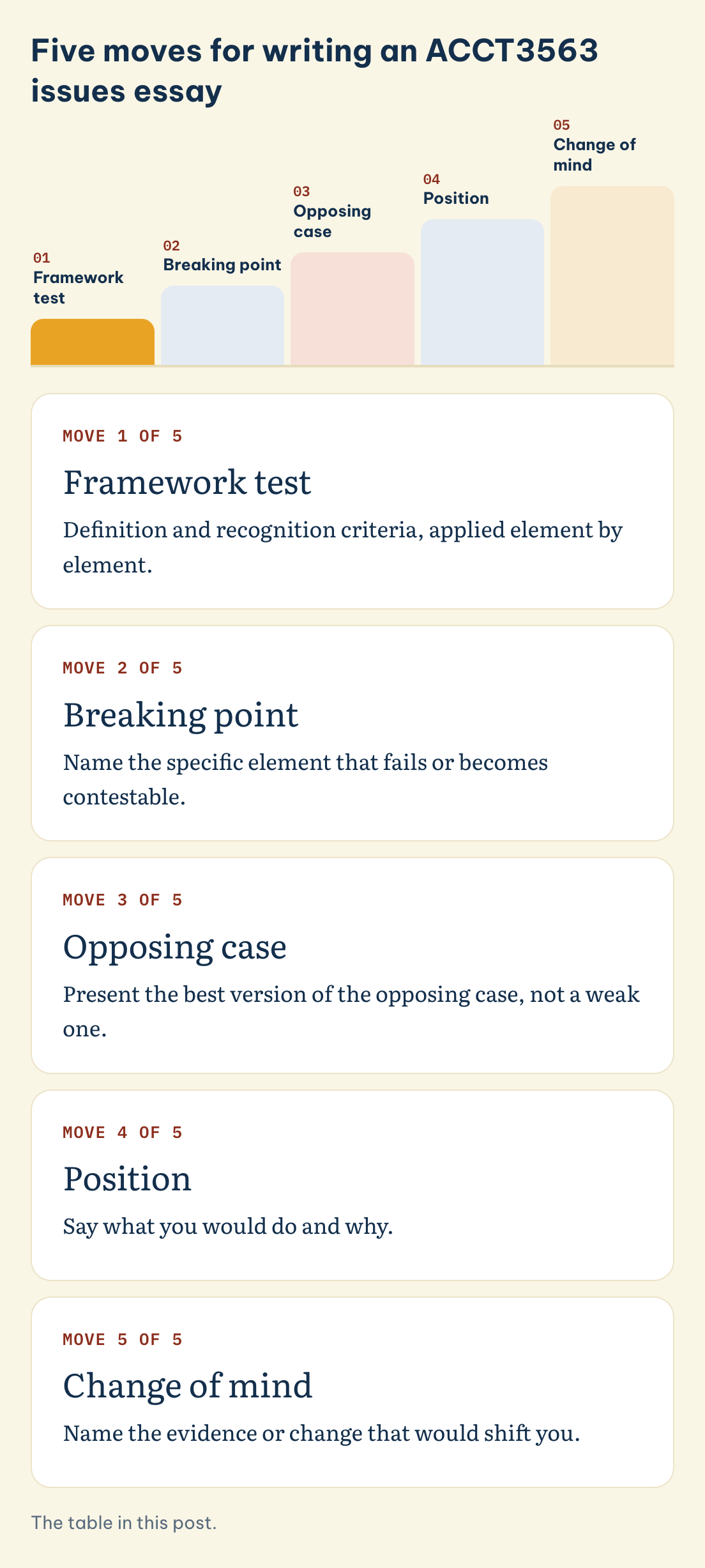
Five moves for writing an ACCT3563 issues essay
The five moves run in order, from the framework test to the statement of what would change your mind. The bar heights and colours only mark the order and carry no weight.
Move 1 of 5
Framework test
Definition and recognition criteria, applied element by element.
Move 2 of 5
Breaking point
Name the specific element that fails or becomes contestable.
Move 3 of 5
Opposing case
Present the best version of the opposing case, not a weak one.
Move 4 of 5
Position
Say what you would do and why.
Move 5 of 5
Change of mind
Name the evidence or change that would shift you.
Save this figure
| Move | What it looks like | Why it earns marks |
|---|---|---|
| State the framework test | Definition and recognition criteria, applied element by element | Shows the analysis is grounded, not opinion |
| Locate the breaking point | Name the specific element that fails or becomes contestable | This is the actual finding |
| Present the opposing case at strength | The best version, not a weak one | Markers can tell which you chose |
| Take a position | Say what you would do and why | An issues question wants a judgement |
| State what would change your mind | Name the evidence or change that would shift you | Converts a stance into reasoning |
Evidence: A course built around contested questions cannot be marked on whether you reached the right answer, because the profession has not. It is marked on whether you understood why the question is hard and defended a position knowingly. As a broad guide, not a fixed rule, an issues essay commonly runs 1,500 to 2,500 words, and the last two rows of the table above often account for 30% to 40% of the marks on their own. That is also why the last row matters more here than in a technical course.
Example: Two 1,800 word essays reached opposite conclusions on heritage recognition and both scored well. Both had worked through the recognition criteria, both had stated the strongest opposing argument, and both had said what would change their view. The essay that scored poorly agreed with the textbook and never said why the question was disputed.
◆ Section 5 / 7 · Technical half
What about the technical half?
Direct answer: Do not let the interesting half crowd it out. Associates, joint ventures, foreign currency translation and derivatives are examinable in the ordinary way, and they carry the marks you cannot argue your way to.
Evidence: These topics sit alongside the issues content in the same description, and they build directly on ACCT2542. Foreign currency translation in particular tends to be underprepared, because it combines mechanics students find fiddly with a conceptual question about which exchange rate reflects the economic substance of a balance. Technical questions of this kind commonly carry 40% to 50% of the total marks in a course built this way, so a small mechanical error can cost more than a shaky paragraph on an issues question.
Example: A student who wrote a genuinely thoughtful 2,000 word essay on ethical reporting lost more marks on translation mechanics in the exam than the essay had gained. The issues component rewards thinking; it does not compensate for the technical component.
◆ Section 6 / 7 · Ethical dilemmas
How should you handle ethical reporting dilemmas?
Direct answer: As reporting questions with consequences for users, not as questions about whether people should be honest. The interesting cases are ones where every option is legal and defensible and they still lead users to different conclusions.
Evidence: The framing in Carnegie et al. (2022) is useful here even outside the heritage context. Treating accounting as a technical practice alone makes the ethical dimension look like something bolted on afterwards. Treating it as also a social and moral practice puts the question where it belongs, which is in the choice itself rather than in the character of the person making it.
Example: Asked about an entity choosing an accounting policy that is permitted but flattering, a weaker answer said the choice was unethical. A stronger one accepted that the choice was within the standards, identified which users would draw a different conclusion because of it, and asked what disclosure would restore what the choice had obscured.
◆ Section 7 / 7 · Order of work
A practical order of work
Direct answer: Sort every question into technical or issue before starting, since each is answered and marked differently. Apply the ACCT2542 framework to technical questions, but apply the same framework first to issues questions too, then locate where it stops giving a clear answer and take a position.
- Sort every question into technical or issue before you start. They are answered differently and marked differently.
- For technical questions, follow the ACCT2542 discipline: classify the relationship, apply the criterion the facts turn on, state what each entry achieves.
- For issues questions, apply the framework first anyway. Your finding is the specific point at which it stops giving a clear answer, usually 1 to 2 sentences long.
- Read at least one exchange in the literature rather than one paper, such as the heritage assets debate that runs from Carnegie and Wolnizer's 1995 paper to Carnegie et al.'s 2022 paper. A disagreement teaches you more than a conclusion.
- Take a position and say what would change it, in a short closing paragraph of 3 to 4 sentences. Fence-sitting reads as not having done the analysis.
- Keep the technical revision going even when the issues material is more interesting. It carries marks you cannot recover by argument.
If your standards-application groundwork still feels thin, the ACCY201 guide covers the recognition, measurement, presentation and disclosure ordering that this subject assumes you already have.
Frequently asked questions
Is ACCT3563 harder than ACCT2542?
Different rather than harder. The technical content is more advanced, but the real adjustment is being marked on judgement in the issues component instead of on reaching a defined answer.
Can I disagree with the standard setter in an essay?
Yes, where the question invites analysis, provided you argue from the framework rather than from preference. Published scholars have done exactly this on heritage assets for thirty years.
How many sources should an issues essay use?
Follow your course outline. As a rule, 2 papers that disagree with each other are worth more than 4 that agree, because they let you show reasoning rather than summarising. A 1,500 to 2,500 word essay rarely has room to do justice to more than 2 to 3 sources in real depth.
Does the issues content change between terms?
The description presents the topical examples as drawn from past years, so treat your current outline as authoritative and this article as background on the shape of the course.
Is this course required for the professional bodies?
It is a later course in the UNSW accounting sequence and part of the accredited major, so check the current accreditation requirements for the pathway you intend to take.
Where MAAS fits
MAAS mentors work alongside students on courses like this rather than in place of them. On an issues essay the most useful work is usually adversarial, spent on 2 to 3 rounds of the same question: taking the opposite position to yours and pressing until either your argument holds or you find the point where it does not. Students often discover their conclusion was fine and their reasoning had a gap they could not see from inside it. The analysis stays yours. If that is useful, our academic support service and our tutoring service are the two places to start. If you are working through the consolidation groundwork this course assumes, our guide to ACCT2542 Corporate Financial Reporting and Analysis covers it.
References
Carnegie, G. D., Ferri, P., Parker, L. D., Sidaway, S. I. L., & Tsahuridu, E. E. (2022). Accounting as technical, social and moral practice: The monetary valuation of public cultural, heritage and scientific collections in financial reports. Australian Accounting Review, 32(4), 460–472. https://doi.org/10.1111/auar.12371
Carnegie, G. D., & Wolnizer, P. W. (1995). The financial value of cultural, heritage and scientific collections: An accounting fiction. Australian Accounting Review, 5(9), 31–47. https://doi.org/10.1111/j.1835-2561.1995.tb00164.x
Carnegie, G. D., & Wolnizer, P. W. (1999). Unravelling the rhetoric about the financial reporting of public collections as assets. Australian Accounting Review, 9(1), 16–21. https://doi.org/10.1111/j.1835-2561.1999.tb00095.x
Tools & resources
UNSW Sydney. (2024). ACCT3563: Issues in Financial Reporting and Analysis. https://www.handbook.unsw.edu.au/undergraduate/courses/2024/ACCT3563
A free 20-minute consultation is a conversation about where you are with ACCT3563.
Book a free consultation ▸