
ACCY201 Advanced Financial Accounting at the University of Wollongong is not a subject where the entry is the answer. The handbook asks you to interpret standards in complex business arrangements and to defend the interpretation, and one of its three assessment components is an industry-collaborative project rather than a closed problem set. That changes what a strong submission looks like. This guide sets out how MAAS mentors read an ACCY201 task.
Author: MAAS Editorial Team
Last updated: 2026-09-22
Category: accounting-finance
What is ACCY201 Advanced Financial Accounting about?
Direct answer: ACCY201 is a 200-level, 6 credit point subject in UOW's School of Business, inside the Faculty of Arts, Society and Business. It builds directly on ACCY200 Financial Accounting and asks students to apply accounting standards to complex business arrangements, exercising professional judgement rather than following a fixed procedure.
Evidence: The 2026 UOW Course Handbook entry describes the subject as building on ACCY200 "to understand and evaluate advanced accounting techniques", with students applying critical and analytical skills to the interpretation and application of accounting standards in complex business arrangements. It carries the Embedded WIL designation, meaning part of the subject simulates or draws on professional practice.
Example: A Vietnamese student at UOW came to MAAS with a draft that was technically clean, every journal balanced, every schedule footed. It sat at a Credit. The mentor's diagnosis took one reading: the draft showed what the student did and never once said why that treatment rather than the permitted alternative. The numbers were never the problem.
Why should you work from your own year's handbook?
Direct answer: Because the assessment structure of ACCY201 has already changed once. The subject description and all four learning outcomes are identical in the 2024 and 2026 handbook entries, but the first assessment component is not, so a guide written against an older year can be accurate about content and wrong about what you are marked on.
Evidence: The 2024 entry lists the three components as Participation, an industry-collaborative work-integrated learning project, and a final exam. The 2026 entry replaces the first with Weekly Quizzes and Moodle Activities. The owning faculty also changed, from Business and Law, now marked retired, to Arts, Society and Business, while the School of Business remained the same. UOW's own handbook carries a notice on superseded pages telling students to follow the version for the year and session in which they take the subject.
Example: A MAAS mentor once watched a student prepare from a note pack bought for a matching subject code at a different institution. Everything in the pack was competent. None of it was the subject she was sitting. Study-notes sites index by code, not by year or university, which is why that mistake keeps happening.
Which AASB standards does an ACCY201 task usually reach?
Direct answer: Complex-arrangement tasks at this level usually reach business combinations, consolidation, joint arrangements, leases, financial instruments and fair value measurement, supported by the presentation and disclosure standards. Identify the transaction type first, then locate the standard. Working in the other direction, choosing a familiar standard and forcing the facts into it, is the most common structural error.
Evidence: The Australian Accounting Standards Board maintains the current text of each standard, including AASB 3 Business Combinations, AASB 10 Consolidated Financial Statements, AASB 11 Joint Arrangements, AASB 16 Leases, AASB 9 Financial Instruments, AASB 13 Fair Value Measurement, AASB 124 Related Party Disclosures and AASB 101 Presentation of Financial Statements. Standards are amended, so check the version applicable to the reporting period in your scenario, not the newest version on the page.
| Arrangement in the scenario | Standard to locate first | The judgement that usually carries the marks |
|---|---|---|
| One entity acquires another | AASB 3 | Is this a business, and what is the acquisition date? |
| An investee that may be controlled | AASB 10 | Does control exist on these facts, not on the shareholding alone? |
| A shared arrangement | AASB 11 | Joint operation or joint venture, and on what evidence? |
| A contract that may convey an asset | AASB 16 | Is there an identified asset, and what is the lease term? |
| A financial asset | AASB 9 | Classification, and what the business model test shows |
| A measurement with no observable price | AASB 13 | Which level of the hierarchy, and why that input |
Example: A student analysing a 45 per cent shareholding assumed no consolidation because the holding was below half. Her mentor sent her back to the control test rather than to a threshold. On the facts of her case, dispersed remaining holdings and board composition, control existed. The whole answer changed, and so did the mark.
How do you structure the analysis of each arrangement?
Direct answer: Work in four layers, in order: recognition, then measurement, then presentation, then disclosure. Recognition asks whether the item meets the definition and criteria. Measurement asks at what amount, initially and subsequently. Presentation asks where it appears. Disclosure asks what the notes must say. Answers that jump straight to measurement lose the recognition reasoning entirely.
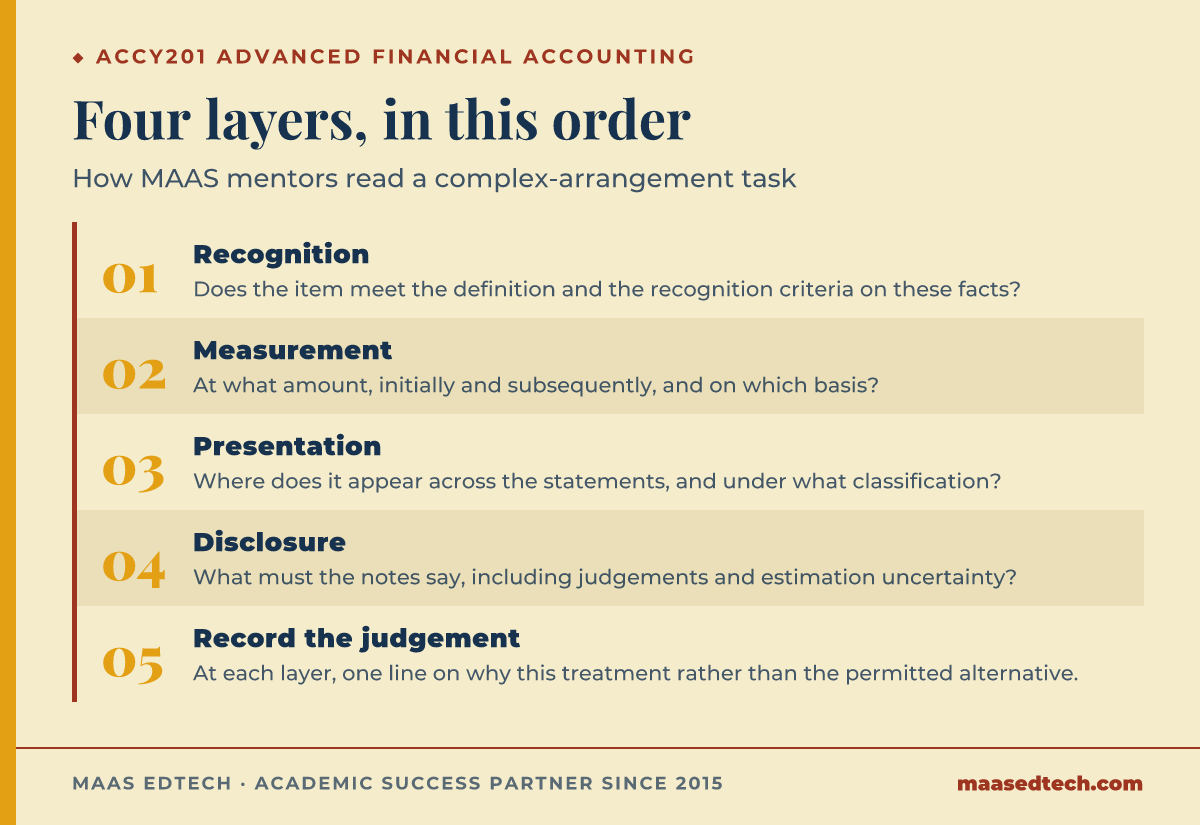
Evidence: This four-layer order mirrors the structure of the standards themselves, which is why it works as a checking device. Where a standard permits alternatives or the scenario is novel, the Conceptual Framework supplies the definitions of assets and liabilities, the recognition criteria and the measurement bases you need in order to justify a choice rather than assert it.
Example: A MAAS mentor gave one student a single instruction for a redraft: put a heading above every paragraph naming which of the four layers it was doing. Three paragraphs turned out to have no layer at all. They were background. Cutting them freed roughly 400 words, which went into disclosure, the layer her draft had skipped.
What does an industry-collaborative project change?
Direct answer: It changes the audience. A problem set is marked against a correct answer. An industry-collaborative project is marked against whether a practitioner could act on your reasoning, which means your assumptions, the limits of your advice and the points where you exercised judgement all have to be visible on the page.
Evidence: The 2026 handbook lists three assessment components for ACCY201: weekly quizzes and Moodle activities, an industry-collaborative work-integrated learning project, and a final exam. Weightings are set in the Subject Outline for your campus and session, so take them from there rather than from any guide, including this one. The handbook also states the subject gives students the opportunity to acquire skills necessary for professional practice, including industry-based experience.
Example: A student treated the project like an exam question and submitted a treatment with no assumptions section. Her mentor asked one question: if the client's circumstances differ from what you assumed, how would they know your answer no longer holds? She added 180 words of assumptions and limitations. Nothing else in the document changed.
How much ethics and governance analysis is expected?
Direct answer: Enough to be a section rather than a sentence. One of the four published learning outcomes is explicitly evaluative, and it is the outcome most often answered with a closing paragraph about integrity that could have been written for any subject.
Evidence: UOW's 2026 handbook states that on successful completion students will be able to "Critically evaluate the interrelated ethical and corporate governance issues related to accounting practice". The word doing the work there is interrelated. The outcome asks you to connect a governance arrangement to an accounting consequence, not to append a general statement of values.
Example: A student wrote a competent analysis of a related-party transaction and closed with three sentences on the importance of ethical behaviour. Her mentor asked her to instead trace who benefited from the chosen treatment and which governance control should have caught it. Same transaction, same standard, and the section finally addressed the outcome it was aimed at.
Why do markers reward judgement over technique at this level?
Direct answer: Because standards of this kind are written as principles rather than as detailed rules, and a principle requires someone to decide how it applies. Once a subject moves past mechanical application, the assessable skill becomes the quality of the reasoning behind each choice, including the reasoning you bring to genuine ambiguity.
Evidence: Psaros and Trotman (2004) found that the type of accounting standard materially affects the judgements preparers make, which is the empirical basis for treating standard interpretation as a skill rather than a lookup. Han et al. (2019) examined whether tertiary accounting education builds tolerance for ambiguity in IFRS and reported a significant difference between first-year and third-year students in their preference for using IFRS across ten financial reporting contexts, concluding that IFRS-based programs do help prepare students to practise under that regime. Agrawal et al. (2022), working with undergraduates at an Australian university, found that case studies embedded with judgement and decision making shifted how students understood a complex technical concept.
Psaros and Trotman set the result against the assumption it tested, writing that "this finding is contrary to anecdotal claims that the imprecision of substance-over-form standards may be less effective in stopping biased financial reporting than rules-based standards" (Psaros & Trotman, 2004, p. 76). The looser standard did not produce the looser reporting.
Example: That research finding is why MAAS mentors read a draft twice, once for the numbers and once for the sentences that begin with because. If the second reading finds nothing, the draft has a ceiling regardless of how clean the schedules are.
A practical order of work
Direct answer: Restate the scenario in your own words, identify each arrangement, locate the standard for each, work the four layers, build the supporting schedules, then write the judgements and assumptions last. Writing judgements last is deliberate. You cannot honestly describe a judgement until you have made it.
Evidence: Reversing this order is what produces the most common failure mode at 200 level, a document where the assumptions section was written first and no longer matches the analysis that followed it. Markers notice the mismatch quickly because the assumptions read as generic while the analysis is specific.
Example: One student kept a running list of every point where she had to choose, with one line on why. When she reached the write-up, the judgements section was already drafted. It took her twenty minutes and it was the strongest part of the submission.
Frequently asked questions
Which institution offers ACCY201?
The University of Wollongong, where the 2026 handbook records it as Advanced Financial Accounting, a 200-level subject worth 6 credit points in the School of Business. Confirm against your own enrolment record, because codes of this shape are reused elsewhere for unrelated subjects.
What should I have completed first?
The subject description states it builds on ACCY200. Prerequisites are restated each academic year, so check the enrolment rules published for your year rather than relying on an older handbook version.
How is ACCY201 assessed?
The 2026 handbook lists weekly quizzes and Moodle activities, an industry-collaborative work-integrated learning project, and a final exam. Weightings vary by campus, delivery mode and session, so take them from your own Subject Outline.
Which standards should I cite?
Whichever ones the arrangements in your scenario actually engage, cited from the AASB standards portal at the version applying to the reporting period in the question. Citing a standard you did not apply is a reliable way to lose credibility with a marker.
How much does the Conceptual Framework matter?
More than most students expect. It is what lets you justify a choice when a standard permits alternatives, and it is the difference between saying a treatment is allowed and explaining why it is appropriate here.
Does ACCY201 matter beyond the degree?
It sits in the professional core of the accounting stream, and the judgement it asks for is the same judgement professional practice asks for. Treating it as a hurdle rather than as foundation tends to be an expensive choice later.
Related reading
- ACCT4104 Advanced Financial Accounting: the same subject name at a different institution, where convergence creates a different trap
- ACCT3011 Reporting on Business Groups: deeper detail on the control test and consolidation scope
- ACCT3563 Issues in Financial Reporting and Analysis: the theory-heavy companion to a standards-application subject
- MECH343 Heat Transfer and Aerodynamics: a different discipline where the same habit applies, recording each judgement at the point you make it
Where MAAS fits
- Coursework and assignment support: developmental feedback on your own draft through the Outline, Draft, Final model with a discipline-matched expert
- Subject tutoring, one to one: 60 or 90 minute sessions with a tutor matched to your subject area. Tutoring is advisory, so it carries no grade target; if the tutor is not the right fit, you can ask to change expert
- Course-code assignment coaching: how MAAS mentors approach any unit assignment
References
- Agrawal, P., Birt, J., Bayne, L., & Schonfeldt, N. (2022). The use of case studies in developing students' understanding of the concept 'material misstatement'. Accounting & Finance, 62(S1), 1307–1338. https://doi.org/10.1111/acfi.12824
- Han, Y., Chand, P., & Mala, R. (2019). Impact of ambiguity tolerance and tertiary education on professional judgment. Accounting Forum, 43(4), 426–447. https://doi.org/10.1080/01559982.2019.1569813
- Psaros, J., & Trotman, K. T. (2004). The impact of the type of accounting standards on preparers' judgments. Abacus, 40(1), 76–93. https://doi.org/10.1111/j.1467-6281.2004.00144.x
Tools & resources
- Australian Accounting Standards Board. (2019). Conceptual framework for financial reporting. https://www.aasb.gov.au/admin/file/content105/c9/Conceptual_Framework_05-19.pdf
- University of Wollongong. (2024). Course handbook: ACCY201 Advanced Financial Accounting (2024 version). Retrieved September 22, 2026, from https://courses.uow.edu.au/subjects/2024/ACCY201
- University of Wollongong. (2026). Course handbook: ACCY201 Advanced Financial Accounting. Retrieved September 22, 2026, from https://courses.uow.edu.au/subjects/2026/ACCY201
This article is part of the MAAS Journal series for Vietnamese international students. MAAS Assignment & Essay Support is an academic support partner; we coach students through the Outline, Draft, Final delivery model with developmental feedback from discipline-matched experts. We do not write or submit work on a student's behalf.