
◆ Accounting & Finance
ACCY200 report: how do you justify a treatment using the Framework?
ACCY200 Financial Accounting at the University of Wollongong asks you to apply accounting standards and the Conceptual Framework, not to recite them. The 2026 handbook gives the report 35 per cent of the mark, more than twice the weight of in-class participation, and the report is where the difference between a pass-level and a high-level submission usually shows. This guide gives general advice on turning a standard into an argument, checked against the handbook's own learning outcomes. The report brief itself is set in your Subject Outline, so treat the structure below as a method, not as the ACCY200 brief.
◆ Section 1 / 9 · About ACCY200
What is ACCY200 Financial Accounting about?
Direct answer: ACCY200 is a 200-level, 6 credit point undergraduate subject in the University of Wollongong's School of Business, within the Faculty of Arts, Society and Business. It builds on ACCY121 and ACCY122 and asks you to apply accounting standards and the conceptual framework to prepare and analyse general-purpose financial reports and related disclosures.
Evidence: The 2026 UOW Course Handbook lists five learning outcomes. Three are about doing: understanding the operating environment and the concepts behind general-purpose financial reports, applying International Financial Reporting Standards to transactions that involve measurement and professional judgement, and solving practical problems to prepare and interpret those reports. The other two are about thinking: critically evaluating current national and international developments in financial reporting, and analysing information from a variety of sources and communicating it in formal and informal situations. The subject is run on the General Schedule and carries the Embedded work integrated learning designation.
Example: Suppose two students both explain that a company capitalised a cost. One lists the paragraph of the standard. The other explains why the item met the definition of an asset and what a user would have lost if it had been expensed. The handbook's fourth outcome, "critically evaluate", is written for the second student.
◆ Section 2 / 9 · Subject name
Why does the subject name differ between sources?
Direct answer: The handbook titles the subject "Financial Accounting", with no numeral. Some study sites and degree tables add "IIA" or similar labels. Treat the handbook entry for your own commencement year as the authority, and do not assume a note pack written for a differently named subject matches what you are sitting.
Evidence: The 2026 UOW handbook page is headed "ACCY200 - Financial Accounting". Handbook pages for earlier years carry a notice that a more recent version has been published and advise students to follow the handbook of the year they commence their degree, while subject availability should follow the year and session in which they take the subject. Codes of this shape are also reused by other institutions for unrelated subjects, so a code search alone can return the wrong material.
Example: A student who prepares from a third-party exam guide labelled with the same code should still open the 2026 handbook first and check the five learning outcomes against the guide's contents. If the guide covers topics the outcomes never mention, it was probably written for a different institution or year.
◆ Section 3 / 9 · Assessment
How is ACCY200 assessed?
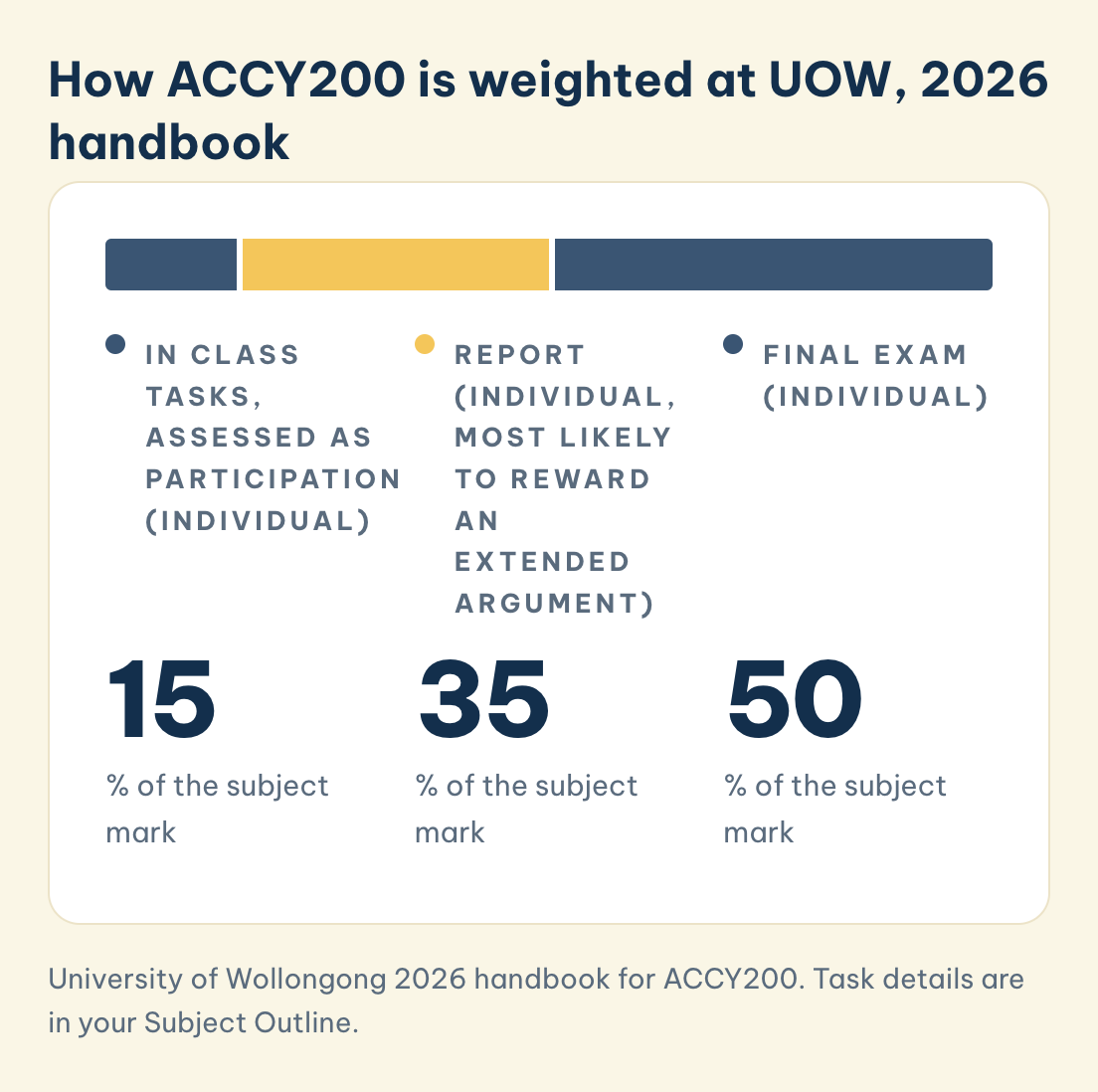
Direct answer: The 2026 handbook lists three individual assessments: an in-class task assessed as participation at 15 per cent, a report at 35 per cent, and a final exam at 50 per cent. The report is the component most likely to reward an extended argument, so it deserves early planning.
How ACCY200 is weighted at UOW, 2026 handbook
The yellow part is the report. All three assessments are individual.
In Class Tasks, assessed as participation (individual)
15
% of the subject mark
Report (individual, most likely to reward an extended argument)
35
% of the subject mark
Final Exam (individual)
50
% of the subject mark
Save this figure
Evidence: The handbook gives each assessment a number, a type, a weighting and an individual or group designation. All three are marked individual. Task details such as due dates, word limits, case company and referencing style are not in the handbook; they sit in the Subject Outline and on the subject's Moodle site for your campus and session. Always take word limits and the referencing style from those documents, and treat any guide, including this one, as secondary.
| Assessment | Type in handbook | Weight | Mode |
|---|---|---|---|
| In Class Tasks | Participation | 15% | Individual |
| Report | Report | 35% | Individual |
| Final Exam | Exam | 50% | Individual |
Example: If the report brief says "analyse the accounting treatment of an item in a listed company's annual report", the Subject Outline will normally tell you the item, the company or the choice you are allowed to make. Confirm that before you read a single note, because choosing a different company from the one your tutor expects could cost the whole task.
◆ Section 4 / 9 · Report structure
How do you structure a standards-application report?
Direct answer: Work in five moves: the accounting issue, the governing standard, the application to the facts, the Conceptual Framework evaluation, and a conclusion that says whether the treatment is appropriate. Each move has a different job. In MAAS's experience, skipping the fourth, the evaluation, leaves a competent description without any reasoning for the marker to reward.
Evidence: The first move names the transaction or balance and the reporting period, for example a lease, an impairment, inventory or revenue. The second cites the exact standard and the paragraphs on recognition, measurement, presentation and disclosure. The third pulls evidence from the accounting policies and notes, with figures and a short table where they help. The fourth asks whether the treatment gives users relevant information that is a faithful representation. The fifth states a position, and if a permitted alternative exists, compares it using the Framework rather than calling one "better".
Example: A report on a trade receivables allowance would name the issue, cite the relevant financial instruments standard, show the allowance from the notes, test it against relevance and faithful representation, and then conclude whether the disclosure lets a reader understand the judgement. Five moves, five short sections.
◆ Section 5 / 9 · Conceptual Framework
What does the Conceptual Framework actually do in your report?
Direct answer: The Conceptual Framework is not a standard, and it never overrides one. The Framework explains and tests the standard, and it helps preparers choose accounting policies where no standard applies or where a standard allows a choice. In a report, use it to justify a choice, not to replace the rule.
Evidence: The IASB's Conceptual Framework for Financial Reporting was issued in 2010 and revised in March 2018. It names two fundamental qualitative characteristics, relevance and faithful representation, and four enhancing ones: comparability, verifiability, timeliness and understandability. A faithful representation is complete, neutral and free from error, and the Framework defines prudence as "the exercise of caution when making judgements under conditions of uncertainty" (IFRS Foundation, 2018, para. 2.16). Pelger (2020) shows that the 2018 revision brought stewardship back into the objective, reintroduced prudence as an aspect of neutrality and added a tolerable level of measurement uncertainty. MAAS's reading is that a 2026 report quoting the 2010 text would be out of date.
Example: A student writes "the company's estimate is accurate". The Framework says an estimate of an unobservable value cannot be called accurate or inaccurate, but it can be a faithful representation if it is clearly described as an estimate and the limitations of the process are explained. Changing one word from "accurate" to "faithfully represented, because the note explains the estimation method" is the kind of precision markers reward.
◆ Section 6 / 9 · Qualitative characteristics
How do you apply the qualitative characteristics to real numbers?
Direct answer: Ask one question per characteristic and answer it with evidence from the company's own disclosures. Relevance asks whether the information could change a user's decision. Faithful representation asks whether it is complete, neutral and free from error. Comparability asks whether it can be compared over time or with peers. Each answer needs a number or a quoted note behind it.
| Framework concept | The question to answer in the report | Where the evidence usually sits |
|---|---|---|
| Relevance | Could this change a user's assessment of future cash flows? | Notes on judgements and estimates |
| Faithful representation | Is the description complete, neutral and free from error? | Accounting policy note, reconciliation tables |
| Comparability | Can a reader compare it with last year or with a peer? | Comparative columns, policy changes |
| Verifiability | Could an independent observer reach the same amount? | Disclosed inputs and methods |
| Materiality | Does the omission or misstatement affect decisions? | Quantitative thresholds and context |
Evidence: Psaros and Trotman (2004) found that the type of accounting standard changes the judgements preparers make, which is the research basis for treating standard interpretation as a skill rather than a lookup. Han et al. (2019) examined whether tertiary accounting education builds tolerance for ambiguity and reported a significant difference between first-year and third-year students in their preference for IFRS across ten reporting contexts, although the difference in ambiguity tolerance itself was not significant. The research supports teaching judgement; the advice to show the choice, not just the result, is MAAS's own.
Example: For a lease note, relevance is shown by pointing to the discount rate the company disclosed and what it implies for the liability. Faithful representation is shown by checking whether the note discloses the lease term assumption. Comparability is shown by reading the prior-year column. Three sentences, three characteristics, each tied to a figure.
◆ Section 7 / 9 · More than one treatment
What do you do when a standard permits more than one treatment?
Direct answer: Name both treatments, state the criteria the Framework gives for choosing between them, and recommend one with a reason. Do not say that one is better in general. Say which treatment gives users more relevant, more faithfully represented information on these facts, and say what would change your answer if the facts were different.
Evidence: Where a standard allows a choice of accounting policy, the Framework's stated purpose includes assisting preparers to develop consistent policies. That makes it the correct instrument to use in the evaluation move. The recommendation should be realistic and supported by the standard or the Framework; a vague suggestion that the company "should disclose more" without a paragraph reference gains nothing.
Example: Suppose a standard permits either of two measurement bases for an item. Weak answer: "Fair value is more modern." Strong answer: "Fair value is more relevant to a user assessing the next period's cash flows, but its inputs are less verifiable than historical cost, so the disclosure of inputs becomes the decisive evidence." The second answer states a trade-off between characteristics, which is exactly what the Framework describes.
◆ Section 8 / 9 · Costly mistakes
Which mistakes cost the most marks?
Direct answer: Four mistakes are worth checking for: describing a standard without applying it to the company's numbers; using the Framework as a substitute for the specific standard; failing to separate what the report discloses from what you infer; and leaving references until the end. The first two weaken the analysis, and the last two weaken accuracy and academic integrity.
Evidence: A report that cites a standard but never quotes the company's note shows no application. A report that cites the Framework but not the paragraph of the standard shows no rule. A report that blends an inference into a quotation misleads the reader about what the company actually said. References belong to the working process, because each claim about a standard needs an exact version and paragraph while you still have the document open.
Example: Before submitting, read every paragraph and mark it with one letter: S for standard, F for facts from the report, C for Framework reasoning, or R for recommendation. If a section has no C, you have described instead of evaluated. If it has no F, you have written about accounting in general rather than about this company.
◆ Section 9 / 9 · Order of work
A practical order of work
Direct answer: Read the brief and Subject Outline, choose the item, read the standard, extract facts from the notes, draft the Framework evaluation, and write the introduction and conclusion last. Writing the conclusion last is deliberate because you cannot honestly state a position until you have tested the treatment.
Evidence: The order follows the five-move structure above and mirrors the weighting: with 35 per cent on a single report, an early reading of the Subject Outline for word limit, referencing style and permitted case choices prevents the most expensive redraft, which is starting again on the wrong item.
Example: Keep a running list of every point where you had to choose, with one line saying why. When you reach the write-up, the evaluation section is already half drafted, and the list doubles as a check that no judgement is left implicit.
Frequently asked questions
Which institution offers ACCY200?
The University of Wollongong, where the 2026 handbook records it as Financial Accounting, a 200-level subject worth 6 credit points in the School of Business. Confirm against your own enrolment record, because codes of this shape are reused elsewhere for unrelated subjects.
What should I have completed first?
The subject description states that it builds on the knowledge and skills acquired in ACCY121 and ACCY122. Enrolment rules are restated each academic year, so check the entry for your commencement year.
How is ACCY200 assessed?
The 2026 handbook lists in-class tasks assessed as participation (15%), a report (35%) and a final exam (50%), all individual. Task details are in your Subject Outline.
What is the difference between a conceptual framework and accounting standards?
Standards set specific requirements for recognising, measuring, presenting and disclosing items. The Conceptual Framework sets the concepts behind them and does not override any standard. In a report, use the standard for the rule and the Framework for the reasoning.
What is the conceptual framework for financial reporting?
It is the IASB's statement of the objective of general purpose financial reporting and the concepts that underpin it, issued in 2010 and revised in March 2018. It covers the objective, qualitative characteristics, the elements, recognition, measurement, presentation and disclosure.
Does ACCY200 matter beyond the degree?
It sits in the accounting stream, and the handbook describes it as developing the professional judgement needed to evaluate accounting practice.
Related reading
- ACCY122 Accounting Principles: the first-year subject this one builds on, covering double-entry and the first financial statements
- ACCY201 Advanced Financial Accounting: the next subject in the sequence, where standards are applied to complex business arrangements
- ACCT4104 Advanced Financial Accounting: the same subject name at a different institution, with a different trap
- ACCT3563 Issues in Financial Reporting and Analysis: the theory-heavy companion to a standards-application subject
- ACCT1101 Accounting for Decision Making: the introductory subject that shows how users read the reports you are learning to prepare
Where MAAS fits
- Coursework and assignment support: developmental feedback on your own draft through the Outline, Draft, Final model with a discipline-matched expert
- Subject tutoring, one to one: 60 or 90 minute sessions with a tutor matched to your subject area. Tutoring is advisory, so it carries no grade target; if the tutor is not the right fit, you can ask to change expert
- Course-code assignment coaching: how MAAS mentors approach any unit assignment
References
- Han, Y., Chand, P., & Mala, R. (2019). Impact of ambiguity tolerance and tertiary education on professional judgment. Accounting Forum, 43(4), 426–447. https://doi.org/10.1080/01559982.2019.1569813
- IFRS Foundation. (2018). Conceptual framework for financial reporting. IFRS Foundation.
- Pelger, C. (2020). The return of stewardship, reliability and prudence: A commentary on the IASB's new conceptual framework. Accounting in Europe, 17(1), 33–51. https://doi.org/10.1080/17449480.2019.1645960
- Psaros, J., & Trotman, K. T. (2004). The impact of the type of accounting standards on preparers' judgments. Abacus, 40(1), 76–93. https://doi.org/10.1111/j.1467-6281.2004.00144.x
Tools & resources
- Australian Accounting Standards Board. (2019). Conceptual framework for financial reporting. https://www.aasb.gov.au/admin/file/content105/c9/Conceptual_Framework_05-19.pdf
- IFRS Foundation. (2018). Conceptual framework for financial reporting. https://www.ifrs.org/content/dam/ifrs/publications/pdf-standards/english/2021/issued/part-a/conceptual-framework-for-financial-reporting.pdf
- University of Wollongong. (2026). Course handbook: ACCY200 Financial Accounting. Retrieved October 2, 2026, from https://courses.uow.edu.au/subjects/2026/ACCY200
This article is part of the MAAS Journal series for Vietnamese international students. MAAS Assignment & Essay Support is an academic support partner; we coach students through the Outline, Draft, Final delivery model with developmental feedback from discipline-matched experts. We do not write or submit work on a student's behalf.
A free 20-minute consultation is a conversation about where you are with ACCY200.
Book a free consultation ▸