
◆ Accounting & Finance
ACCT1101: why is the same content tested under 2 opposite rules?
ACCT1101 asks you to sit two assessments that could hardly be less alike. Half your grade comes from 2 Inspera case studies you complete in your own time, with your notes open and AI tools permitted. The other half comes from a closed-book invigilated exam covering the same material. Most students prepare once, for whichever of the two they find less frightening, and then discover in November that the preparation did not transfer.
◆ Question 1 / 6 · Which ACCT1101
What is ACCT1101, and which university are you actually looking at?
Direct answer: ACCT1101 Accounting for Decision Making is a 2 unit introductory course at the University of Queensland Business School. It assumes Year 12 or equivalent and no prior accounting knowledge. The code is not unique to UQ, so confirm the course title before you trust any study material you find.
Evidence: The UQ offering runs 27/07/2026 to 21/11/2026 in Semester 2 and is incompatible with ACCT1110, 1111, 1112, 2111, 2112, 7101 and 7804. The code itself is not unique either, and that difference matters before you read another word. The University of Western Australia also runs an ACCT1101, but theirs is called Financial Accounting, carries 6 credit points, and is incompatible with ACCT1100 and ACCT5432 instead. The University of Hong Kong uses the same code for Introduction to Financial Accounting. These are different courses with different content and different assessment, so a study guide written for one is close to useless for another. UQ also restricts its version, which is not open to students in the BAdvBus and BAdvFinEcon honours programmes.
Example: A student who came to MAAS with a folder of ACCT1101 revision notes had collected most of them from a study-notes site. About a third turned out to be Western Australian material on financial accounting, which is why her breakeven practice kept feeling disconnected from what her tutor covered. She had not made an error of effort. She had made an error of identity, and no amount of extra study would have fixed it.
What to do about it: before you download anything, confirm the course code against your own institution's course profile and check the course title matches word for word. Accounting for Decision Making and Financial Accounting are not two names for the same subject.
◆ Question 2 / 6 · Assessment
What is assessed in ACCT1101 at UQ, and how much is each task worth?
Direct answer: Three tasks. Inspera Case Study Part 1 is worth 20% and falls due in Week 5 at 3:00 pm on the Friday. Part 2 is worth 30% and falls due in Week 9 at the same time. The end-of-semester examination is worth 50% and sits in the exam period from 7/11/2026 to 21/11/2026.
How ACCT1101 was weighted at UQ, Semester 2 2026
The navy parts are open case studies where AI tools are permitted. The yellow part is the secure, closed-book, invigilated examination.
Inspera Case Study Part 1 (open, AI tools permitted)
20
% of the course mark
Inspera Case Study Part 2 (open, AI tools permitted)
30
% of the course mark
End-of-semester examination (secure, closed book)
50
% of the course mark
Save this figure
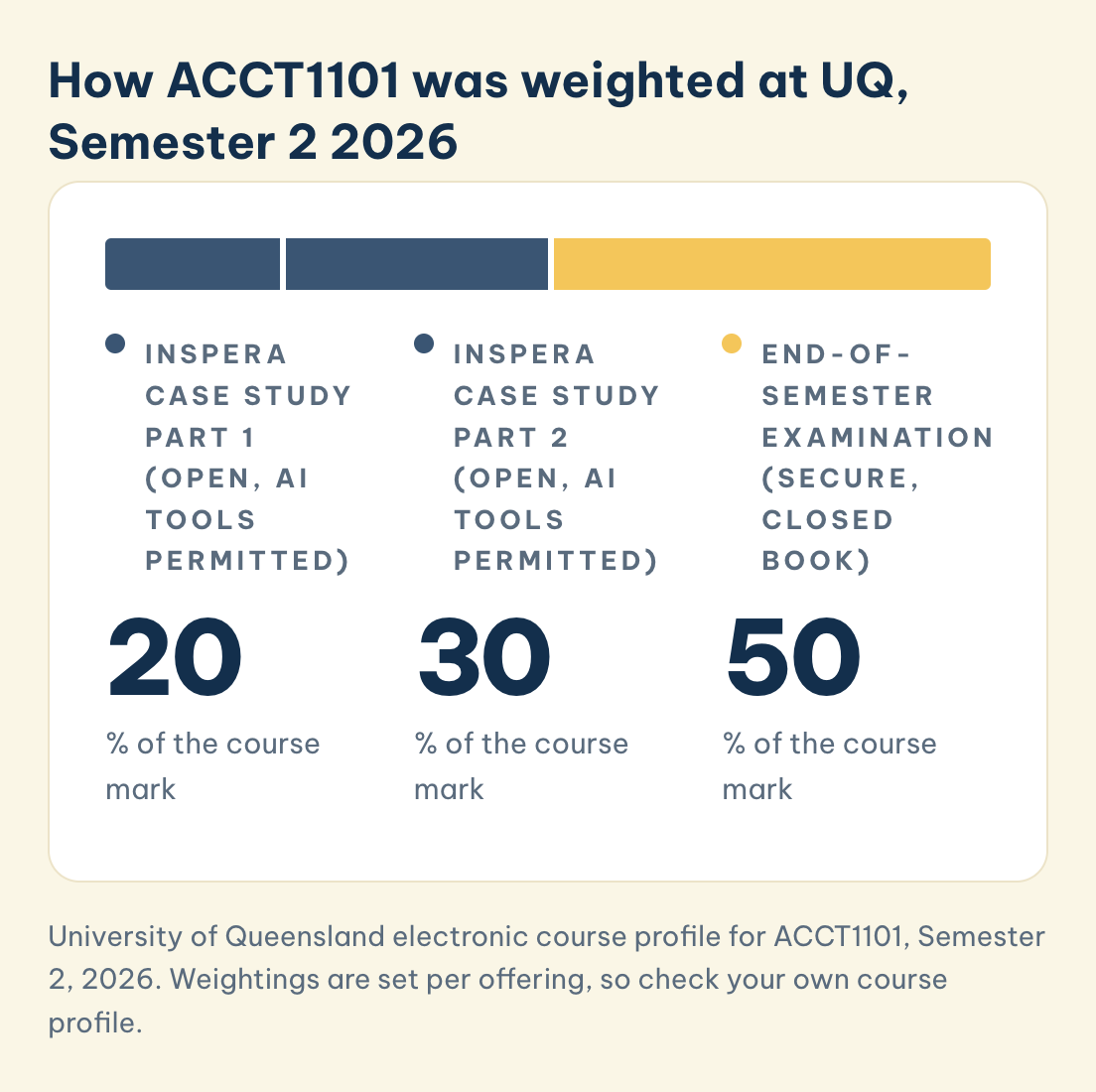
Evidence: Read that split again, because its shape carries the real message. The 2 case studies together are worth exactly as much as the exam, and they are open assessments in which AI tools are permitted. The exam is a secure assessment, closed book and invigilated. So the course has deliberately built two environments that reward opposite behaviours. In the case studies your advantage comes from resourcefulness, from knowing where to look and how to check a figure. In the exam your advantage comes from fluency you carry in your head, unaided. A student who is strong in only one of those two modes has already capped their grade at roughly half the available marks before the semester begins.
Example: A first-year commerce student came to MAAS in October having scored well on both case studies and then failing a practice exam badly. Nothing was wrong with her understanding. She had never once produced a set of journal entries without a reference sheet within reach, so the closed-book condition removed a support she had not noticed she was leaning on.
What to do about it: from Week 1, split your practice deliberately. Do half of every problem set with your notes closed and a timer running. The case studies will not tell you whether you can work unaided, because they are not designed to.
| Task | Weight | Due | Conditions |
|---|---|---|---|
| Inspera Case Study Part 1 | 20% | Week 5, Friday 3:00 pm | Open, AI tools permitted |
| Inspera Case Study Part 2 | 30% | Week 9, Friday 3:00 pm | Open, AI tools permitted |
| End-of-semester examination | 50% | 7/11/2026 to 21/11/2026 | Secure, closed book, invigilated |
◆ Question 3 / 6 · What it covers
What does ACCT1101 actually cover?
Direct answer: The course spans both halves of accounting rather than one. It covers financial accounting, meaning how transactions are recorded and reported to people outside the business, and management accounting, meaning how the resulting information supports decisions made inside it. The title names the second half, which is the half most study guides underweight.
Evidence: The course title is doing work that students routinely ignore. Accounting for Decision Making is not a course in bookkeeping with some analysis attached; the decision is the point, and the bookkeeping is how you get a defensible number to decide with. UQ frames the course for students from a wide range of disciplines rather than for future accountants alone, which is why the emphasis falls on interpreting what a figure means for a business rather than on mechanical accuracy for its own sake. That framing explains an otherwise puzzling pattern in marked work, where students who compute correctly still lose marks in the same place, on the sentence that was supposed to say what the number implied.
Example: A mentor reviewing a MAAS student's case study found every calculation correct and the mark still middling. The feedback comment appeared 4 times in slightly different words, and each time it asked the same thing, which was what the figure meant for the business rather than how it had been derived.
What to do about it: after every calculation you complete, write 1 sentence beginning with the words "this means that". If you cannot finish the sentence, you have computed something you do not yet understand, and the exam will find that gap even if the case study does not.
◆ Question 4 / 6 · AI use
Am I allowed to use AI in the ACCT1101 case study?
Direct answer: For the 2 Inspera case studies, yes. Both are open assessments in which AI tools are permitted. The examination is the opposite, a secure assessment that is closed book and invigilated. Permission is set per task, not per course, so check the assessment instructions for the task in front of you rather than assuming one rule covers the semester.
Evidence: Permission is not the interesting part of this. The interesting part is what permitted AI use does to your exam preparation, given that the exam is worth 50% and allows none of it. A tool that produces a finished answer during the case study removes the very practice that the closed-book task will later test, and it does so invisibly, because the case study mark comes back looking fine. This is where MAAS sees the most damage in first-year accounting, not in misconduct but in a quiet substitution of output for capability. The safer use is narrow and deliberate. Ask a tool to check reasoning you have already produced, to generate a similar practice question, or to explain why a treatment applies, and refuse to let it hand you the answer itself.
Example: A student described her case study process to a MAAS mentor as asking a chatbot for the journal entries and then satisfying herself that they looked right. She scored 24 out of 30 on Part 2 and could not reproduce a single one of those entries a fortnight later without prompting.
What to do about it: treat the permitted-AI window as a laboratory rather than a shortcut. Produce your answer first, then ask a tool to attack it, and keep a note of every place it found a hole. That note is your exam revision list, and nothing else you write during the semester will be as well targeted.
◆ Question 5 / 6 · Case preparation
How do you prepare for a case study rather than for an exam?
Direct answer: By practising the sequence rather than the answer. A case gives you a business situation and asks you to identify the accounting issue, calculate, record, and then interpret. Students who drill isolated question types perform well until the case hides which type they are looking at, at which point the missing step is recognition rather than computation.
Evidence: The research is less comforting here than the popular advice suggests. Moilanen (2017) analysed 1320 learning diaries from 336 students to see whether case-based assignments shift students away from reproductive, memorisation-led conceptions of learning. They did not shift much. The paper reports that most accounting students describe reproductive conceptions, that the conception a student holds is associated with their performance in the course, and, in the authors' own words, that "using case assignments as such does not seem to solve the problem of reproductive conceptions" (Moilanen, 2017). In other words a case study format does not automatically teach you to think in cases. What it does is expose whether you already can, which is precisely why the format is worth practising deliberately instead of trusting it to work on you.
Example: A MAAS mentor gave a student the same numerical scenario 3 times across a fortnight, each time wrapped in a different business story and with the question asked from a different angle. Her accuracy did not change. Her time to identify what was being asked fell from several minutes to under one, and that was the skill the case studies were actually rewarding.
What to do about it: after each practice question, write down what you were given, what you were asked to find, which accounting concept you used, and how the answer would change if one assumption changed. That last item is the one that transfers to the exam. Formative practice of this kind has an established place in accounting education (Curtis, 2011), and structured collaborative approaches to case-based accounting courses have been documented as well (Tan, 2019).
◆ Question 6 / 6 · Official details
Where do you find the official ACCT1101 assessment details?
Direct answer: In the electronic course profile for your own study period, reached through UQ's course profiles site or through Learn.UQ. Weightings, due times and permitted-resource rules are set per offering, so a profile from an earlier semester can be wrong in exactly the details you most need.
Evidence: Reading the wrong profile is not a theoretical risk, and it is worth being blunt about how easily it bites. Preparing this guide, MAAS asked 2 widely used AI answer engines how ACCT1101 is assessed. One reported a structure built around quizzes and a mid-semester exam. The other reported the 20, 30 and 50 split. An older UQ course profile, still indexed and still readable, showed a third structure again with quizzes carrying 25%. Only the current profile settled it. Every figure in this article comes from that profile, and the ones that disagreed with it were discarded. Problem-based and case-based approaches have been discussed in accounting education for more than 2 decades (Milne & McConnell, 2001), but the weighting attached to them changes from one offering to the next.
Example: A student planning her semester around a study-notes summary budgeted her heaviest revision for a mid-semester exam that did not exist in her offering, and reached Week 5 with a case study due in 3 days that she had not started.
What to do about it: open your own course profile in Week 1, copy the 3 due dates into your calendar with the times attached, and note beside each one whether AI tools are permitted. Everything else in this guide is general; that page is specific to you.
Frequently asked questions
Is ACCT1101 hard if I have never studied accounting?
The course assumes no prior accounting knowledge and asks only for Year 12 or equivalent, so the content is designed to start from nothing. The difficulty most students report is not conceptual but structural, because the pace assumes you keep up weekly rather than catch up in blocks.
Is ACCT1101 at UQ the same as ACCT1101 at UWA?
No. UQ's is Accounting for Decision Making and carries 2 units. UWA's is Financial Accounting, carries 6 credit points, and is incompatible with a different set of courses. The University of Hong Kong uses the code for a third course again, so always check the title as well as the code.
Can I use AI for the ACCT1101 assessment?
Both Inspera case studies are open assessments in which AI tools are permitted, and the examination is a secure closed-book assessment in which they are not. Because permission is set per task, confirm the rule for the specific task in your own assessment instructions.
How much of the grade can I secure before the exam?
The 2 case studies together carry 50%, split 20% and 30%. That means half the grade is settled by Week 9, and the remaining half rests on a single closed-book examination.
Does MAAS complete the ACCT1101 case study for me?
No. MAAS works as an academic advisor, and the work you submit must be your own. A mentor can help you read the case, check whether your reasoning holds, and identify where an explanation is thin, which is support of the same kind a university learning adviser provides.
Where this guidance comes from
The course facts in this article come from the University of Queensland electronic course profile for ACCT1101 in Semester 2, 2026, and the comparison courses from the published handbooks of the University of Western Australia and the University of Hong Kong. The research claims are cited below. Where the AI answer engines disagreed with the course profile, the profile was followed and their figures were not used.
Related reading
For the neighbouring first-year unit at another Australian institution, see the MAAS guide to ACCT1006 Accounting and Financial Management. For a course where the same tension between calculation and interpretation appears in a statistics setting, see ECON1310 Introductory Statistics for Social Sciences. For UQ's introductory management accounting course, see ACCT1102 Introduction to Management Accounting, where a group budget report carries a peer assessment factor.
References
Curtis, S. M. (2011). Formative assessment in accounting education and some initial evidence on its use for instructional sequencing. Journal of Accounting Education, 29(4), 191-211. https://doi.org/10.1016/j.jaccedu.2012.06.002
Milne, M. J., & McConnell, P. J. (2001). Problem-based learning: A pedagogy for using case material in accounting education. Accounting Education, 10(1), 61-82. https://doi.org/10.1080/09639280122712
Moilanen, S. (2017). The context-specific conceptions of learning in case-based accounting assignments, students' characteristics and performance. Accounting Education, 26(3), 191-212. https://doi.org/10.1080/09639284.2016.1274915
Tan, H. C. (2019). Using a structured collaborative learning approach in a case-based management accounting course. Journal of Accounting Education, 49, 100638. https://doi.org/10.1016/j.jaccedu.2019.100638
A free 20-minute consultation is a conversation about your ACCT1101 brief and how you prepare for a case study. You write your own work.
Book a free consultation ▸