
◆ Accounting & Finance
ACCT1102 Introduction to Management Accounting: UQ budget and exams
The ACCT1102 group assignment at UQ carries a "peer assessment factor", and UQ's own teaching institute defines that as a factor "applied to an individual student's mark". Four students can therefore submit one Business Report on Budget Preparation, worth 20%, and receive different marks for it. The other 80% of the grade sits in two closed-book, 90-minute paper exams.
◆ Question 1 / 7 · Which ACCT1102
Which ACCT1102 is this, and who takes it?
Direct answer: ACCT1102 Introduction to Management Accounting is a 2-unit undergraduate course run by the UQ Business School at St Lucia. In Semester 2, 2026 it runs in person from 27 July to 21 November 2026, requires ACCT1110 Financial Reporting and Analysis first, and is closed to students in the BAdvBus(Hons) and BAdvFin&Econ(Hons) programs.
Evidence: The course profile assumes you already handle journal entries, T-accounts and closing entries, and can read an income statement, a balance sheet and a cash flow statement. It then organises ACCT1102 in three parts. Part one covers the differences between financial, management and cost accounting, together with cost behaviour and allocation. Part two covers budgeting procedures, including the group assignment. Part three covers variance analysis and control, performance measurement, strategy and sustainability balanced scorecards, and ethics. Five learning outcomes run from LO1, understanding the roles of management and cost accounting, to LO5, critically evaluating ethics cases in management accounting.
A second course uses the same code. The University of New Haven in the United States lists ACCT 1102 Introduction to Managerial Accounting as a 3-credit course with ACCT 1101 as its prerequisite, and its 2022–2023 catalogue includes income tax planning among the topics. Notes labelled "ACCT1102" on file-sharing sites can come from that course, so check the university before you trust a summary.
◆ Question 2 / 7 · Assessment
How is ACCT1102 assessed in Semester 2, 2026?
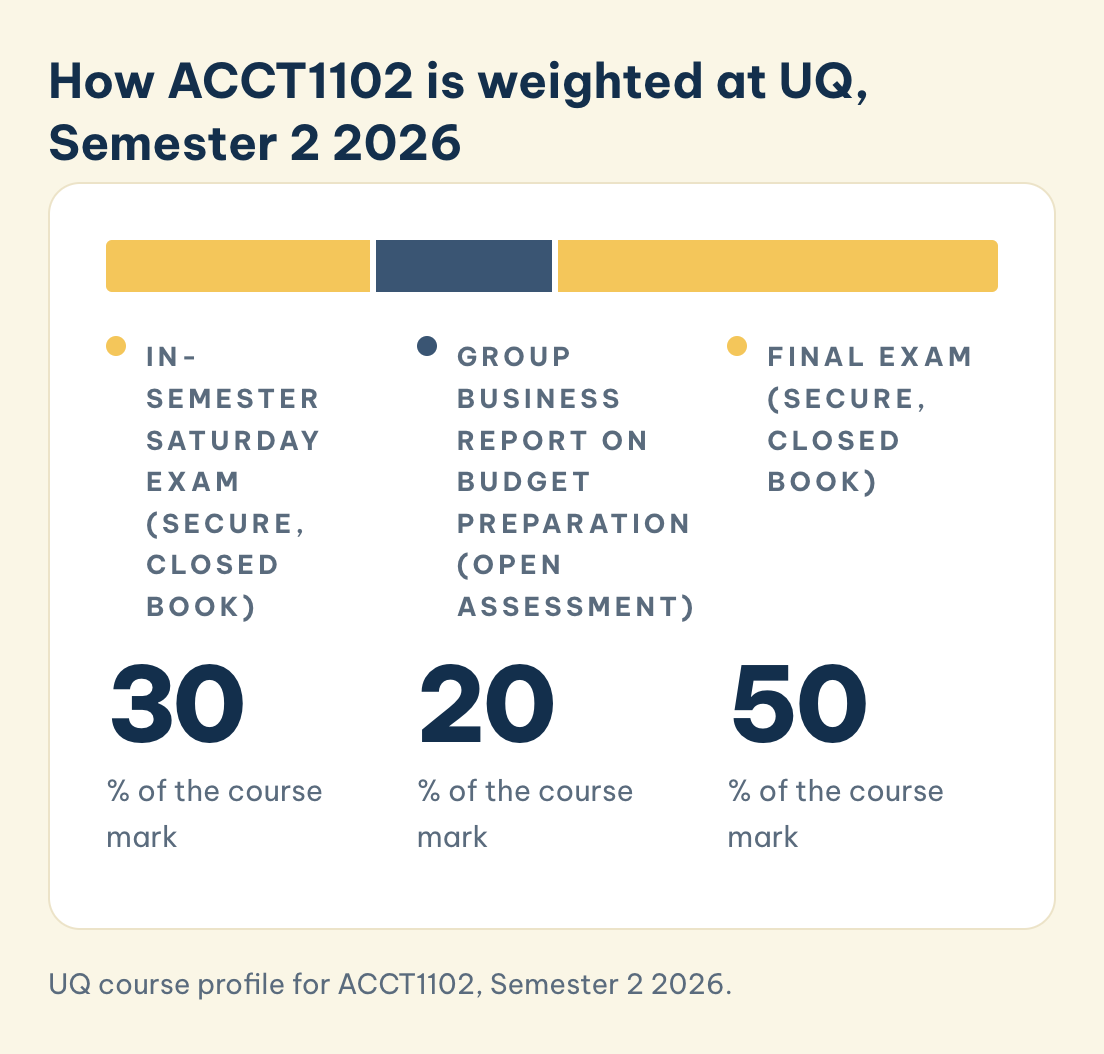
Direct answer: Three tasks count. An in-semester Saturday exam worth 30% falls between 5 and 20 September 2026 and covers Topics 1 to 4. A group Business Report on Budget Preparation worth 20% is due on 9 October 2026 at 1:00 pm. A final exam worth 50% covers Topics 5 to 12 in the 7 to 21 November 2026 exam period.
How ACCT1102 is weighted at UQ, Semester 2 2026
The yellow parts are the two secure, in-person, closed-book exams. The navy part is the open group Business Report on Budget Preparation.
In-semester Saturday exam (secure, closed book)
30
% of the course mark
Group Business Report on Budget Preparation (open assessment)
20
% of the course mark
Final exam (secure, closed book)
50
% of the course mark
Save this figure
| Task | Weight | Timing | Conditions in the profile |
|---|---|---|---|
| In-Semester Saturday Exam | 30% | 5 to 20 September 2026, centrally timetabled | Identity verified, in person, secure, time limited, Topics 1 to 4 |
| Group Assignment: Business Report on Budget Preparation | 20% | 9 October 2026, 1:00 pm | Groups of exactly 4 students, peer assessment factor, open assessment |
| Final Exam | 50% | 7 to 21 November 2026 exam period | Identity verified, in person, secure, time limited, Topics 5 to 12 |
Evidence: Both exams give you 10 minutes of planning time and 90 minutes of working time, on paper, invigilated in person, closed book with no written materials permitted. The only calculators allowed are the Casio FX82 series or a UQ approved and labelled calculator. The profile states that you may be able to defer either exam and that supplementary assessment is available for the course. A grade of 4, a Pass, starts at 50%, and a grade of 7, High Distinction, starts at 85%.
The group report carries its own late rules. The penalty is 10% of the maximum possible mark for each 24 hours after the deadline, for up to 7 days, after which the mark is 0. Extensions can reach a maximum of 14 days and are granted in multiples of 24 hours.
When MAAS asked Google AI Mode about ACCT1102 on 13 September 2026, it returned 35% for a mid-semester exam, 30% for group work and 35% for the final exam, citing study-notes sites rather than UQ. Perplexity returned the correct 30%, 20% and 50% split. Only the course profile for your own semester binds the marker.
◆ Question 3 / 7 · Peer assessment factor
What does a peer assessment factor do to your group mark?
Direct answer: It lets your individual mark on the 20% group report differ from your teammates' marks. UQ's Institute for Teaching and Learning Innovation defines a peer assessment factor as a factor "applied to an individual student's mark". Each of the 4 members completes a form rating the relative contribution of every member, whether equal or unequal.
Evidence: The same ITaLI page defines a different condition, Peer Assessed, as an assessment that "is peer marked, with moderation provided by the course coordinator". The difference matters. Under a peer assessment factor, your classmates do not mark the report itself. They rate who contributed what, and that rating adjusts the individual mark. The Semester 2, 2026 profile does not publish the formula, and it points you to Blackboard for the specific assignment information.
The label has also moved. The Semester 1, 2025 profile listed the group task as Peer assessed and Longitudinal, and the Semester 2, 2025 profile listed it as Peer assessed. Only the Semester 2, 2026 profile uses the words peer assessment factor. None of the three profiles states whether the underlying calculation changed, so treat a senior student's 2025 description of how peer marks worked as a guess until Blackboard confirms it.
What to do about it: Groups must have 4 students, no more and no fewer, and students arrange the groups themselves. If a member stops replying, contact your tutor early, because the profile names the tutor as the person who helps with joining or forming a group.
◆ Question 4 / 7 · Fair peer ratings
Is a peer rating a fair measure of who did the work?
Direct answer: The accounting education research is split. Hassan, Fox and Hannah (2014) found that self- and peer-assessment in accounting and finance "appear to be neither accurate nor valid", even though students rated them positively. Sridharan, Muttakin and Mihret (2018) found students linked appropriate mark allocation with less free riding. Both findings bear on a group of 4 like yours.
Evidence: Sridharan, Muttakin and Mihret (2018) studied students in an Australian master's course and reported that students valued anonymity when rating peers. Cadiz Dyball, Reid, Ross and Schoch (2007) evaluated assessed group work in a second-year management accounting subject and found that students saw it as positive and as a way to build transferable skills, and called for assessed group work to be integrated and scaffolded.
Read together, these studies suggest a tension that the ACCT1102 form cannot resolve on its own. A peer rating measures contribution that teammates noticed, and that is not always the contribution that mattered most. The member who quietly rebuilt the cash budget after an error may be less visible than the member who ran the group chat and formatted the report.
What to do about it: Make contribution visible without turning the group into a surveillance exercise. Agree roles in writing when the Week 7 lecture introduces the group assignment, keep the draft in one shared document so version history shows who built which schedule, and write two lines of notes after each meeting. When you fill in the form, rate what you can point to.
◆ Question 5 / 7 · Task changes since 2025
How has the group budget task changed since 2025?
Direct answer: In Semester 1, 2025 groups submitted a Draft Budget with an Excel model and a PowerPoint presentation delivered in tutorials, with one formative feedback draft. Since Semester 2, 2025 the task has been a written Business Report on Budget Preparation. Semester 2, 2026 adds a single due date and labels the task an open assessment.
Evidence: The Semester 1, 2025 profile set a due window from the Thursday of Week 4 to the Friday of Week 13, recorded the in-class presentations for marking, and covered Topics 1 to 5 in the in-semester exam. The Semester 2, 2025 profile switched to the written report, kept the Week 4 to Week 13 window and the rule that group members come from the same tutorial class, and warned that "a failure to reference AI use may constitute student misconduct".
The Semester 2, 2026 profile replaces that warning with an open assessment statement. You may use notes, course materials and other tools, including AI, and the profile explains that "the focus is not on memorising information, but on understanding, applying judgement, and demonstrating your own thinking." Both exams, by contrast, are now labelled secure assessments.
What to do about it: Discard any 2025 advice about rehearsing a presentation or polishing an Excel file for submission. Check Blackboard for whether AI use still needs to be acknowledged in your report, because the 2026 profile describes permission but does not describe a disclosure format.
◆ Question 6 / 7 · What the report tests
What is a budget report actually testing?
Direct answer: LO3 asks you to work in a group to prepare and professionally communicate a draft budget. The course description adds budgeted financial statements and sensitivity analysis. A report that only reproduces schedules shows preparation, so the explanation of assumptions, and of what happens when they move, is where a report can show the communication half of LO3.
Evidence: Four consecutive lectures build the task. Week 4 introduces budgets and responsibility accounting, Week 5 covers operating budgets, Week 6 covers financial statements and cash, and Week 7 covers budgets together with the group assignment. The research literature shows why the communication matters. Hansen, Otley and Van der Stede (2003) reviewed practice developments in budgeting and described practitioners splitting into two camps. In their words, "One approach advocates improving the budgeting process and primarily focuses on the planning problems with budgeting" (Hansen et al., 2003, p. 95), while the other advocates abandoning the budget because of its performance evaluation problems.
A budget therefore does two jobs at once, and they pull against each other. A planning budget should be realistic. A budget used to evaluate managers can invite padding, because a manager who helps set an easy target looks good against it. ACCT1102 returns to that second job in Week 10, Performance Measurement and Compensation.
Example: Suppose your group assumes most credit sales are collected in the month of sale. A strong report states that assumption plainly, shows the cash budget when half of those collections slip into the following month, and says what the business would need to arrange, such as an overdraft facility, if that happened.
◆ Question 7 / 7 · Exam preparation
How should you prepare for two closed-book 90-minute exams?
Direct answer: Treat the 80% exam share as a test of word problems without notes. Both papers allow 10 minutes of planning and 90 minutes of working time, a Casio FX82 series or UQ approved and labelled calculator, and no written materials. The in-semester paper mixes multiple-choice questions with calculative problems on Topics 1 to 4.
Evidence: Johnson and Sargent (2014) tested students from eight US colleges on cost-volume-profit problems. Students performed better when assignments were phrased in everyday language. Formula sheets helped on formula-based questions, but the authors found some evidence of weaker performance on application questions when formula sheets were provided, and the effect of different instruction methods was very small. ACCT1102 allows no formula sheet at all, so the formula-sheet habit gives you no advantage in the exam room.
The final exam spans Topics 5 to 12. That range runs from operating budgets through traditional overhead allocation in Week 8 and variance analysis in Week 9, then performance measurement, the balanced scorecard and sustainability in Week 11, and ethics in accounting in Week 12. The Week 13 lecture is course revision. Ethics maps to LO5, which asks you to critically evaluate cases, so expect to write reasoning and not only numbers.
What to do about it: Practise rebuilding the break-even formula from contribution margin logic instead of memorising it, and redo tutorial problems with the question reworded in plain English. If you are reading this in mid-September 2026, the in-semester window is already open, and the date and time are advised by UQ Exams.
Frequently asked questions
What is the ACCT1102 assessment breakdown in Semester 2, 2026?
The in-semester Saturday exam is worth 30%, the group Business Report on Budget Preparation is worth 20%, and the final exam is worth 50%. Both exams are closed book, paper based and 90 minutes long.
Can I use AI in ACCT1102?
The Semester 2, 2026 profile labels the group assignment an open assessment in which tools including AI may be used. Both exams are secure assessments where only approved materials and tools are allowed. Check Blackboard for any disclosure requirement.
What happens if the group report is late?
The penalty is 10% of the maximum possible mark per 24 hours for up to 7 days, and the mark becomes 0 after 7 days. Extensions can reach 14 days and are granted in 24-hour multiples.
Is ACCT1101 the prerequisite for ACCT1102?
No. The prerequisite for ACCT1102 is ACCT1110 Financial Reporting and Analysis. ACCT1101 Accounting for Decision Making is a separate UQ course.
Does MAAS complete ACCT1102 work for students?
No. MAAS works as an academic advisor. A mentor can walk you through cost-volume-profit reasoning, budget schedules and variance analysis so that you can do your own group work and sit the exams yourself.
Related reading
For another first-year accounting course at UQ, see our guide to ACCT1101 Accounting for Decision Making, which pairs open case studies with a closed-book exam. For management accounting at a more advanced level, read ACCT2522 Management Accounting for Decision Analysis and ACCT20001 Accounting for Management Decisions. If you want timed practice on budgeting and variance problems, our 1-on-1 university subject tutoring pairs you with a mentor for worked problem sets.
References
Cadiz Dyball, M., Reid, A., Ross, P., & Schoch, H. (2007). Evaluating assessed group-work in a second-year management accounting subject. Accounting Education, 16(2), 145–162. https://doi.org/10.1080/09639280701234385
Hansen, S. C., Otley, D. T., & Van der Stede, W. A. (2003). Practice developments in budgeting: An overview and research perspective. Journal of Management Accounting Research, 15(1), 95–116. https://doi.org/10.2308/jmar.2003.15.1.95
Hassan, O. A. G., Fox, A., & Hannah, G. (2014). Self- and peer-assessment: Evidence from the accounting and finance discipline. Accounting Education, 23(3), 225–243. https://doi.org/10.1080/09639284.2014.905259
Johnson, B. G., & Sargent, C. S. (2014). Impact of formulas, language and instruction on student performance on cost-volume-profit problems. Accounting Education, 23(1), 22–41. https://doi.org/10.1080/09639284.2013.824702
Sridharan, B., Muttakin, M. B., & Mihret, D. G. (2018). Students' perceptions of peer assessment effectiveness: An explorative study. Accounting Education, 27(3), 259–285. https://doi.org/10.1080/09639284.2018.1476894
Tools & resources
- UQ course profile for ACCT1102, Semester 2 2026 for the assessment weights, exam conditions and weekly topics
- UQ course profile for ACCT1102, Semester 2 2025 for the previous AI statement and due window
- UQ course profile for ACCT1102, Semester 1 2025 for the earlier Excel model and presentation format
- UQ ITaLI Course Profile assessment categories for the definitions of peer assessed and peer assessment factor
A free 20-minute consultation is a conversation about where you are with ACCT1102.
Book a free consultation ▸