
◆ Accounting & Finance
ACCT20001 Melbourne: the 2026 exam is 30 minutes shorter, same 65%
The University of Melbourne renamed Cost Management in 2026. The subject now carries the title Accounting for Management Decisions, keeps the code ACCT20001, and keeps the same 65% weighting on the final exam, but the 2026 handbook lists that exam at 2.5 hours where the 2025 handbook listed 3 hours. Nothing in ACCT20001 is a take-home assignment, so every mark is earned against a clock, and the clock got tighter.
◆ Question 1 / 7 · Which ACCT20001
Which ACCT20001 is this, and what changed in 2026?
Direct answer: ACCT20001 Accounting for Management Decisions is a level 2 undergraduate subject at the University of Melbourne, worth 12.5 credit points and taught on campus at Parkville in Semester 1 and Semester 2. Until 2025 the same code was called Cost Management. The prerequisite is ACCT10001 Accounting Reports and Analysis, and no other Australian university uses the code.
Evidence: The 2026 handbook entry, last updated on 17 August 2026, lists the subject at 12.5 credit points with one 1.5-hour lecture and one 1.5-hour tutorial per week and a total time commitment of 170 hours. Semester 2 teaching runs from 27 July 2026 to 25 October 2026, the census date is 31 August 2026, and the assessment period ends on 20 November 2026. The Semester 1 coordinator is Sujay Nair and the Semester 2 coordinator is Sarah Yang Spencer.
The rename matters more than it looks. Every study-notes site, every Reddit thread and most shared practice material still file this subject under Cost Management, which is the name students searched for from at least 2016 to 2025. The overview paragraph did not change with the title: the subject still "explores the design and implementation of cost management systems in a variety of organisational contexts." What moved is the emphasis in the name, from building a costing system to using what it produces.
◆ Question 2 / 7 · Assessment
How is ACCT20001 assessed, and why does the shorter exam matter?
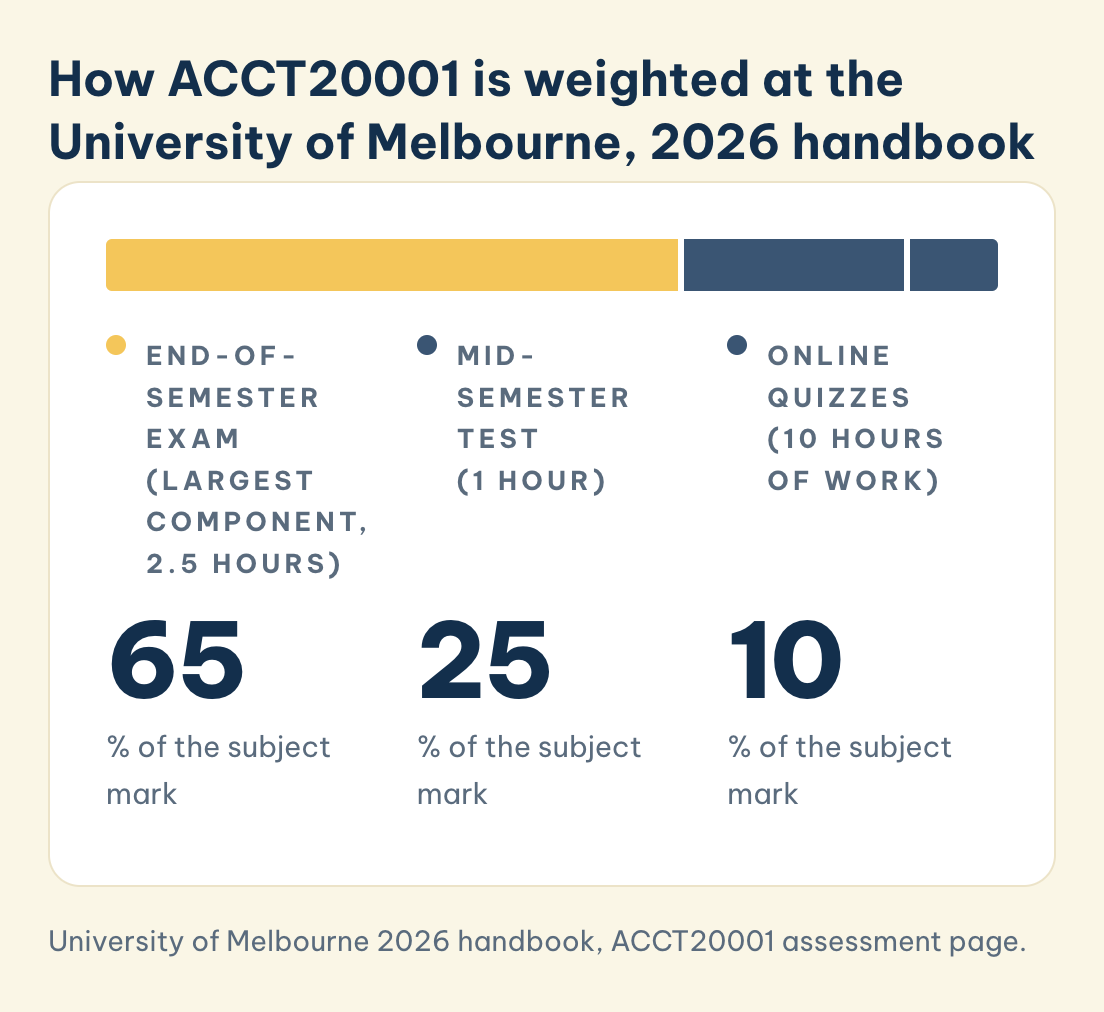
Direct answer: Every mark in 2026 comes from three timed components, and the largest one lost time. The end-of-semester exam still carries 65% but now runs 2.5 hours instead of the 3 hours listed in 2025, alongside a 1-hour mid-semester test at 25% and online quizzes at 10%.
How ACCT20001 is weighted at the University of Melbourne, 2026 handbook
The yellow part is the 2.5-hour end-of-semester exam, the largest component. The navy parts are the 1-hour mid-semester test and the online quizzes.
End-of-semester exam (largest component, 2.5 hours)
65
% of the subject mark
Mid-semester test (1 hour)
25
% of the subject mark
Online quizzes (10 hours of work)
10
% of the subject mark
Save this figure
Evidence: The arithmetic is simple and it changes how you should practise. In 2025 the final exam allowed 180 minutes for 65 percentage points, which is about 2.8 minutes per point. In 2026 it allows 150 minutes for the same 65 points, which is about 2.3 minutes per point, a cut of roughly 17%. The mid-semester test sits at 60 minutes for 25 points, or 2.4 minutes per point, so the 2026 final now runs at almost exactly the pace of the mid-semester test.
| Component | 2025 handbook | 2026 handbook | Minutes per percentage point in 2026 |
|---|---|---|---|
| End-of-semester exam | 3 hours, 65% | 2.5 hours, 65% | about 2.3 |
| Mid-semester test | 1 hour, 25% | 1 hour, 25% | about 2.4 |
| Online quizzes | 40 minutes in total, 10% | 10 hours of work, 10% | not timed as one sitting |
An older version of the assessment page, still indexed by Google without a visible year, listed a 3-hour exam at 70%, a 1-hour mid-semester test at 20% and tutorial preparation at 10%. That history is the practical warning. Practice exams shared online may come from any of three assessment designs, and a paper written for 180 minutes will teach you a pace you no longer have.
What to do about it: time every past paper you use against 2.3 minutes per mark, not against the length printed on the paper. If a 20-mark question takes you longer than about 46 minutes, the problem is speed of setting up the schedule, and that is trainable.
◆ Question 3 / 7 · Activity-based costing
Is activity-based costing always the more accurate answer?
Direct answer: No, and ACCT20001 questions often reward saying so with a reason. Activity-based costing produces better product costs when overhead is driven by activities other than volume, but it produces costs that are relevant for decisions only under narrow conditions, and a strong exam answer names the condition that the case violates.
Evidence: Cooper and Kaplan (1988) made the case for activity-based costing by showing how volume-based allocation, which spreads overhead in proportion to direct labour hours or machine hours, systematically overcosts high-volume standard products and undercosts low-volume complex ones. The complex products consume setups, inspections and purchase orders out of proportion to their volume, and a single volume driver cannot see that consumption. Banker, Potter and Schroeder (1995) later tested the idea with plant-level data and reported that manufacturing overhead was associated with transaction-based measures of complexity, not only with production volume.
Noreen (1991) supplied the limit that most revision notes leave out. He showed that activity-based costs equal the costs relevant to a decision only when three conditions hold: total cost can be split into pools that each depend on a single activity, the cost in each pool is strictly proportional to that activity, and each activity can be divided among products without joint processes. Real overhead rarely satisfies all three. A setup cost that jumps in steps when a second crew is hired is not strictly proportional, so the activity rate overstates the saving from dropping one small batch.
Kaplan and Anderson (2004) conceded a related practical problem from inside the activity-based costing camp. Conventional implementations relied on interviewing staff about how they split their time, which was costly to maintain and tended to allocate 100% of capacity to activities even when part of it sat idle. Their time-driven version estimates only two parameters, the cost per minute of supplying capacity and the minutes each activity consumes, which makes unused capacity visible instead of burying it in product cost.
What to do about it: whenever a question asks you to compute activity-based costs and then recommend, add one sentence testing Noreen's second condition. Ask whether the cost in the pool would actually fall if the activity fell. If it would not, say that the activity-based figure overstates the avoidable cost.
◆ Question 4 / 7 · High-low method
What does the high-low method quietly assume?
Direct answer: It assumes cost is linear in activity within the relevant range and that the same line applies whether activity is rising or falling. Both assumptions are testable in an exam answer, and the second one is contradicted by published evidence on how costs actually behave.
Evidence: The mechanics are fixed. Take the observations with the highest and lowest activity, not the highest and lowest cost, divide the change in cost by the change in activity to get the variable cost per unit, and back out the fixed cost from either point. The method uses 2 observations out of however many the question supplies, so a single unusual period at either end moves the whole line.
The study that gave the pattern its name opens with the assumption most costing courses leave unspoken: "A fundamental assumption in cost accounting is that the relation between costs and volume is symmetric for volume increases and decreases" (Anderson et al., 2003, p. 47). Anderson, Banker and Janakiraman then examined selling, general and administrative costs across 7,629 firms over 20 years and found that these costs rose on average by 0.55% for each 1% increase in sales but fell by only 0.35% for each 1% decrease. They called this cost stickiness. Managers keep staff and capacity through a downturn because cutting and rehiring is expensive, so cost does not retrace the path it took on the way up. A high-low estimate built from a year of growth will therefore overstate the saving from a fall in volume.
What to do about it: after any cost estimation question, write two short lines. The first states the relevant range your estimate covers. The second says whether the decision in front of you involves activity moving outside that range or moving downward, because either one weakens the estimate you just produced.
◆ Question 5 / 7 · Relevant costs
How do relevant costs and opportunity costs fit a timed answer?
Direct answer: Build the comparison as a table with alternatives as columns, include only future costs that differ between the alternatives, and add the contribution lost on displaced work whenever capacity is full. In a 2.3-minutes-per-mark exam, the table is also the fastest way to show the marker every judgement you made.
Evidence: The pattern repeats across special order, make-or-buy, drop-or-retain and sell-or-process-further questions. Allocated fixed overhead that continues under every alternative is excluded, and so is any cost already incurred. The line that separates strong answers from average ones is opportunity cost. If accepting a special order uses machine hours that would otherwise produce a product earning $40 of contribution per hour, that $40 per hour belongs in the special order column even though no invoice will ever show it.
The special order case is where Cooper and Kaplan (1988) and Noreen (1991) meet in a single question. A product cost produced by a well designed activity-based system is still a full cost, built for pricing and profitability analysis over time. A decision about next month's spare capacity needs the avoidable cost, and the two numbers can differ by the whole of the fixed overhead in the pool.
What to do about it: write the column headings and the row labels before any arithmetic. A labelled empty table takes about a minute and prevents the most common lost marks, which come from including a sunk or unavoidable cost that the numbers never needed.
◆ Question 6 / 7 · Revision
How should you revise when practice exams are scarce?
Direct answer: Turn tutorial questions into timed sets and add a written judgement to each one. A Reddit thread from students in this subject asked how to prepare because few practice exams were released, and the useful answer is not more papers but a different use of the questions you already have.
Evidence: The handbook's final learning outcome asks students to "analyse and evaluate cost information for the purposes of making a variety of value-based decisions." The word evaluate is the one a calculation-only revision plan never trains. A tutorial question you have already solved correctly still holds three untouched exam skills: doing it inside the 2026 time budget, stating the assumption the answer depends on, and saying what the manager should do differently because of it.
The quiz component also changed shape between the two handbooks. The 2025 entry described the quizzes as 40 minutes of work in total, while the 2026 entry lists 10 hours of work for the same 10%. That is a signal that the weekly quizzes now carry most of the routine practice, which leaves tutorial time free for exactly the interpretive work the exam rewards.
What to do about it: each week, redo one solved tutorial question under a timer set at 2.3 minutes per mark, then write 3 sentences underneath it covering the assumption, the limitation and the recommendation. Over a 12-week semester that is 12 fully rehearsed exam answers built from material you already own.
◆ Question 7 / 7 · Common errors
What do students most often get wrong in ACCT20001?
Direct answer: They revise it as Cost Management, a subject about computing, when the 2026 version is explicitly about deciding. The calculations are necessary and they are not sufficient, and an answer that stops at a correct number leaves the evaluation marks untouched.
Evidence: Consider two answers to the same activity-based costing question. Both allocate overhead correctly across four cost pools and both find that a low-volume product is loss-making once setups are traced properly. The first recommends dropping it. The second recommends investigating before dropping it, because the setup pool is staffed by a salaried crew whose cost will not fall if one product disappears, and notes that the product is ordered by a customer who also buys the high-volume lines. The numbers are identical. Only the second answer uses the cost information to make a value-based decision in the handbook's sense.
The second common error is carrying a financial accounting habit forward from ACCT10001. Absorption cost per unit is the right figure for valuing inventory in the statements and the wrong figure for a short-term capacity decision. Students who move straight from the prerequisite into this subject often reach for the unit cost they already know how to calculate.
What to do about it: before writing any recommendation, ask which cost the decision needs: full, avoidable or incremental. Name it in the answer. That one word tells the marker you chose the figure rather than defaulted to it.
Frequently asked questions
Is ACCT20001 the same subject as Cost Management?
Yes. The code is unchanged and the handbook overview paragraph is the same. The University of Melbourne handbook lists the subject as Cost Management up to 2025 and as Accounting for Management Decisions in 2026, so older notes remain useful on content but may reflect an older assessment design.
Does ACCT20001 have an assignment?
Not in the 2026 handbook. The assessment is online quizzes worth 10%, a 1-hour mid-semester test worth 25% and a 2.5-hour end-of-semester exam worth 65%. Confirm the details in the subject guide released on the LMS for your own semester.
What do I need before enrolling in ACCT20001?
The 2026 handbook lists one prerequisite, ACCT10001 Accounting Reports and Analysis, and no corequisites or non-allowed subjects. Check your own course plan, because degree rules are versioned by year.
Is activity-based costing always better than traditional costing?
It gives better product costs when overhead is driven by complexity rather than volume, as Cooper and Kaplan (1988) argued. It gives decision-relevant costs only under the restrictive conditions Noreen (1991) set out, so an exam answer should test those conditions rather than assume them.
Does MAAS complete my ACCT20001 work?
No. MAAS works as an academic advisor. A mentor can time you through a past question, check whether your relevant cost table excluded the right items, or work through an activity-based costing limitation with you until you can explain it unaided. The quizzes, test and exam remain your own work.
Related reading
If the pressure is on a timed assessment, our online exam support mentors focus on exam technique and pacing rather than on answers. For another University of Melbourne subject assessed almost entirely under time limits, see our guide to BLAW10001 Principles of Business Law. For the report-based side of management accounting at other universities, see ACCT2019 Accounting Analysis for Management Decisions and ACCT1101 Accounting for Decision Making. If you are starting from the financial side at Melbourne, the first-year subject is covered in our guide to ACCT10002 Introductory Financial Accounting.
References
Anderson, M. C., Banker, R. D., & Janakiraman, S. N. (2003). Are selling, general, and administrative costs "sticky"? Journal of Accounting Research, 41(1), 47–63. https://doi.org/10.1111/1475-679X.00095
Banker, R. D., Potter, G., & Schroeder, R. G. (1995). An empirical analysis of manufacturing overhead cost drivers. Journal of Accounting and Economics, 19(1), 115–137. https://doi.org/10.1016/0165-4101(94)00372-C
Cooper, R., & Kaplan, R. S. (1988). Measure costs right: Make the right decisions. Harvard Business Review, 66(5), 96–103.
Kaplan, R. S., & Anderson, S. R. (2004). Time-driven activity-based costing. Harvard Business Review, 82(11), 131–138.
Noreen, E. (1991). Conditions under which activity-based cost systems provide relevant costs. Journal of Management Accounting Research, 3, 159–168.
Tools & resources
- University of Melbourne Handbook entry for ACCT20001 for the overview, prerequisite and learning outcomes of your year
- ACCT20001 assessment page, 2026 Handbook to confirm the current weightings and durations
- ACCA technical article on relevant costs for the future, incremental, cash-flow test
A free 20-minute consultation is a conversation about where you are with ACCT20001.
Book a free consultation ▸