
◆ Law
BLAW10001 Principles of Business Law: answer a problem question
BLAW10001 is a law subject in which you never hand in an essay. Every mark comes from a quiz or an exam sat under a clock, and both are open book. Students read the word open and relax. The subject is in fact testing how fast you can recognise a legal issue, because the one thing an open book cannot give you is time.

◆ Question 1 / 7 · The subject
What is BLAW10001, and which university teaches it?
Direct answer: BLAW10001 Principles of Business Law is an undergraduate level 1 subject at the University of Melbourne worth 12.5 points, delivered at Parkville in both Semester 1 and Semester 2, with weekly lectures released online and a compulsory on-campus final exam. The 2026 Handbook lists Tanya Josev as Semester 1 coordinator and Arlen Duke as Semester 2 coordinator.
Evidence: The subject is deliberately built for students who have never studied law. The Handbook states that no prior legal knowledge is required and describes it as a broad introduction to law from a business perspective, designed for students from all disciplines. The Handbook first frames the legal system, covering the nature and purpose of law and how laws are made, evolve and are enforced, then lists its key topics: contract formation and breach, consumer protection, property law, negligence and liability in tort, and the law of agency. That is 5 distinct bodies of law on top of the system framing, all inside a single 12.5 point subject, which is why the pace surprises people who expected an introductory subject to be slow. The Handbook is explicit that you will "read and interpret legislation and case law, and apply them to practical, real-world situations", and the verb carrying the marks in that sentence is apply.
What to do about it: in week 1, open the Canvas subject page for your own semester and write down which of those 5 topics your semester actually covers and in what order. The Handbook lists the full territory, but the teaching order changes between coordinators, and your quiz windows are pegged to the teaching order rather than to the Handbook list.
◆ Question 2 / 7 · Assessment
How is BLAW10001 assessed, and why does the format change how you study?
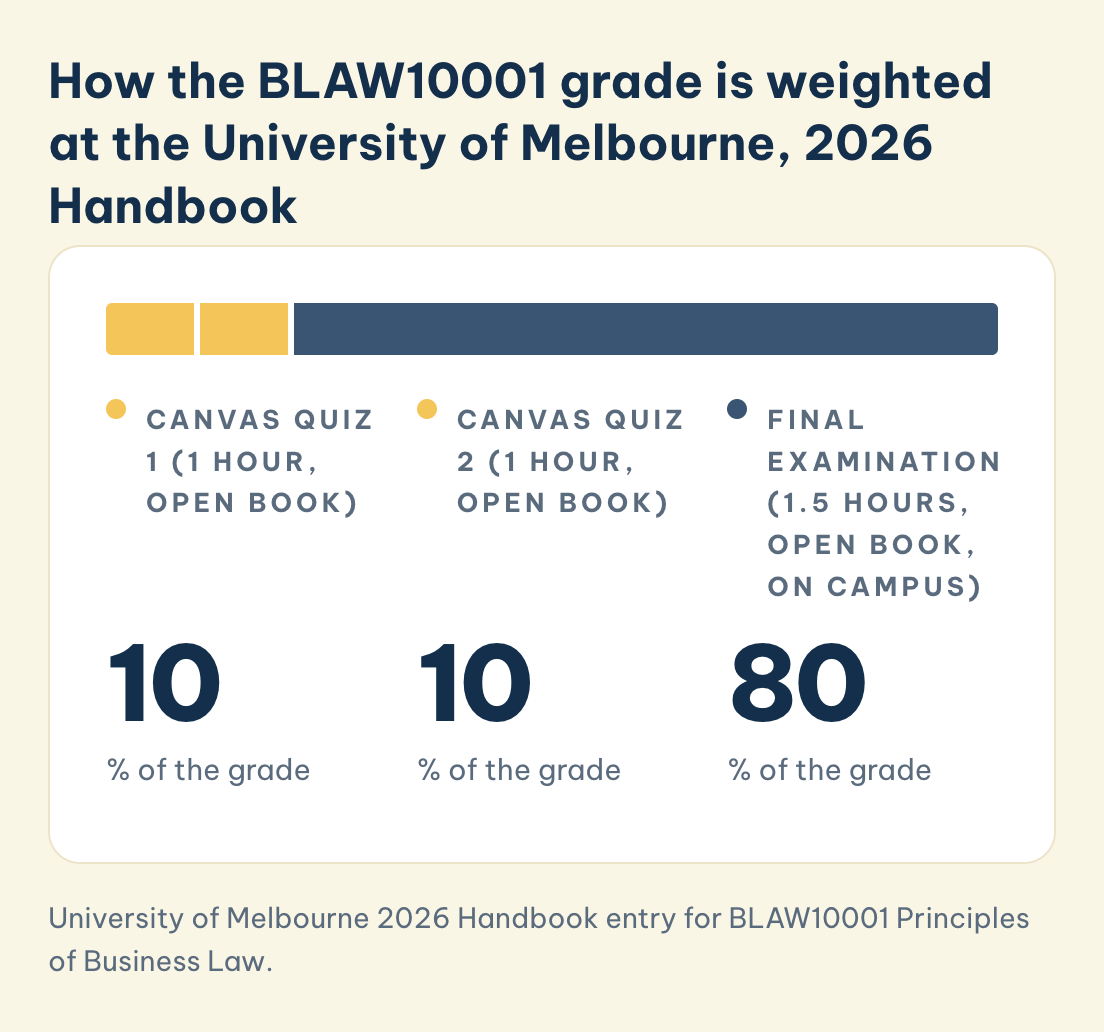
Direct answer: The 2026 Handbook lists two assessment items. Two 1 hour open-book Canvas quizzes worth 10% each run from week 4 to week 9, making up 20%. An open-book exam of multiple choice and short-answer questions, sat on campus during the examination period, carries the remaining 80% in 1.5 hours.
How the BLAW10001 grade is weighted at the University of Melbourne, 2026 Handbook
Two Canvas quizzes make up 20% and the final examination carries the remaining 80%.
Canvas quiz 1 (1 hour, open book)
10
% of the grade
Canvas quiz 2 (1 hour, open book)
10
% of the grade
Final examination (1.5 hours, open book, on campus)
80
% of the grade
Save this figure
Evidence: Two features of that split do most of the damage. The first is that 80% of your grade is decided in 90 minutes, so a single afternoon carries four times the weight of the entire semester's continuous assessment. The second is that the exam is open book but sat on campus under time pressure, which is a different instrument from a take-home paper. Bengtsson (2019) reviewed the take-home examination literature and concluded that the format suits higher-order questions because it allows time for reflection, while noting that the research community is openly divided on how it changes study habits. Read carefully, that conclusion is about the time it grants, and a timed on-campus paper grants none of it. Cognitive load theory suggests why this matters. Sweller et al. (2019) argue that working memory is the bottleneck in complex reasoning. Applying that to an exam room is our inference rather than their finding, but it is a reasonable one: searching unfamiliar notes is itself a task competing for the same limited capacity as the legal reasoning. Notes you have not internalised become a cost rather than a resource.
| Assessment item | Format | Timing | Weight |
|---|---|---|---|
| Canvas quiz 1 | 1 hour, open book, online | Between week 4 and week 9 | 10% |
| Canvas quiz 2 | 1 hour, open book, online | Between week 4 and week 9 | 10% |
| Final examination | 1.5 hours, open book, on campus, multiple choice and short answer | Examination period | 80% |
A third feature is easy to miss. At 12.5 points, BLAW10001 is one quarter of a standard full-time load of 50 points per semester, so the 80% exam decides one fifth of that semester's weighted average on its own. The 2026 Handbook entry records a last update of 17 August 2026, and it is worth checking each year because the delivery has changed: the exam ran online for Semester 1 in 2021, as a Zoom supervised open-book paper in 2022 and 2023, and the online qualifier was dropped from 2024, with the 2026 entry stating the exam is sat on campus. The 20 and 80 split itself has held since 2021.
What to do about it: treat the two quizzes as instruments rather than as marks. Together they are worth 20%, which is small, but they are the only sample of the exam's question style you will see before the 80% item. After each quiz, write down every question you got wrong and the reason it was wrong, sorted into two piles: you did not know the rule, or you knew the rule and misread the facts. Those two failure modes need opposite remedies.
◆ Question 3 / 7 · IRAC
What is the IRAC method, and how do you apply it here?
Direct answer: IRAC stands for Issue, Rule, Application, Conclusion. You run the full cycle once for every legal issue you find in the scenario, not once for the scenario as a whole. A problem with 3 issues in it produces 3 issues, 3 rule statements, 3 applications and 3 conclusions.
Evidence: The most common structural failure in a first-year business law answer is a single long IRAC covering everything, which forces the rules of contract formation, misrepresentation and consumer protection into one undifferentiated paragraph. The marker then cannot award element-by-element marks, because the elements are not separated on the page. In a short-answer exam question worth perhaps 8 or 10 marks, the marking scheme almost always allocates marks per element, so a merged answer loses marks it has actually earned in substance. Count your conclusions against your issues before you move on. If those two numbers differ, the answer has a structural problem no amount of extra content will fix.
Example: A student answered a 3 issue problem with one 600 word block of prose. The legal reasoning was largely correct. The mark was mid-range, because the marker awarding 2 marks for consideration could not find where the student had addressed consideration.
◆ Question 4 / 7 · Legal issues
How do you identify the legal issues in a scenario?
Direct answer: Read the facts before you read the question, and treat every specific detail as deliberate. Examiners rarely include a dollar figure, a date, an exact form of words or a communication method by accident. Each one is usually the trigger for an element of a legal test.
Evidence: In contract formation alone, the standard elements generate 4 separate questions: was there an offer, was there acceptance, was consideration present, was there an intention to create legal relations. A scenario in which one party replies to a $1,000 asking price with $900 has placed an issue in front of you about whether that reply is an acceptance or a counter-offer, and the number is the reason the issue exists. Change the reply to "yes" and the issue disappears. This is why issue spotting is a reading skill before it is a legal one.
What to do about it: before writing anything, annotate the scenario in the margin with one word per fact that you think is doing legal work: offer, price, silence, delay, signature, notice. In a 90 minute exam covering several questions, this costs you 2 to 3 minutes per problem and prevents the single most expensive error available, which is writing 300 correct words about an issue the question did not raise.
◆ Question 5 / 7 · Authority
How do you use cases and legislation as authority rather than decoration?
Direct answer: A case is cited for a proposition, not for its fame. State the rule, then name the authority that establishes it, then say what that authority actually decided that makes it relevant here. Naming a case without the proposition it stands for earns nothing.
Evidence: Compare two sentences about the same case. "Carlill v Carbolic Smoke Ball Co [1893] 1 QB 256 is a famous contract case" tells the marker only that you have heard of it. "Carlill v Carbolic Smoke Ball Co [1893] 1 QB 256 establishes that an offer may be made to the world at large and accepted by performing the specified conditions" tells the marker you know why it is in your reading list and, crucially, when it applies. The same discipline governs statute. BLAW10001 covers consumer protection, which in Australia means the Australian Consumer Law in Schedule 2 to the Competition and Consumer Act 2010 (Cth). Citing the Act by name is not enough when the marks sit at the level of the specific prohibition.
What to do about it: build a one-page authority table before the exam with 3 columns: proposition, case or section, one line on the facts. Because the exam is open book, this table is the single most valuable page you can bring in. A 40 page set of lecture slides is not searchable in 90 minutes. A one-page table sorted by proposition is.
◆ Question 6 / 7 · Applying the law
How do you apply the law to the facts instead of restating them?
Direct answer: Application is the paragraph where the rule and the facts meet, and it is usually the most heavily weighted part of the answer. A working formula is rule, then fact, then the reasoning connecting them, then a mini-conclusion. If a sentence in your application paragraph contains no fact from the scenario, it belongs in the rule paragraph instead.
Evidence: Weak application restates the rule and then asserts the outcome. Strong application does the connecting work out loud. "An acceptance must correspond with the terms of the offer. Here, A offered the computer at $1,000 while B responded proposing $900. Because B's response introduces a different price, it is unlikely to constitute acceptance and is better characterised as a counter-offer. No contract was formed at that point." Four sentences, four functions, and every one of them earns something. The connecting words are the load-bearing part: because, since, here, therefore. Their absence is the reliable signature of an answer that has stated the law without deciding anything.
What to do about it: after drafting, highlight every sentence in your application paragraph that contains a fact from the scenario. If fewer than half do, you have written a second rule paragraph and labelled it application.
◆ Question 7 / 7 · Weekly preparation
What does effective preparation look like week by week?
Direct answer: Because 80% of the grade rides on a single timed paper, preparation should be built around retrieval under time pressure rather than around rereading lecture notes. Practise writing complete IRAC cycles against a clock from week 4 onward, and build your one-page authority table early enough that you refine it during semester rather than the night before.
Evidence: Bengtsson (2019) puts the reason plainly, concluding that take-home exams "promote higher-order thinking skills and allow time for reflection" (Bengtsson, 2019, para. 1), and a timed on-campus paper grants you neither. Roediger and Karpicke (2006) demonstrated that retrieving material from memory produces substantially better long-term retention than restudying the same material for the same amount of time. The effect is directly relevant here, because the two Canvas quizzes are themselves retrieval events. Johanns et al. (2017), reviewing comparisons of open-book and closed-book examinations in nursing education, found that the open-book format does not by itself deliver the critical thinking gains commonly assumed of it. Taken together, these findings point the same way: the format will not carry you, and the practice that helps is producing answers rather than reviewing notes.
What to do about it: from week 4, run one 20 minute timed problem per week. Write a full IRAC, then mark it against your own authority table. Ten of those across a semester is roughly 200 minutes of practice, and it is the closest available simulation of the instrument that decides 80% of your grade.
Frequently asked questions
Is BLAW10001 the same subject at other universities?
No. The code is specific to the University of Melbourne. Other Australian institutions run business law under codes such as BLAW2012 at Curtin, which is a second-level applied contract law unit rather than an introductory one, and LAW2447 at RMIT. The content and assessment differ in each case. Notes downloaded from a study-sharing site under a similar code may describe a different subject entirely.
Does open book mean I do not need to memorise anything?
No. The exam runs for 1.5 hours and includes multiple choice and short answer questions. Searching unfamiliar material under that clock costs more time than it saves, which is why a condensed authority table outperforms a full set of notes.
Do I need prior legal knowledge to take BLAW10001?
No. The Handbook states that no prior legal knowledge is required and that the subject is designed for students from all disciplines, including commerce, engineering, science and arts.
How many issues should I find in a problem question?
There is no fixed number, but your count of conclusions should match your count of issues. If you have written 3 issues and reached 1 conclusion, an issue has gone unanswered.
What citation style does BLAW10001 use?
Australian law subjects generally use the Australian Guide to Legal Citation. Confirm the requirement on your own Canvas subject page, since assessment instructions for a given semester override any general expectation.
Ready to work through BLAW10001 problem questions with a mentor?
MAAS mentors work with students on legal reasoning technique: how to spot issues, how to structure an IRAC cycle, and how to make an application paragraph do the work it is meant to do. You write the answers; the mentor shows you where the marks were lost and why. Get in touch through our contact page to talk about what you need.
Related guides
- BLAW2012 Applied Contract Law assignment guide
- LAW2447 Business Law assignment guide
- LAWS2012 Property and Commercial Law assignment guide
- ACCT20001 Accounting for Management Decisions guide, another University of Melbourne subject marked entirely under time limits
References
Bengtsson, L. (2019). Take-home exams in higher education: A systematic review. Education Sciences, 9(4), 267. https://doi.org/10.3390/educsci9040267
Johanns, B., Dinkens, A., & Moore, J. (2017). A systematic review comparing open-book and closed-book examinations: Evaluating effects on development of critical thinking skills. Nurse Education in Practice, 27, 89–94. https://doi.org/10.1016/j.nepr.2017.08.018
Roediger, H. L., & Karpicke, J. D. (2006). Test-enhanced learning: Taking memory tests improves long-term retention. Psychological Science, 17(3), 249–255. https://doi.org/10.1111/j.1467-9280.2006.01693.x
Sweller, J., van Merriënboer, J. J. G., & Paas, F. (2019). Cognitive architecture and instructional design: 20 years later. Educational Psychology Review, 31(2), 261–292. https://doi.org/10.1007/s10648-019-09465-5
Tools & resources
- University of Melbourne Handbook, BLAW10001 subject entry: https://handbook.unimelb.edu.au/2026/subjects/blaw10001
- Australian Guide to Legal Citation, Melbourne University Law Review: https://law.unimelb.edu.au/mulr/aglc
- Australian Consumer Law, Schedule 2 to the Competition and Consumer Act 2010 (Cth): https://www.legislation.gov.au/C2004A00109/latest/text
A free 20-minute consultation is a conversation about where you are with BLAW10001.
Book a free consultation ▸