
◆ Law
BLAW2012: who is your contract law memo actually written for?
BLAW2012 Applied Contract Law at Curtin University is assessed in a way that quietly asks for two different people. A roughly 2-hour examination rewards doctrine stated and applied under time pressure, while the written memo rewards an adviser writing to someone who must make a commercial decision and has no patience for being taught contract law along the way, and most students write both, sometimes only 2 weeks apart, as though the same reader sat on the other end.

◆ Question 1 / 7 · Coverage
What does BLAW2012 actually cover?
Direct answer: BLAW2012 Applied Contract Law is a unit taught out of Curtin Law School at Curtin University, one of Western Australia's largest providers of business law units. Curtin's syllabus, recorded in the 2019 handbook, covers contract formation, negotiation and operation, business contract structure, risk management, termination clauses, remedies, and dispute resolution, with a prerequisite of the introductory business law unit.
Evidence: Read that syllabus closely and it is not a list of doctrine at all. 2 of its 5 elements concern the document itself, its clauses and its risk management and termination provisions, rather than what a court would do afterwards. A unit that puts boilerplate and risk management on its own syllabus line, alongside dispute resolution, is signalling that the useful question is often not who would win, but what should have been written into the agreement so the question never arose.
Example: A Vietnamese student at Curtin, 6 weeks into the semester, told his MAAS mentor that the unit felt like a list of unrelated topics that happened to share the word contract. His mentor asked him to write the 5 topics again as a timeline, from negotiation through to remedies. The list stopped looking like a syllabus and started looking like the life of an agreement, and the topics he had been memorising separately turned out to be sequential.
◆ Question 2 / 7 · Assessment
How is the unit assessed, and why does the split matter?
Direct answer: Curtin publishes assessment detail in the unit outline rather than in the handbook, so the only structure worth quoting is one attached to a named offering. In the version delivered online through Open Universities Australia, the split is an online multiple-choice component worth around 10% to 20%, a written memorandum of roughly 1,500 to 2,500 words carrying the largest single share of the written work, and a final examination running close to 2 hours. Your own offering may differ and the unit outline is the authority. What is worth taking from a split like that is strategic rather than numerical, because the components test different things. The multiple-choice component tests whether you know the rules, the memo tests whether you can advise, and the examination tests whether you can do both quickly.
What each BLAW2012 assessment component really tests
Each row sets one component of a split like the Open Universities Australia version of the unit beside what it really tests.
Component
What it really tests
Multiple choice
Precision on rules and exceptions
Written memo
Advice a business person can act on
Final examination
Applied doctrine under time pressure
Save this figure
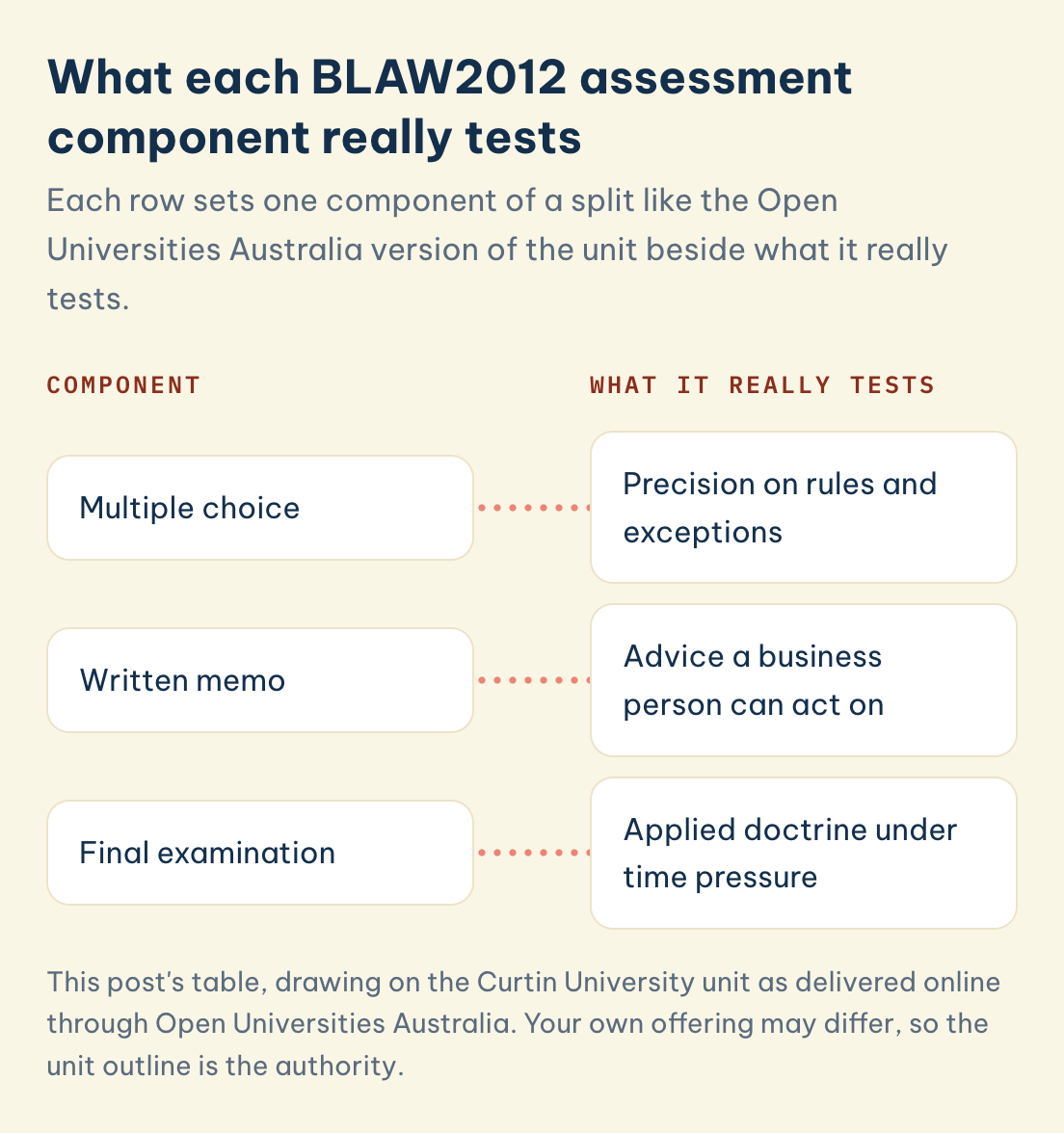
| Component, where a split like this applies | What it really tests | Where students go wrong |
|---|---|---|
| Multiple choice | Precision on rules and exceptions | Studying themes rather than elements |
| Written memo | Advice a business person can act on | Writing an essay about contract law |
| Final examination | Applied doctrine under time pressure | Running out of time on issue spotting |
Evidence: A unit that spreads weight across recall, applied writing and timed application is deliberately preventing a single study method from carrying a student through, whether that is 3 hours of rote revision the night before or a memo drafted without a plan. Preparing for one component in the style of another is the most common structural mistake, and it is invisible until the mark comes back.
Example: A student who had scored a Distinction in her earlier law unit, worth 12 credit points, prepared for the BLAW2012 memo the way she had prepared for essays, by reading widely around the topic and drafting 3,000 words. Her mentor's response was to take the reading away and hand her a single question instead: what is the client deciding, and what would change their mind? Her second draft, cut to 1,800 words, cited fewer than half the cases and scored considerably better.
◆ Question 3 / 7 · Memo or essay
What makes a memo different from an essay?
Direct answer: A memo is written to be used, not to be marked. It leads with the answer in the opening 100 words rather than building to it over several pages, it tells the reader what to do as well as what the law is, and it keeps the reasoning visible but subordinate to the recommendation.
An essay can defensibly spend 1 page establishing context before arriving anywhere. A memo that does the same has failed at its job, because the reader in the scenario is a person deciding whether to sign, sue, settle or walk away.
Evidence: Legal writing scholarship draws a firm line between predictive writing, which advises a client on the likely outcome, and persuasive writing, which argues a position to a decision maker (Neumann et al., 2021). Advisory writing is expected to be candid about weakness, because a client who is only told the good news cannot make a real decision. In a memo of 2,000 words, the weakness usually earns 1 short paragraph rather than a full page, and a memo that reads as advocacy for the client's preferred outcome has confused the two genres.
An open-access legal writing manual states the same distinction directly: "Unlike persuasive writing, the goal of predictive writing is not to convince your audience that your argument is correct." (Mangan et al., 2025, Section C5)
Example: One student's memo concluded that the client had a strong case. His mentor asked what the other side would say first. He had not written it down anywhere. Adding 2 sentences acknowledging the strongest counter-argument, and explaining why it did not change the recommendation, added 40 words and did not weaken the memo. It was the difference between an assertion and advice.
◆ Question 4 / 7 · Handling facts
How do you handle the facts without just retelling them?
Direct answer: Use facts as evidence, not as narrative. The client already knows what happened, so a memo that opens with 300 words of chronology is spending its most valuable space telling the reader something they told you. Facts should appear at the moment they do legal work, attached to the element they satisfy or defeat. If a fact in your memo is not doing that job, it is decoration.
Evidence: Contract doctrine is built from elements, and each element is a place where a fact either lands or does not. Paterson, Robertson and Duke (2020) organise agreement, consideration, intention and certainty as the four elements a court checks in sequence before it will find a binding contract at all, and each turns on identifiable conduct or words rather than on what a party privately intended. Organising a memo around those elements rather than around the sequence of events is what makes the analysis auditable by a marker and useful to a client.
Example: A student submitted a draft in which the first 600 words were a retelling of the dispute. Her mentor deleted the section and asked her to reintroduce each fact only where it proved something. 11 facts came back, across 4 elements. The rest, it turned out, had been in the draft because they were in the problem, not because they mattered.
◆ Question 5 / 7 · Risk allocation
Where does risk allocation change the analysis?
Direct answer: It changes what counts as a good answer. Doctrinal analysis asks what the position is now that the parties are in dispute. Risk allocation asks what the agreement should have said so that the position was never in doubt. Applied contract units reward students who can do both, because a commercial reader usually wants to know 2 things: where do we stand, and how do we stop this happening again. The second question is frequently where the higher marks sit, often the final 1 or 2 paragraphs, and where most students write nothing at all.
Evidence: Curtin's syllabus lists risk management and termination clauses, and dispute resolution, as elements in their own right rather than as afterthoughts to remedies, and a well-drafted clause can sit alongside statutory protections like the Australian Consumer Law rather than displace them entirely. A clause that limits liability, defines a term precisely in 1 or 2 sentences, or specifies how a disagreement is escalated within 30 days does more practical work than any remedy claimed after the fact, because remedies are what you are left with once the allocation has failed.
Example: A memo about a defective supply arrangement ended with an assessment of damages, which was accurate. The mentor's note was a single line asking what a better contract would have said. The student added a closing section of 150 words proposing a specific definition of the goods and an inspection window of 5 business days. It was the only part of the memo the marker commented on positively by name.
◆ Question 6 / 7 · Credit or Distinction
What separates a Credit answer from a Distinction one?
Direct answer: Certainty, honestly handled. Weaker answers state a conclusion with more confidence than the facts support, or hedge across 3 to 4 pages so thoroughly that no advice is given at all. Stronger answers identify precisely which fact is doing the deciding, say what would happen if that fact were different, and tell the reader what to find out next, usually in 1 closing sentence. A conclusion that names its own weak point reads as competence rather than doubt.
Evidence: Predictive legal advice is by nature probabilistic, since the point is to estimate an outcome before a court has ruled, a distinction Neumann et al. (2021) treat as the line separating predictive writing from persuasive writing. Advice that presents a probability as a certainty misrepresents the state of knowledge, and in an assessment context it also removes the student's opportunity to show the reasoning that a marker is trying to see.
Example: Two students reached the same conclusion on the same problem, both within a limit of 1,800 words. One wrote that the term would be held to be a condition. The other wrote that it would likely be held to be a condition, that the outcome turned on how essential the timing was to the buyer at formation, and that evidence of the pre-contract discussions would settle it. The second answer earned the higher mark, and it was not because it was longer.
◆ Question 7 / 7 · Study period
How should you prepare across the study period?
Direct answer: Build the element checklists in the first 2 weeks and keep a case list that records what each case decided rather than what it was about. For the memo, draft the recommendation first and let the analysis be assembled to support it, then check that every paragraph earns its place against that recommendation. For the examination, practise spotting issues under time pressure rather than rereading notes, since a typical paper runs 2 hours, because the failure mode in a timed contract paper is almost never ignorance and almost always triage.
Evidence: The rules in contract law are finite and heavily structured, which Carter (2018) sets out across a single volume covering formation, terms, discharge and remedies, so the marginal value of a 4th reading of the notes, after 3 earlier passes, is close to zero while the marginal value of a first timed attempt of 2 hours is large. Units assessed partly by multiple choice reward exactly this kind of precision drilling, because the distractors in a well-written question target the exception rather than the rule.
Example: A student who had read the unit materials 3 times sat his first practice paper 7 days out and finished barely half of it in the allotted 120 minutes. His mentor's only intervention was to make him do 3 more under the clock. His accuracy did not improve much. His coverage nearly doubled, and coverage was what had been costing him.
Frequently asked questions
Do I need a law background to take BLAW2012?
You need the introductory business law unit, which is a listed prerequisite, so some prior legal study is assumed rather than none. Beyond that the unit is built for business students rather than for law students. What it demands is a willingness to work with precise language, since in contract law a small difference in wording often changes the result.
How many cases should I cite in the memo?
Enough to support each step of the reasoning and no more. A memo of 2,000 words that cites 20 cases usually shows reading rather than judgement, where 4 to 6 well-chosen authorities usually do more work. Citing the authority that actually decides your point, and explaining why it applies to these facts, is worth more than a list.
Should the memo cover arguments against my client?
Yes. Advisory writing is expected to be candid (Neumann et al., 2021), and a client who does not know the weakness in their position cannot make a real decision. Acknowledging the strongest counter-argument, usually in 1 or 2 paragraphs, and explaining why it does not change the recommendation strengthens the advice.
Is the multiple-choice component worth serious preparation?
It is worth precise preparation rather than long preparation, especially where it makes up 10% to 20% of the final grade. Questions of this kind tend to turn on exceptions and on the boundaries between elements, so drilling the distinctions is more useful than rereading the topic summaries.
Can MAAS help me with BLAW2012?
Yes. MAAS Academic Support coaches you through the unit with the Outline → Draft → Final model, including issue mapping, memo structure, authority selection and timed examination practice with mentors from a commercial law background. We coach your work; we do not write it for you.
Ready to write a BLAW2012 memo someone could act on?
If you know the law and the memo still comes back marked as descriptive, the problem is usually the reader you had in mind rather than the research you did. MAAS Academic Support works alongside you through Outline → Draft → Final so the legal reasoning stays yours while the advice becomes usable. Every engagement sets a three-tier target grade with you at the start (Pass, Merit or Distinction) and 45 days of follow-up support after submission.
Bring your BLAW2012 unit outline and we will match you to a commercial law expert within 48 hours. Of our 100+ experts, 23% hold a PhD.
Book a free 20-minute BLAW2012 consultation with MAAS Academic Support →
Related guides
- BLAW10001 Principles of Business Law assignment guide: the Melbourne first-year subject that introduces the same contract principles under a timed open-book exam
- LAW2447 Business Law assignment guide: the RMIT sibling unit on applying legal principles to a set of facts
- LAWS2012 Property and Commercial Law assignment guide: commercial law analysis where property interests are in play
- BUS301 Business Law assignment guide: reasoning from legislation and decided cases in an Australian business law unit
- MAAS Academic Mentoring service: 1:1 coaching with PhD-level mentors in your discipline
- Course-code assignment coaching: pillar guide on tackling any unit assignment with a MAAS mentor
References
- Carter, J. W. (2018). Contract law in Australia (7th ed.). LexisNexis Butterworths.
- Mangan, J., Cohen, D., Easterlin, F., Goad, B., Gravel, G., Lyndale, C., Miseyko, G. M., & Whitest, E. (2025). Legal writing manual (4th ed.). University of Georgia School of Law, Affordable Learning Georgia. https://digitalcommons.law.uga.edu/books/196
- Neumann, R. K., Margolis, E., & Stanchi, K. M. (2021). Legal reasoning and legal writing (9th ed.). Aspen Publishing.
- Paterson, J., Robertson, A., & Duke, A. (2020). Principles of contract law (6th ed.). Thomson Reuters.
Tools & resources
- Curtin University. (2019). Courses handbook: BLAW2012 Applied Contract Law. Retrieved August 18, 2026, from https://archive.handbook.curtin.edu.au/july2019/units/31/318736.html
- Curtin University. (n.d.). Referencing at Curtin. Retrieved August 18, 2026, from https://libguides.library.curtin.edu.au/referencing
- Australasian Legal Information Institute. (n.d.). AustLII. Retrieved August 18, 2026, from https://www.austlii.edu.au
This article is part of the MAAS Journal series for Vietnamese international students. MAAS Academic Support is an advisory partner; we coach students through the Outline → Draft → Final delivery model with developmental feedback from discipline-matched experts. We do not write or submit work on a student's behalf.
A free 20-minute consultation is a conversation about where you are with BLAW2012.
Book a free consultation ▸