
BUS301 Business Law asks you to read a commercial situation, find the law that governs it in both legislation and decided cases, and reason to a conclusion; the rubric rewards that legal reasoning over a summary of topics. Most students who struggle are not short on effort. They can describe the areas of law but rarely spot the precise issue or reason from the authority that actually decides it, which is what the seven questions below work through.
Author: MAAS Editorial Team
Last updated: 2026-07-22
Category: business-management

What is BUS301 Business Law about?
Direct answer: BUS301 is an undergraduate business law unit that introduces the Australian legal system and the areas of law that most affect commerce: contract law, negligence, the Australian Consumer Law, and business structures (sole trader, partnership, and company). It wants you to understand where these rules come from and apply them to a business situation.
Evidence: Australian business law rests on two sources working together: statute and common law, connected by the doctrine of precedent, under which courts are bound by the reasoning of higher courts in the same hierarchy when the facts are similar (Latimer, 2020). This is why a strong business law answer cites both the relevant Act and the leading case, rather than paraphrasing a textbook, and why statutory interpretation and case reading are core skills in the unit (Gibson, 2025).
Example: A Vietnamese student studying business law in Australia came to MAAS treating BUS301 as a list of topics to memorise. Her MAAS mentor reframed it: the unit is about reading a situation, locating the governing law in statute and cases, and reasoning to an answer. Once she started asking "which law governs this, and where does it come from", her answers stopped listing topics and started reasoning.
What assessment does the BUS301 assignment usually involve?
Direct answer: Business law units at this level are typically assessed through a problem-based assignment (a commercial scenario you analyse), often alongside an exam or a shorter written task. You are usually given a fact situation and asked to advise a party by identifying the legal issues, stating the law from legislation and cases, applying it, and concluding. Always confirm the exact brief, weighting, and format in your own unit outline, because assessment structure varies by provider and semester.
Evidence: Problem-based legal assessment is marked on issue identification and the quality of legal reasoning, not on how many topics you can recall. Learning outcomes in Australian business law units commonly ask students to "apply" contract, consumer, and tort law to a business context and to justify advice "from case law and legislation".
Example: A Vietnamese student wrote an assignment that summarised each topic from the unit in turn, whether or not it was relevant to the scenario. His MAAS mentor cut everything the facts did not raise and rebuilt the answer around the two issues that actually arose. Same knowledge, same scenario; the focused version earned a far higher mark.
How is the BUS301 assignment graded, and what does the rubric reward?
Direct answer: Business law rubrics reward four things, roughly in this order: (1) identifying the precise legal issues the facts raise, (2) reasoning from the correct legislation and case authority, (3) applying the law to the specific facts, and (4) legal writing and accurate citation. Describing an area of law earns limited marks; the marks concentrate in spotting the issue and reasoning to a conclusion the facts support. If you can turn a description of a topic into reasoning about the issue, do it every time.
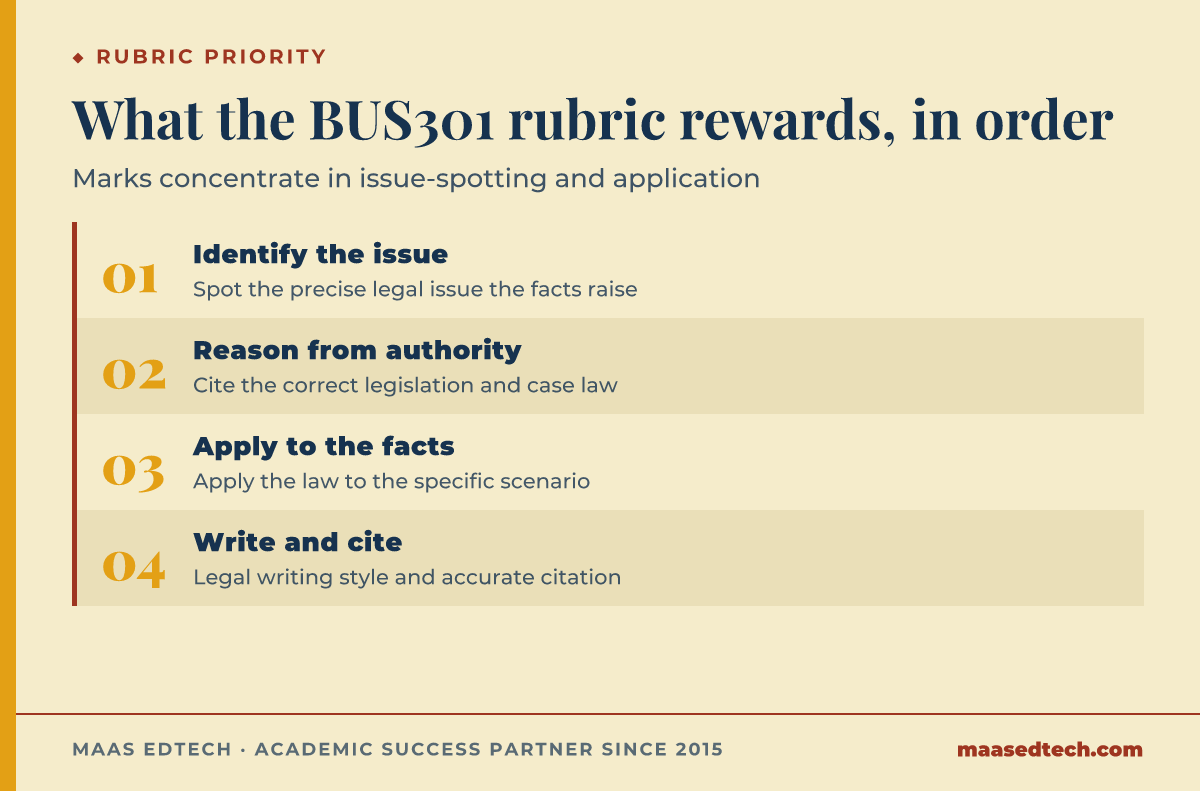
Evidence: The skill that separates bands in business law is issue-spotting followed by application. A student who identifies the wrong issue, or who recites the law without applying it, cannot reach the higher bands however much content they include. Marking criteria typically reward "analyse" and "apply", not "describe".
Example: A MAAS mentor mapped one Vietnamese student's assignment and found she had written accurately about consumer law, but the scenario actually turned on negligence. Once the correct issue was identified and the negligence elements applied to the facts, the same writing ability produced a much stronger answer, because it was finally answering the right question.
Which areas of law and skills should you use in BUS301?
Direct answer: Anchor your answer in the core areas the unit covers and apply only the ones the facts raise: contract law (formation, terms, breach, remedies), negligence (duty of care, breach, causation, damage), the Australian Consumer Law (misleading or deceptive conduct and consumer guarantees), and business structures (liability of sole traders, partners, and companies). The underlying skills are issue-spotting, reading statute and case law, and applying the doctrine of precedent. Do not write everything you know about every area.
| Core area | What it governs | What the assignment tests |
|---|---|---|
| Contract law | Agreements between parties | Whether a valid contract exists and whether it was breached |
| Negligence | Harm caused by a failure to take care | Whether duty, breach, causation, and damage are all present |
| Australian Consumer Law | Conduct toward consumers | Whether conduct was misleading or a guarantee was breached |
| Business structures | How a business is legally organised | Who bears liability under each structure |
Evidence: These four areas, contract, negligence, consumer law and business structures, are the standard content of Australian business law textbooks (Pentony et al., 2023), and each rests on identifiable authority: negligence on the duty of care established in Donoghue v Stevenson [1932] AC 562, and consumer protection on the Australian Consumer Law in Schedule 2 of the Competition and Consumer Act 2010 (Cth). Citing the case and the section, rather than a general statement, is what earns the authority marks.
Lord Atkin's own words in the judgment set out the test directly: "You must take reasonable care to avoid acts or omissions which you can reasonably foresee would be likely to injure your neighbour." (Donoghue v Stevenson [1932] AC 562, 580)
Example: A Vietnamese student analysing a defective-product scenario tried to cover contract, negligence, and consumer law all at length. His MAAS mentor showed that the facts pointed mainly to the Australian Consumer Law, focused the answer there, and applied the consumer guarantees to the facts. Fewer areas, applied precisely, a stronger answer.
How should you structure the BUS301 answer?
Direct answer: For a problem question, work through each legal issue in turn using a clear reasoning structure: identify the issue, state the governing law from legislation and cases, apply it to the facts, and conclude, then move to the next issue. Keep statements of law tight and spend most of your words applying them.
For an essay, use a standard argumentative structure but support every point with legislation or case authority. Many Australian units teach the IRAC method (Issue, Rule, Application, Conclusion) for exactly this purpose, and the same four-part structure underlies the worked examples in Pentony et al. (2023).
Evidence: Marking rubrics weight issue-spotting and application above description, so a structure that handles each issue separately and dedicates most space to application makes the available marks reachable. An answer that blends several issues together, or that states law without applying it, tends to lose marks it could have earned.
Example: A Vietnamese student submitted an assignment that discussed the law in general and only mentioned the facts at the end. His MAAS mentor restructured it issue by issue, moving the facts into each application. The content scarcely changed, but the reasoning became visible to the marker and the grade rose.
What are the most common mistakes that lose marks in BUS301?
Direct answer: Three recurring mistakes show up across MAAS business law coaching engagements. First, students describe every topic rather than spotting the specific issue the facts raise. Second, students state the law without applying it, or refer to "the law" instead of the actual case and section. Third, students reach a conclusion the reasoning did not support, or omit a clear conclusion. Fixing these three lifts most answers by at least one band.
Evidence: Because business law is assessed on reasoning from authority to a conclusion, an answer that never applies the law to the facts, or that identifies the wrong issue, cannot reach the higher bands. Citing Donoghue v Stevenson or the specific consumer-law provision, rather than paraphrasing, is also what distinguishes a legally literate answer.
Example: A Vietnamese student concluded a partnership was liable without applying the rules on partners' liability to what the partners had actually done. His MAAS mentor asked, "which fact makes each partner liable, and under which rule?", and the revised answer, reasoning fact by fact, reached a conclusion the analysis could support.
How can Vietnamese students do well in BUS301?
Direct answer: Read the scenario carefully and spot every issue before you write, apply only the areas the facts raise, and reason from the actual legislation and cases rather than describing topics. Spend most of your words applying the law to the facts, and always reach a clear conclusion.
Confirm your referencing style in your unit outline, because legal work may use the Australian Guide to Legal Citation (AGLC) rather than a Harvard style, and citing authority correctly earns marks. If English legal writing is the barrier rather than the law itself, that is exactly where structured mentoring helps most.
Evidence: Business law rewards a shift from describing areas of law to reasoning from authority, which is a thinking-and-writing skill as much as knowledge. Vietnamese students who read the assignment as "advise this party using the law", rather than "explain the law", tend to reach the higher bands quickly.
Example: A Vietnamese student studying in Australia worried her English would cap her mark. Her MAAS mentor showed her that the examiner was rewarding the reasoning in her application, not elegant sentences, and coached her to name the case or section behind every rule she used. Her clarity, and her mark, rose together.
Frequently asked questions
Is BUS301 a hard unit?
It is conceptually demanding rather than technically hard; there is no maths, but reasoning from law to a conclusion is a genuine skill. Students who treat it as "memorise the law" struggle; students who treat it as "solve a legal problem using the law" do well.
Do I need to cite real cases and legislation?
Yes. Legal answers are stronger when they cite primary authority, the actual case (such as Donoghue v Stevenson for negligence) and the actual section of legislation (such as the Australian Consumer Law). Paraphrasing a textbook without citing the source loses authority marks.
What is the doctrine of precedent and why does it matter?
It is the rule that courts are bound by the reasoning of higher courts in the same hierarchy in similar earlier cases (Latimer, 2020). It matters because it means a business law answer is built from decided cases, not just from statute, so you need to read and apply the leading cases, not only quote the Act.
What referencing style does BUS301 use?
Confirm in your unit outline. Australian legal work commonly uses the Australian Guide to Legal Citation (AGLC), a footnote style, though some business units use a Harvard style. Either way, cite legislation and cases using the correct legal conventions.
How do I spot the legal issues in a problem question?
Read the facts closely and ask which area of law each fact touches and what dispute it could create. A fact about a promise points to contract; a fact about harm from carelessness points to negligence; a fact about a misleading claim to a consumer points to the Australian Consumer Law. Address each issue you find separately.
Can MAAS help me with BUS301?
Yes. MAAS Assignment & Essay Support coaches you through the assignment with the Outline to Draft to Final model, rubric decoding, issue-spotting and structure, draft feedback, and a pre-submission citation audit, all with discipline-matched experts. We coach your work; we do not write it for you.
Ready to approach BUS301 with a clear strategy?
If you know the areas of law but struggle to spot the issue and reason from authority, that is exactly where a discipline-matched expert helps most. MAAS Assignment & Essay Support is an academic support partner; we work alongside you through Outline to Draft to Final so the analysis stays yours and the structure earns the marks.
Bring your BUS301 brief and we will match you to a Business Law mentor, 23% of our 100+ experts hold a PhD, within 48 hours when our network already covers that field. If it does not, MAAS opens a dedicated recruitment round for your case, which usually takes about 2 weeks.
Book a free 15-minute BUS301 consultation with MAAS Assignment & Essay Support →
Related guides
- LAW2447 at RMIT: how do you approach the Business Law assignment?: sibling business law guide focused on the IRAC method
- OMGT2199 at RMIT: how do you approach Operations Management?: sibling business course guide on analysing an operation
- How to write a methodology in an essay: for the analytical-rigour half of any assignment
- How to write a theoretical framework: for applying frameworks with academic depth
- MAAS Academic Mentoring service: 1:1 coaching with PhD-level mentors in your discipline
- Tutoring service: 1:1 subject tutoring in 60- or 90-minute sessions with an expert matched on your course code, always inside your discipline
- Course-code assignment coaching: pillar guide on tackling any unit assignment with a MAAS mentor
References
- Donoghue v Stevenson [1932] AC 562 (HL).
- Gibson, A. (2025). Business law (12th ed.). Pearson Australia.
- Latimer, P. (2020). Australian business law. CCH Australia.
- Pentony, B., Graw, S., Lennard, J., & Parker, D. (2023). Understanding business law (10th ed.). LexisNexis Butterworths.
Tools & resources
- Australian Government. (n.d.). Australian Consumer Law. Retrieved July 22, 2026, from https://consumer.gov.au/
- Federal Register of Legislation. (n.d.). Competition and Consumer Act 2010. Retrieved July 22, 2026, from https://www.legislation.gov.au/
This article is part of the MAAS Journal series for Vietnamese international students. MAAS Assignment & Essay Support is an academic support partner; we coach students through the Outline to Draft to Final delivery model with developmental feedback from discipline-matched experts. We do not write or submit work on a student's behalf.