
OMGT2199 Operations Management asks you to look at a real organisation as a system that turns inputs into products and services, then judge how well that system performs and how it could perform better. The rubric rewards analysis over description, yet most students explain what a company's operation does but never argue why it is designed that way. This guide answers the seven questions Vietnamese students at RMIT ask MAAS mentors most often before they start OMGT2199.
Author: MAAS Editorial Team
Last updated: 2026-07-22
Category: business-management

What is OMGT2199 Operations Management about?
Direct answer: OMGT2199 is an RMIT operations management course, offered at RMIT Melbourne and RMIT Vietnam, examining how organisations design, plan, control, and improve the processes creating their products and services. The course wants you to see any operation, a factory, an airline, a hospital, a café, as a transformation system, and reason about its performance the way an operations manager would.
Evidence: The dominant framework for courses of this type is the input-transformation-output (ITO) model set out in Slack, Brandon-Jones and Burgess, Operations Management (Pearson). As one open operations-management text defines it: "A transformation process is any activity or group of activities that takes one or more inputs, transforms and adds value to them, and provides outputs for customers or clients" (Abbas & Goosheh, 2024, p. 8). The book is organised around a "4 Ds" structure (directing, designing, delivering, and developing operations) that maps closely onto the topics most OMGT2199 assessments draw from, which is why the textbook is the reference point examiners expect you to work from. Krajewski, Malhotra and Ritzman (2019) cover the same ground through a processes-and-supply-chains lens, so if your reading list points you there instead, the underlying logic still transfers.
Example: A Vietnamese student at RMIT Vietnam came to MAAS convinced OMGT2199 was "just describing how a company makes things". Her MAAS mentor reframed it: the course is about the choices behind the process, why this layout, this capacity, this quality system, and whether those choices serve the operation's objectives. Once she read her case company as a set of design decisions rather than a description, her draft stopped narrating and started analysing.
What assessment does the OMGT2199 assignment usually involve?
Direct answer: Operations management courses at this level are typically assessed through a case-study analysis, an individual report built around one real organisation, often paired with a group report or presentation on a related operations problem. You are usually asked to map a company's operation, diagnose a performance issue (a bottleneck, a quality failure, a capacity mismatch), and recommend evidence-based improvements. Always confirm the exact brief, weighting, and case company in your own Canvas shell, because assessment structure changes by semester and campus.
Evidence: RMIT business and operations assessments are criterion-referenced, meaning marks are awarded against published rubric criteria rather than ranked against classmates. This is set out in RMIT's assessment policy, and it is why decoding the rubric matters more than writing length.
Example: A Vietnamese RMIT student chose a well-known logistics firm as his case and spent almost half his word count describing the company's history and product range. His MAAS mentor cut that background to a short paragraph and reallocated the words to analysing the firm's delivery-speed problem against operations performance objectives. Same company, same word count; the analysis-heavy version earned a far stronger mark.
How is the OMGT2199 assignment graded, and what does the rubric reward?
Direct answer: Operations management rubrics at this level reward four things, roughly in this order: (1) depth of critical analysis of the operation, (2) correct and explicit use of operations frameworks and tools, (3) practical, justified recommendations, and (4) academic writing and referencing. Describing what a company does earns almost no marks on its own; the marks live in why it does it, whether it should, and what it should do instead. If you can replace a descriptive sentence with an analytical one, do it every time.
Evidence: RMIT rubrics use criterion bands (Pass, Credit, Distinction, High Distinction). The jump from Credit to Distinction is almost always defined by the word "critical", critical evaluation, critical application of theory, critical judgement, and not by adding more content or more diagrams.
The same describe-versus-analyse split decides marks in third-year project management units, where a report can present every planning tool correctly and still miss the analytical outcomes; our guide to MGMT3002 Techniques for Business Project Management works through that gap on a course whose assessment weighting ANU does not publish in advance.
Example: A MAAS mentor colour-coded one Vietnamese student's draft sentence by sentence as "describe" or "analyse". The draft was roughly 75% describe. After a single restructuring pass that flipped the balance toward analysis, the same process map and the same data moved the mark up two full bands, because the examiner could finally see judgement rather than narration.
Which operations management frameworks should you use in OMGT2199?
Direct answer: Anchor your analysis in two or three established frameworks rather than name-dropping many. The most useful for OMGT2199 are: the input-transformation-output model to map the operation, the four Vs (volume, variety, variation, and visibility) to characterise it, and the five operations performance objectives (quality, speed, dependability, flexibility, and cost) to judge it. For strategy-level questions, order winners and qualifiers help you connect operations decisions to what the market actually values. Pick the frameworks that fit your case company's real situation; do not force all of them in.
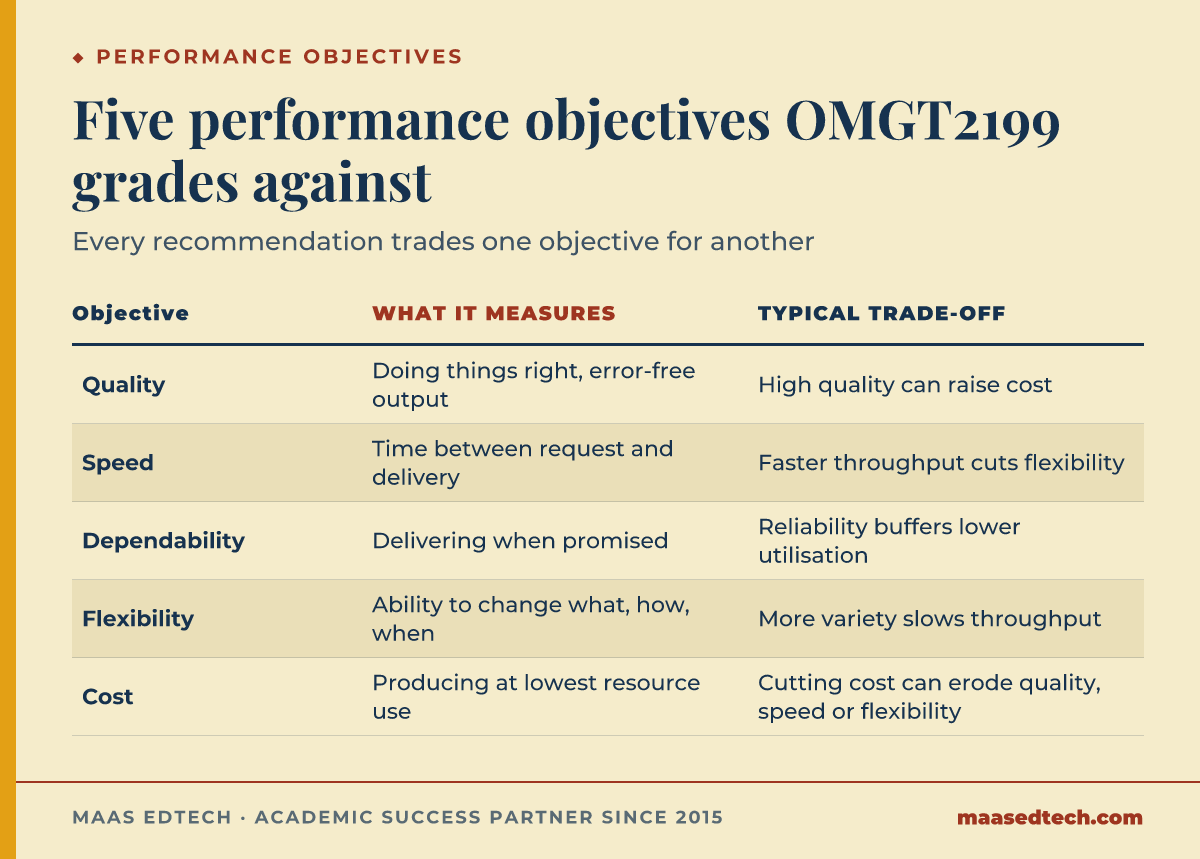
| Performance objective | What it measures | Typical trade-off tension |
|---|---|---|
| Quality | Doing things right, error-free products and services | High quality can raise cost if pursued without process control |
| Speed | Time between request and delivery | Faster throughput may reduce flexibility or raise inventory cost |
| Dependability | Delivering when promised | Building in reliability buffers can lower utilisation |
| Flexibility | Ability to change what, how much, or when | More variety and change usually cost more and slow throughput |
| Cost | Producing at the lowest resource use | Cutting cost too hard erodes quality, speed, or flexibility |
Evidence: Slack, Brandon-Jones and Burgess (2022) present the input-transformation-output model, the four Vs typology, and the five performance objectives as the core diagnostic lenses of operations management; Terry Hill's order winners and qualifiers distinction links operations priorities to market requirements (Hill, 2000). These are foundational, examiner-recognised sources, not blog-level references.
Example: A Vietnamese RMIT student analysing a coffee-chain operation tried to apply five tools at once and explained each shallowly. Her MAAS mentor cut it to two: the four Vs to show why the chain's high-variety menu drove complexity, and the performance-objective trade-offs to argue why chasing speed had quietly eroded consistency. Fewer tools, deeper application, higher mark.
How should you structure the OMGT2199 report?
Direct answer: Use an operations-led structure: (1) a brief introduction and case-company context (keep it under 10% of the word count), (2) a map of the operation using the input-transformation-output model, (3) a diagnosis of the specific performance problem using your chosen frameworks, (4) evidence-based recommendations with their trade-offs acknowledged, and (5) a conclusion. The single biggest structural fix is shrinking the description sections and expanding the diagnosis and recommendation sections, where the marks concentrate.
Evidence: Criterion-referenced rubrics weight "analysis and application" and "recommendations and justification" far above "context and background". Structuring your word budget to match the rubric weighting is the most reliable way to lift a grade without new research.
Example: A Vietnamese RMIT student submitted a draft with a long company profile and a two-sentence recommendations section. His MAAS mentor inverted the ratio, cutting the profile and developing three specific, costed recommendations tied directly to the diagnosed bottleneck. The final report, same case and same sources, moved from a borderline Credit to a clear Distinction because the recommendations were finally detailed enough to be assessed.
What are the most common mistakes that lose marks in OMGT2199?
Direct answer: Three recurring mistakes show up across MAAS operations-coaching engagements. First, students describe the operation instead of analysing it; the company profile crowds out the argument. Second, students use frameworks as labels rather than tools; they name the four Vs or the performance objectives but never use them to reach a judgement about the operation. Third, recommendations are generic ("the company should improve efficiency") rather than specific, quantified, and tied to the diagnosis, with their trade-offs ignored. Fixing these three lifts most drafts by at least one rubric band.
Evidence: Because operations performance objectives trade off against each other, a recommendation that ignores the trade-off it triggers reads as naive to an examiner. Slack, Brandon-Jones and Burgess (2022) stress that operations decisions are choices among competing priorities, so a Distinction-level answer names the cost of its own recommendation, not just the benefit.
Example: A Vietnamese student recommended that a manufacturer "increase automation to cut costs" without noting that it would reduce the flexibility the firm relied on for its custom orders. His MAAS mentor asked one question, "what does this recommendation cost the operation elsewhere?", and the revised version, which weighed cost savings against lost flexibility, read as genuine operations judgement.
How can Vietnamese students at RMIT do well in OMGT2199?
Direct answer: Treat every part of the assignment as a chance to analyse a decision, not to report a fact. Map the operation early with the input-transformation-output model so you can see where the problem sits, choose two or three frameworks that genuinely fit, and spend most of your word count on diagnosis and recommendations.
Confirm your referencing style (RMIT business courses default to RMIT Harvard) and use RMIT's Easy Cite tool to keep entries consistent. If English academic writing is the barrier rather than the operations content, that is exactly where structured mentoring helps most.
Evidence: Operations management is conceptually demanding rather than mathematically hard at undergraduate level; the marks reward reasoning about design and improvement, which is a writing-and-judgement task as much as a technical one. Vietnamese students who read the rubric as an argument brief, rather than a content checklist, tend to close the gap to the top bands quickly.
Example: A Vietnamese RMIT Vietnam student worried her English would cap her mark. Her MAAS mentor showed her that the examiner was rewarding the logic of her operations analysis, not sentence polish, and coached her to lead each paragraph with a claim and then defend it. Her clarity, and her mark, rose together.
Frequently asked questions
Is OMGT2199 a hard course?
It is conceptually demanding rather than technically hard; there is little heavy maths at this level, but the course expects you to analyse and improve operations rather than memorise definitions. Students who treat it as "describe how a company operates" struggle; students who treat it as "diagnose and improve an operation" do well.
Can I use a well-known company as my case for OMGT2199?
Yes, large, well-documented organisations work well because there is enough public information to analyse. The risk is spending too long on company background. Pick a firm with a clear operations problem you can diagnose, not just a famous name.
How many frameworks should I use in the assignment?
Two or three, applied deeply, beats five applied shallowly. Examiners reward critical application, using a framework to reach a judgement about the operation, not the number of models you can list.
What referencing style does OMGT2199 use?
RMIT Harvard is the default for RMIT business and operations courses. Always confirm in your own brief, and use RMIT's Easy Cite tool to format entries consistently.
Do I need real numbers for the operations analysis?
Where you can find or reasonably estimate data (throughput, lead time, defect rates, capacity), use it, because quantified analysis and quantified recommendations score higher than qualitative claims. State your assumptions clearly when exact figures are not public.
Can MAAS help me with OMGT2199?
Yes. MAAS Assignment & Essay Support coaches you through the assignment with the Outline to Draft to Final model, rubric decoding, framework selection, draft feedback, and a pre-submission referencing audit, all with discipline-matched experts. We coach your work; we do not write it for you.
Ready to approach OMGT2199 with a clear strategy?
If you have the case company but not the diagnosis, that is exactly where a discipline-matched expert helps most. MAAS Assignment & Essay Support is an academic support partner; we work alongside you through Outline to Draft to Final so the analysis stays yours and the structure earns the marks.
Bring your OMGT2199 brief and we will match you to an Operations and Supply Chain mentor, 23% of our 100+ experts hold a PhD, within 48 hours when our network already covers that field. If it does not, MAAS opens a dedicated recruitment round for your case, which usually takes about two weeks.
Book a free 15-minute OMGT2199 consultation with MAAS Assignment & Essay Support →
Related guides
- BUSM4187 assignment: how do you approach International Human Resource Management?: sibling RMIT business guide on applying theory to a real multinational
- How to write a methodology in an essay: for the analytical-rigour half of any operations report
- How to write a theoretical framework: for applying operations frameworks with academic depth
- MAAS Academic Mentoring service: 1:1 coaching with PhD-level mentors in your discipline
- Tutoring service: 1:1 subject tutoring in 60- or 90-minute sessions with an expert matched on your course code, always inside your discipline
- Course-code assignment coaching: pillar guide on tackling any unit assignment with a MAAS mentor
References
- Abbas, A., & Goosheh, S. (2024). Operations management. Fanshawe College Pressbooks.
- Hill, T. (2000). Manufacturing strategy: Text and cases (2nd ed.). Palgrave Macmillan.
- Krajewski, L. J., Malhotra, M. K., & Ritzman, L. P. (2019). Operations management: Processes and supply chains (12th ed.). Pearson.
- Slack, N., Brandon-Jones, A., & Burgess, N. (2022). Operations management (10th ed.). Pearson.
Tools & resources
- RMIT University. (n.d.). Assessment and exams. Retrieved July 22, 2026, from https://www.rmit.edu.au/students/student-essentials/assessment-and-exams
- RMIT University. (n.d.). Easy Cite referencing tool. Retrieved July 22, 2026, from https://www.rmit.edu.au/library/study/referencing
This article is part of the MAAS Journal series for Vietnamese international students. MAAS Assignment & Essay Support is an academic support partner; we coach students through the Outline to Draft to Final delivery model with developmental feedback from discipline-matched experts. We do not write or submit work on a student's behalf.