
LAW2447 Business Law asks you to apply legal principles to a set of facts and reach a reasoned conclusion, and the rubric rewards application over reciting the law. Most students who struggle with this RMIT course are not short on effort: they can state the rules of contract or negligence accurately but never apply them to the facts, where the marks live. This guide answers the seven questions Vietnamese students at RMIT ask MAAS mentors most often.
Author: MAAS Editorial Team
Last updated: 2026-07-22
Category: law

What is LAW2447 Business Law about?
Direct answer: LAW2447 is an RMIT law course, offered at RMIT Vietnam Saigon South, that introduces the legal principles most relevant to business, covering contract, negligence, the Australian Consumer Law, and business structures. It is a compulsory core course in the Bachelor of Business that wants you to apply rules to a scenario like a lawyer advising a business, not memorising definitions.
Evidence: The standard method for this is IRAC (Issue, Rule, Application, Conclusion), the problem-solving structure used across Australian law schools, including RMIT's own guidance. It exists precisely because a good legal answer is not a summary of the law; it is a structured application of the law to a specific set of facts.
Example: A Vietnamese student at RMIT Vietnam came to MAAS convinced Business Law was "memorising legal rules". Her MAAS mentor reframed it: the course rewards using those rules to solve a problem. Once she stopped writing everything she knew about contract law and started applying only the relevant elements to the facts in front of her, her answers became focused and her marks rose.
What assessment does the LAW2447 assignment usually involve?
Direct answer: Business law courses at this level are typically assessed through a problem-based assignment (a hypothetical scenario you analyse using IRAC), sometimes paired with a shorter essay or an exam. You are usually given a fact situation, for example a disputed contract or a possible negligence claim, and asked to advise a party on their legal position. Always confirm the exact brief, weighting, and required format in your own Canvas shell, because assessment structure changes by semester and campus.
Evidence: Legal problem questions are marked on how well you identify the issues and apply the law, not on how much law you can recall. A well-applied answer that reaches a defensible conclusion outscores a longer answer that recites rules without applying them.
Example: A Vietnamese RMIT student wrote three pages summarising everything he knew about the elements of a contract before barely addressing the actual dispute. His MAAS mentor cut the general summary and rebuilt the answer around the two contested elements, applying each to the facts. Same knowledge, same case; the applied version earned a far higher mark.
How is the LAW2447 assignment graded, and what does the rubric reward?
Direct answer: Business law rubrics at this level reward four things, roughly in this order: (1) correct identification of the legal issues raised by the facts, (2) application of the relevant law to those facts, (3) accurate use of legislation and case authority, and (4) legal writing and citation. Stating a rule earns some marks, but the largest share sits in the application, showing how the rule operates on these particular facts. If you can turn a statement of law into an application to the facts, do it every time.
Evidence: In IRAC, the "A" (Application) is typically where most marks are awarded, because it is where legal reasoning actually happens. Students commonly write strong Issue and Rule sections and then a thin Application, which is the single most common reason a competent answer stays at a pass rather than reaching a distinction.
Example: A MAAS mentor mapped one Vietnamese student's answer against IRAC and found the Rule section was three times longer than the Application. After rebalancing, moving detail out of Rule and into a fact-by-fact Application, the same authorities produced a clearly stronger answer, because the reasoning was finally visible.
Which legal method and areas should you use in LAW2447?
Direct answer: Structure every problem answer with IRAC, and anchor your rules in the core areas the course covers: contract law (offer, acceptance, consideration, intention, terms, breach and remedies), negligence (duty of care, breach, causation, damage), and the Australian Consumer Law (misleading or deceptive conduct and consumer guarantees), the same coverage set out in the standard Australian business law texts (Gibson, 2025; Latimer, 2020). Apply only the areas the facts actually raise; do not write everything you know about every topic.
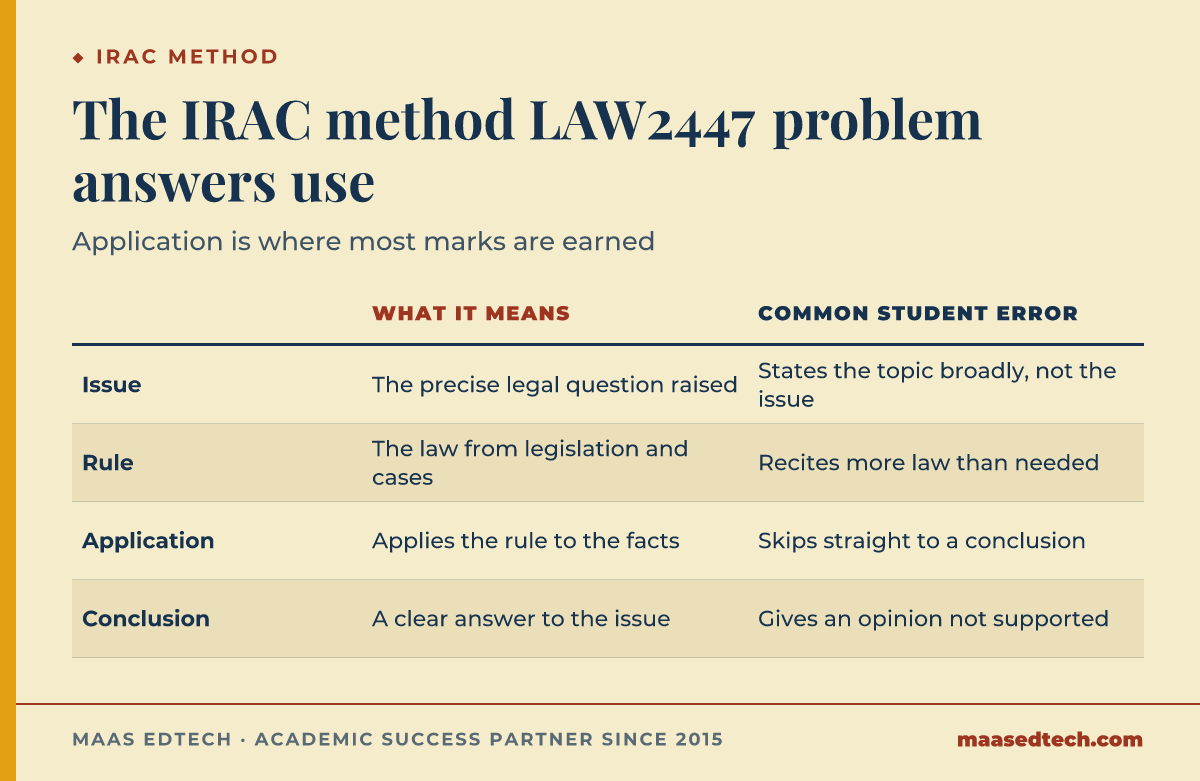
| IRAC step | What it means | Common student error |
|---|---|---|
| Issue | The precise legal question the facts raise | Stating the topic broadly instead of the specific issue |
| Rule | The relevant law from legislation and cases | Reciting far more law than the issue requires |
| Application | Applying the rule to these exact facts | Skipping straight to a conclusion without reasoning |
| Conclusion | A clear answer to the issue, based on the application | Giving an opinion the application did not support |
Evidence: IRAC is the problem-solving methodology recognised across Australian law study, and each of the substantive areas has foundational authority: negligence rests on the duty of care established in Donoghue v Stevenson [1932] AC 562, and consumer protection rests on the Australian Consumer Law in Schedule 2 of the Competition and Consumer Act 2010 (Cth). Citing the actual case and section, rather than a textbook paraphrase, is what earns the authority marks.
Example: A Vietnamese RMIT student analysing a negligence scenario listed every negligence case she had read. Her MAAS mentor cut it to the specific authorities the facts required, then applied each element (duty, breach, causation, damage) to the scenario in turn. Fewer authorities, applied precisely, a stronger answer.
How should you structure the LAW2447 answer?
Direct answer: For a problem question, structure the whole answer with IRAC, and repeat the cycle for each separate legal issue the facts raise: identify the issue, state the relevant rule with authority, apply it to the facts, and conclude, then move to the next issue. Keep the Rule sections tight and let the Application carry the length. For an essay task, use a standard argumentative structure but still support every point with legislation or case authority.
Evidence: Marking rubrics for legal problems weight issue-spotting and application far above rule-statement. Structuring your answer so that each issue gets a full IRAC cycle is the most reliable way to make sure the marks in each section are actually available to you.
Example: A Vietnamese RMIT student wrote one long undivided answer that mixed three issues together, making it hard to follow. His MAAS mentor split it into three IRAC cycles, one per issue. The content barely changed, but the marker could now see each issue analysed in turn, and the mark moved up two bands.
What are the most common mistakes that lose marks in LAW2447?
Direct answer: Three recurring mistakes show up across MAAS business law coaching engagements. First, students recite the law instead of applying it; the Rule section swallows the answer and the Application is thin. Second, students fail to cite primary authority, referring to "the law says" rather than to the actual case or section. Third, students give a conclusion the application did not support, or no clear conclusion at all. Fixing these three lifts most answers by at least one band.
Evidence: Because legal reasoning is assessed in the Application step, an answer that never applies the rule to the facts cannot reach the higher bands, however accurate its statement of law. Citing Donoghue v Stevenson or the specific ACL provision, rather than a general paraphrase, is also what distinguishes a legally literate answer from a summary.
Example: A Vietnamese student concluded that a business had breached a contract without ever applying the terms to what each party actually did. His MAAS mentor asked, "which fact satisfies each element, and which does not?", and the revised answer, which worked through the facts element by element, reached a conclusion the reasoning could actually support.
How can Vietnamese students at RMIT do well in LAW2447?
Direct answer: Learn IRAC and use it for every problem, spend most of your words on Application rather than Rule, and cite the actual cases and legislation the facts require. Read the scenario carefully to spot every issue, and deal with each one separately.
Confirm your referencing style in your course brief, because legal work may use the Australian Guide to Legal Citation (AGLC) rather than a Harvard style, and citing authority correctly earns marks. If English legal writing is the barrier rather than the law itself, that is exactly where structured mentoring helps most.
Evidence: Business law rewards a shift from stating the law to applying it, which is a reasoning-and-writing skill as much as knowledge of the rules. Vietnamese students who read the assignment as "advise this party using the law", rather than "explain the law", tend to reach the higher bands quickly.
Example: A Vietnamese RMIT Vietnam student worried her English would cap her mark. Her MAAS mentor showed her that the examiner was rewarding the reasoning in her Application, not elegant sentences, and coached her to write "applying [the rule] to these facts..." before every conclusion. Her clarity, and her mark, rose together.
Frequently asked questions
Is LAW2447 a hard course?
It is conceptually demanding rather than technically hard; there is no maths, but applying legal rules to facts is a genuine skill. Students who treat it as "memorise the law" struggle; students who treat it as "solve a legal problem using the law" do well.
What is IRAC and do I have to use it?
IRAC stands for Issue, Rule, Application, Conclusion, and it is the standard structure for answering legal problem questions in Australian courses. Even if your brief does not name it, using it makes your reasoning clear to the marker, and the Application step is typically where most marks are.
Do I need to cite real cases and legislation?
Yes. Legal answers are stronger when they cite primary authority, the actual case (such as Donoghue v Stevenson for negligence) and the actual section of legislation (such as the Australian Consumer Law). Paraphrasing a textbook without citing the source loses authority marks.
What referencing style does LAW2447 use?
Confirm in your course brief. Australian legal work commonly uses the Australian Guide to Legal Citation (Melbourne University Law Review Association, 2018), a footnote style, though some business courses use a Harvard style. As the guide's own preface states, the AGLC "remains the authoritative legal citation guide within Australia and is widely used by practitioners, law students and academics alike" (Melbourne University Law Review Association, 2018, p. x). Whichever applies, cite legislation and cases correctly, as legal citation has its own conventions.
How do I write a strong Application section?
Take each element of the rule and match it to a specific fact in the scenario, stating whether that element is satisfied and why. Deal with the arguments on both sides where the facts are contested, then conclude. The Application should be the longest part of your answer.
Can MAAS help me with LAW2447?
Yes. MAAS Assignment & Essay Support coaches you through the assignment with the Outline to Draft to Final model, rubric decoding, IRAC structuring, draft feedback, and a pre-submission citation audit, all with discipline-matched experts. We coach your work; we do not write it for you.
Ready to approach LAW2447 with a clear strategy?
If you know the rules but struggle to apply them to the facts, that is exactly where a discipline-matched expert helps most. MAAS Assignment & Essay Support is an academic support partner; we work alongside you through Outline to Draft to Final so the analysis stays yours and the structure earns the marks.
Bring your LAW2447 brief and we will match you to a Business Law mentor, 23% of our 100+ experts hold a PhD, within 48 hours when our network already covers that field. If it does not, MAAS opens a dedicated recruitment round for your case, which usually takes about two weeks.
Book a free 15-minute LAW2447 consultation with MAAS Assignment & Essay Support →
Related guides
- BLAW10001 Principles of Business Law assignment guide: the University of Melbourne introductory subject covering the same contract, tort and consumer law ground
- BUSM4187 assignment: how do you approach International Human Resource Management?: sibling RMIT business guide on applying theory to a real organisation
- OMGT2199 at RMIT: how do you approach Operations Management?: sibling RMIT business course guide on analysing an operation
- How to write a methodology in an essay: for the analytical-rigour half of any assignment
- How to write a theoretical framework: for applying frameworks with academic depth
- MAAS Academic Mentoring service: 1:1 coaching with PhD-level mentors in your discipline
- Tutoring service: 1:1 subject tutoring in 60- or 90-minute sessions with an expert matched on your course code, always inside your discipline
- Course-code assignment coaching: pillar guide on tackling any unit assignment with a MAAS mentor
References
- Gibson, A. (2025). Business law (12th ed.). Pearson Australia.
- Latimer, P. (2020). Australian business law. CCH Australia.
- Melbourne University Law Review Association. (2018). Australian guide to legal citation (4th ed.).
Tools & resources
- RMIT University. (n.d.). 002917 Business Law course guide. Retrieved July 22, 2026, from https://www.rmit.edu.au/study-with-us/levels-of-study/course-guides/002/002917
- RMIT University. (n.d.). Answering a legal problem: IRAC. Retrieved July 22, 2026, from https://www.rmit.edu.au/students/study-support
- RMIT University. (n.d.). Easy Cite referencing tool. Retrieved July 22, 2026, from https://www.rmit.edu.au/library/study/referencing
This article is part of the MAAS Journal series for Vietnamese international students. MAAS Assignment & Essay Support is an academic support partner; we coach students through the Outline to Draft to Final delivery model with developmental feedback from discipline-matched experts. We do not write or submit work on a student's behalf.