
◆ Law
LAWS2012: property is not a thing, and that is the examinable part
Almost every property problem asks who owns something, and almost none of them are answered by naming an owner. The question is really asking which of several competing interests ranks first, against whom, and why the law sorts them in that order. Students who keep looking for the owner write confident answers that never engage the issue. Students who look for the ranking find that the doctrine they were taught is a machine built to produce exactly that.

◆ Section 1 / 9 · Which LAWS2012
First, check which LAWS2012 you are enrolled in
Direct answer: Two Australian law schools use this code for property units with different scope. At the University of Sydney it is Property and Commercial Law, extending into personal property and security interests under the Personal Property Securities Act 2009 (PPSA). At Southern Cross University it is Property Principles, concentrating on real property interests such as leases, mortgages, easements and covenants.
Evidence: The overlap is real, which is what makes the difference easy to miss. Both cover foundational property concepts. The Sydney unit runs further into commercial territory, taking in personal property and security interests under the Personal Property Securities Act 2009 (PPSA), while the Southern Cross unit concentrates on real property interests such as leases, mortgages, easements and covenants.
Example: A student used a friend's notes from another university and prepared thoroughly for easements and covenants. The problem question turned on a security interest in goods. Nothing in the notes was wrong. The unit was different.
This guide covers the University of Sydney unit. If you are at Southern Cross, the first half will still be useful and the commercial half will not apply.
◆ Section 2 / 9 · The Sydney unit
What does the Sydney unit actually cover?
Direct answer: LAWS2012 Property and Commercial Law is a 6 credit point undergraduate unit in Sydney Law School. The prerequisite is LAWS1015 or LAWS1026, and it is prohibited against LAWS5008. The published description covers real property topics including tenure, estates, native title and fixtures, together with personal property matters involving ownership, possessory interests and security interests under the Personal Property Securities Act 2009 (PPSA).
Evidence: The description then names what LAWS2012 does with that material, which is analysing legal and equitable interests, their creation, their assignment and their priority ranking, while developing statutory interpretation and problem-solving skills. Read that list as a sequence rather than as topics. Creation asks whether an interest exists. Assignment asks whether it moved. Priority asks who wins. Most problem questions walk that sequence, and most weak answers stop after the first step.
Example: Asked about a disputed interest in land, a weaker answer established that an equitable interest had been created and concluded there. A stronger one established the same thing in two sentences and spent the rest of the answer on whether it survived against a later purchaser. The first answer was correct and unfinished.
◆ Section 3 / 9 · Who owns it
Why does "who owns it" almost never answer the question?
Direct answer: Because property in law is a set of relations between people with respect to a thing, not a relation between a person and a thing. Once you see that, the question stops being "whose is it" and becomes "what can this person assert, against whom, and what happens when two assertions collide".
Evidence: Hohfeld (1913) made this precise a century ago by breaking legal relations into correlative pairs, so that a right in one person is always a duty in another and a power in one is always a liability in another. That analysis is why an answer that says a person "owns" something has not yet said anything examinable. Ownership is a bundle of those relations, and property disputes are almost always about one strand of the bundle rather than the whole of it.
Example: Two students answered a fixtures problem. One concluded that the item belonged to the landowner. The other said the same thing and then identified whose claim that defeated, which right the tenant had lost, and what the tenant could still assert. The second answer was three sentences longer and a band higher.
◆ Section 4 / 9 · What the problem asks
What is the problem really asking?
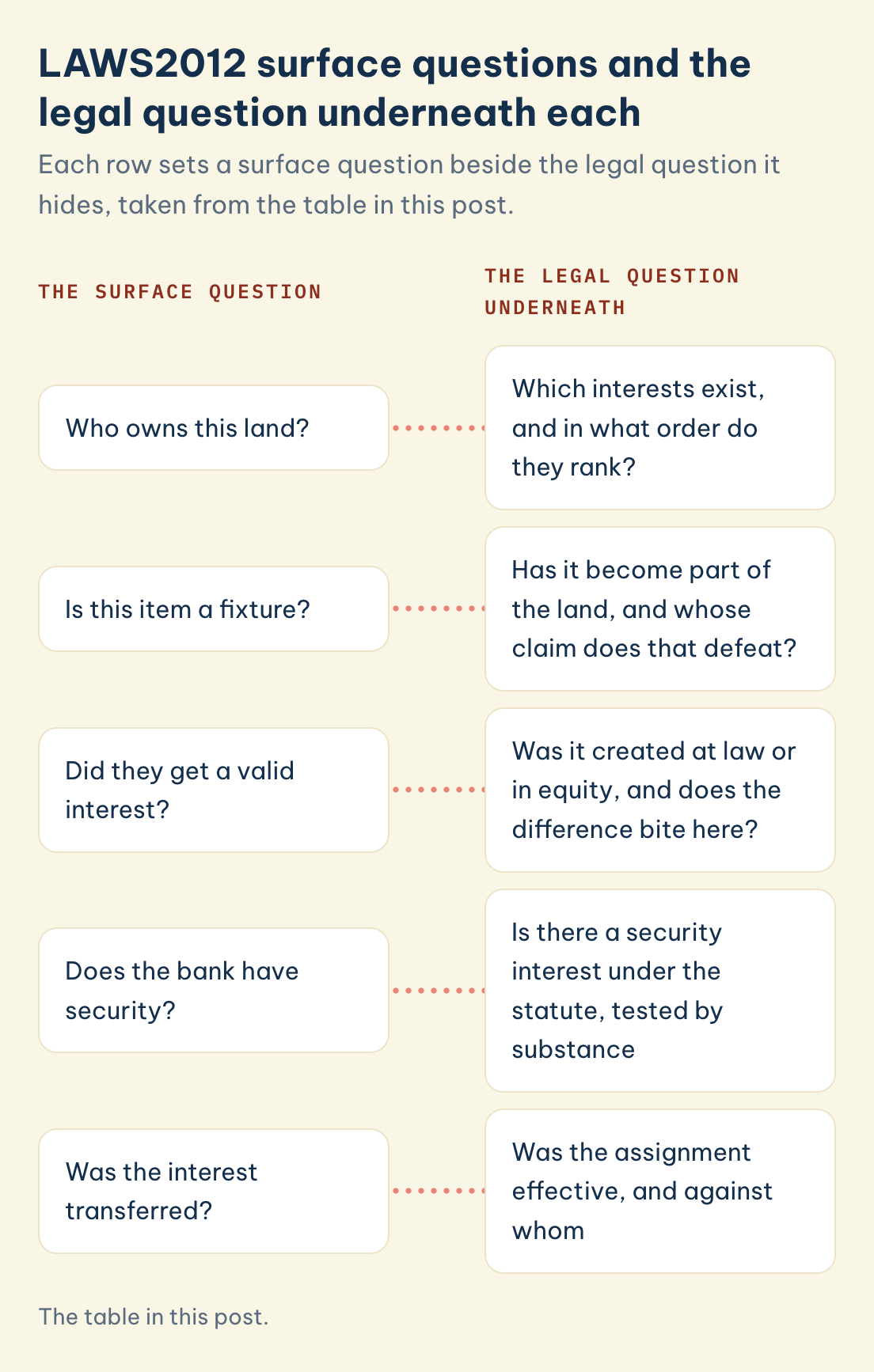
Direct answer: Every surface question, such as who owns this land or is this item a fixture, hides a legal question about which interests exist, in what order they rank, and whose claim defeats whose. The marks sit in applying the priority rules, the annexation test or the PPSA's functional test to the specific facts, not in naming an owner.
LAWS2012 surface questions and the legal question underneath each
Each row sets a surface question beside the legal question it hides, taken from the table in this post.
The surface question
The legal question underneath
Who owns this land?
Which interests exist, and in what order do they rank?
Is this item a fixture?
Has it become part of the land, and whose claim does that defeat?
Did they get a valid interest?
Was it created at law or in equity, and does the difference bite here?
Does the bank have security?
Is there a security interest under the statute, tested by substance
Was the interest transferred?
Was the assignment effective, and against whom
Save this figure
| The surface question | The legal question underneath | Where the marks are |
|---|---|---|
| Who owns this land? | Which interests exist, and in what order do they rank? | Applying the priority rules to these facts |
| Is this item a fixture? | Has it become part of the land, and whose claim does that defeat? | Degree and object of annexation, argued both ways |
| Did they get a valid interest? | Was it created at law or in equity, and does the difference bite here? | Naming why the distinction matters on these facts |
| Does the bank have security? | Is there a security interest under the statute, tested by substance | Applying the functional test rather than the label |
| Was the interest transferred? | Was the assignment effective, and against whom | Formality requirements and notice |
◆ Section 5 / 9 · Closed list of interests
Why can you not simply invent a new kind of interest?
Direct answer: Because property law recognises interests only in a closed list of standard forms. Parties can agree to almost anything between themselves, but they cannot create a novel category of property right that binds the rest of the world. This is a real constraint and students regularly write around it without noticing.
Evidence: Merrill and Smith (2000) set out the reasoning behind that closed list, the numerus clausus principle, arguing that standardising the forms of property interests reduces the information costs imposed on third parties who must investigate them. As they put it, "when property rights are created, third parties must expend time and resources to determine the attributes of these rights, both to avoid violating them and to acquire them from present holders" (Merrill & Smith, 2000, p. 8). The argument is useful in an exam because it converts a rule you might have memorised into a reason you can deploy. If a novel arrangement would force every future purchaser to investigate an unlimited range of possible claims, that is precisely the cost the principle exists to prevent.
Evidence, second layer: Merrill and Smith (2001) argue separately that the analytical tradition has drifted towards treating property as merely a bundle of contractual relations, which loses sight of what makes property rights good against the world rather than against a counterparty. That distinction between rights in rem and rights in personam is the one doing the work whenever a problem introduces a third party, and third parties appear in almost every property problem for exactly that reason.
Example: Asked whether an unusual arrangement gave the claimant a proprietary interest, a weaker answer said the parties clearly intended it to. A stronger one accepted the intention, then asked whether the law recognises an interest of that shape at all, and said what the parties could have used instead to achieve the same commercial result.
◆ Section 6 / 9 · The history
Why is the history examinable?
Direct answer: Because one of LAWS2012's stated learning outcomes asks you to synthesise knowledge of property and commercial law history alongside the rules. That is not decoration. In property, several current doctrines are only legible as history, and applying them without it produces answers that are technically right and shallow.
Evidence: Tenure and estates are the clearest case. The proposition that all land is held of the Crown, and that what a person owns is an estate in land rather than the land itself, is a feudal inheritance that no one would design today, and it still determines how interests are described and ranked. Native title sits in a genuinely difficult relation to that structure, because it is a set of rights recognised by the common law rather than granted by it, arising from traditional laws and customs that predate the legal system doing the recognising. The recognition of native title in Mabo v Queensland (No 2) (1992) required the High Court of Australia to work out what the doctrine of tenure could and could not entail. Parliament responded by enacting the Native Title Act 1993 (Cth), which now sits alongside the common law doctrine the case established. Land registration in every Australian state instead runs on the Torrens title system, a separate statutory framework students often confuse with the tenure doctrine itself. A student who has learned tenure only as a formula has nothing to say about that.
Example: Asked to explain why Australian law speaks of estates rather than of owning land outright, a weaker answer described the difference. A stronger one explained what the tenure doctrine was originally doing, why the estate concept follows from it, and what the persistence of that framework makes difficult when the law confronts interests that arose outside it.
◆ Section 7 / 9 · The commercial half
What changes when the unit moves to the commercial half?
Direct answer: The method of classification changes. Older security law asked what form a transaction took, which meant that economically identical arrangements attracted different rules depending on the label. The Personal Property Securities Act 2009 (PPSA) replaced that with a functional test, asking in substance whether a transaction secures payment or performance of an obligation.
Evidence: Bozzi (2020) sets out how the PPSA draws together previously separate devices under a single concept of a security interest, with one registration regime and a common set of priority rules. The practical consequence for your answers is that the first move on a commercial problem is not to name the transaction. It is to ask what the arrangement does. A lease of goods, a retention of title clause and a charge may all fall inside the statutory concept, and reasoning from the label will send you to the wrong rules.
Example: A student identified an arrangement as a lease and concluded that the security provisions did not apply. The arrangement secured payment in substance. The label was accurate and the classification was wrong, which is exactly the error the reform was designed to eliminate.
◆ Section 8 / 9 · Problem answers
What does a problem answer need that an essay does not?
Direct answer: A visible route. The learning outcome about communicating logically structured written legal arguments is assessed on whether the marker can follow the path from facts to conclusion, not on whether the conclusion is one they would have reached.
Evidence: The most common structural failure is answering the question in the first line and then justifying it, which reads as assertion even when the reasoning underneath is sound. The second is treating an arguable point as settled. Where the authorities pull in different directions, saying so and choosing is worth more than a confident answer that hides the difficulty, because the outcome asks you to critically analyse rather than to report.
Example: Vietnamese students on Australian law units often have precise doctrinal knowledge and lose marks on structure, because the expected form of legal argument here is more explicit than in many other systems. The useful fix is mechanical rather than intellectual: run the IRAC structure explicitly for each issue, write the rule, apply it to the specific facts you were given, name the counter-argument, and then conclude. Nothing about the knowledge changes and the mark moves.
◆ Section 9 / 9 · Order of work
A practical order of work
Direct answer: Read the problem twice, once for facts and once for dates, then list every interest anyone might claim before analysing any of them. For each interest, ask in order whether it was created, whether it moved and where it ranks. Test the substance under the PPSA before accepting the label, then argue both sides before deciding.
- Read the problem twice, once for the facts and once for the dates. Priority disputes are usually decided by sequence.
- List every interest anyone might claim before analysing any of them. Missing a party is more costly than mis-analysing one.
- For each interest, ask three questions in order. Was it created, did it move, and where does it rank?
- On commercial facts, test the substance under the PPSA before accepting the label. Ask what the arrangement secures.
- Where LAWS2012 has taught a doctrine's history, use it to explain why the rule takes the shape it does rather than restating the rule.
- Argue both sides on anything genuinely arguable, then decide. An unhedged conclusion on a contested point reads as a missed issue.
Frequently asked questions
Which university does this guide cover?
The University of Sydney, where LAWS2012 is Property and Commercial Law, a 6 credit point Sydney Law School unit. Southern Cross University uses the same code for Property Principles, which has a narrower scope, so confirm the unit description before relying on material found by code.
What do I need to have completed first?
The published prerequisite is LAWS1015 or LAWS1026, and LAWS2012 is prohibited against LAWS5008. Requirements are restated each year, so check the Sydney Law School entry for your own year of enrolment.
Is this unit mostly land law?
Real property is a large part of it, but LAWS2012 also covers personal property, possessory interests and security interests under the Personal Property Securities Act 2009 (PPSA). Preparing only for land law leaves the commercial half unattended.
How much history do I need to know?
Enough to explain why a doctrine has the shape it does. A learning outcome names history explicitly, which means it is available to be assessed rather than offered as background reading.
What is the difference between a legal and an equitable interest for exam purposes?
It usually matters at priority. Knowing the definitional difference is the starting point, and the marks sit in showing when the distinction changes the outcome on the facts in front of you.
Should I cite cases in a problem answer?
Yes, and briefly, using the Australian Guide to Legal Citation (AGLC), the referencing standard used across every Australian law school, including Sydney Law School. A case is cited for the proposition it supplies, so name the proposition and move to the facts. Long case narration consumes words that the application section needs.
Related reading
- BLAW10001 Principles of Business Law assignment guide: the University of Melbourne introductory subject that uses the same IRAC method
- LAWS123: why do study notes for this course quietly go out of date?
- LAWS212: is your employment law answer citing the right year?
- LAWS5180: who owns the work when a machine helped make it?
Ask a MAAS mentor about your unit
Where MAAS fits
MAAS mentors work alongside students on units like this rather than in place of them. In property law the most useful review is often a structural one: reading a problem answer back to check that every interest was listed before any was analysed, that each issue moved from rule to these facts rather than to facts in general, and that arguable points were argued rather than resolved by assertion. Students commonly find their doctrine was accurate and their route was invisible to the marker. The work stays yours. If that is useful, our academic support service and our tutoring service are the two places to start.
References
Bozzi, C. (2020). Personal Property Securities Act. In Australian commercial law (pp. 217–256). Cambridge University Press. https://doi.org/10.1017/9781108629003.013
Hohfeld, W. N. (1913). Some fundamental legal conceptions as applied in judicial reasoning. The Yale Law Journal, 23(1), 16. https://doi.org/10.2307/785533
Merrill, T. W., & Smith, H. E. (2000). Optimal standardization in the law of property: The numerus clausus principle. The Yale Law Journal, 110(1), 1. https://doi.org/10.2307/797586
Merrill, T. W., & Smith, H. E. (2001). What happened to property in law and economics? The Yale Law Journal, 111(2), 357. https://doi.org/10.2307/797592
Tools & resources
Personal Property Securities Act 2009 (Cth). Federal Register of Legislation. https://www.legislation.gov.au/C2009A00130/latest/text
The University of Sydney. (2026). LAWS2012: Property and Commercial Law. https://www.sydney.edu.au/units/LAWS2012
- LAWS2010 administrative law: writing the research essay for the Sydney unit that sits alongside this one.
A free 20-minute consultation is a conversation about where you are with LAWS2012.
Book a free consultation ▸