
◆ Law
LAWS2010: how do you write the administrative law research essay?
Students who lose marks in LAWS2010 usually know the cases. What they have not yet learned is that an administrative law essay is graded on whether it took a position a reasonable person could disagree with. Restating what the High Court held is the raw material of the essay; it is not the essay.

◆ Question 1 / 7 · The unit
What is LAWS2010, and which university is it at?
Direct answer: LAWS2010 Administrative Law is a 6 credit point unit at Sydney Law School, the University of Sydney, with LAWS1021 listed as its prerequisite. Its stated outcomes cover judicial review principles, the jurisdiction of courts, statutory review mechanisms including merits review and ombudsman review, and the political and legal structures governing administrative law in Australia.
Evidence: The code is not unique across the sector, and that trips students up before they read a single case. Southern Cross University runs a unit under the same LAWS2010 code covering environmental law, and the legacy University of New South Wales handbook carried LAWS2010 as Business Associations 1. Three different subjects share one string of characters, so a set of notes downloaded from a study-sharing site can be entirely accurate and entirely useless to you. The prerequisite code carries the same risk, since UNSW runs its own course under that code, covered in our guide to LAWS1021 Crime and the Criminal Process. Sydney's own published outcomes are explicit that the unit asks you to "apply relevant legal research methodologies" to "respond critically and innovatively to administrative law questions", and the word doing the work in that sentence is critically.
What to do about it: in week 1, open the unit of study outline for your own semester on the Canvas site and write down 4 things: the weighting of each assessment item, the word limit for the research essay, the prescribed citation style, and whether any component carries a hurdle. That takes about 20 minutes. Never plan a semester from a study-notes site, because it may be describing a different university's unit entirely.
◆ Question 2 / 7 · Judicial and merits review
What is the difference between judicial review and merits review?
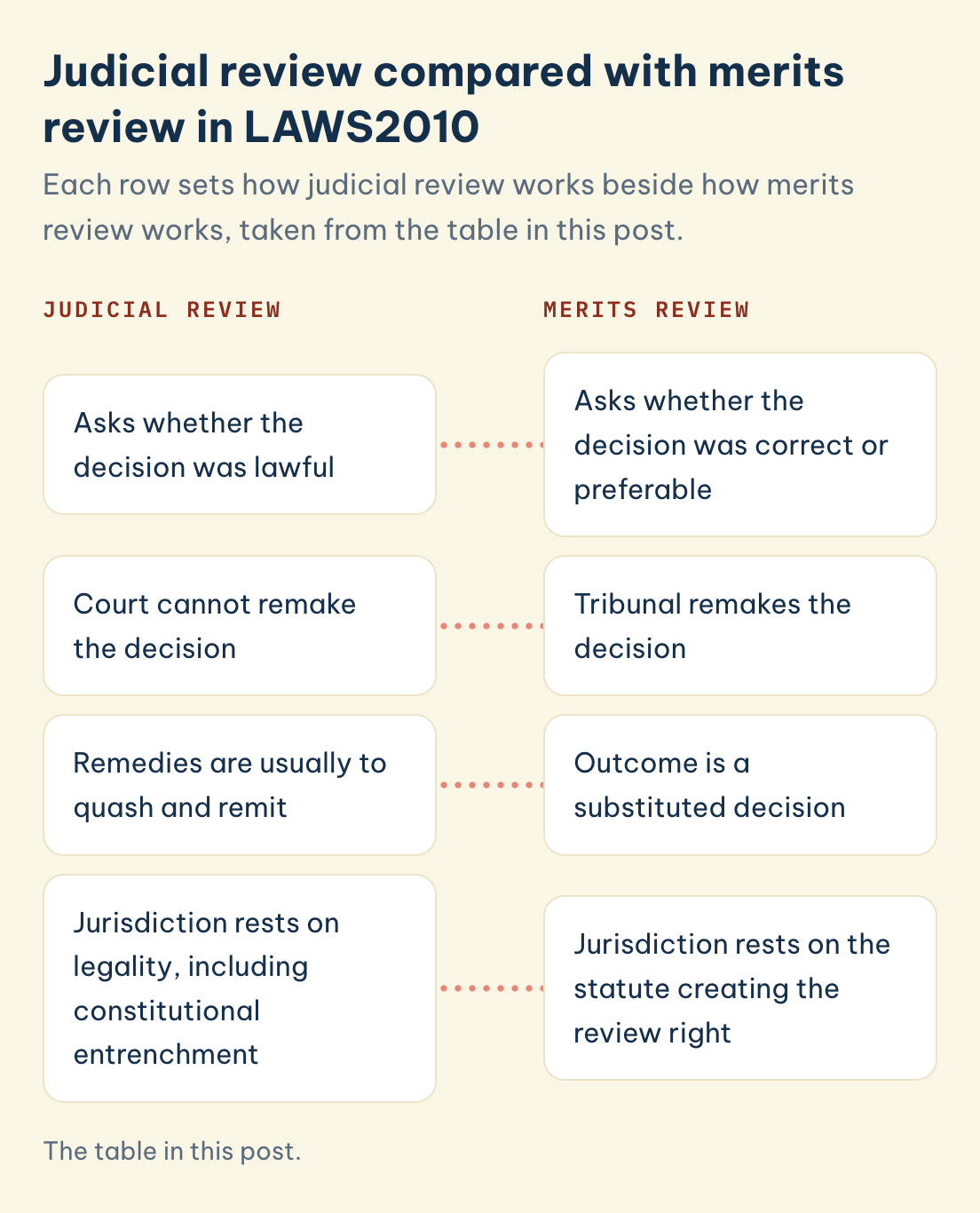
Direct answer: Judicial review asks whether a decision was made lawfully. Merits review asks whether the decision was the correct or preferable one. A court on judicial review cannot substitute its own view of the facts; a tribunal on merits review can, because it stands in the shoes of the original decision-maker and remakes the decision.
Judicial review compared with merits review in LAWS2010
Each row sets how judicial review works beside how merits review works, taken from the table in this post.
Judicial review
Merits review
Asks whether the decision was lawful
Asks whether the decision was correct or preferable
Court cannot remake the decision
Tribunal remakes the decision
Remedies are usually to quash and remit
Outcome is a substituted decision
Jurisdiction rests on legality, including constitutional entrenchment
Jurisdiction rests on the statute creating the review right
Save this figure
Evidence: This distinction carries constitutional weight in Australia rather than being a mere labelling convention, and it is the single boundary that most essay questions are built around. Raad (2019), writing in the Sydney Law Review at volume 41, issue 2, pages 265 to 279, argues that the High Court's decision in Hossain v Minister for Immigration and Border Protection (2018) 92 ALJR 780 created tensions with "the constitutionally significant legality/merits distinction" by importing a threshold of materiality into jurisdictional error. That case note is worth reading precisely because it shows the boundary being contested rather than simply stated. A student who writes that the distinction is settled is writing against a body of scholarship published in the last 8 years.
Example: A student answered a question on unreasonableness by explaining, over 700 words, why a particular visa refusal was harsh. Every sentence was about outcome. None was about power. The essay had answered a merits review question in a judicial review unit, and the marker could not award analysis marks for an argument the unit had not asked for.
| Judicial review | Merits review |
|---|---|
| Asks whether the decision was lawful | Asks whether the decision was correct or preferable |
| Court cannot remake the decision | Tribunal remakes the decision |
| Remedies are usually to quash and remit | Outcome is a substituted decision |
| Jurisdiction rests on legality, including constitutional entrenchment | Jurisdiction rests on the statute creating the review right |
◆ Question 3 / 7 · Grounds of review
What are the grounds of review, and how do you use them in an essay?
Direct answer: The Administrative Decisions (Judicial Review) Act 1977 (Cth) sets out statutory grounds for a review application, and the common law supplies overlapping grounds including procedural fairness, jurisdictional error and legal unreasonableness. In an essay, a ground is a hook for an argument, not a heading to fill.
Evidence: The grounds have not sat still, and treating them as a fixed list is what produces a descriptive essay. Boughey (2022), in the UNSW Law Journal at volume 45, issue 1, beginning at page 113, examines the changes the High Court has made to unreasonableness and asks whether the ground now needs a new justification, noting that unreasonableness and procedural fairness now overlap considerably because unreasonableness has been extended to discretionary process decisions. Carey (2021), in the same journal at volume 44, issue 2, pages 548 to 583, argues that the materiality threshold introduced in Hossain and confirmed in Minister for Immigration and Border Protection v SZMTA is "a new presumption of statutory interpretation which universally qualifies the existing implied limitations on executive decision-making power" (Carey, 2021, p. 548), and contends the High Court "did not adequately justify the presumption's creation". Carey goes further, criticising the presumption's reversal of the onus of proof and the residual discretion to refuse relief. Two scholars pressing on 2 different grounds in the same journal, 1 year apart, is exactly the raw material a research essay needs.
What to do about it: for whichever ground your question targets, build a 4 column table before you draft: the case, what it decided, what changed after it, and which scholar disputes that change. If the fourth column is empty for every row, you have found a topic with no live disagreement, and you should reread the question because you have probably misread it.
◆ Question 4 / 7 · Thesis
How do you turn the essay question into a thesis?
Direct answer: A thesis is a contestable answer to the question, stated in 1 sentence, that the rest of the essay proves. "This essay discusses procedural fairness" is a topic. "Procedural fairness constrains administrative power, but its effectiveness is limited by the flexibility of its content and by statutory exclusion" is a thesis.
Evidence: The difference is whether a reasonable marker could disagree with your opening sentence. If nobody could disagree, you have written a summary, and summaries sit in the pass band regardless of how much law they contain. Break the question into 5 components before you draft: the topic, the task word, the legal proposition you are asked to assess, the jurisdiction, and the limits imposed by word count and prescribed readings. The task word matters more than students expect, because "to what extent" and "critically evaluate" ask for a degree, and a degree requires you to name what is on the other side of your own position.
Example: A student was set a question asking whether the materiality threshold had improved administrative law. Her first draft opened by defining jurisdictional error for 300 words. Her mentor asked her to write the last sentence of her conclusion first. She wrote that materiality made review more pragmatic but shifted a burden onto applicants, and that single sentence, moved to the top of the introduction, reorganised the whole essay without changing a single authority she had already found.
◆ Question 5 / 7 · Analysing a case
How do you analyse a case rather than describe it?
Direct answer: Describing tells the marker what a case says. Analysing tells the marker why that case helps answer this question. The test is simple. Delete the case name and the citation from your paragraph, then read what is left and see whether a recognisable argument still survives on the page.
Evidence: The gap between describing and analysing is the point at which most LAWS2010 essays are decided, and it is a writing habit rather than a knowledge gap. A useful paragraph runs in 4 moves: point, authority, analysis, link. The point is your claim, the authority is the case or the statute, the analysis explains why the authority supports the claim and what its limits are, and the link returns the paragraph to your thesis. Where students collapse the paragraph is the third move, because facts feel like content while doing none of the work. Compare 2 sentences about the same authority. The descriptive one says the High Court considered procedural fairness and held that it applied. The analytical one says the decision demonstrates the difficulty of identifying when procedural fairness is attracted, because the court rejected an approach based solely on legal rights while still treating the statutory context as decisive.
What to do about it: after each paragraph, ask 1 question in the margin: "why does this authority help me?" If the honest answer is "it is on the topic", cut the paragraph to 2 sentences and spend the words you recover on the argument instead. On a 2,000 word essay, this habit typically frees 300 to 400 words for the analysis the rubric is actually marking.
◆ Question 6 / 7 · Citation style
Which citation style does the essay require?
Direct answer: Australian law schools generally require the Australian Guide to Legal Citation, currently in its fourth edition and known as AGLC4, and Sydney Law School is no exception. Your unit outline is the authority on this, and marks are commonly allocated to citation accuracy as a discrete criterion.
Evidence: Two habits cause most of the avoidable loss here. The first is copying a citation format straight out of a database or a search engine, which produces formats designed for other jurisdictions. The second is failing to separate primary from secondary authority. In a legal research essay, primary authority, meaning cases and legislation, should carry the weight when you are stating what the law is, while scholarship such as the Carey and Raad articles above is at its most valuable when you are evaluating whether the law is satisfactory. Note that this article uses APA style because it is a general study guide, not a law assessment; your LAWS2010 essay uses AGLC4.
What to do about it: build the footnotes as you draft rather than in the final hour. Keep 1 running document with the full AGLC4 citation for every source the moment you first read it, which costs about 2 minutes per source and removes an entire category of late-night error.
◆ Question 7 / 7 · Pass and distinction
What separates a pass from a distinction?
Direct answer: A pass essay states the law accurately and applies it. A distinction essay also names the strongest objection to its own thesis, then answers that objection with something specific in the doctrine, rather than conceding vaguely in a closing paragraph that nobody has to take seriously.
Evidence: The gap is not effort and it is not word count. It is whether a position appears on the page and whether that position has been tested. An essay that concedes a limitation and then explains why the limitation does not overturn its central claim is doing the evaluative work the learning outcomes describe. The scholarship models this directly: Carey (2021) does not merely dislike the materiality threshold, he sets out the pragmatic case for it and then explains why the reversal of the onus of proof outweighs that case. That is the move a distinction essay copies. A counterargument paragraph placed roughly three quarters of the way through, running 150 to 250 words, is usually enough.
Example: A student argued that a decision was unreasonable and stopped there. Her mentor asked her to write the respondent's reply in full, as counsel for the decision-maker would put it, and only then return to her own paragraph. The reply turned out to be stronger than she expected on the deference point, and answering it in the essay was what moved her from a competent statement of the ground to an argument about where its edge sits.
What to do about it: take each ground you rely on and name the case that most nearly goes the other way. If you cannot name one, you have not yet read enough for that ground, and a marker who knows the field will notice the gap before they notice anything else in the paragraph.
Frequently asked questions
Is LAWS2010 the same subject at every Australian university?
No. At the University of Sydney LAWS2010 is Administrative Law, at Southern Cross University the same code covers environmental law, and the legacy UNSW handbook used it for Business Associations 1. Always confirm the code against your own university's handbook before buying textbooks or downloading notes.
Do I need to have completed LAWS1021 first?
The University of Sydney lists LAWS1021 as the prerequisite for LAWS2010. Prerequisite chains are set in the handbook for your commencing year, so check the entry for your own cohort rather than a current listing if you are on an older program.
How much detail should I give about case facts?
Only the facts that carry your argument. If a fact does not change the legal principle you are relying on or explain why the court reasoned as it did, it is taking up words that the analysis criterion is waiting for.
Can MAAS write my administrative law essay for me?
No. MAAS works as an academic advisor under Australian academic integrity expectations, and the essay you submit must be your own work. A MAAS mentor can help you clarify the question, test whether your thesis is genuinely contestable, and give feedback on drafts you have written, in the same way a consultation with a tutor works.
Should I cite academic commentary or is case law enough?
A research essay needs both. Cases and legislation establish what the law is; scholarship such as Boughey (2022) and Carey (2021) is where you find the disagreement that makes an evaluative argument possible. An essay built only on cases tends to describe, because the cases do not argue with each other on the page.
References
Boughey, J. (2022). Legal unreasonableness: In need of a new justification? UNSW Law Journal, 45(1), 113.
Carey, N. (2021). Presumptions upon presumptions: Problems with the threshold of materiality. UNSW Law Journal, 44(2), 548–583.
Raad, C. (2019). Hossain v Minister for Immigration and Border Protection: A material change to the fabric of jurisdictional error? Sydney Law Review, 41(2), 265–279.
Tools & resources
- MAAS academic support for feedback on a draft you have written.
- MAAS tutoring for working through the legality and merits distinction with a mentor.
A free 20-minute consultation is a conversation about where you are with LAWS2010.
Book a free consultation ▸