
◆ Law
LAWS1021: how do you write the court report after a Local Court visit?
Most students walk out of their first morning in a Local Court with four pages of notes and no argument. They have written down what happened. The report asks them to explain why what happened looked so unremarkable, and that is a different task, one that no earlier piece of legal writing has trained them for.

◆ Section 1 / 7 · The course
What is LAWS1021, and where does it sit in the UNSW law degree?
Direct answer: LAWS1021 Crime and the Criminal Process is a 6 unit-of-credit undergraduate course at UNSW Sydney that introduces criminal law together with the criminal justice process. It still appears in the 2026 UNSW Handbook, and it is a foundation course rather than an elective, which means the reasoning habits you build here carry into every later criminal law subject.
Evidence: The course pairs two things that many law schools teach separately. One half is doctrinal, covering the physical and mental elements of offences and applying them to statutory offences such as public order and drug offences. The other half is about operation, that is, how police, prosecutors and magistrates make the decisions that determine which conduct becomes a charge at all. The published course description makes the second half explicit, noting that the application of criminal law is shaped by and dependent on decisions made by criminal justice actors. Recurring themes named in the course information include criminalisation and over-criminalisation, the use and misuse of discretion, the reliance on summary justice, and the over-representation of Indigenous people and other vulnerable groups.
A caution about assessment details: UNSW states that assessment specifics can change between offerings, and the current course outline on Moodle is the only authoritative source for your term. Course outlines that circulate on study-notes sites describe a structure built around a court report, a final examination and a participation component, but those figures come from earlier offerings and should not be planned against. Check your own outline in week 1 and write the weightings and due dates somewhere you will see them.
A warning about the code: LAWS1021 is not unique to UNSW. The University of Sydney also uses a LAWS1021 code, and Sydney lists it as the prerequisite for its own LAWS2010 Administrative Law unit. Notes downloaded from a study-sharing site can be entirely accurate and still describe a different university's course, so confirm which institution a set of materials belongs to before you rely on it.
What to do about it: treat the two halves as one subject rather than two. A student who studies the doctrine and skips the process material can define an offence and still fail to explain why 2 people who did the same thing received different outcomes, which is precisely the comparison the course asks you to make.
◆ Section 2 / 7 · The court report
What is the court report actually asking you to produce?
Direct answer: The court report asks you to use what you observed as evidence for a claim about how the criminal process works. Observation is the raw material; the argument is the assessment. A report that narrates a morning of proceedings in chronological order, however accurately, has not yet started.
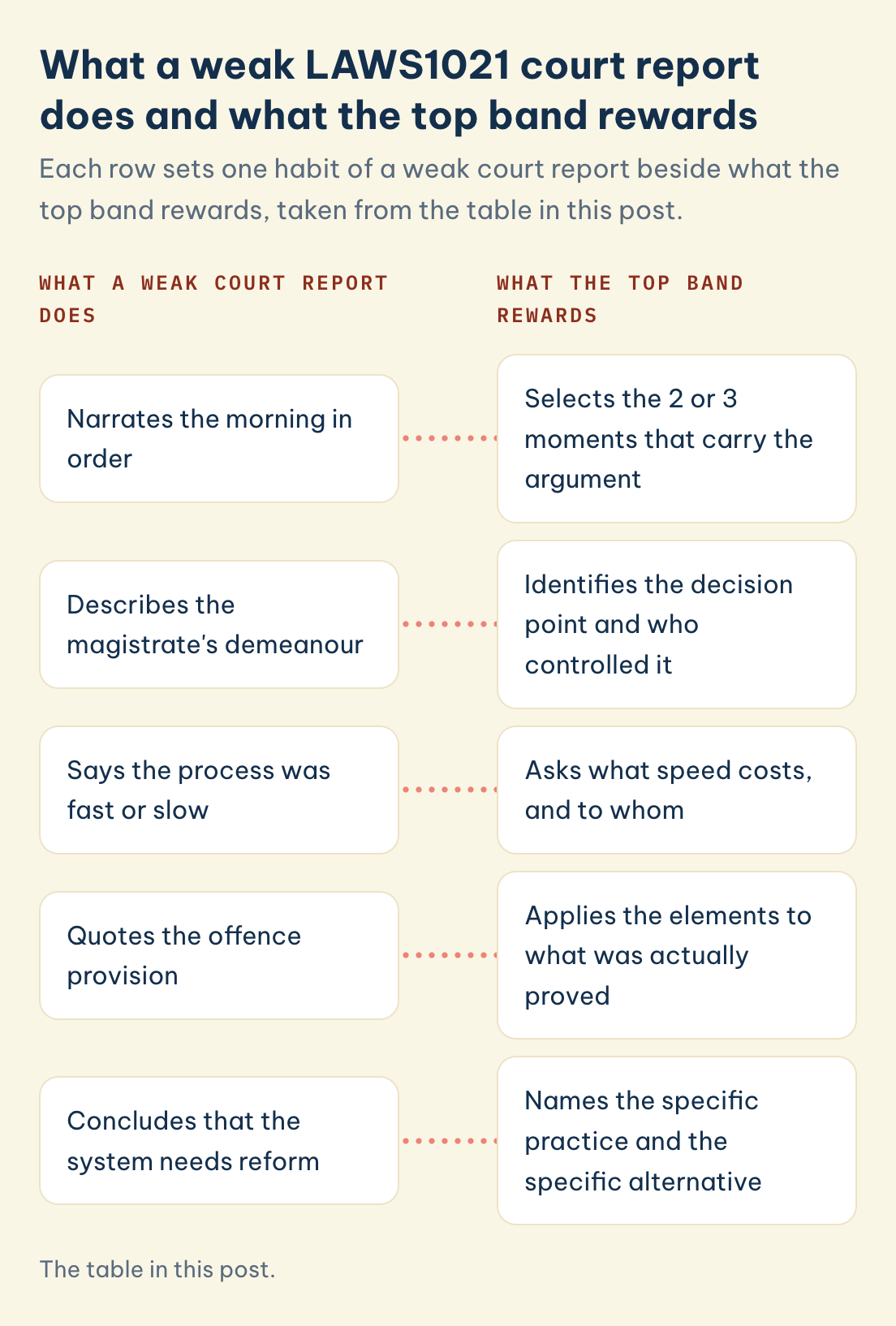
What a weak LAWS1021 court report does and what the top band rewards
Each row sets one habit of a weak court report beside what the top band rewards, taken from the table in this post.
What a weak court report does
What the top band rewards
Narrates the morning in order
Selects the 2 or 3 moments that carry the argument
Describes the magistrate's demeanour
Identifies the decision point and who controlled it
Says the process was fast or slow
Asks what speed costs, and to whom
Quotes the offence provision
Applies the elements to what was actually proved
Concludes that the system needs reform
Names the specific practice and the specific alternative
Save this figure
Evidence: The intellectual frame most course materials point students toward comes from Conviction, in which McBarnet (1981) argued that the summary jurisdiction operates under what she called an "ideology of triviality". The claim is that because summary matters are treated as minor, they attract little scrutiny, and the procedural protections that dominate the public image of criminal justice thin out at exactly the level where most people actually encounter it. That framing is still doing work in current Australian scholarship. Quilter and McNamara (2013) write of the offences they study that although such crimes are among the most frequently prosecuted in Australia, "their legal nature is poorly understood and rarely the subject of judicial scrutiny or academic explanation" (Quilter & McNamara, 2013, p. 534). They explicitly extend McBarnet's list of lesser crimes to offensive conduct and offensive language under sections 4 and 4A of the Summary Offences Act 1988 (NSW), noting that the ideology of triviality pervading the jurisdiction is part of why the elements of those offences have gone judicially unexamined for decades.
Example: Two students observed the same list. The first wrote that the magistrate dealt with 11 matters before the morning break, most in under 4 minutes, and concluded that the court was efficient. The second reported the same 11 matters and the same timing, then asked what a defendant would need to know to contest a charge in 4 minutes, and answered it using the elements of the offence she had learned in the doctrinal half of the course. Only the second student had a report.
| What a weak court report does | What the top band rewards |
|---|---|
| Narrates the morning in order | Selects the 2 or 3 moments that carry the argument |
| Describes the magistrate's demeanour | Identifies the decision point and who controlled it |
| Says the process was fast or slow | Asks what speed costs, and to whom |
| Quotes the offence provision | Applies the elements to what was actually proved |
| Concludes that the system needs reform | Names the specific practice and the specific alternative |
◆ Section 3 / 7 · Summary volume
Why does the volume of summary matters matter to your argument?
Direct answer: Because the argument only lands if you can show that what you saw is typical rather than a bad morning. Published figures let you do that, and a report that anchors an observation to a documented pattern reads very differently from one that generalises from a single visit.
Evidence: Quilter and McNamara (2013) set out the scale in New South Wales. In 2012, 5,612 charges for offensive conduct and offensive language were finalised in the Local Court of NSW, and a further 6,808 people were issued with a Criminal Infringement Notice for alleged breaches of the same 2 sections, so the 2 offences were enforced more than 12,000 times in a single year. In the same year more than 14,000 public order charges were finalised in the Local Court, of which 1,830 were offensive language and 3,782 were offensive conduct, together close to 40 per cent of the public order caseload. Their central complaint is that for offences enforced at that volume, it remained unclear what the elements of the crime even were, and that no comprehensive guidance on sections 4 and 4A had come from the Supreme Court of NSW.
Evidence on how those powers are exercised: Trollip, McNamara and Gibbon (2019) studied police use of section 4A across 3 Sydney Local Area Commands during 2016 and reported that offensive language laws more commonly operate as a police power to control persons exhibiting undesirable or nuisance behaviour in public places, and to exercise power over persons who demonstrate a lack of deference to the authority of the police. That finding is a gift to a court report, because it converts an impression that policing looked discretionary into a documented, citable claim.
What to do about it: pick one offence type, find one published figure for it, and build the report around the gap between the figure and what you watched. One number used precisely beats 6 numbers used decoratively.
◆ Section 4 / 7 · Over-representation
How do you write about over-representation without slipping into assertion?
Direct answer: Cite the measure, state the year, and say what the number is a rate of. Over-representation is the theme markers see handled worst, usually because students assert that the system is discriminatory without ever specifying the comparison that would show it.
Evidence: The Australian Law Reform Commission (2017) reported in its Pathways to Justice inquiry that although Aboriginal and Torres Strait Islander adults made up around 2 per cent of the national population, they constituted 27 per cent of the national prison population, and that in 2016 around 20 in every 1,000 Aboriginal and Torres Strait Islander people were incarcerated. The report also traced how over-representation compounds across the stages of the process rather than appearing all at once: in 2016 Aboriginal and Torres Strait Islander people were 7 times more likely than non-Indigenous people to be charged and appear before the courts, 11 times more likely to be held on remand awaiting trial or sentence, and 12.5 times more likely to receive a sentence of imprisonment, with Aboriginal and Torres Strait Islander women 21.2 times more likely to be in prison than non-Indigenous women. Incarceration rates rose 41 per cent between 2006 and 2016, and 76 per cent of Aboriginal and Torres Strait Islander prisoners had been in prison before. The inquiry produced 35 recommendations and reflected the law as at 1 December 2017.
That escalation across stages is the analytically useful part. It tells you that a court report focused on bail, or on remand, is examining a point where the differential grows, which is a stronger place to stand than a general statement about the system. The ALRC also insisted on a qualification worth carrying into your own writing, that the majority of Aboriginal and Torres Strait Islander people never commit a criminal offence, so a claim about rates is not a claim about people.
What to do about it: write the sentence as measure, year, comparison. "In 2016, Aboriginal and Torres Strait Islander people were 11 times more likely to be held on remand than non-Indigenous people (Australian Law Reform Commission, 2017)" does work that "Indigenous people are over-policed" does not.
◆ Section 5 / 7 · The examination
How is the final examination different from the report?
Direct answer: The examination tests application under time pressure, which usually means moving between a fact scenario and the elements of an offence, and then evaluating the rule you have just applied. The report rewards depth on one observed situation; the examination rewards speed and coverage across unfamiliar ones.
Evidence: The published learning outcomes for the course require students to navigate and apply both common law and statutory criminal law, to communicate legal concepts effectively, and to incorporate appropriate legal research, which means an answer that stops at the correct rule has satisfied only part of what is being marked. The statutory material makes the point concretely. Section 4 of the Summary Offences Act 1988 (NSW) provides that a person must not conduct himself or herself in an offensive manner in or near, or within view or hearing from, a public place or a school, carrying a maximum of 6 penalty units or imprisonment for 3 months, while section 4A covers offensive language with a maximum of 6 penalty units. Both sections provide a defence where the defendant satisfies the court that there was a reasonable excuse. Under section 4A a court may order community service work instead of a fine, capped at 100 hours. Quilter and McNamara (2013) built their analysis of those elements on the High Court's approach in He Kaw Teh v The Queen, which is the method the course expects you to use when a statute does not state its own fault element.
What to do about it: practise on the offences the course actually sets rather than on generic problem questions. Write out the physical elements and the fault elements of 3 set offences in a table before the study period begins, and note for each one whether the fault element is stated, implied, or contested. That table is the spine of every problem answer you will write.
◆ Section 6 / 7 · Credit and distinction
What separates a credit from a distinction in this course?
Direct answer: The willingness to argue against your own position. Students who reach the top band do not simply criticise the criminal process; they state the strongest case for the practice they are criticising and then explain why it fails on the evidence they have.
Evidence: The course is built on a tension rather than a conclusion. McNamara and Quilter (2014) framed the underlying policy question directly, asking whether there remains any place in Australia for laws that criminalise public conduct or language deemed offensive, and noted that a report of the NSW Law Reform Commission had catalogued compelling evidence pointing toward no without formally reaching that conclusion. A student who reproduces only the critical side has taken a position; a student who explains why the offences persist, that they are administratively convenient, that they are enforced largely by notice rather than by charge, and that a review stopped short of recommending repeal, has produced analysis. The NSW Ombudsman's review of the first 9 months of the statewide Criminal Infringement Notice scheme, from November 2007 to July 2008, found that 70 per cent of the notices issued in that period were for offensive conduct or offensive language, a figure reported by Quilter and McNamara (2013), which is exactly the sort of detail that lets you argue both sides from the same fact.
What to do about it: in every substantial paragraph, write one sentence beginning "the strongest response to this is". If you cannot complete the sentence, you do not yet understand the practice well enough to criticise it.
◆ Section 7 / 7 · How MAAS works
How MAAS works with LAWS1021 students
MAAS mentors work alongside students on the reasoning, not on the submission. For a court report that usually means a conversation before you attend, so you know which decision points to watch for, and a conversation after, where you talk through which of your observations can carry an argument and which are description. For examination preparation it means working through problem scenarios with you and pushing on the step where your reasoning thins out. You write your own work; the mentor helps you see what the rubric is asking. If you want to talk through where you are stuck, get in touch with MAAS.
Frequently asked questions
Is LAWS1021 a prerequisite for later criminal law courses at UNSW?
In substance, yes. The UNSW handbook records that an introductory course of this kind may be required before a more advanced course, and LAWS1021 is the foundation that later criminal law study at UNSW builds on, so the doctrinal vocabulary and the process framing you learn here are assumed knowledge afterwards. Treat it as scaffolding rather than as a subject you can pass and forget.
Where do I find the real assessment weightings for my term?
In your course outline on Moodle. UNSW states that assessment specifics can change when a course is offered, so figures published on study-notes sites or in archived outlines from earlier years are not reliable for planning. Read the outline in week 1 and record the weightings and due dates yourself.
Do I need legal experience before I can write a court report?
No, and the assessment is designed on that assumption. What you need is a framework to observe with. Read the process material before you attend rather than after, because the difference between a useful morning and a wasted one is knowing in advance which decisions to watch.
How many sources should a first-year court report cite?
Fewer than most students expect, used more carefully. A report anchored in 3 or 4 sources that each do identifiable work will outscore one that lists 12 in the bibliography and engages with none of them in the body.
Can I write about a case I only read about rather than observed?
Not for a court report, because the assessment is testing observation and its interpretation. If you have a genuine reason you cannot attend, raise it with the course convenor early rather than substituting reading for attendance without asking.
References
Australian Law Reform Commission. (2017). Pathways to justice: Inquiry into the incarceration rate of Aboriginal and Torres Strait Islander peoples (Final Report No. 133). https://www.alrc.gov.au/publication/pathways-to-justice-inquiry-into-the-incarceration-rate-of-aboriginal-and-torres-strait-islander-peoples-alrc-report-133/
McBarnet, D. J. (1981). Conviction: Law, the state and the construction of justice. Macmillan.
McNamara, L., & Quilter, J. (2014). Turning the spotlight on 'offensiveness' as a basis for criminal liability. Alternative Law Journal, 39(1), 36-39. https://doi.org/10.1177/1037969X1403900110
Quilter, J., & McNamara, L. (2013). Time to define 'the cornerstone of public order legislation': The elements of offensive conduct and language under the Summary Offences Act 1988 (NSW). UNSW Law Journal, 36(2), 534-562. https://www.austlii.edu.au/au/journals/UNSWLJ/2013/20.html
Trollip, H., McNamara, L., & Gibbon, H. (2019). The factors associated with the policing of offensive language: A qualitative study of three Sydney Local Area Commands. Current Issues in Criminal Justice, 31(4), 493-512. https://doi.org/10.1080/10345329.2019.1639591
A free 20-minute consultation is a conversation about where you are with LAWS1021.
Book a free consultation ▸