
Most students arriving at IP: Copyright and Designs expect the hard questions to concern infringement. The harder questions come earlier: Australian law asks whether copyright existed in the first place, looking for a human author who put independent intellectual effort into a particular form of expression. Once that requirement is taken seriously, a great deal of modern output becomes genuinely uncertain, and the strongest assignments in this unit notice that uncertainty rather than assuming it away.
Author: MAAS Editorial Team
Last updated: 2026-08-12
Category: law

First, confirm the unit you are enrolled in
Direct answer: At the University of Sydney, LAWS5180 is IP: Copyright and Designs, a 6 credit point elective in the Juris Doctor (JD), taught in Semester 2 over 10 weeks. It carries prohibitions against LAWS3033, LAWS3423 and LAWS3480, the Bachelor of Laws (LLB) twin, and closes off the Master of Laws (LLM) unit LAWS6873 Principles of Intellectual Property afterwards.
Evidence: The Sydney Law School handbook lists the unit, its credit value, its teaching pattern and its prohibitions, and the Master of Laws table records LAWS5180 among the units that bar later enrolment in LAWS6873. That web of prohibitions is worth reading properly, because it tells you what the faculty considers equivalent coverage.
Example: A student planning a specialisation assumed she could take the JD elective and later add the LLM intellectual property unit for depth. The handbook had already ruled that out. Finding this in week one rather than in her final year changed which units she chose.
This guide describes the Sydney unit. If you are looking for patents and trade marks as the main content, you are in a different unit.
What does this unit actually cover?
Direct answer: Copyright and designs, treated as two recognised branches of intellectual property that overlap awkwardly at the edges. The published description sets out the requirements for protection in each, examines the bases on which an infringement action can be brought, and places particular emphasis on the expanding scope of copyright, the implications of the internet, and the overlap provisions in the Copyright Act 1968 (Cth) intended to address the apparent overlap between copyright and design protection.
Evidence: The unit description is unusually candid about its own method. It says the teaching will emphasise legal doctrine from the perspective of a relatively depoliticised formalism, while also recognising that the deployment and regulation of intellectual property have substantial cultural, technological and economic consequences that in turn shape doctrine. It names a concrete instance, treating a literary work still in copyright as both a monetary asset and the focus of civil rights activism demanding a right to imitate for criticism and parody.
Example: Asked to advise on a design that also functions as an artistic work, a weaker answer picked one regime and argued it well. A stronger answer identified that the choice of regime was itself the legal question, because the overlap provisions exist precisely to stop a claimant taking the longer copyright term for something the designs system would protect for much less.
Why do good arguments lose marks in copyright papers?
Direct answer: Usually because they answer a question one stage removed from the one asked. Copyright problems have a fixed order, and skipping a stage is more costly than getting a later stage slightly wrong.
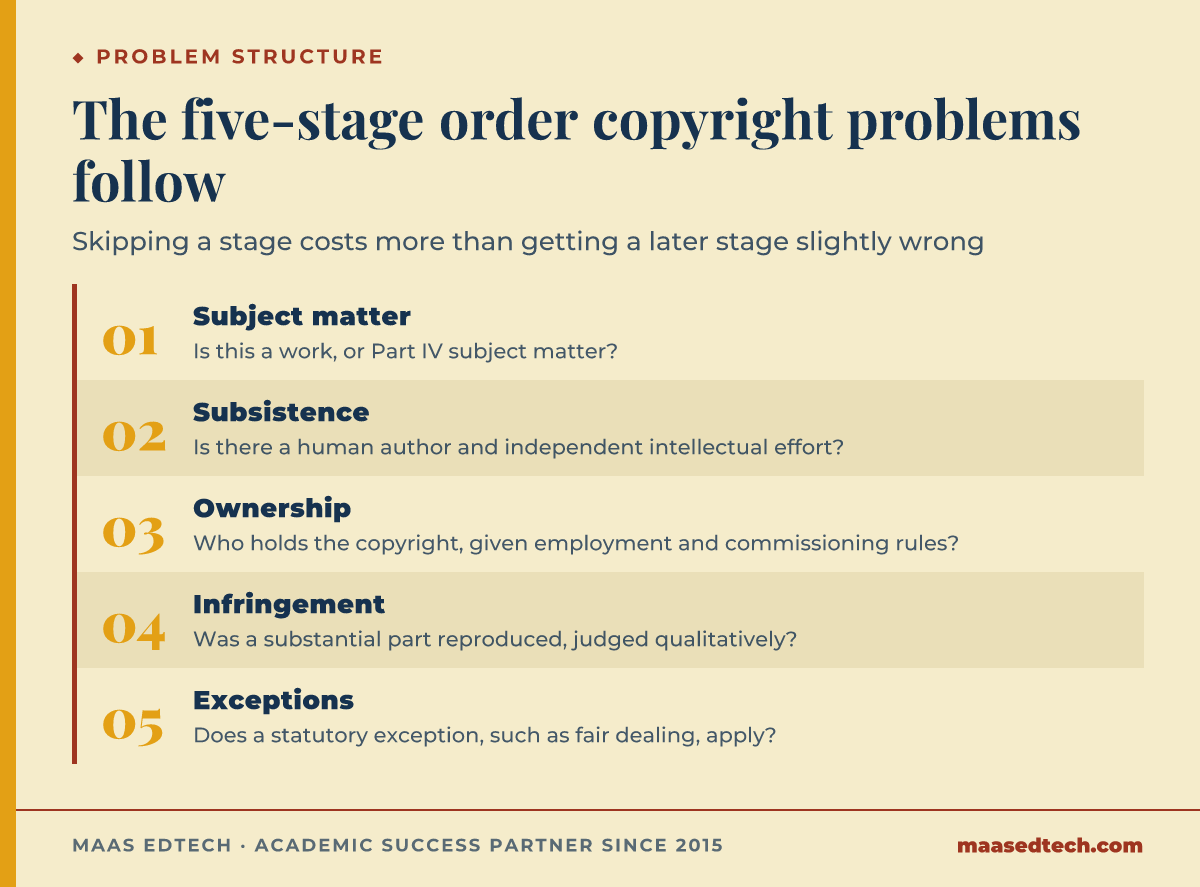
| Stage | The question it answers | Where students go wrong |
|---|---|---|
| Subject matter | Is this a work, or Part IV subject matter? | Assuming the category rather than arguing it |
| Subsistence | Is there a human author and independent intellectual effort in the form of expression? | Treating this as a formality and moving straight to infringement |
| Ownership | Who holds the copyright, given employment and commissioning rules? | Conflating authorship with ownership |
| Infringement | Was a substantial part reproduced, judged qualitatively? | Counting how much was taken rather than what was taken |
| Exceptions | Does a statutory exception apply? | Reaching for fair dealing as a general fairness argument |
Evidence: The order is not an academic convention, it is how the litigation actually failed in the leading cases. In Telstra Corporation Ltd v Phone Directories Company Pty Ltd (2010), the Full Federal Court of Australia rejected the directory claim without ever reaching infringement, because it found no copyright subsisted in the White Pages and Yellow Pages directories in the first place. A student who treats subsistence as a warm-up has removed the very stage where the real cases were decided.
Example: Two answers on a database problem both argued infringement persuasively. The first spent one line on subsistence. The second spent a third of the answer on it, concluded that subsistence was doubtful, and argued infringement in the alternative. The second is how a practitioner would advise, and it is also how the marking criteria are written.
What is the authorship problem, and why is it the live issue now?
Direct answer: Australian law requires that a work originate from an identifiable human author whose intellectual effort was directed to the material form of expression. When software does the arranging, that requirement can fail, and the work falls outside copyright entirely rather than being protected weakly.
Evidence: That human-authorship requirement is settled enough to argue from. Reviewing the transformation of the law after IceTV Pty Ltd v Nine Network Australia Pty Ltd (2009), Lindsay (2012) shows how the High Court of Australia placed new weight on the role of the author in originating works, and how that shift left unresolved questions about what is needed to establish that a work originates from an author, when the use of computers denies copyright for insufficient human authorship, and what makes multiple contributors joint authors. Fitzgerald and Seidenspinner (2013) address the same gap from the legislative side, stating plainly: "the Copyright Act 1968 (Cth) does not contain specific provisions on the subsistence of copyright in computer-generated materials" (Fitzgerald & Seidenspinner, 2013, p. 37), and asking whether such provisions should be enacted. Thambaiya (2025) carries the analysis into generative systems, arguing that the traditional principles of human authorship, originality and material form do not accommodate autonomously generated output and that legislative reform is required.
Example: A problem question involving a marketing agency using a generative tool invites two very different answers. One asks whether the output infringes. The better one asks first whether the agency has any copyright to assert, notes that effort spent selecting and prompting may be characterised as anterior to the expression rather than directed at it, and only then turns to infringement.
How do you use the overlap between copyright and designs?
Direct answer: As a boundary problem with a policy reason behind it, not as a technicality. The statutory provisions exist because copyright's long term would otherwise swallow the designs system whenever a mass-produced article could also be described as an artistic work. In Australia, registered designs are examined and registered by IP Australia, a separate agency from the Federal Court that hears the copyright and passing-off disputes this overlap produces.
Evidence: The unit description names this overlap explicitly as a focus, which signals that examiners expect you to know why the provisions exist rather than merely how they operate. An answer that recites the mechanism without the rationale cannot explain the hard cases, because the hard cases are precisely the ones where the mechanism produces a result the policy did not intend.
Example: Asked about a designer chair reproduced by a competitor, one student applied the artistic work analysis and stopped. Another asked whether the design had been industrially applied, explained what that does to the copyright claim, and observed that the answer turns on commercial conduct rather than on artistic merit.
How much policy should a doctrinal answer contain?
Direct answer: Enough to explain a doctrinal choice, and no more. The unit is taught from a formalist perspective by its own description, so policy earns marks when it makes a rule intelligible, and loses them when it substitutes for the rule.
Evidence: The description itself models the balance. It commits to doctrine, then names the cultural, technological and economic consequences as things that inform and shape doctrinal development. The word shape matters. Policy is presented as an input to doctrine, not as an alternative to it.
Example: An essay on parody that opened with two pages on freedom of expression and reached the statutory exception on page three had inverted the structure. Opening with the exception and using the free-expression argument to explain why its boundaries sit where they do would have made the same points inside a doctrinal frame.
A practical order of work
- Classify the subject matter before anything else, and say why the classification is arguable if it is.
- Argue subsistence properly. Name the author, name the intellectual effort, and connect that effort to the material form.
- Separate authorship from ownership. They coincide often enough that students forget they are different questions.
- On infringement, argue quality rather than quantity, and say which features carry the originality.
- Check whether the designs overlap provisions are engaged before you settle on a regime.
- Cite cases at the level of the proposition you need, not the level of the whole judgment. A single AGLC pinpoint reference is worth more than a bare case name.
Frequently asked questions
Do I need a technical background to do well in this unit?
No. Copyright and designs are doctrinal subjects, and the technological material is context rather than content. What you do need is the willingness to describe how something was made in enough detail to identify where the human contribution sat.
How should I handle a problem question where subsistence is genuinely uncertain?
Argue it both ways and say which way you would advise a client to plan for. Uncertainty acknowledged and managed reads as competence, whereas uncertainty concealed by a confident assertion reads as a gap.
Can I write about AI-generated works if my seminar has not covered them?
Check your unit outline first. Where the topic is open, the safer approach is to use it as an application of the authorship requirement rather than as a separate topic, because that keeps you inside the doctrine the unit is assessing.
Are secondary sources expected, or is case law enough?
Follow your outline. Case law carries the argument, but a claim about what a line of authority has done to the law is a claim about scholarly consensus, and it should be supported by scholarship rather than asserted. Cite every case and article using the Australian Guide to Legal Citation (AGLC), the referencing standard applied across Australian law schools, including at the University of Sydney.
How do I keep the designs material from being an afterthought?
Give it its own analysis rather than a closing paragraph. Most overlap questions are decided in the designs analysis, so treating it as an appendix guarantees you finish where the marks are and run out of words.
Where MAAS fits
MAAS mentors work alongside law students rather than in place of them. On a copyright problem question, that usually means testing whether your subsistence argument would survive being pushed on, checking that your authority actually supports the proposition you have attached to it, and asking the question the examiner will ask about the stage you moved through quickly. The analysis stays yours. If that is useful, our academic support service and our tutoring service are the two places to start.
References
Fitzgerald, A., & Seidenspinner, T. (2013). Copyright and computer generated materials: Is it time to reboot the discussion about authorship? Victoria University Law and Justice Journal, 3(1), 37–54. https://doi.org/10.15209/vulj.v3i1.25
Lindsay, D. (2012). Protection of compilations and databases after IceTV: Authorship, originality and the transformation of Australian copyright law. Monash University Law Review, 38(1), 17–59. https://www.austlii.edu.au/au/journals/MonashULawRw/2012/3.html
Thambaiya, N. (2025). Copyright law in the age of AI: Analysing the AI-generated works and copyright challenges in Australia. International Review of Law, Computers & Technology. Advance online publication. https://doi.org/10.1080/13600869.2025.2486893
Tools & resources
The University of Sydney. (n.d.). Juris Doctor electives part 1 unit of study table. https://www.sydney.edu.au/handbooks/law/postgraduate/juris-doctor/p1-electives-unit-of-study-table.html