
◆ Law
LAWS212: is your employment law answer citing the right year?
Employment law in Australia changed on 26 August 2024, striking at the most basic question the subject asks: who counts as an employee. An answer that reasons from the 2022 High Court decisions can still reach the wrong conclusion, because the test those cases settled is no longer the test that statute directs. This is the hazard of a subject that asks you to analyse recent developments, recent enough that a good textbook can be out of date.
Note on the code: this guide describes the Australian Catholic University unit. Victoria University of Wellington uses LAWS212 for The Law of Torts, which is unrelated, so check the unit title on your own enrolment first.

◆ Question 1 / 7 · The unit
How is the unit built?
Direct answer: LAWS212 Employment Law is a 10 credit point elective at Australian Catholic University, with LAWS104 Foundations of Law and Legal Research and LAWS105 Contract Law as prerequisites. The published handbook entry lists two assessment tasks, each weighted at 50%, and each may take the form of a problem-based question or a research essay.
Evidence: The handbook entry sets out three learning outcomes: describing how Australian employment laws protect worker rights and dignity, developing and communicating reasoned opinions and advice on employment matters, and critically analysing recent developments in employment law. The content spans the employment contract, sources of entitlements, express and implied duties, equal opportunity, work health and safety, dispute resolution, termination under both Fair Work Act remedies and common law remedies, and industrial action. The structure tells you something useful: with only two assessments and no exam listed, each piece carries half your result, so there is no low-stakes task to learn the format on.
Example: A student who had done well in Contract Law treated the first assignment as a contract problem with an employment flavour. The analysis of the written agreement was strong. It was also insufficient, because the statutory overlay does work that the contract cannot displace.
The 2026 offering is listed as online scheduled in Semester 2, and offerings are subject to minimum enrolment numbers, so confirm against the current handbook and your own enrolment before planning around it.
◆ Question 2 / 7 · Date of your source
Why does the date of your source decide whether your answer is right?
Direct answer: Because the test for who is an employee, for Fair Work Act purposes, changed on 26 August 2024. Before that date the question turned on what the parties had agreed. From that date it turns on how the relationship actually works.
What a LAWS212 answer must establish after the 26 August 2024 test change
Each row sets one thing the answer must establish beside why it matters, taken from the table in this post.
What your answer must establish
Why it matters
Which date the facts fall on
The applicable test differs before and after 26 August 2024
Whether the question is a Fair Work Act question
The statutory definition governs for that purpose, not for every purpose
How the work was actually performed, not only what the contract says
Under the current test, practice and contract are both in scope
Save this figure
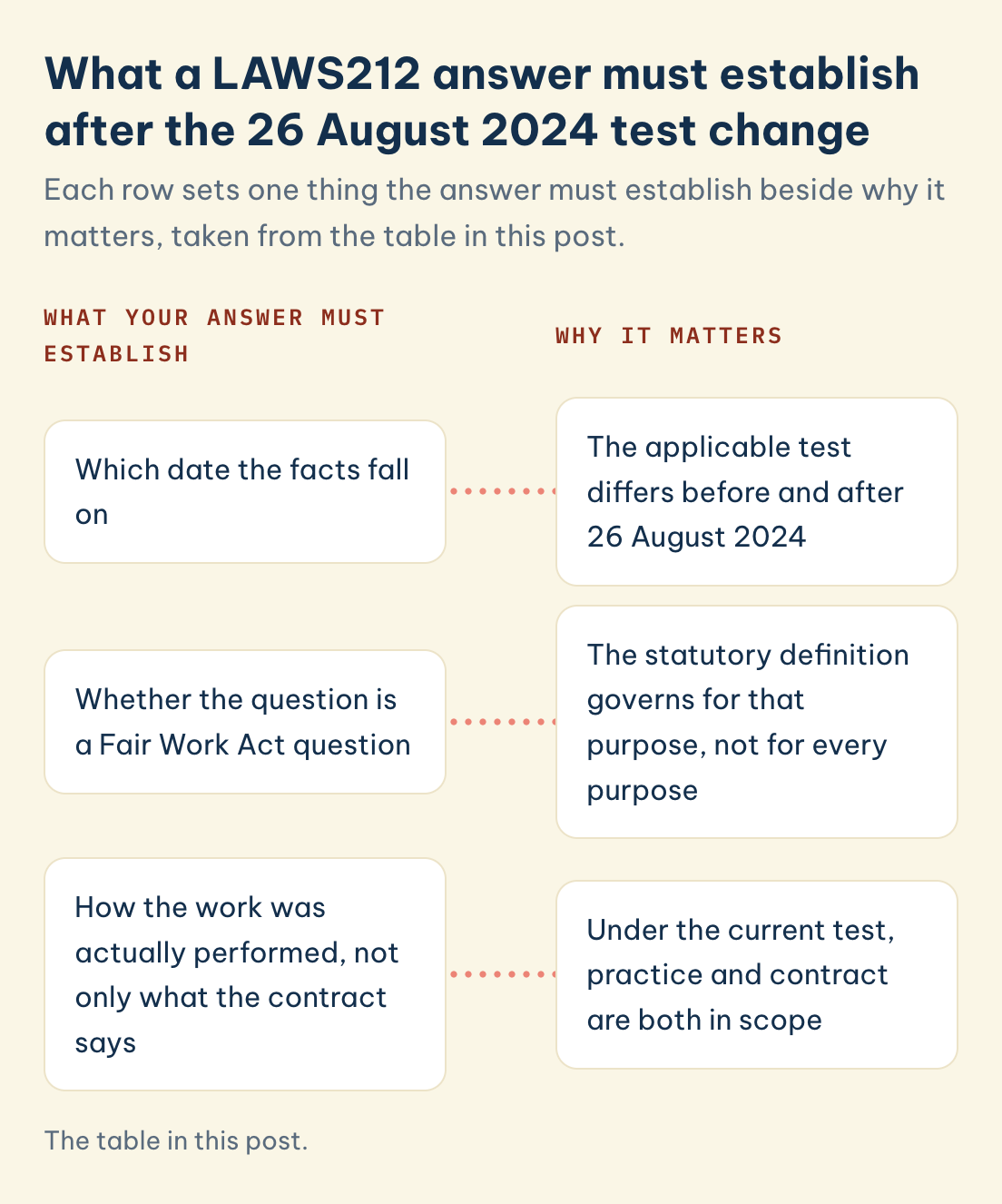
Evidence: The Fair Work Ombudsman sets out both tests directly. Under what it calls the start of relationship test, which applies to the period before 26 August 2024, the focus is on what the parties agreed, as set out in the contract and any later variations. Under the whole of relationship test, applying from 26 August 2024, the question is determined by reference to the real substance, practical reality and true nature of the relationship, which requires considering the terms of the contract together with how the contract is performed in practice. The Ombudsman also warns that there is usually no single deciding factor, and that a worker having an ABN or issuing invoices does not by itself make them a contractor.
| What your answer must establish | Why it matters |
|---|---|
| Which date the facts fall on | The applicable test differs before and after 26 August 2024 |
| Whether the question is a Fair Work Act question | The statutory definition governs for that purpose, not for every purpose |
| How the work was actually performed, not only what the contract says | Under the current test, practice and contract are both in scope |
Example: Two students answered the same classification problem. One reasoned entirely from the written agreement and reached a contractor conclusion. The other noted the date in the facts, applied the whole of relationship test, and worked through how the arrangement operated day to day. The first answer would have been correct for facts occurring in 2023. The facts were set in 2025.
◆ Question 3 / 7 · The 2022 case law
Does the 2022 case law stop mattering?
Direct answer: No, and saying so in an assignment would be its own error. What changed is which test governs the employee question for Fair Work Act purposes. The judicial reasoning still matters, and it still governs questions that fall outside that statutory definition.
Evidence: This distinction between the statutory test and the judicial reasoning is where a careless answer and a careful one separate, and the distinction is worth stating explicitly in your writing because markers are looking for it. A statutory definition operates for the purposes of the Act that contains it. Characterisation questions arising in other contexts, and the body of reasoning about control, integration and the multifactorial approach, do not vanish because Parliament has legislated for one purpose. The safer analytical habit is to state which question you are answering, identify the source of the test you are applying, and note the limit of that test rather than treating the most recent development as having swept everything before it.
Freedland (2007) made the underlying point well before this reform, arguing that the contract of employment has struggled to carry the full weight of labour and employment law's protective purposes and that the law has repeatedly reached beyond it. A student who frames the 2024 change as one episode in that longer pattern, rather than as an isolated legislative event, is doing the critical analysis the third learning outcome asks for. Freedland published the argument in the International Labour Review in 2007, which makes it a comparative labour-law source rather than an Australian statutory one, so cite it for the pattern and not for the current tests.
Example: An answer that opened by declaring the 2022 decisions overruled lost credit twice: once for overstating the effect of the amendment, and once for missing the chance to explain the more interesting position, which is that statute and common law now answer slightly different questions.
◆ Question 4 / 7 · Problem and essay
What actually changes between a problem question and a research essay?
Direct answer: The reader's purpose. A problem question is written for someone who needs to know what happens to these parties. A research essay is written for someone who needs to know whether a proposition holds. Same law, different structure, and using the wrong one is a structural error rather than a stylistic preference.
Evidence: In a problem question, every paragraph must earn its place by moving toward advice, which means law that does not bear on these facts is padding no matter how accurate it is, and an answer that ends without stating the likely outcome has not completed the task. In a research essay, the equivalent failure is describing the state of the law without taking a position on it, since the assessment is of your evaluation rather than your coverage. Dawe (2020) examined how law students approach problem solving, noting that "mastery goal achievement orientation in students fosters better quality, deep learning and leads to better outcomes" (Dawe, 2020, p. 249), and argues for teaching that shifts students toward mastery rather than performance goals, which fits the pattern markers see: students recite the framework they know rather than engaging with the difficulty in front of them.
Example: A student submitted a well-researched piece surveying unfair dismissal law across 15 paragraphs, exactly the performance-goal pattern Dawe (2020) describes, then concluded that the employer should seek advice. It read as a competent essay and answered no question. The same material, reorganised so that each element of the claim was tested against the facts, produced a piece half as long with a stated conclusion. Dawe (2020), writing in The Law Teacher, builds on achievement goal theory, which contrasts mastery goals, where the aim is to understand, with performance goals, where the aim is to look competent.
◆ Question 5 / 7 · Remedies
Why do answers weaken at the remedies stage?
Direct answer: Because students treat remedies as an afterthought once liability is established, while the unit content puts Fair Work Act remedies and common law remedies in separate topics precisely because the choice between them is substantive.
Evidence: The two routes have different eligibility conditions, different time limits, different forums and different outcomes, so an answer that establishes a wrong without identifying which mechanism the client can actually use has stopped short of advice. The published content list separates termination remedies under the Fair Work Act from common law remedies, which signals that the unit expects you to distinguish them rather than to treat termination as one undifferentiated topic. Marmo, Sinopoli and Guo (2022) analysed worker exploitation in the Australian gig economy and the mechanisms through which it is sustained, which is useful context here: the practical question for many workers is not whether a norm was breached but whether any available mechanism reaches their situation.
Example: An answer correctly identified conduct amounting to a dismissal in breach of an implied term, then recommended an unfair dismissal application without checking the minimum employment period on the facts. The legal analysis was sound and the advice was unusable.
◆ Question 6 / 7 · International students
Where do international students most often lose marks?
Direct answer: In treating statute as background and case law as the real law, which is often the reverse of how Australian employment law works, and in citing sources that a marker cannot verify.
Evidence: Employment law in Australia is heavily statutory, and an answer that reasons from principle toward a conclusion without anchoring in the relevant provision reads as underdone regardless of how sophisticated the reasoning is. The second issue is narrower and entirely fixable. Summaries of the 2024 reforms are widely available on law firm websites, and they are often accurate, but an assignment that rests a proposition on a firm's client update rather than on the legislation or the regulator's own guidance is relying on a source the marker has no reason to accept. Go to the provision, or to the Fair Work Ombudsman's published guidance, and cite that.
Example: A student's draft supported the central classification point with three consultancy blog posts. Replacing them with the Ombudsman's own guidance changed nothing about the argument and everything about how it read.
◆ Question 7 / 7 · MAAS mentors
What do MAAS mentors actually do on a unit like this?
Two assessments at 50% each leave no room to learn by getting one wrong, so the useful support arrives early. Before you draft, the questions are diagnostic: is this a problem question or an essay, what date do the facts fall on, and which body of law actually governs the question you have been asked. While you write, the work is mostly about discipline, cutting accurate law that does not bear on these facts and pushing an answer that stops at liability through to a usable remedy. Near submission, it is verification, checking that every proposition rests on a source your marker can open. The legal reasoning is yours throughout; what a mentor supplies is the reader who asks why a paragraph is there.
If you are unsure which test governs the facts you have been given, bring us the problem before you start drafting.
Frequently asked questions
Do I need LAWS105 Contract Law before LAWS212?
The handbook lists LAWS104 Foundations of Law and Legal Research and LAWS105 Contract Law as prerequisites. Prerequisite structures are revised between offerings, so confirm against the handbook entry for your own year.
Is LAWS212 offered on campus?
The 2026 handbook lists the unit as online scheduled in Semester 2, and notes that offerings may be subject to minimum enrolment numbers. Check the current offering before planning your enrolment sequence.
Which citation style should I use?
Australian law units generally require AGLC rather than APA. Follow the style your unit outline specifies, since it governs regardless of what other subjects in your degree use.
How recent do my sources need to be?
Recent enough that they reflect the law as it stood at the relevant date in your facts. That is not the same as recent in general: for facts set before 26 August 2024 the earlier test is the correct one, and applying the current test to those facts would also be an error.
Can I cite a law firm's summary of the reforms?
It is reasonable to read one to orient yourself, and unwise to rest an argument on it. Trace the proposition to the legislation or to the regulator's guidance and cite that instead.
Related reading
References
Dawe, H. (2020). Learning achievement goal theory and teaching students legal problem solving. The Law Teacher, 54(2), 249–260. https://doi.org/10.1080/03069400.2019.1657733
Freedland, M. (2007). Application of labour and employment law beyond the contract of employment. International Labour Review, 146(1–2), 3–20. https://doi.org/10.1111/j.1564-913X.2007.00002.x
Marmo, M., Sinopoli, E. A., & Guo, S. (2022). Worker exploitation in the Australian gig economy: Emerging mechanisms of social control. Griffith Law Review, 31(2), 171–192. https://doi.org/10.1080/10383441.2022.2076036
Tools & resources
A free 20-minute consultation is a conversation about where you are with LAWS212.
Book a free consultation ▸