
Every other unit in a law degree teaches students to find the rule and apply it to the facts. Legal Theory removes the rule, asking what law is, where its authority comes from, and whether an unjust law counts as law, without an answer to look up. Students who have spent 3 years mastering rule-application often struggle here, because the skill this unit rewards, building and defending a position rather than locating an answer, is different.
Author: MAAS Editorial Team
Last updated: 2026-08-12
Category: law

What is the unit, and where does it sit?
Direct answer: At Australian Catholic University, LAWS403 is Legal Theory, a 10 credit point Level 4 unit and Law Specified Unit in the Bachelor of Laws, with LAWS104 Foundations of Law and Legal Research as its prerequisite. Teaching runs 3 hours a week over 12 weeks, delivered in intensive, weekly or online mode.
Evidence: The published description says the unit explores the general nature and meaning of the law and of legal rights, responsibilities and obligations, covering the work of classical theorists and the various schools of thought. The listed topics are the nature and relevance of jurisprudence, the meaning of law, natural law, legal positivism, realism, critical legal theory, feminist legal theory, and law, morality and rights.
Example: A student who had done well in Torts and Contract assumed Legal Theory would be a lighter unit because it had no cases to memorise. The reading load was smaller and the writing was harder, which is the usual pattern.
What is actually being assessed?
Direct answer: Three things with very different demands. ACU lists ongoing lesson activities across weeks 2 to 11 worth 20%, a short essay on the early topics, and a research essay worth 50%.
Evidence: Read what each one says it is for. The lesson activities exist to consolidate knowledge of legal theory. The short essay assesses your ability to read and understand theoretical materials and to write in essay form, and in jurisprudence units of this kind such essays commonly run 1,000 to 1,500 words. The research essay is described as developing your research skills, your knowledge of legal theory, and your ability to apply legal theory to a legal issue, with assessment covering research, understanding, the ability to apply theory creatively and critically, and communication; research essays of this type commonly run 2,500 to 3,000 words.
That last item is the one to plan around. Half the unit's marks sit on a task where applying theory to an issue is named explicitly, and where creatively and critically are the qualifying words.
Example: A student wrote a research essay that surveyed natural law, positivism and realism accurately across 2,500 words and concluded that each has strengths and weaknesses. Every sentence was defensible. Nothing in it applied a theory to anything, which is what the task said it was marking.
Why does a survey essay score poorly?
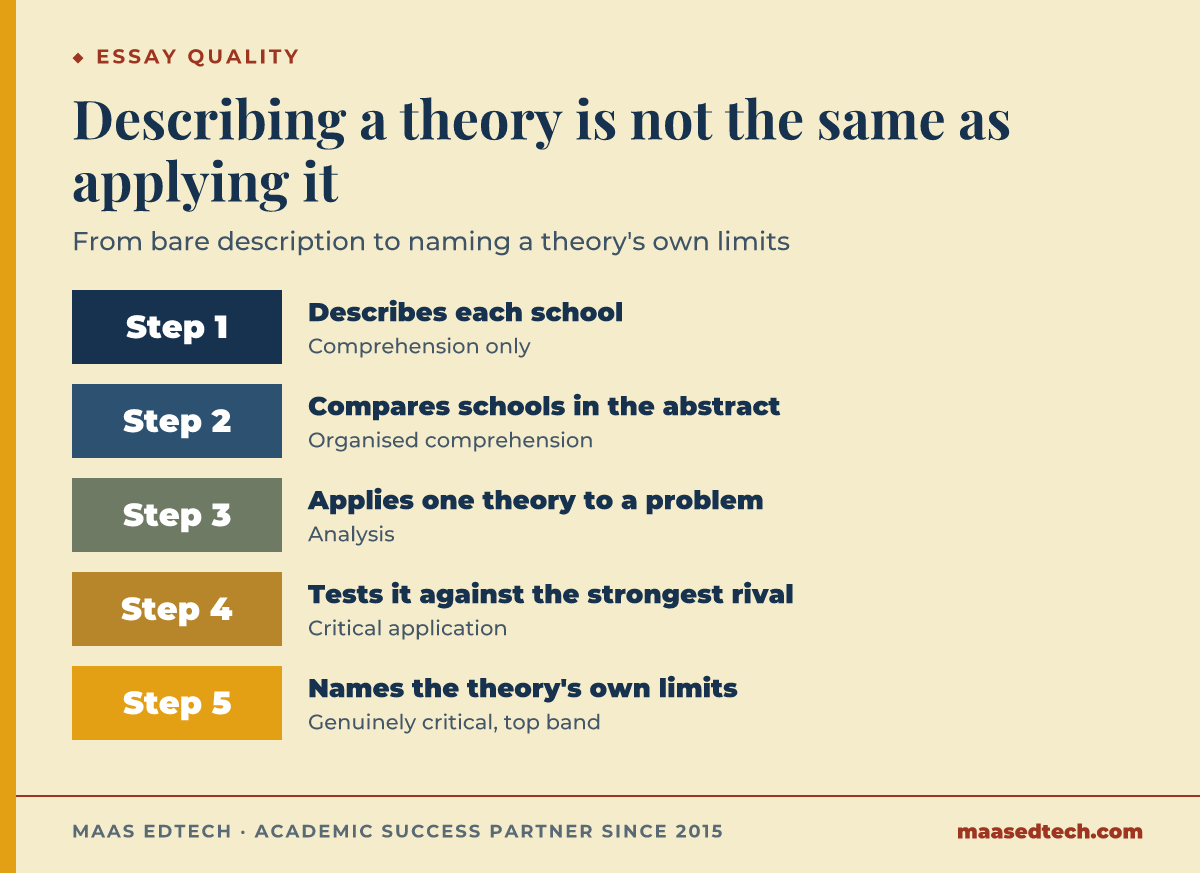
Direct answer: Because describing or comparing schools of thought only proves comprehension, while ACU markers reward application, the same distinction the Hart and Fuller debate tests. The table runs from bare description through applying a theory, testing it against its strongest rival, with the top band naming its limits. An essay that stops at description has completed the reading, not the task.
| What the essay does | How it reads | What the task asked for |
|---|---|---|
| Describes each school in turn | Comprehension | Application |
| Compares schools in the abstract | Organised comprehension | Application to an issue |
| Applies one theory to a legal problem | Analysis | Closer |
| Applies a theory, then tests it against the strongest rival reading | Critical application | This |
| All of the above, with the limits of the theory named | Genuinely critical | This, at the top of the band |
Evidence: The difference is visible in the verb. Knowing the schools of thought is the prerequisite for the essay rather than its content. An essay that stops at description has completed the reading, not the task, which is why students who found the material genuinely interesting sometimes still score in the middle.
Example: Given a question about whether officials in an unjust legal system are bound to obey, one student explained natural law and positivism and left the reader to decide. Another took a position, worked the problem through positivism to its conclusion, then showed exactly where a natural law theorist would say that conclusion becomes intolerable, and defended the position anyway.
Which debate should you learn properly?
Direct answer: Hart and Fuller. It is the clearest available model of what this unit wants, because both papers apply theory to the same concrete problem and reach different answers, and they were published back to back in the same 1958 issue of the Harvard Law Review.
Evidence: H.L.A. Hart (1958) defends the positivist insistence on distinguishing the law that is from the law that ought to be, arguing that critics had confused this distinction with other positivist doctrines that deserved criticism. He is candid about where the distinction strains, conceding that in the penumbra of a rule, where it is unclear whether a case falls under it, "in this area men cannot live by deduction alone" (Hart, 1958, p. 608), and their soundness must rest on some conception of what the law ought to be.
Lon Fuller (1958) replies directly. Rephrasing the question in terms of order and good order, he argues that Hart ignores what he calls the internal morality of law, the set of conditions without which a system of rules cannot function as law at all. His illustration is a monarch who issues commands but never checks who obeyed, so that he habitually punishes loyalty and rewards disobedience. Fuller's point is that such a ruler cannot create law even for his own selfish ends until he accepts a minimum self-restraint, so law considered merely as order already contains an implicit morality.
Example: A student who names both papers in a footnote gets nothing from them. A student who notices that Hart concedes the penumbra and that Fuller attacks precisely there has found the joint in the argument, and can write about a live disagreement rather than two positions in a list.
How do you apply theory to a legal issue without forcing it?
Direct answer: Pick an issue where the theories genuinely disagree about the outcome, not one where they happen to agree. If every school reaches the same conclusion on your facts, the essay has nowhere to go.
Evidence: This follows from what the assessment rewards. Creative and critical application means the theory has to do work, and a theory does no work when the answer was obvious anyway. Issues where a rule is valid by every formal criterion and still produces an outcome people find intolerable are the ones that separate the schools, which is why they recur in the literature.
Example: A student applied feminist legal theory to a contract dispute where the analysis added nothing, and the essay stalled. Reframing around a doctrine that presents itself as neutral while distributing burdens unevenly gave the same theory something to actually say.
What about the unit's Catholic institutional context?
Direct answer: Natural law is on the syllabus as a school of thought, and it will be taught seriously. That is a scholarly position with a long history running back through Thomas Aquinas, not a requirement that you adopt it.
Evidence: The listed topics run from natural law through positivism, realism, critical legal theory and feminist legal theory, which is a standard jurisprudence sequence. The assessment rewards critical application rather than agreement, and the unit is described as developing the ability to apply theories to legal questions.
Example: A student worried that arguing for positivism would be received badly. It was not. What would have been received badly is arguing for any position without engaging the strongest version of its rival.
A practical order of work
Direct answer: Work through six steps: read the assessment verbs before the reading list, learn two theories deeply, such as Bentham and Austin, rather than six shallowly, write one line on what a theory says law is and what it cannot explain, choose issues where theories disagree, read the Hart and Fuller exchange in full, and name the limits you defend.
- Read the assessment descriptions before the reading list. The verbs in them tell you what to practise.
- Learn two theories properly rather than six superficially. Depth is what allows application. The classical positivist line runs from Jeremy Bentham and John Austin through Hart; the natural law tradition most units teach runs through Fuller and John Finnis; Ronald Dworkin's work is the standard modern challenge to both.
- For each theory, write one line on what it says law is and one line on what it cannot explain.
- Choose issues where the theories disagree. If they agree, change the issue.
- Read at least one exchange in full, not summaries of it. Hart and Fuller are right there and they are readable.
- In the research essay, name the limits of the position you defend. Half the marks are on the task that asks for critical application, and acknowledging limits is what makes application critical.
Frequently asked questions
Do I need philosophy background for LAWS403?
No. The prerequisite is LAWS104, and the unit teaches the theories from the beginning. What it assumes is willingness to argue about definitions rather than to look them up.
How many theorists should a research essay cover?
Follow your unit outline. As a rule, two treated properly beats five treated briefly, because the marking criteria reward application and you cannot apply a theory you have only summarised. A 2,500 to 3,000 word essay rarely has room to do justice to more than two positions in real depth.
Is it acceptable to argue that an unjust law is still law?
Yes. That is the positivist position and it has serious defenders. What matters is whether you engage the strongest objection to it rather than the easiest one, ideally working through 2 to 3 competing readings before defending your own.
Can I use current legal controversies as my issue?
Usually yes, and it often works well, provided the controversy is one where the theories actually diverge, since a 2,500 to 3,000 word essay needs genuine disagreement to have anywhere to go. Check your outline for any restrictions on topic choice.
How is this unit different from Statutory Interpretation?
Statutory Interpretation asks how to determine what a provision means within the system. Legal Theory, a separate 10 credit point unit, asks what makes the system law in the first place. Students sometimes answer the first question in an essay that asked the second.
Where MAAS fits
MAAS mentors work alongside law students rather than in place of them. In jurisprudence the most useful session is usually spent on one question about your draft: what work is this theory doing that a plain description of the facts would not do? If the answer is none, the essay is a survey wearing an argument's clothes, and it is better to find that out in week 9 than after the mark comes back. The writing stays yours. If that is useful, our academic support service and our tutoring service are the two places to start.
References
Fuller, L. L. (1958). Positivism and fidelity to law: A reply to Professor Hart. Harvard Law Review, 71(4), 630–672. https://doi.org/10.2307/1338226
Hart, H. L. A. (1958). Positivism and the separation of law and morals. Harvard Law Review, 71(4), 593–629. https://doi.org/10.2307/1338225
Tools & resources
Australian Catholic University. (2026). LAWS403 Legal Theory, Handbook 2026. https://www.acu.edu.au/handbook/handbook-2026/unit/laws403