
There is a specific trap in Introduction to Statute Law that has nothing to do with how hard the material is. The governing New Zealand statute changed in 2021, and much of the study material circulating for this course still predates that change. A student working from an older summary can produce a competent-looking answer built on a repealed provision, a worse position than not knowing the rule at all, because nothing in the answer looks wrong.
Author: MAAS Editorial Team
Last updated: 2026-08-11
Category: law

What changed in 2021, and why does it matter for your marks?
Direct answer: The Interpretation Act 1999 was repealed on 28 October 2021, when the Legislation Act 2019 came into force. The interpretation rule now sits in section 10 of the Legislation Act 2019, providing that the meaning of legislation must be ascertained from its text and its purpose and context, whether or not that purpose is stated in the legislation.
Evidence: The repeal was effected by the Legislation (Repeals and Amendments) Act 2019 (NZ), s 6, and the commencement date is recorded in the Legislation Act 2019 Commencement Order 2021 (LI 2021/249). The wording matters: the old section 5 of the Interpretation Act 1999 referred to text and purpose, while section 10 adds context as a named element. That is not merely tidier drafting, since context is what lets you argue from surrounding provisions, the structure of the Act and its place in the wider statute book.
Example: A student who cited section 5 of the Interpretation Act 1999 in a test answer had learned the rule correctly, from a source that was correct when written. The substance of her argument was sound. She lost marks for citing a provision that no longer exists, which is the cheapest kind of mark to lose and the easiest to prevent.
What to do about it: check the currency of any summary, outline or shared set of notes before relying on it, and read the provision itself on the official legislation website rather than through someone's paraphrase. This habit is being assessed anyway. A course about reading statutes will not be impressed by a student who reads statutes through intermediaries.
What is the course, and where does it sit in the degree?
Direct answer: LAWS 123 Introduction to Statute Law is a core 100-level course in the LLB at Te Herenga Waka Victoria University of Wellington, taken alongside LAWS 121 Introduction to the New Zealand Legal System and LAWS 122 Introduction to Case Law. The published description covers the process of legislation, the techniques of statutory interpretation and legislative drafting, how these interact with the interpretation of case law, and the range of other issues bearing on interpretive principles and methods.
Evidence: The university publishes the course and its place in the LLB structure, and the law faculty's first-year information booklet records that Case Law and Statute Law at 100 level are taught in the second trimester, and that passing LAWS 121, 122 and 123 is part of the progression requirement for later years. In other words the course is a prerequisite in substance as well as in form, and the interpretive method you build here is assumed by every statute-based course that follows.
Example: A student who scraped through this course found second-year courses harder than his classmates did, not because the later material was more difficult but because he was still reading statutes sentence by sentence while others were reading them structurally. The same jump appears in Australian programs, where a first-year criminal law course carries the same load; our guide to LAWS1021 Crime and the Criminal Process at UNSW works through how that foundation is assessed.
Why is reading a statute a different skill from reading a case?
Direct answer: Because a case gives you reasoning and asks you to extract a principle, while a statute gives you a text and asks you to construct the reasoning yourself. Students arrive from LAWS 122 with a well-developed skill and apply it to a task that does not reward it.
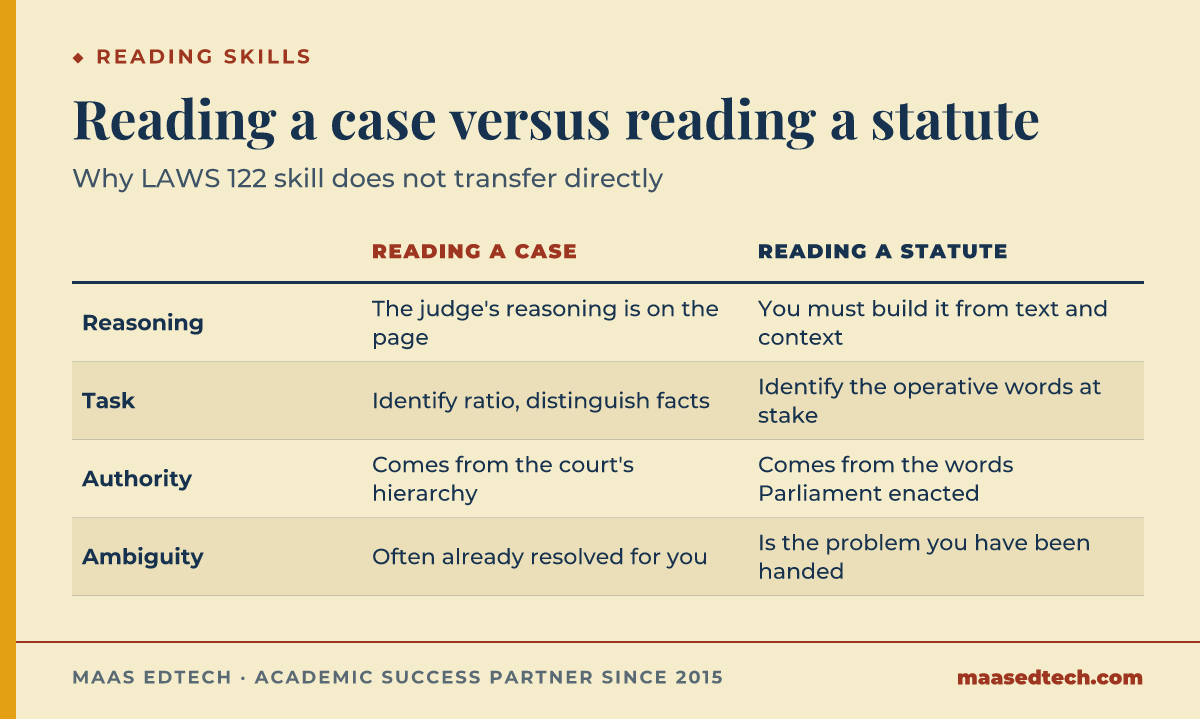
| Reading a case | Reading a statute |
|---|---|
| The judge's reasoning is on the page | The reasoning must be built from text, purpose and context |
| You identify ratio and distinguish facts | You identify the operative words and what turns on them |
| Authority comes from the court's position in the hierarchy | Authority comes from the words Parliament enacted |
| Ambiguity is often resolved for you | Ambiguity is the problem you have been handed |
Evidence: This distinction is the reason the two courses are taught separately rather than as one introduction to legal method. Carter (2021) treats statutory interpretation as a discipline with its own techniques, presumptions and drafting conventions, and the length of that treatment is itself the point. The techniques do not follow from case-reading skill.
Example: Asked whether a provision applied to a set of facts, one student wrote a page summarising three cases in which similar provisions had been considered. The stronger answer began with the words of the provision, identified which word the facts turned on, and only then used a case to show how that word had been construed. Same materials, opposite order, and the second order is the one the course teaches.
What does a strong interpretation answer actually contain?
Direct answer: The operative words, the competing readings those words can bear, the purpose and context that support each reading, and a conclusion that acknowledges what would defeat it.
Most weak answers skip the first step. They state a conclusion about what the provision means without first isolating which words are doing the work, which makes the rest of the answer impossible to assess. If the dispute is about whether a vehicle includes a bicycle, the analysis lives inside the word vehicle and the surrounding provisions that show what kind of mischief the Act was addressing, not in a general discussion of transport policy.
Evidence: Legislation Act 2019 (NZ), s 10 names three inputs, and a complete answer should show all three doing work. A submission that argues purely from purpose, without anchoring in text, has skipped the element the section places first. One that argues purely from the dictionary meaning of a word has ignored the two elements that follow. There is also a live scholarly debate about how much interpretation statutes of this kind actually constrain interpretive practice. Konca argues that the majority of provisions contained in Interpretation Acts "do not engage with debates concerning the proper approach to legal interpretation, but instead focus on matters of sound legislative drafting" (Konca, 2025), so treating section 10 as a formula that mechanically produces answers would be a misreading of its role.
Example: Two answers reached the same conclusion on a contested provision. The first asserted that Parliament clearly intended the wider reading. The second showed that the wider reading fitted the words, was supported by the Act's stated purpose, and was consistent with a neighbouring section that would become redundant on the narrow reading, then noted that a specific definition elsewhere in the Act was the strongest point against it. The second is the one that demonstrates method.
Where do international students most often lose marks?
Direct answer: On the assumption that there is a settled correct answer to find, and on writing that asserts rather than argues.
The first is a genuine difference in legal culture rather than a language problem. Students trained in systems where the code supplies the answer and the task is to locate it can find the New Zealand approach unsettling, because here the provision genuinely may bear more than one reading and the assessment is of how well you handle that. Searching harder for the right answer is the wrong response. Setting out both readings and explaining which is better supported is the task.
The second is linguistic and quite fixable. Legal argument in English runs on markers that signal the strength of a claim: it is arguable that, the better view is, this reading is supported by, on balance, the contrary argument is. Answers written without them read as assertion, and assertion is exactly what a discipline built on contestable readings does not reward. The habit also protects you, because a claim expressed as arguable and then defended survives a marker who disagrees with your conclusion, while a bare assertion does not.
A note on terminology: keep the technical terms in English and use them precisely. Provision, section, subsection, enactment, purposive approach and presumption are not interchangeable, and Carter (2021) treats each as a term of art with its own drafting conventions, and a student who calls everything a rule signals imprecision before the argument even begins.
How should you prepare for assessment in this course?
Direct answer: By practising on provisions you have not seen before, under time limits, rather than by rereading annotated ones.
The practical method is narrow and repeatable. Take an Act you have not studied, open it on the official legislation site, and pick a provision. Write down the operative words. Write two readings the words can bear, even if one seems strained. Find the purpose provision if there is one, and read the sections immediately around your provision to see what context does to the reading. Then write a short conclusion that names the strongest objection. Fifteen minutes on an unfamiliar provision teaches more than an hour re-reading one already worked through in class, because the difficulty in this course is the encounter with unfamiliar text.
Evidence: This mirrors the assessed task rather than the study experience. Course materials you have annotated carry your earlier thinking in the margins, so rereading them rehearses a conclusion instead of building the skill of reaching one.
What do MAAS mentors actually do on a course like this?
MAAS works as an academic advisor. On an interpretation course the useful work is in the reasoning, not the prose. A mentor will ask which words your argument turns on and press when the answer is vague, check whether you have argued from text, purpose and context or only from one of them, look for the counter-argument you left out, and confirm that every provision you cite is current. You do your own reading, form your own view and submit your own work, with citation conventions checked inside the review.
Frequently asked questions
Which university does this guide describe?
Te Herenga Waka Victoria University of Wellington, where LAWS 123 is Introduction to Statute Law, a core 100-level course in the LLB. Codes beginning LAWS appear at many universities and are not interchangeable, so check your own course page before relying on any material.
Which Act governs statutory interpretation in New Zealand now?
The Legislation Act 2019. Section 10 sets out that meaning is ascertained from text, purpose and context. The Interpretation Act 1999 was repealed on 28 October 2021 and should not be cited as current law.
When is the course taught?
Faculty materials record that the 100-level Case Law and Statute Law courses are taught in the second trimester. Confirm the current offering through the university's course finder, since teaching patterns are reviewed.
Do I need to memorise cases?
Less than in a case-law course, and the cases you do use should be doing interpretive work rather than supplying facts. A case that shows how a word has been construed is worth more here than three cases summarised for their outcomes.
Is this course harder than Introduction to Case Law?
Students find it different rather than harder, and the difficulty clusters in the first few weeks while the reading method changes. Those who struggle usually do so because they keep applying case-reading technique to statutory text.
Why does it matter beyond first year?
Most later law courses are built on statutes, so the interpretive method here is assumed rather than retaught. It is also part of the progression requirement into later years of the LLB.
Where this guidance comes from
The legal claims above trace to primary legislation, not secondary summaries: the Legislation Act 2019, the Legislation (Repeals and Amendments) Act 2019, and the Legislation Act 2019 Commencement Order 2021, all published on the official New Zealand Legislation website. The interpretive commentary draws on Carter's (2021) sixth edition of Burrows and Carter Statute Law in New Zealand and Konca's (2025) review in the Statute Law Review, a 4-year gap that itself shows how live the scholarly debate around section 10 still is.
Related reading
Talk to a MAAS mentor about your course
References
Carter, R. (2021). Burrows and Carter statute law in New Zealand (6th ed.). LexisNexis NZ.
Konca, P. (2025). Helpful or hollow? Rethinking the interpretive role of Interpretation Acts. Statute Law Review, 46(3), Article hmaf032. https://doi.org/10.1093/slr/hmaf032
Legislation Act 2019 (NZ), s 10. https://www.legislation.govt.nz/act/public/2019/0058/latest/whole.html
Legislation (Repeals and Amendments) Act 2019 (NZ), s 6. https://www.legislation.govt.nz/act/public/2019/0059/latest/whole.html
Legislation Act 2019 Commencement Order 2021 (LI 2021/249) (NZ). https://www.legislation.govt.nz/regulation/public/2021/0249/latest/whole.html