
ACCT10001 Accounting Reports and Analysis: what does it test?
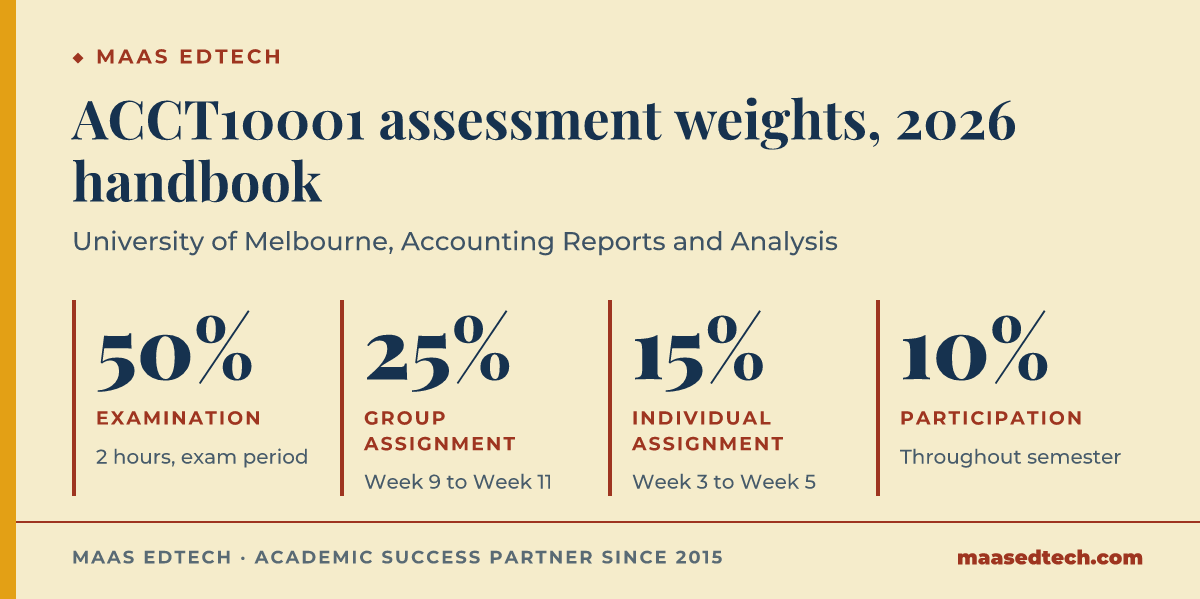
It tests whether you can read accounts, not whether you can produce them. The University of Melbourne (2026a) says the subject focuses on "the informed use of accounting information rather than the preparation of accounts", and the assessment follows that line: an examination of 2 hours worth 50%, a group assignment worth 25%, an individual assignment worth 15%, and in-class participation worth 10%.
Author: MAAS Editorial Team
Last updated: 2026-09-20
Category: accounting-finance

Which ACCT10001 is this guide about?
Direct answer: This guide covers ACCT10001 Accounting Reports and Analysis at the University of Melbourne, a level 1 undergraduate subject taught on campus at Parkville in both Semester 1 and Semester 2 of 2026, with Wayne Coetzee listed as principal coordinator for each (University of Melbourne, 2026d). Your own subject guide remains the authority for your semester.
The handbook lists a total time commitment of 170 hours and weekly contact of one lecture of 90 minutes plus one tutorial of 90 minutes. In Semester 1 of 2026 the teaching period runs from 2 March to 31 May, census date falls on 31 March, and the assessment period ends on 26 June. Semester 2 teaches from 27 July to 25 October, with an assessment period ending 20 November. Those dates matter more than they look, because the last date to withdraw without fail sits well before the group assignment is finished: 8 May in Semester 1 and 25 September in Semester 2.
Students searching the subject code will find notes on file-sharing sites dated 2021 or 2023. Those notes can still help with the mechanics of debits and credits, but several of them describe quiz structures and hurdle rules that the 2026 page does not contain, so the handbook has to be the first thing you check rather than the last.
Who can enrol in ACCT10001, and why does the quota matter?
Direct answer: Anyone can enrol on paper, because the 2026 handbook records no prerequisites, no corequisites and no non-allowed subjects (University of Melbourne, 2026c). In practice the subject is rationed by a quota of 1,900 places each semester, allocated first come, first served, with preference given to students taking it as compulsory or core.
The handbook is unusually direct about the consequence: "Students taking the subject as breadth may be withdrawn and should consider enrolling in the subject in a subsequent study period." Initial self-enrolment is provisional, and a place is not guaranteed until the selection process runs. The last self-enrol date is 13 March 2026 in Semester 1 and 7 August 2026 in Semester 2, and subject enquiries for both semesters go to ara-enquiries@unimelb.edu.au. A breadth student who self-enrols in week one and starts reading can still lose the place after the selection round.
This combination, an open door with a queue behind it, shapes the room you will sit in. A subject with no prerequisite at all cannot assume you have seen a balance sheet before, so it starts from the purpose of accounting rather than from bookkeeping technique. That is why the handbook frames the subject as being designed "to meet the needs of undergraduate students from all disciplines". The cohort is engineers, arts students and commerce students at once, and the assessment is written for that mixture.
How is ACCT10001 assessed in 2026?
Direct answer: The 2026 handbook (University of Melbourne, 2026b) lists four components: in-class participation at 10% spread across the semester, an individual assignment of 600 words at 15% due between Week 3 and Week 5, a group assignment of 3,000 words at 25% due between Week 9 and Week 11, and an end-of-semester examination of 2 hours at 50%.
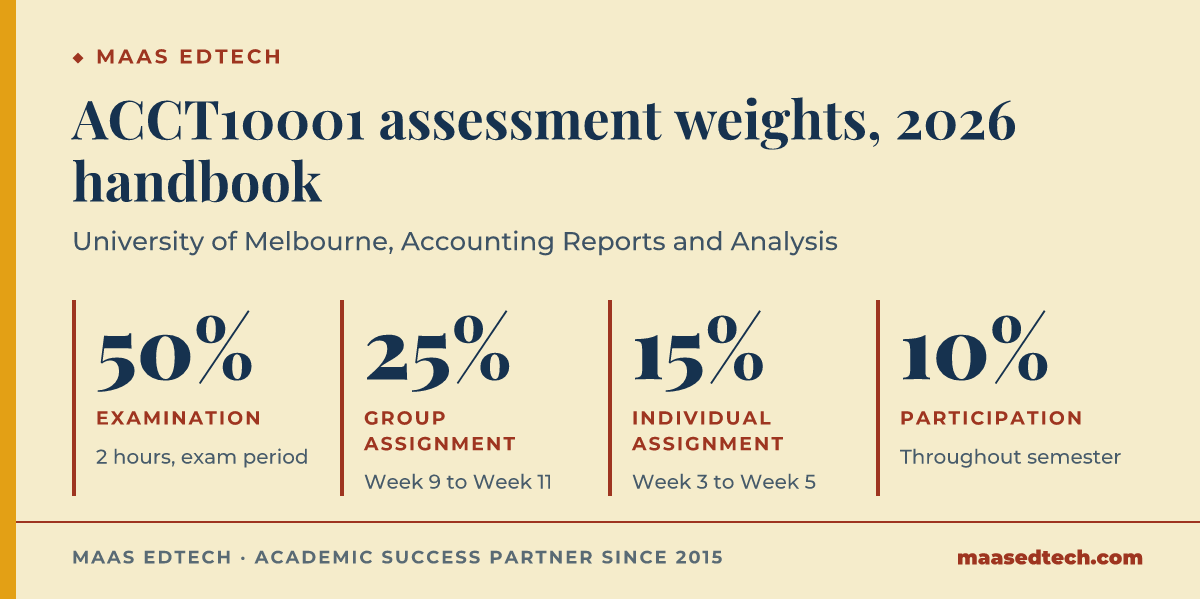
| Component | Length | Timing | Weight |
|---|---|---|---|
| In-class participation | Ongoing | Throughout the semester | 10% |
| Individual assignment | 600 words | Week 3 to Week 5 | 15% |
| Group assignment | 3000 words, groups of 3-4, 750-1000 words each | Week 9 to Week 11 | 25% |
| End-of-semester examination | 2 hours | Examination period | 50% |
Two features of this table are worth sitting with. The first is that half the mark arrives before the exam, which is a more coursework-heavy split than ACCT10002, where the examination carries 60%. The second is the size of the individual assignment relative to its weight: 600 words for 15% means roughly 40 words per mark, so there is no room for a warm-up paragraph that restates the question. The group assignment is more generous at 3,000 words for 25 marks, roughly 120 words per mark, but that budget is split across 3 or 4 writers and shrinks to between 750 and 1000 words each.
A note on the hurdle question, which comes up constantly in student forums. The 2026 assessment page for ACCT10001, last updated on 14 September 2026, lists the four components above and no hurdle requirement. The reason is that the assessment changed in 2026. The 2025 page for this same subject carried an examination of 3 hours at 70%, alongside three coursework tasks of 10% each (University of Melbourne, 2025), and most stale snippets are still quoting that older table rather than a different subject. If passing the exam separately matters to your planning, confirm it in your own subject guide for your own semester rather than in a search snippet.
What does the group assignment actually ask for?
Direct answer: The handbook specifies 3,000 words produced by a group of 3 to 4 students, with each member contributing 750 to 1000 words, submitted between Week 9 and Week 11. The structure means the marker receives one document assembled from three or four separately written sections, and the seam between those sections is usually visible.
That visibility is the real assessment risk, and it has been documented for a long time in the higher education literature. Davies (2009) reviewed the recurring problems of group assessment and grouped them around free riding, uneven contribution and the difficulty of marking a joint product fairly. A 750-word slice per person is small enough that everyone can finish their piece alone, which is precisely what produces four unconnected essays under one cover page.
The practical response is to spend the first meeting on the argument rather than on the division of labour. Agree what the group is claiming about the company or the data before anyone is allocated a section, then write sections that carry that claim forward. A section that opens by re-introducing the company has already spent a fifth of its words repeating what section one did.
Why does "use rather than preparation" change how you should study?
Direct answer: Because the questions reward interpretation of a number, not the production of it. A student who can post a journal entry but cannot say what a rising inventory balance implies about a company is well prepared for a subject ACCT10001 is not.
The handbook's learning outcomes make the emphasis explicit. They ask students to "analyse and interpret major financial statements and the accounting policy choices that influence their preparation", to "critically evaluate the strengths and weaknesses of accounting information relative to the purposes it serves", and to explain corporate governance and ethics and their influence on accounting. Only 1 of the 9 intended learning outcomes concerns defining the categories of assets, liabilities, equity, income, expenses and cash flow activities. The other eight ask for something else, mostly analysis, evaluation and application.
Biggs (1996) called this alignment. Writing about constructivist learning theory, in the abstract of that paper he placed at its centre "the centrality of the learner's activities in creating meaning" (p. 347), which is why teaching, intended outcomes and assessment tasks should point at the same kind of thinking, and students read assessment to work out what kind of thinking is wanted. When the outcomes ask for evaluation and the study method is memorisation of entries, the misalignment sits with the student rather than the subject.
There is a second reason the emphasis exists. Lusardi and Mitchell (2014) surveyed the evidence on financial literacy and found it low even among populations who make consequential financial decisions, which is the case for reading accounts as much as for household finance. A subject built for students from all disciplines is answering that gap, and it marks accordingly.
Where do students most often lose marks?
Direct answer: Marks are lost in four places: describing a ratio instead of interpreting it, treating an accounting policy choice as neutral, writing a group report of 3,000 words that reads as three or four separate essays, and answering an exam question about limitations with a definition instead of a judgement.
Ratio description is the easiest of the four to fall into. Writing that the current ratio fell from 1.8 to 1.3 over 12 months restates a figure the marker can already see. The mark sits in the next sentence, which has to say what would produce that fall and what it implies for the company's position, then test the reading against a second figure rather than stopping at the first plausible story.
Policy choice is the second. Accounting standards leave managers real discretion over recognition, measurement and disclosure, and the handbook lists "accounting policy choices available to managers for key assets and incentives associated with policy choices" among the topics. The word doing the work there is incentives. Hopwood (1983) argued that accounting has to be studied in the contexts in which it operates rather than as a technique standing on its own, and a policy answer that never mentions who benefits from the choice has left the context out. Depreciation method, inventory valuation and the capitalisation of development costs are 3 typical examples of the kind of choice being asked about.
The third is the group seam discussed above. The fourth is the limitations question. Asked what accounting information cannot tell you, students often define an accounting concept instead. The Australian Accounting Standards Board (2019) conceptual framework sets out the qualitative characteristics that financial information is meant to have, and a strong answer uses those characteristics as a measuring stick against a specific case rather than reciting them.
How does ACCT10001 relate to ACCT10002 and to finance subjects?
Direct answer: ACCT10001 approaches accounting as a reader; ACCT10002 Introductory Financial Accounting approaches it from the preparer's side in order to understand reporting from a user's perspective, and it carries a heavier examination weighting. ACCT10002 is not a prerequisite for ACCT10001 in the 2026 handbook, although ACCT10001 does appear among the prerequisites listed for ACCT10002.
The eligibility page for ACCT10002 lists ACCT10001 at 12.5 credit points, which is the standard level 1 load at the University of Melbourne. The distinction matters for study planning. Students who intend to major in accounting generally meet the preparation-heavy stream, where recording transactions and building statements is the skill assessed. Students taking ACCT10001 as a compulsory or core subject in a non-accounting degree meet a subject whose exam asks them to reason about statements someone else produced. Finance subjects sit beside both and ask a third question, about valuing and funding, which is why comparing the three by their reading lists rather than their titles is more useful than it sounds.
If you are choosing between subjects, read the assessment page and the learning outcomes side by side before the enrolment deadline. Given the 1,900-place quota and the provisional nature of self-enrolment, a decision made in Week 3 is more expensive than the same decision made in the week before teaching starts.
What do MAAS mentors do on this subject?
Direct answer: A mentor works through your own questions and drafts with you and explains where an answer stops short of what the outcome asks. You write the submitted work; the mentor helps you see the gap between a description and an evaluation.
A typical session on ACCT10001 takes one ratio or one policy choice from your own tutorial set and asks you to argue it out loud, because the sentence you can say is usually the sentence you can write. Over a 12-week teaching period that runs from 2 March to 31 May in Semester 1, two or three sessions placed before Week 3, before Week 9 and before the examination period usually cover the three points where the subject changes what it is asking for. For the group assignment, mentors more often help a student plan the shared argument before drafting than comment on a finished section, since the seam problem cannot be fixed after the fact.
Frequently asked questions
Does ACCT10001 have a prerequisite?
No. The 2026 handbook lists no prerequisites, no corequisites and no non-allowed subjects for this subject.
How much is the ACCT10001 exam worth?
The end-of-semester examination is worth 50% and runs for 2 hours during the examination period, according to the 2026 handbook.
How long is the group assignment, and how big are the groups?
It is 3,000 words in groups of 3 to 4 students, with each member writing 750 to 1000 words, submitted between Week 9 and Week 11.
Can I lose my place in ACCT10001 after enrolling?
The handbook states that self-enrolment is provisional and that students taking the subject as breadth may be withdrawn, because a quota of 1,900 places applies in each semester and preference goes to students taking it as compulsory or core.
How many hours should I expect to spend?
The handbook lists a total time commitment of 170 hours, including one lecture of 90 minutes and one tutorial of 90 minutes each week.
Ready to work through ACCT10001 with a mentor?
If your ratio answers keep coming back marked as descriptive, or the group report is turning into three separate essays, a short conversation usually shows where the reasoning stops. Book a free 15-minute consultation and bring your own tutorial questions. MAAS matches you with a subject mentor within 48 hours when the network already has a suitable person; otherwise a dedicated search usually takes around two weeks.
Explore one-to-one subject tutoring
Related guides
- ACCT10002: introductory financial accounting
- ACCT20001: accounting for management decisions
- ACCT1101: accounting for decision making
Talk to a MAAS mentor about your subject
References
Australian Accounting Standards Board. (2019). Conceptual framework for financial reporting. AASB. https://www.aasb.gov.au/admin/file/content105/c9/Conceptual_Framework_05-19.pdf
Biggs, J. (1996). Enhancing teaching through constructive alignment. Higher Education, 32(3), 347-364. https://doi.org/10.1007/BF00138871
Davies, W. M. (2009). Groupwork as a form of assessment: Common problems and recommended solutions. Higher Education, 58(4), 563-584. https://doi.org/10.1007/s10734-009-9216-y
Hopwood, A. G. (1983). On trying to study accounting in the contexts in which it operates. Accounting, Organizations and Society, 8(2-3), 287-305. https://doi.org/10.1016/0361-3682(83)90035-1
Lusardi, A., & Mitchell, O. S. (2014). The economic importance of financial literacy: Theory and evidence. Journal of Economic Literature, 52(1), 5-44. https://doi.org/10.1257/jel.52.1.5
University of Melbourne. (2025). Accounting reports and analysis (ACCT10001): Assessment [Handbook entry, 2025 edition]. https://handbook.unimelb.edu.au/2025/subjects/acct10001/assessment
University of Melbourne. (2026a). Accounting reports and analysis (ACCT10001) [Handbook entry]. https://handbook.unimelb.edu.au/2026/subjects/acct10001
University of Melbourne. (2026b). Accounting reports and analysis (ACCT10001): Assessment [Handbook entry]. https://handbook.unimelb.edu.au/2026/subjects/acct10001/assessment
University of Melbourne. (2026c). Accounting reports and analysis (ACCT10001): Eligibility and requirements [Handbook entry]. https://handbook.unimelb.edu.au/2026/subjects/acct10001/eligibility-and-requirements
University of Melbourne. (2026d). Accounting reports and analysis (ACCT10001): Dates and times [Handbook entry]. https://handbook.unimelb.edu.au/2026/subjects/acct10001/dates-times