
ACCT10002 Introductory Financial Accounting: how do you pass?
You pass it mostly in the exam room. The University of Melbourne's 2026 handbook gives the 2.5-hour end-of-semester examination 60% of ACCT10002, and the other 40% is spread across engagement, quizzes and accounting software practice sets that reward steady weekly work more than any single burst of effort.
Author: MAAS Editorial Team
Last updated: 2026-09-19
Category: accounting-finance
Which ACCT10002 is this guide about?
Direct answer: This guide covers ACCT10002 Introductory Financial Accounting at the University of Melbourne, a level 1 undergraduate subject worth 12.5 credit points, taught on campus at Parkville in Semester 1 and Semester 2 of 2026. Demi Wang is listed as principal coordinator for both semesters, so check your own subject guide for any changes.
Evidence: The University of Melbourne (2026a) handbook says the subject looks at accounting "from the perspective of a preparer of financial reports in order to understand financial reporting from a user perspective." The listed time commitment is 170 hours, delivered through one 1-hour lecture, one 1-hour tutorial and one 1-hour online self-directed session each week. In Semester 2 of 2026 teaching runs from 27 July to 25 October, and the assessment period ends on 20 November.
Example: A student searching "ACCT10002" may find notes from 2023 or 2024 on sharing sites. Those notes can still help with debits and credits, but the assessment advice inside them may describe a structure the 2026 subject no longer uses, so the handbook should always be your first check.
How is ACCT10002 assessed in 2026?
Direct answer: The 2026 handbook lists four components: subject engagement across the semester (10%), a quiz component across the semester (10%), accounting software practice sets from Week 6 to Week 11 (20%), and a 2.5-hour end-of-semester examination (60%). There is no essay, so almost every mark comes from recording, preparing and analysing numbers.
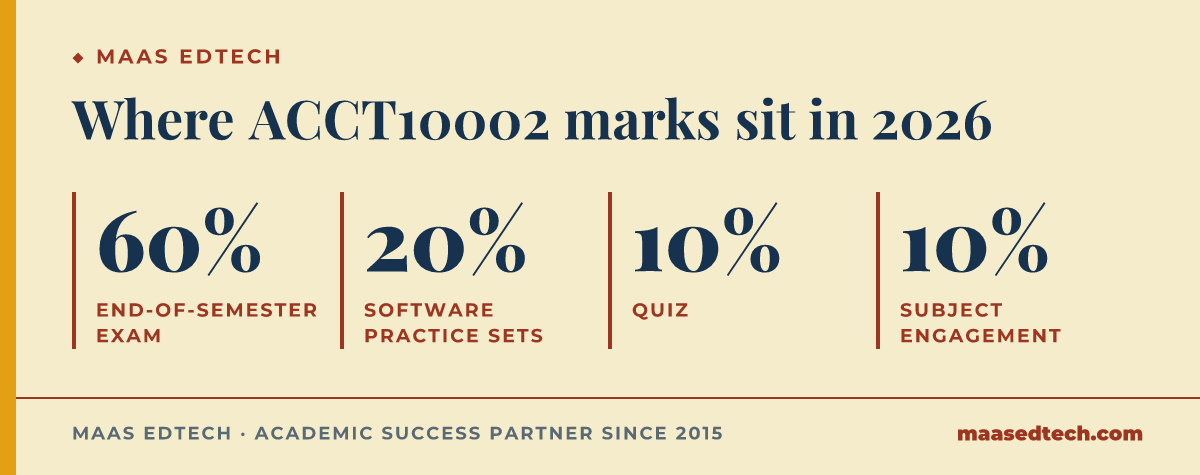
| Assessment | Weight | Workload listed | When |
|---|---|---|---|
| Subject engagement | 10% | 10 hours | Throughout semester |
| Quiz | 10% | 10 hours | Throughout semester |
| Accounting software practice sets | 20% | 20 hours | Weeks 6 to 11 |
| End-of-semester examination | 60% | 2.5 hours | Examination period |
Evidence: The University of Melbourne (2026b) assessment page, last updated on 14 September 2026, gives these weights. A search result for the same page still shows an older version that described three one-hour quizzes and 12 hours of engagement work, which is a useful warning: descriptions change between years, and the version stamped 2026 is the one that governs this year.
Example: Add up the marks that depend on regular effort rather than exam performance. Engagement and quizzes together make 20%, and the practice sets add another 20%, so most of that 40% is settled before the exam begins. A student who secures most of that 40% walks into the exam needing far less from it.
What are the accounting software practice sets, and how do you do well on them?
Direct answer: The practice sets run from Week 6 to Week 11, carry 20%, and ask you to process a business's transactions inside accounting software. Marks follow from accuracy at each step, so the habit that matters most is checking every entry against the underlying double-entry logic before moving on.
Evidence: The handbook's fourth learning outcome asks students to "record accounting transactions and prepare the Trial Balance, Balance Sheet and the Income Statement", and its generic skills list rates "use of computer software" at a high level of development, alongside problem solving. Software posts the entry you give it; it does not tell you whether an expense should have been recorded as an asset. One mistaken classification in Week 6 can flow through every report the set asks for by Week 11.
Example: Before entering a transaction, write the journal on paper: which account rises, which falls, and why. If a supplier invoice for 12 months of insurance arrives, the paper version forces the question of whether it is an expense now or a prepayment spread over the year. Students who skip this step often find their trial balance balances but their profit is wrong, because balancing only proves debits equal credits.
What does the ACCT10002 exam test, and why does the cash flow statement matter so much?
Direct answer: The handbook publishes no exam outline, but its 12 learning outcomes range from Australian reporting regulation to cash flow statements and ratio analysis, and the 60% exam is where most of them can be tested. Give the cash flow statement extra time, because it tests how profit and cash differ.
Evidence: The handbook's ninth outcome asks students to "construct and analyse a Cash Flow Statement", and the tenth asks them to assess a firm's performance "in comparison with past performance and with other firms". Sloan (1996) found that earnings built mostly on accruals tend to persist less than earnings backed by operating cash flow, and that investors did not fully price the difference. That is why reconciling profit with operating cash flow is worth practising: the gap between them tells a reader something about earnings quality.
Example: A company reports a profit of $500,000 but negative operating cash flow of $80,000, because customers owe it more and inventory has built up. A strong exam answer calculates both figures correctly, then states what the gap suggests about collections and stock, and what a lender or investor would want to check next.
How do you answer questions on accounting policy choice?
Direct answer: Treat a policy choice question as a question about judgement: name the options the standard allows, show how each changes the reported figures, then explain why a preparer might prefer one. A correct calculation without that explanation usually leaves marks behind, because the outcome asks you to describe flexibility, not only to apply a rule.
Evidence: The handbook overview says "Choices within accounting standards and the implications for financial reports are explored", and the seventh outcome refers to "the flexibility that preparers have in applying the accounting standards." Fields et al. (2001) reviewed the research on accounting choice and grouped managers' motives into three areas: contracting, asset pricing, and influencing third parties. Watts and Zimmerman (1990) earlier argued that such choices can be predicted from contracts such as debt covenants and bonus plans, which gives you a framework for explaining why a firm chose one method.
Example: Asked to compare straight-line and diminishing-balance depreciation on a $100,000 machine with a five-year life, calculate both, then note that the diminishing-balance method lowers early profit. A manager whose bonus depends on this year's profit may prefer straight-line, and saying so, with the reason, shows the evaluation the outcome describes.
Why does the Conceptual Framework keep appearing in questions?
Direct answer: The Conceptual Framework is the reasoning behind the standards, so questions use it to test whether you can justify a treatment rather than recite it. Expect to explain the objective of general purpose financial reporting, the qualitative characteristics of useful information, and the definitions of assets, liabilities, income and expenses.
Evidence: Outcomes two and three ask students to describe the objectives of general purpose financial reporting and explain the Conceptual Framework's key components. The International Accounting Standards Board (2018) framework, adopted in Australia by the Australian Accounting Standards Board (2019), names relevance and faithful representation as the two fundamental qualitative characteristics. Healy and Palepu (2001) wrote that "corporate disclosure is critical for the functioning of an efficient capital market" (p. 405), and they explain why: financial reports exist because managers know more about the firm than outside investors, and credible reporting reduces that information gap.
Example: If a question asks whether a company should recognise a lawsuit it will probably lose, apply the liability definition step by step: is there a present obligation, does it arise from a past event, and could it require the firm to transfer economic resources? A reasoned answer earns more than a bare "yes, recognise a provision".
Who can take ACCT10002, and how does it relate to ACCT10001?
Direct answer: In 2026 the prerequisite is admission into the Bachelor of Commerce before 2026 or completion of ACCT10001 Accounting Reports and Analysis, and ACCT20008 Accounting Information for Reporting is listed as a non-allowed subject. Enrolment can be refused on these grounds, so check eligibility before planning your study sequence.
Evidence: The University of Melbourne (2026c) eligibility page states these rules. On Reddit's r/unimelb, a student asked why a friend received an email saying the subject was unavailable because its content was covered by a level 2 subject, which is consistent with the non-allowed listing, though one post is an anecdote rather than a rule. ACCT10001 Accounting Reports and Analysis builds reading and analysis of reports, while ACCT10002 moves to the preparer's side of recording and preparing them.
Example: A student who started the Bachelor of Commerce in 2026 and has not completed ACCT10001 should confirm the pathway with a course adviser before selecting subjects, rather than assuming the older sequence still applies.
Where do students most often lose marks?
Direct answer: Marks are commonly lost in five places: missing engagement tasks early in semester, trusting the software without checking classifications, memorising cash flow formats without understanding them, calculating policy choices without explaining them, and starting exam practice too late. Each follows from misjudging where the 60% sits and what it rewards.
Evidence: With 20% from engagement and quizzes and 60% from the exam, the grade rewards consistency first and applied understanding second. Vietnamese students who studied bookkeeping before may arrive strong in the mechanics from high school or earlier study, which helps with journals, but the Australian regulatory framework, the Conceptual Framework and sustainability reporting in outcome 12 are usually new material. Those topics need reading, not only practice.
Example: A useful weekly routine takes about 90 minutes: complete the pre-tutorial questions, redo one question you got wrong without looking at the solution, and write two sentences explaining a concept from that week in your own words. Over a 12-week semester, that builds the habit the exam tests.
What do MAAS mentors do on this subject?
MAAS mentors work through the concepts and your own practice attempts with you: tracing why a trial balance does not reconcile, explaining the logic of a cash flow reconciliation, or timing past-style exam questions. Your submissions stay your own work, which is also what the subject assesses.
Frequently asked questions
How many credit points is ACCT10002 worth?
12.5 points. It is a level 1 undergraduate subject at the University of Melbourne.
How much is the ACCT10002 exam worth?
The end-of-semester examination is worth 60% in the 2026 handbook and runs for 2.5 hours during the examination period.
When are the accounting software practice sets due?
They run from Week 6 to Week 11 and are worth 20% in total. Check your subject guide for the exact dates in your semester.
What is the prerequisite for ACCT10002?
You need either a Bachelor of Commerce place that began before 2026 or a pass in ACCT10001. Students who have taken ACCT20008 cannot also enrol, so check the eligibility page for your year.
How many hours should I expect to study?
The handbook lists a total time commitment of 170 hours across the semester, including three scheduled hours each week: a lecture, a tutorial and an online self-directed session.
Ready to work through ACCT10002 with a mentor?
If your trial balance keeps coming out right while your profit comes out wrong, or cash flow questions still feel like guesswork, a short conversation often shows where the logic breaks. Book a free 15-minute consultation and bring your practice questions. MAAS matches you with a subject mentor within 48 hours when the network already has a suitable person; otherwise a dedicated search usually takes around two weeks.
Explore one-to-one subject tutoring
Related guides
- ACCT10001: accounting reports and analysis
- ACCT20001: accounting for management decisions
- ACCT2511: financial accounting fundamentals
- ACCT1101: accounting for decision making
Talk to a MAAS mentor about your subject
References
Australian Accounting Standards Board. (2019). Conceptual framework for financial reporting.
Fields, T. D., Lys, T. Z., & Vincent, L. (2001). Empirical research on accounting choice. Journal of Accounting and Economics, 31(1-3), 255-307. https://doi.org/10.1016/S0165-4101(01)00028-3
Healy, P. M., & Palepu, K. G. (2001). Information asymmetry, corporate disclosure, and the capital markets: A review of the empirical disclosure literature. Journal of Accounting and Economics, 31(1-3), 405-440. https://doi.org/10.1016/S0165-4101(01)00018-0
International Accounting Standards Board. (2018). Conceptual framework for financial reporting. IFRS Foundation.
Sloan, R. G. (1996). Do stock prices fully reflect information in accruals and cash flows about future earnings? The Accounting Review, 71(3), 289-315.
University of Melbourne. (2026a). Introductory financial accounting (ACCT10002) [Handbook entry]. https://handbook.unimelb.edu.au/2026/subjects/acct10002
University of Melbourne. (2026b). Introductory financial accounting (ACCT10002): Assessment [Handbook entry]. https://handbook.unimelb.edu.au/2026/subjects/acct10002/assessment
University of Melbourne. (2026c). Introductory financial accounting (ACCT10002): Eligibility and requirements [Handbook entry]. https://handbook.unimelb.edu.au/2026/subjects/acct10002/eligibility-and-requirements
Watts, R. L., & Zimmerman, J. L. (1990). Positive accounting theory: A ten year perspective. The Accounting Review, 65(1), 131-156.