
Students arrive at ACCT2019 from introductory accounting, where a figure is either right or wrong and a standard decides which. Management accounting does not work that way. Overhead allocation, which costs count as relevant, the assumptions behind a budget: these are choices, and two competent analysts making different defensible choices will produce different numbers from identical data. Students keep hunting for the correct answer and write up the search instead of the decision.
Author: MAAS Editorial Team
Last updated: 2026-08-11
Category: accounting-finance

Where the unit sits, and what it takes to get in
Direct answer: ACCT2019 Accounting Analysis for Management Decisions is a unit worth 6 credit points in the University of Sydney Business School, one of 24 units in a standard 144 credit point undergraduate degree, sitting one level above the introductory accounting units and requiring both of them.
Evidence: The published unit page lists prerequisites of ACCT1001 or ACCT1005 or BUSS1030, together with ACCT1002 or ACCT1006, and prohibits ACCT2012. It runs in both semesters. Its stated purpose is to give students the competencies to apply management accounting tools, techniques and methods to analyse complex business challenges and evaluate organisational performance.
The published outcomes reach further than technique. One asks you to communicate to a professional standard; another asks you to apply the tools to interpret organisational problems and make ethical decisions; another names budgets, costing and cost control, business planning and internal control as the working material. Read together, they describe someone advising a manager rather than someone completing a worksheet.
A note if you are coming from BUSS1030. BUSS1030 taught you to serve an external reader working from published accounts. Here the reader sits inside the organisation, wants a decision made this month, and is not bound by any reporting standard. Nearly every difficulty in ACCT2019 traces back to that change of audience.
Why is there no single correct number?
Direct answer: Because management accounting numbers are constructed to answer a specific question, and a different question legitimately produces a different number from the same data.
Consider overhead. Activity-based costing, developed by Kaplan and Cooper (1998) in Cost and Effect, published by Harvard Business School Press, to trace overhead to the activities that actually drive it, is one alternative to a single volume-based rate. Allocating factory overhead by machine hours, by labour hours or by activity drivers will make the same product look profitable under one method and marginal under another. None of those methods is wrong. What would be wrong is choosing one without saying why, or presenting the resulting figure as though it were a fact about the product rather than an output of your method.
| Financial accounting habit | What this unit expects instead |
|---|---|
| Find the treatment the standard requires | Choose a method and justify it against the decision at hand |
| One right answer per question | A defensible answer, with its basis stated |
| The figure is the output | The figure plus the reasoning is the output |
| Accuracy | Relevance to the decision |
Evidence: Johnson and Kaplan (1987), in Relevance Lost, built their well-known critique of the field on precisely this point, arguing that management accounting had drifted into serving external reporting conventions and had stopped producing information managers could act on. The corrective, which shaped the syllabus you are now studying, was to design costing and performance information around the decision it supports rather than around what was convenient to report.
Example: Asked whether to discontinue a product line showing a loss, a student recalculated the loss carefully and recommended closure. The allocated head-office overhead in that figure would not disappear if the line closed; it would land on the remaining products. The stronger answer separated costs that would actually stop from costs that would merely move, and found the line was contributing.
What makes relevant costing so easy to get wrong?
Direct answer: Because the rule is simple, the psychology fighting it is strong, and exam questions are built to exploit the gap.
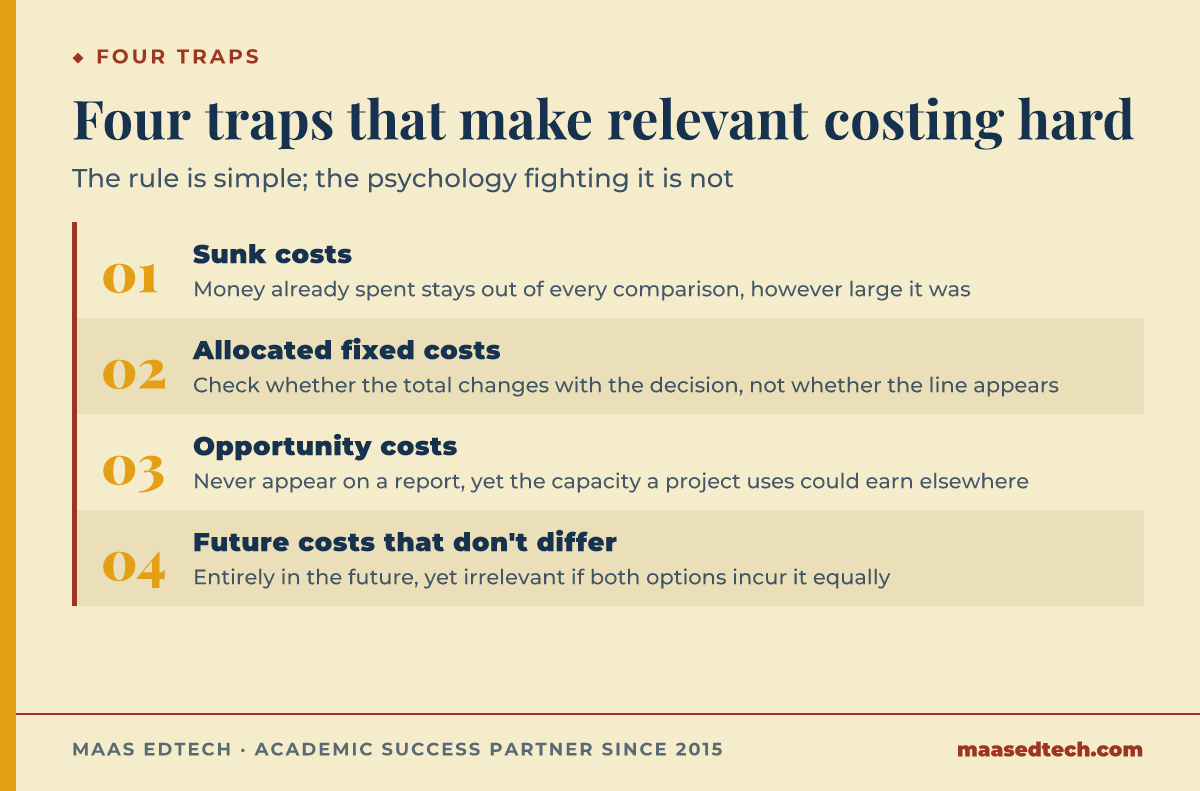
A cost is relevant to a decision if it differs between the alternatives and lies in the future. That single sentence disposes of most of the difficulty, and students who can recite it still fall into the traps, because the traps are not intellectual.
- Sunk costs. Money already spent cannot be recovered by any option in front of you, so it belongs in no comparison, the same sunk cost fallacy Arkes and Blumer (1985) documented: "The sunk cost effect is manifested in a greater tendency to continue an endeavor once an investment in money, effort, or time has been made" (Arkes & Blumer, 1985). Every question that mentions what was already invested in a project is testing whether you will let that figure pull you.
- Allocated fixed costs. These appear on the report and often do not change with the decision. Check whether the total changes, not whether the line item is present.
- Opportunity costs. These never appear on any report and frequently are relevant. The capacity a project consumes could have earned something else.
- Future costs that do not differ. A cost can be entirely in the future and still be irrelevant if both options incur it equally.
Evidence: The relevance test here is the same standard Johnson and Kaplan (1987) argued was missing from cost information generally. Arkes and Blumer (1985), publishing in Organizational Behavior and Human Decision Processes, demonstrated the sunk cost effect experimentally, showing that people persist with an inferior option in proportion to what they have already committed to it, even when the prior expenditure is explicitly irrecoverable. Their finding explains why the sunk cost trap survives being taught: knowing the rule and resisting the pull are separate capacities, and only the second is being examined.
Example: A question described a machine purchased 2 years ago, with 5 years of useful life remaining, for a large sum and asked whether to replace it now. One answer weighed the original purchase price against the new machine's cost. The other noted that the purchase price was unrecoverable and compared only the future operating costs and disposal value of each option. The second reached the opposite recommendation, and it was the correct one.
How should you write a management accounting recommendation?
Direct answer: State the decision, show only the figures that bear on it, name your method and its basis, and say what would change your answer.
The instinct carried over from ACCT1001 or ACCT1005 is to show everything you calculated, on the theory that more work earns more marks. Here it does the reverse, because including irrelevant costs is not extra effort but a substantive error. A schedule containing sunk costs signals that you have not applied the relevance test, whatever the surrounding prose says.
The professional-standard communication outcome is asking for something specific: a manager reading your analysis should be able to act on it without reconstructing your reasoning. That means the recommendation comes first, the supporting numbers are the ones that matter, and the assumptions are visible rather than buried.
Example: Two submissions on the same make-or-buy decision reached the same conclusion. The first presented a full cost schedule and a paragraph of discussion. The second presented four lines, stated that fixed overhead had been excluded because it would not change under either option, and added that the recommendation would reverse if the supplier's price rose above a stated threshold. The second is what the outcome about professional communication describes.
What about the ethical dimension?
Direct answer: The ethical dimension is named in the published outcomes, and it is not decoration. The same discretion that makes management accounting useful makes it manipulable.
If you choose the allocation method, you can choose the one that makes a division look better. If you set the budget, you can build in slack that guarantees a favourable variance. If you select performance measures, you can select those that flatter. These are not exotic frauds; they are ordinary choices made in a self-serving direction, and they are why an outcome about ethical decisions appears in a technical unit.
Questions in this area reward specificity. Writing that managers should act with integrity earns little. Identifying that a divisional manager evaluated on return on investment (ROI) has an incentive to reject a project that would benefit the company overall, and explaining the mechanism, is an answer about a real conflict in the design of the measurement system.
A caution on shared study material. The unit page lists a prohibition against ACCT2012, a management accounting unit no longer offered, and material still circulates under that code. The technical topics overlap heavily, but the framing around decisions, ethics and communication in the current published outcomes is where the marks sit, and that is exactly the part an inherited summary will underweight.
If English is not your first language, where does the pressure land?
Direct answer: On the justification sentences, which are short, unavoidable and carry disproportionate weight.
The calculations are largely language-free, so ACCT2019 is often more approachable than it first appears. The pressure is concentrated in explaining why a cost was included or excluded, and those sentences are hard to write vaguely without sounding wrong. That is uncomfortable and also an opportunity, since a handful of well-built sentence patterns will serve across the entire unit: this cost is excluded because it does not differ between the alternatives, the allocation basis chosen reflects, this recommendation assumes, the conclusion reverses if.
On vocabulary, hold the distinctions firmly. Cost, expense, expenditure and outlay are not interchangeable here, nor are avoidable and variable, nor are contribution and profit. Managerial and financial accounting sometimes use identical words for different things, so a term you learned in the prerequisite unit may not carry the same meaning in this one.
Working with a MAAS mentor on management accounting
Our role is advisory, and on ACCT2019 the conversation is mostly about what you left out and why. A mentor will ask which costs you excluded and whether the relevance test actually supports that; check that your chosen method is justified against the decision rather than by habit; look for the opportunity cost that appears in no report; test whether a manager could act on your recommendation as written; and probe whether your ethics discussion identifies a specific incentive or only gestures at good conduct. The analysis is yours, the recommendation is yours, and the submission is your own.
Frequently asked questions
Which institution offers this unit?
The University of Sydney (USYD), based on the Camperdown Campus, where ACCT2019 is Accounting Analysis for Management Decisions, a Business School unit worth 6 credit points. Verify the title against your own enrolment, since codes of this form appear at other institutions for unrelated subjects.
What do I need to have passed first?
The unit page lists ACCT1001 or ACCT1005 or BUSS1030, together with ACCT1002 or ACCT1006, and prohibits ACCT2012. Requirements change between years, so check the page for your year rather than relying on a friend's experience.
How different is this from introductory accounting?
Different enough that strong marks there do not predict strong marks here. The mechanics are comparable in difficulty; the shift is from applying rules to justifying choices. If the prerequisite itself is where you struggled, the ACCT1006 guide sets out where that unit tends to break down.
Is it heavy on calculation?
Calculation is constant but rarely complex. The marks concentrate in method selection, relevance judgments and the written justification around the figures.
Why does an accounting unit assess communication?
Because management accountants produce advice for decision-makers rather than reports for regulators. An analysis a manager cannot act on has not done its job, which is why the outcome sits alongside the technical ones.
Is material circulating under ACCT2012 still usable?
The technical topics overlap heavily, but treat the current published outcomes as authoritative for what is assessed, particularly the parts on ethical decisions and professional communication.
Related reading
- BUSS1030: accounting for decision making
- BUSS1020: quantitative business analysis
- Academic support from MAAS mentors
Ask a MAAS mentor about your unit
References
Arkes, H. R., & Blumer, C. (1985). The psychology of sunk cost. Organizational Behavior and Human Decision Processes, 35(1), 124–140. https://doi.org/10.1016/0749-5978(85)90049-4
Johnson, H. T., & Kaplan, R. S. (1987). Relevance lost: The rise and fall of management accounting. Harvard Business School Press.
Kaplan, R. S., & Cooper, R. (1998). Cost & effect: Using integrated cost systems to drive profitability and performance. Harvard Business School Press.