
◆ Accounting & Finance
ACCT1006: why do adjusting entries decide your semester?
Most students who lose ACCT1006 do not lose it in the final exam. They lose it in the 3 or 4 weeks when adjusting entries are introduced, quietly, while everything still feels manageable. The journal entries in front of them look like the ones from week 2, so they keep pace by pattern-matching. Then the unit asks for a full set of statements, and the pattern stops working, because a statement is not a bigger journal entry. It is the output of a cycle in which one mishandled adjustment moves every figure downstream.
◆ Question 1 / 7 · The unit
What is ACCT1006, and where does it sit in the degree?
Direct answer: ACCT1006 Accounting and Financial Management is a 6 credit point undergraduate unit at the University of Sydney Business School, taught by the Discipline of Accounting, Governance and Regulation. It requires BUSS1030 or ACCT1005 beforehand, and is prohibited against all 4 of ACCT1001 to ACCT1004. The University of Sydney (2026) calls it the gateway unit into further accounting study.
Evidence: Taught on the Camperdown and Darlington campus, the unit carries a description in which the word gateway is doing real work. A gateway unit is one that later units assume rather than revisit, which means the marginal cost of a shaky pass here is paid in second year, not now. The 4 learning outcomes the University published for 2026 ask students to record business transactions and produce financial statements, to analyse business information to solve problems, to communicate professionally, and to apply ethical decision-making. Note that only the first of those four is the mechanical skill most students spend their study time on.
Example: A student arriving at MAAS from a Sydney commerce degree had passed ACCT1006 with a credit and then found ACCT2011 unexpectedly hard. Working backwards through her old material, her mentor found the gap was not in the second-year content. She had never been able to explain why an accrual was recorded, only where it went, and the later unit assumed the explanation. The same split between mechanics and judgement decides a first-year course at another Australian institution, where half the marks sit in open case studies and half in a closed exam; the MAAS guide to ACCT1101 Accounting for Decision Making at UQ works through what that costs students who prepare for only one of the two.
One caution before you go further. ACCT1006 is not a unique code. Western Sydney University teaches an ACCT1006 called Accounting in Context, the first core subject in its accredited accounting program, and the University of South Australia teaches a course called Financial Accounting 1 under the same number. Study notes circulate online without naming the university. If a set of notes does not say Sydney on it, treat it as another institution's material until proven otherwise.
◆ Question 2 / 7 · Assessment
How is ACCT1006 assessed?
Direct answer: The only authoritative source is the unit outline for your session, which the University publishes shortly before teaching begins. The unit page defers to that outline rather than fixing weightings in advance. Historical structures circulating online, typically a split across tutorial work, a mid-semester test and a final exam, describe past sessions rather than yours.
Evidence: Reading the current outline matters more than it sounds. Assessment weightings drive study allocation, and a student who plans a semester around an outdated split can under-prepare for the component that actually carries the marks. A unit outline for this course dated 2014, more than 10 years old, records tutorial work at 10 percent, a mid-semester exam at 20 percent, an individual practice set at 15 percent and a final exam at 55 percent. It is a useful illustration of the shape of assessment in this unit, a mix of continuous small tasks and two larger examinations, and useless as a guide to what your session will weight.
| What the unit outline settles | What it does not settle |
|---|---|
| Weighting of each assessment | Which topics the exam emphasises |
| Submission dates and format | How the marker distinguishes a credit from a distinction |
| Whether a component is individual or group | Whether your working method will survive the volume |
What to do about it: read the outline in week 1, write the weightings somewhere you will see them, and allocate revision in proportion. Students routinely spend equal effort on a 5 percent quiz and a 50 percent final exam because both feel like accounting.
◆ Question 3 / 7 · Adjusting entries
Why are adjusting entries the hardest part of the unit?
Direct answer: Because adjusting entries are the first task in the unit that cannot be solved by recognising a transaction. There is no document to read. You must decide what is true at a date, given the passage of time, then express that judgement as a debit and a credit. That is a change in the kind of thinking, not in difficulty.
Evidence: Difficulty with adjusting entries is a documented pedagogical problem rather than a local complaint. Phillips and Schmidt (2010), publishing in Accounting Perspectives volume 9, issue 2, pages 87 to 96, treated accounting as a language and applied psycholinguistic theory to the question of how instructors can improve students' mental structures for these problems. Their framing of the stakes is blunt: "failure to understand early topics in accounting courses has been found to impact course performance and selection of undergraduate major" (Phillips & Schmidt, 2010, p. 87). Their experiment tested whether requiring students to record the original deferral transaction first improved later performance on the adjustment, and found measurable gains that varied with problem difficulty.
Example: A Vietnamese student in Sydney could produce a correct adjusting entry for insurance paid in advance whenever the question used the word prepaid. When a question described a payment in June 2025 covering July to December without using that word, she recorded nothing. Her mentor did not re-teach prepayments. He had her write, in 1 sentence and before touching debits and credits, what was true on 30 June about that payment. The entries came out right after that, because the judgement now preceded the mechanics.
◆ Question 4 / 7 · Cycle to statements
How do you move from journal entries to a full set of statements?
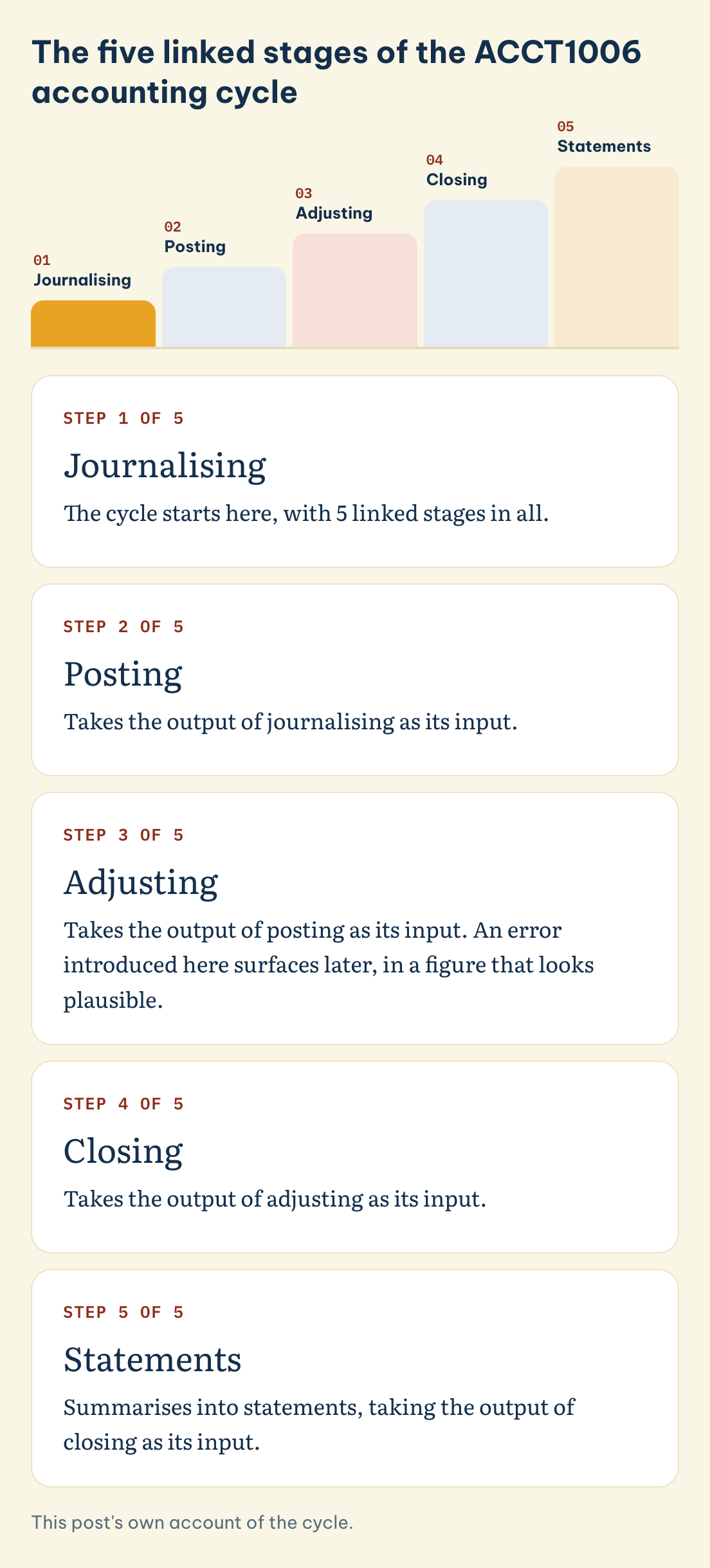
Direct answer: By treating the accounting cycle as one connected sequence rather than a list of separate skills. The cycle runs through 5 linked stages: journalising, posting, adjusting, closing, and summarising into statements. Each stage takes the previous stage's output as its input, so an error introduced at adjustment surfaces 3 stages later, in a figure that looks plausible.
The five linked stages of the ACCT1006 accounting cycle
Select a step to read how it connects to the stage before it. The bar heights and colours only mark the order and carry no weight.
Step 1 of 5
Journalising
The cycle starts here, with 5 linked stages in all.
Step 2 of 5
Posting
Takes the output of journalising as its input.
Step 3 of 5
Adjusting
Takes the output of posting as its input. An error introduced here surfaces later, in a figure that looks plausible.
Step 4 of 5
Closing
Takes the output of adjusting as its input.
Step 5 of 5
Statements
Summarises into statements, taking the output of closing as its input.
Save this figure
Students who are comfortable with individual entries often become overwhelmed at exactly this point, and the reason is structural rather than a matter of effort. Producing one journal entry is a bounded task with a checkable answer. Producing a set of statements is an extended task where the checkable answer arrives at the very end, and where a single early slip propagates silently through every subsequent figure. The skill being assessed is no longer accuracy on a step. It is whether you can hold a sequence together and locate a break in it.
Evidence: The University's own learning outcomes separate recording transactions from analysing information to solve problems, which is a recognition that these are distinct competencies. Practising the first does not automatically build the second.
Example: A student whose trial balance was out by 4,500 spent 1 hour re-checking every journal entry from the start. His mentor asked a different question: which single account, if wrong by 4,500, would produce exactly this imbalance? Working from the discrepancy back to the candidate account took 8 minutes. Reconstructing a whole cycle to find one break is the beginner's method, and it is the reason so many students run out of time under exam conditions.
◆ Question 5 / 7 · Expense terms
Expense, prepaid expense, accrued expense: what is the real difference?
Direct answer: All three describe a cost, and they differ on the relationship between when cash moves and when the cost is recognised. Everyday English treats them as near-synonyms. Accounting does not. Most debit and credit errors in this unit are downstream of a vocabulary error, not an arithmetic one.
| Term | Cash | Recognition | What it is on the balance sheet |
|---|---|---|---|
| Expense | Paid this period | This period | Nothing, it is in profit or loss |
| Prepaid expense | Paid before | A later period | An asset, a future benefit already bought |
| Accrued expense | Paid after | This period | A liability, a benefit used but unpaid |
Evidence: The distinction is a direct application of the accrual basis, which recognises the effects of transactions when they occur rather than when cash is exchanged. Once you can state which column of that table a transaction sits in, the entry follows almost mechanically. The reverse is not true: memorising entries does not build the classification skill, which is why students who drill entries still stall on unfamiliar wording.
Example: Asked to adjust for rent received in advance, a student debited an expense account. She knew the mechanics of accruals well. She had read the words as describing a cost to her, when the transaction described cash received, and the classification error made every subsequent step wrong while each individual step looked competent.
◆ Question 6 / 7 · Mathematics
Do you need strong mathematics for ACCT1006?
Direct answer: No. The assumed knowledge is secondary-level mathematics, equivalent to HSC Mathematics, and the arithmetic in this unit rarely goes beyond addition, subtraction and proportion. What the unit demands instead is precision in reading, because most lost marks come from misreading a transaction, missing a date, or applying a rule mechanically to a case it does not fit.
Evidence: The research is more nuanced than either the reassuring or the alarming version of this claim. Joynt (2023), working at the University of Pretoria in South Africa and reviewing 54 years of studies published between 1968 and 2022, set out in the International Journal of African Higher Education volume 10, issue 1, pages 21 to 49, identified prior knowledge in accounting, academic aptitude and mathematical ability among the significant predictors of first-year accounting performance, alongside personal attributes such as grit and self-efficacy. Mathematical ability is on the list, but it sits beside prior exposure and persistence rather than dominating them. This matters for a student deciding whether to continue: a weak mathematics background is a documented headwind, not a verdict.
Example: A student who described himself as bad at maths was losing marks on multi-step inventory questions. The errors were not calculation errors. He was tracking several transactions and dates at once and losing track of which sale the question was asking about. Breaking each problem down transaction by transaction, rather than attempting it whole, resolved a difficulty he had diagnosed as mathematical.
◆ Question 7 / 7 · Practice
How should you practise, if re-reading worked examples is not enough?
Direct answer: Cover the solution and reproduce it. Reading a worked example while the answer is visible produces a strong feeling of understanding and a weak trace in memory, because recognition is not retrieval. The single change that most reliably improves performance in this unit is converting passive review into attempted production before checking.
Evidence: Roediger and Karpicke (2006) tested this directly across 2 experiments in Psychological Science volume 17, issue 3, pages 249 to 255. Students studied prose passages and either took 1 or 3 immediate recall tests without feedback, or restudied the material the same number of times. Repeated testing produced better long-term retention than repeated study, even though restudying felt more productive at the time. The gap between how well a method feels and how well it works is the trap, and in accounting the worked example is where that trap is set.
A practice sequence that reflects this:
- Attempt the problem before looking at any solution or worked example, even badly.
- Check, then identify which accounting concept produced the error, not just which number was wrong.
- Redo the same problem 2 days later from a blank page.
- Once entries are reliable, practise the whole cycle from transactions through to statements at least 2 times before the exam, under time.
- Treat tutorials as production, not attendance.
Example: A student who had watched every recorded tutorial 2 times failed the mid-semester test. She had not attempted a single problem without the solution visible. Her mentor changed nothing about the content and only the order in which she met it. Her final exam mark was 2 bands above her mid-semester result.
Frequently asked questions
Which university does this guide describe?
The University of Sydney, where ACCT1006 is Accounting and Financial Management, a 6 credit point unit in the Business School. Western Sydney University and the University of South Australia also use ACCT1006 for different courses, so check the code against your own handbook before relying on any shared notes.
What do I need before I can enrol?
BUSS1030 or ACCT1005. The unit is also prohibited against ACCT1001, ACCT1002, ACCT1003 and ACCT1004, so you cannot count it alongside those.
Where do I find the real assessment weightings?
In the unit outline for your session, published shortly before teaching starts. Weightings quoted on study-notes sites describe earlier sessions and should not be planned around.
Is ACCT1006 hard?
Students generally describe it as manageable with consistent weekly work and unpleasant if they fall behind, which follows from its cumulative structure. Difficulty concentrates around adjusting entries and the first full set of statements rather than being spread evenly.
Do I need to be good at maths?
No more than secondary-level mathematics. Careful reading matters more, since most errors come from misreading a transaction or a date rather than from calculation.
What is the single most useful thing to change?
Stop reviewing with the solution visible. Attempt first, check second, and diagnose errors by concept rather than by number.
Where this guidance comes from
The unit facts above, credit points, prerequisites, prohibitions, managing faculty and learning outcomes, come from the University of Sydney's own published unit page rather than from secondary summaries. The claims about why students struggle draw on 3 separate literatures, published in 2006, 2010 and 2023,: a pedagogical experiment on adjusting journal entries in accounting education, a systematic review covering 54 years of research on first-year accounting performance, and an experimental result from cognitive psychology on testing versus restudy. None of the 3 studied ACCT1006 specifically, so they explain the pattern rather than prove it for this unit.
Related reading
References
Joynt, C. (2023). Factors that influence first-year students' academic performance in introductory accounting: A systematic literature review and avenues for future research. International Journal of African Higher Education, 10(1), 21-49. https://doi.org/10.6017/ijahe.v10i1.17185
Phillips, F., & Schmidt, R. N. (2010). Creating early success in financial accounting: Improving performance on adjusting journal entries. Accounting Perspectives, 9(2), 87-96. https://doi.org/10.1111/j.1911-3838.2010.00006.x
Roediger, H. L., & Karpicke, J. D. (2006). Test-enhanced learning: Taking memory tests improves long-term retention. Psychological Science, 17(3), 249-255. https://doi.org/10.1111/j.1467-9280.2006.01693.x
University of Sydney. (2026). ACCT1006: Accounting and financial management. https://www.sydney.edu.au/units/ACCT1006
A free 20-minute consultation is a conversation about your ACCT1006 brief and the adjusting entries you find hardest. Your answers stay your own work.
Book a free consultation ▸