
The published outcomes for Accounting for Decision Making contain a tension that explains most of the marks lost in it. One outcome asks you to prepare conventional financial reports; another asks you to critically interpret accounting information for business decisions. Those are two different jobs: the first produces the numbers, the second decides what to do about them, and students almost always arrive good at one, drift toward it, and are assessed on both.
Author: MAAS Editorial Team
Last updated: 2026-08-11
Category: business-management

The basics, and one thing worth checking before you enrol
Direct answer: BUSS1030 Accounting for Decision Making is a 6-credit-point unit in the University of Sydney Business School, with no prerequisites, offered in both semesters. The Business School holds triple accreditation from AACSB, EQUIS, and AMBA, the three bodies most Business Schools reference when claiming international standing.
Evidence: The published unit page describes the unit as investigating the fundamentals of accounting at an introductory level to give students a user-focused understanding of accounting information, and lists coverage extending from financial statements into business planning, working capital, sustainability and corporate governance. It also carries prohibitions against ACCT1001 through ACCT1005. If you are considering an accounting major or have credit from elsewhere, read that prohibition list before enrolling rather than after, because it determines which pathway units you can still count.
The phrase user-focused in the description is the single most useful clue in the whole page. It tells you the unit is designed around the person reading the accounts rather than the person keeping them, even though it still expects you to be able to keep them.
Why does the double demand cost students marks?
Direct answer: Because each type of student solves the wrong half of the problem and assumes the other half is decoration.
Two failure patterns dominate, and they are near mirror images.
The student who finds the mechanics comfortable treats the interpretation questions as a soft add-on to be filled with general business language. Their statements balance and their commentary says the company appears to be performing adequately. The student who finds the mechanics uncomfortable does the reverse, writing confidently about strategy and stakeholders while the underlying figures are wrong, which makes the commentary unmarkable no matter how fluent it is. Springer and Borthick (2004) describe this same asymmetry between procedural fluency and interpretive judgment in introductory accounting cohorts.
| The half you are strong at | What it will not carry |
|---|---|
| Preparing statements correctly | Any question beginning with what does this suggest or what should the business do |
| Discussing business context fluently | Anything, if the figures underneath are misstated |
Evidence: Springer and Borthick (2004) argued that introductory accounting typically teaches procedures well and critical thinking poorly, and designed a simulation specifically to force students to reason from accounting data rather than merely produce it. Their premise is the same tension this unit's outcomes name openly: procedural competence does not generate interpretive judgment on its own, and it has to be deliberately built.
Example: Given a set of accounts and asked whether the business could fund an expansion from internal resources, one student recalculated every figure accurately and concluded that the company was profitable and therefore could. The stronger answer accepted the same figures, pointed out that operating cash flow was much smaller than profit and that most current assets sat in inventory, and concluded that the funds existed on paper but not in a form available this year.
What does user-focused actually change about your answers?
Direct answer: It changes who your answer is written for. A user-focused answer names the decision and the person making it, rather than describing the accounts in general.
Accounting information exists to be useful to people deciding things: whether to lend, to invest, to extend credit, to expand. The IFRS Foundation's conceptual framework (IFRS Foundation, 2018), produced through the International Accounting Standards Board and underlying the International Financial Reporting Standards used across most of the world, builds the entire structure of financial reporting on that objective of decision-usefulness. As the IFRS Foundation puts it, "It helps to ensure that the Standards are conceptually consistent and that similar transactions are treated the same way, so as to provide useful information for investors, lenders and other creditors" (IFRS Foundation, 2018). Australian companies apply the local equivalent, the Australian Accounting Standards Board's AASB standards, which are aligned with IFRS. When a question in this unit asks what the accounts show, the implied second half is always to whom, and for what decision, and answers that ignore it read as summaries.
The practical difference is visible in one sentence.
- Not user-focused. The company's liquidity ratios have declined over the period.
- User-focused. A supplier deciding whether to offer 60-day terms would note that the current ratio has fallen and that the fall comes from cash rather than inventory, which speaks directly to whether invoices will be paid on time.
Same underlying observation, and the second one answers a question somebody actually has.
Example: Asked to assess a company for a potential investor, a student wrote three paragraphs of ratio analysis with no reference to what an investor would care about. Rewritten to lead with the investor's concern, namely whether returns are sustainable rather than one-off, the same ratios did visible work and roughly half of them turned out to be irrelevant and were cut.
How do you avoid getting stuck on the technical half?
Direct answer: By practising the mechanics in small, frequent doses and refusing to let them become the whole revision plan, the way the University of Sydney Business School expects across most first-year accounting units.
The technical content in an introductory unit is finite. The accounting equation, the three statements and how they connect, accrual adjustments, and the standard ratios cover most of it. That material rewards short repeated practice rather than long sessions, and once it is secure it stops consuming attention.
A workable split, once the basics are in place, is to spend a minority of your time on mechanics and the majority on the harder question of what the mechanics reveal. Students routinely invert this, because computation gives immediate feedback about being right and interpretation does not. The absence of that feedback is precisely why interpretation needs the greater share of the time.
A caution about shared summaries. Introductory accounting notes circulate widely and are often built for a different unit at a different university, where the same topic list is taught for preparers rather than users. Material that drills journal entries in depth and never asks what a statement means may be perfectly accurate and still poorly aimed at this unit.
What tends to go wrong for students writing in English as a second language?
Direct answer: Commentary drifts into description because description is linguistically safer, and description is exactly what the interpretive outcomes do not reward.
Writing a judgment exposes you. Writing a summary does not, so under time pressure many students retreat into restating what the accounts contain. The retreat is understandable and expensive, since the outcome being assessed is analysing and critically interpreting, not reporting.
A reliable structure removes most of the difficulty, because it lets you commit in the first clause and support afterwards: For a lender, the key concern is X. The accounts show Y. This suggests Z, although W would change the assessment. Four short moves, one position, and a caveat that protects you.
On vocabulary, keep the terms in English and respect their narrowness. Profit is not cash, revenue is not income in the everyday sense, and an asset is not simply something valuable the business owns. These distinctions are the content of the unit, so imprecision here reads as a gap in understanding rather than a translation issue.
Working with a MAAS mentor on introductory accounting
Our role is advisory. On a unit with this shape, the useful conversation moves between the two halves rather than sitting in either, whether the unit is BUSS1030 at the University of Sydney or an equivalent introductory accounting unit elsewhere. A mentor will check that your figures hold up, then immediately ask what decision they inform and for whom; press when commentary describes rather than concludes; look at whether you have cut the analysis that does not serve the question; and point out where a technical error has quietly invalidated an otherwise sensible argument. You prepare your own statements, reach your own conclusions, and hand in your own work. In Australia, the professional bodies CPA Australia and Chartered Accountants Australia and New Zealand set the accreditation standards most Commerce programmes design their accounting major around, and both expect graduates to interpret figures, not just produce them.
Frequently asked questions
Which institution does this refer to?
The University of Sydney, where BUSS1030 is Accounting for Decision Making, a 6-credit-point unit in the Business School. Similar codes exist elsewhere for different subjects, so check the unit title against your own enrolment record.
Is this the unit for an accounting major?
It is an introductory unit taken broadly across the Bachelor of Commerce at the University of Sydney, and its prohibition list covers ACCT1001 to ACCT1005. If you intend to major in accounting, confirm the pathway with the current handbook rather than assuming, because the prohibitions determine what you can count later.
Do I need any background?
The unit page lists no prerequisites and no assumed knowledge, and the University of Sydney reviews entry requirements between years, so verify on the page for your own year of enrolment.
Is it mostly bookkeeping?
No, though bookkeeping mechanics are part of it. The published description is explicit that the aim is a user-focused understanding, and the outcomes pair technical competency with critical interpretation. Springer and Borthick (2004) make the same distinction between producing accounting records and using them to decide something.
Does the sustainability content really get examined?
It appears in the published coverage alongside corporate governance, so treat it as examinable. Reporting expectations here increasingly track international sustainability disclosure standards such as those issued by the International Sustainability Standards Board. As with any reporting topic, an answer that explains what a disclosure is intended to achieve and names a limitation will outperform one that praises it.
Which is worth more effort, the calculations or the writing?
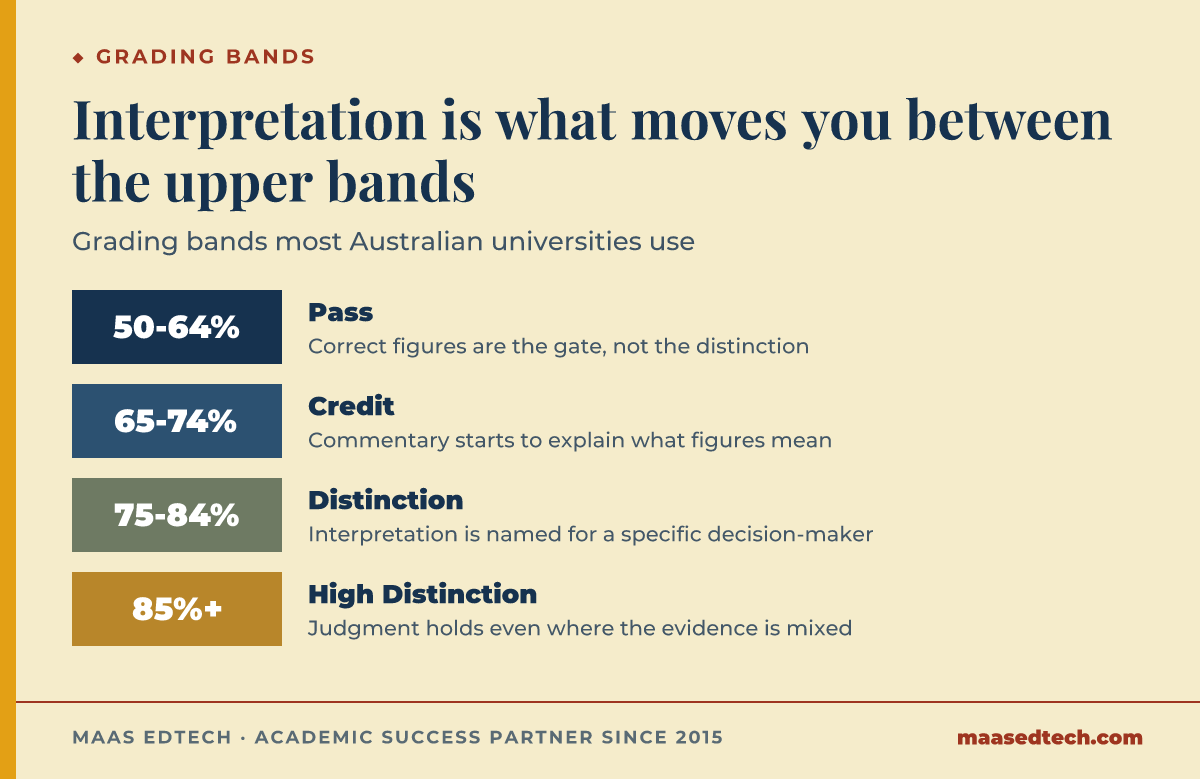
The writing, once the calculations are reliable. The calculations are a gate you must pass and rarely a source of distinction, since a correct figure is expected rather than rewarded. Under the grading bands most Australian universities use, a Pass sits around 50% to 64%, a Credit around 65% to 74%, a Distinction around 75% to 84%, and a High Distinction 85% and above, and interpretation is what moves an answer between those upper bands.
Related reading
- BUSS1020: quantitative business analysis
- COMM1140: financial management
- Academic support from MAAS mentors
Ask a MAAS mentor about your unit
References
IFRS Foundation. (2018). Conceptual framework for financial reporting. IFRS Foundation. https://www.ifrs.org/issued-standards/list-of-standards/conceptual-framework/
Springer, C. W., & Borthick, A. F. (2004). Business simulation to stage critical thinking in introductory accounting: Rationale, design, and implementation. Issues in Accounting Education, 19(3), 277–303. https://doi.org/10.2308/iace.2004.19.3.277