
◆ Accounting & Finance
ACCT4104: the standard reads like IFRS, and that is the trap
The standard examined in ACCT4104 reads almost word for word like the IFRS version. That resemblance is what catches people out. Because the wording matches, it feels safe to prepare from whatever consolidation material the internet offers, most of it written for Australian, British or American readers. The technique does transfer. What does not is the local layer underneath it, and in this final-year Hong Kong course that layer carries a surprising share of the reasoning marks.

◆ Section 1 / 8 · The course
What is the course, and where does it sit?
Direct answer: At the University of Hong Kong, ACCT4104 is Advanced Financial Accounting, a course worth 6 credits in the Faculty of Business and Economics, offered in both the first and second semester. In the BBA in Accounting and Finance it appears as a Year 4 course inside the Professional Core in Accounting, placing it at the end of the accounting sequence.
Evidence: The faculty course list and the BBA syllabus both position it after ACCT3103 Intermediate Financial Accounting II, and the published faculty description centres it on the application of accounting theory to the preparation of standards and their reporting consequences, particularly for consolidation of group accounts, asset valuation and the effect of both on income determination.
Note on sourcing: course lists are reissued every academic year at HKU. Treat the version published for your own year as authoritative for prerequisites and assessment weighting, and use anything written here as orientation rather than as a substitute for it.
Example: A student read the title as "harder consolidation" and prepared accordingly. The consolidation questions were the part he handled well. What he had not prepared for was a question asking him to argue whether a particular measurement basis served users at all, which is a theory question wearing a technical costume.
◆ Section 2 / 8 · Converged standards
Why does a converged standard create a problem rather than solve one?
Direct answer: Because convergence removes the differences you would notice and leaves the ones you would not. Hong Kong Financial Reporting Standards have been aligned with IFRS Accounting Standards since 2005, so the recognition and measurement text you study is effectively the international text. The remaining divergence sits in effective dates, in local interpretations, and above all in company law, which is exactly where a student working from foreign study material has no reason to look.
Evidence: Research on international convergence distinguishes formal adoption of a standard from what a jurisdiction actually ends up applying. Bengtsson and Argento (2023) argue that de jure adoption of IFRS is better understood as a process shaped by national institutional conditions than as a single switch that is either flipped or not, which is why two jurisdictions can hold identical standard text and still produce different reporting obligations.
Example: Asked why a Hong Kong holding company had prepared consolidated statements, a weaker answer cited the accounting standard. A stronger one cited the accounting standard for how to consolidate and the Companies Ordinance for why the directors were required to do it at all. Both students knew the mechanics. Only one knew which instrument answered which question.
◆ Section 3 / 8 · Which layer
Which layer answers which question?
Direct answer: Four different instruments settle four different questions in this course, and mixing them up costs marks fast. Whether consolidation is required at all sits with the Companies Ordinance, whether an investee counts as controlled sits with HKFRS 10, how the acquisition is measured belongs to HKFRS 3, and disclosure comes from HKFRS 12. Sort the instrument you need before writing.
Which instrument settles which ACCT4104 question
Each row sets a question beside the instrument that settles it, taken from the table in this post.
The question you are answering
The instrument that settles it
Must this company produce consolidated statements at all?
Companies Ordinance (Cap. 622), Part 9
Is this investee controlled, and therefore inside the group?
HKFRS 10, applied as a judgement about facts
How is the acquisition measured on day one?
HKFRS 3
What must appear in the notes?
HKFRS 12, plus statutory disclosure requirements
Does an alternative reporting framework apply?
The reporting exemption regime and its SME framework
Save this figure
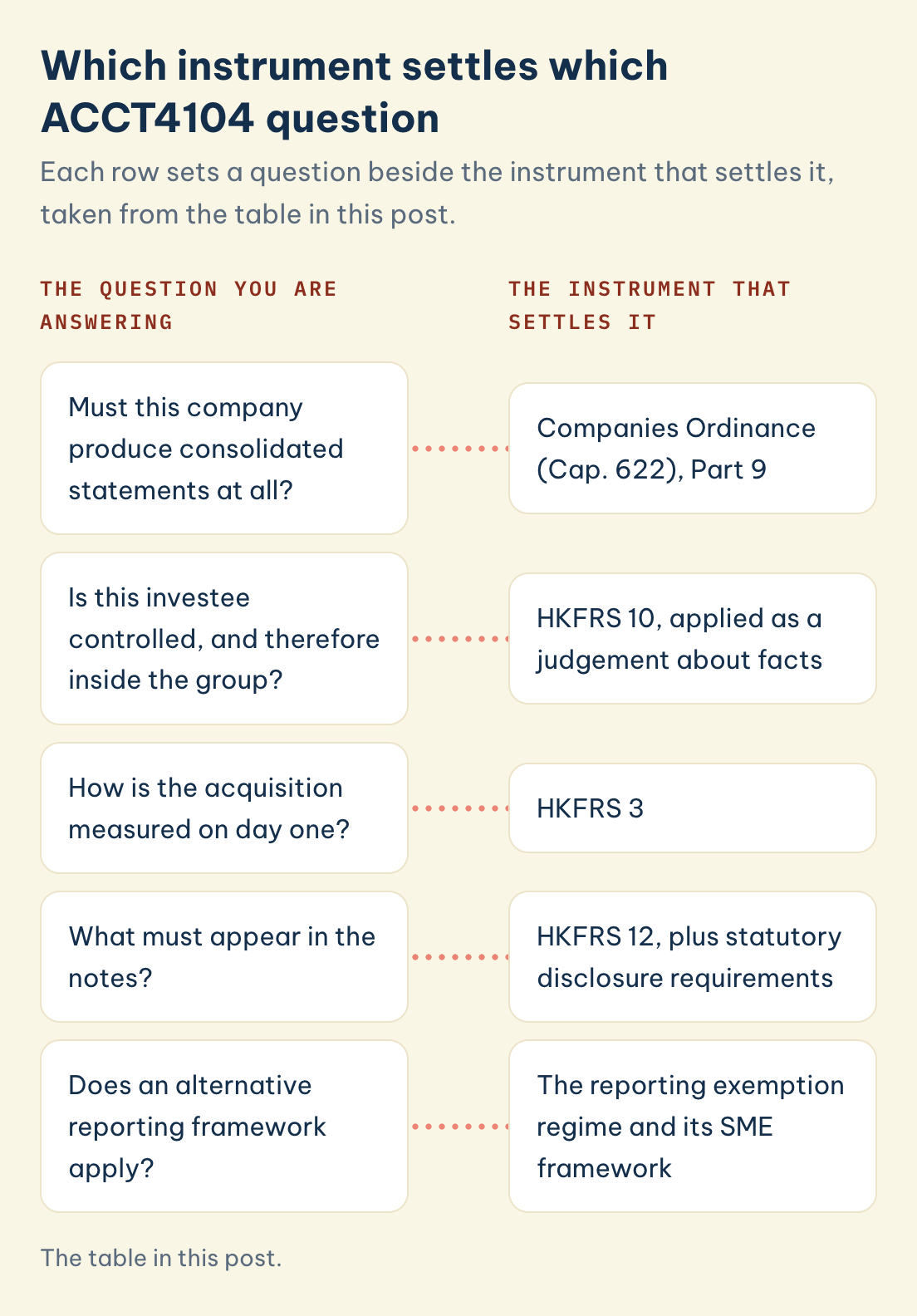
Sorting the sources before you write is the single cheapest habit in this course, because a mark is often lost by citing a correct authority for the wrong question. HKFRS 10 answers whether an investee is controlled, HKFRS 3 governs how the acquisition is measured on day one, and HKFRS 12 sets the disclosure requirements, three separate instruments that a weaker answer collapses into one.
| The question you are answering | The instrument that settles it | What it will not tell you |
|---|---|---|
| Must this company produce consolidated statements at all? | Companies Ordinance (Cap. 622), Part 9 | How to eliminate an intra-group balance |
| Is this investee controlled, and therefore inside the group? | HKFRS 10, applied as a judgement about facts | Whether an exemption relieves the directors of the duty |
| How is the acquisition measured on day one? | HKFRS 3 | Whether the acquirer was identified correctly |
| What must appear in the notes? | HKFRS 12, plus statutory disclosure requirements | Which of the two imposes the stricter requirement |
| Does an alternative reporting framework apply? | The reporting exemption regime and its SME framework | Whether your entity qualifies in the year in question |
◆ Section 4 / 8 · Consolidation duty
What actually decides whether you consolidate?
Direct answer: Two things in sequence, and students routinely collapse them into one. The Companies Ordinance imposes the duty, and the standard defines the boundary. Section 379 of Cap. 622 requires a company's directors to prepare financial statements for each financial year, and where the company was a holding company at the end of that year, to prepare consolidated financial statements instead. Section 379(3) then relieves that duty in defined situations, including where the company is itself a wholly owned subsidiary of another body corporate.
Evidence: That structure matters because it is an obligation on directors rather than a property of the numbers. A group can be economically real and still fall inside a statutory exemption, and a company can be relieved of the duty in one year and carry it in the next without anything changing about how control is exercised.
Example: A student wrote a competent analysis of control under the standard and concluded that consolidated statements were required. The facts included that the company was wholly owned by an overseas parent. The control analysis was right and the conclusion was wrong, because the question that decided the answer was statutory and had never been asked.
◆ Section 5 / 8 · Is control sound
Is control a sound concept, or just a workable one?
Direct answer: Whether control is a sound concept or just a workable one is the question that separates a Year 4 answer from a Year 2 one. Control is the hinge of the entire group reporting model, and it is defensible rather than settled. A final-year course invites you to say so, with reasons.
Evidence: Ben-Shahar, Sulganik and Tsang (2016) argue that the consolidation model under IFRS 10 sits uneasily with accepted economic principles, precisely because a binary control test forces an all-or-nothing presentation onto economic relationships that vary continuously in degree. Their own summary of the finding is blunt: "an applicative example appearing under the new guidelines contradicts the conclusion drawn from widely accepted power indices" (Ben-Shahar et al., 2016). Their argument is not that consolidation is useless. It is that the line drawn by the standard is a reporting convention doing work that economics would do differently, which is a claim you can engage with rather than merely report.
Example: Two students cited the same article. One quoted its conclusion and moved on. The other took the criticism seriously enough to test it, asking what an alternative presentation would look like for a 45% holding with dispersed remaining ownership, and what a user would gain or lose. The second answer engaged with the source. The first only borrowed its authority.
◆ Section 6 / 8 · Beyond consolidation
What lies beyond consolidation in this syllabus?
Direct answer: More than the title suggests. The faculty description has extended the course beyond group accounts to measurement questions such as current cost accounting, to income tax allocation, and to reporting by government entities and non-profit organisations. Those topics are grouped together for a reason worth noticing, which is that each of them is a place where the standard corporate reporting model is being asked to do something it was not designed for.
Evidence: A non-profit has no residual owners, a government entity is not accountable to a capital market, and current cost accounting exists because historical cost stops being informative when prices move. In each case the framework can be applied honestly and still return an unsatisfying answer, which is the recognisable signature of an advanced course rather than a difficult one.
Note on sourcing: the coverage listed here reflects HKU's published faculty course descriptions, and the emphasis given to each block varies by teaching term. Check your own course outline before allocating study time to any of them.
Example: Asked to discuss surplus measurement for a charity, a weaker answer applied the corporate definition of income unchanged. A stronger one paused on the definition itself, noted that it presupposes owners with a residual claim, and made that mismatch the substance of the answer.
◆ Section 7 / 8 · Studying the standard
How do you study a converged standard without slipping into surface learning?
Direct answer: By reading the standard for the criterion it turns on rather than for the rule you can reproduce. That distinction has a name in the education literature, and it predicts performance in exactly this kind of subject.
Evidence: Surveying 402 Chinese undergraduates enrolled as ACCA students, Dong, Bai, Zhang and Zhang (2019) found that the deep approach to learning IFRS, measured with the revised two-factor Study Process Questionnaire of Biggs, Kember and Leung (2001), was associated with better performance at both fundamentals and professional levels, and was adopted more often by students with longer preparation time and greater adaptability. The finding is unsurprising in its direction and useful in its detail, because it locates the advantage in preparation habit rather than in ability.
Example: Vietnamese students at Hong Kong institutions often arrive with strong technical preparation and a habit of learning treatments as rules, which works well through intermediate courses and stops working here. The change that helps is small: for each standard, write the one criterion that would flip the answer if the facts changed. Students who do this stop memorising and start arguing, usually within a fortnight.
◆ Section 8 / 8 · Order of work
A practical order of work
Direct answer: Six steps, in order: answer the statutory duty question before the accounting one, decide the group boundary from facts, verify each source's jurisdiction, take and justify a position on any named debate, state what a measurement basis is meant to show before using it, and finish by asking what a reader could not reconstruct from the statements.
- Answer the statutory question before the accounting one. Is there a duty to consolidate, and does any exemption apply?
- Only then decide the boundary of the group, and argue control from the facts rather than from the percentage.
- Check every source you plan to cite for jurisdiction. Australian and British material is useful for technique and unreliable for obligation.
- Where the course names a debate, take a position and give the reason. An advanced course marks the reasoning, not the side.
- For measurement topics, state what the chosen basis is meant to tell a user before you compute anything with it.
- Finish on disclosure, asking what a reader could not reconstruct from the face of the statements.
Frequently asked questions
Which institution offers ACCT4104?
The University of Hong Kong, where it is Advanced Financial Accounting, a course worth 6 credits in the Faculty of Business and Economics offered in both semesters. Course codes of this shape appear elsewhere for unrelated subjects, so confirm the title against your own enrolment record.
What should I have completed first?
The published faculty course list places it after ACCT3103 Intermediate Financial Accounting II. Prerequisites are restated each academic year, so check the list published for your year rather than relying on an older syllabus.
Can I prepare using IFRS or Australian material?
For technique, largely yes, because the standards are converged. For anything about who must report and what must be filed, no. Those requirements come from Hong Kong company law and have no equivalent in the foreign material.
Is the course mostly consolidation?
Consolidation is the largest technical block, but the published coverage also reaches measurement bases, income tax allocation, and reporting by government and non-profit entities. Answers that treat it as a consolidation course tend to be underprepared for the theory questions.
How much criticism of the standards is expected?
Enough to show you can evaluate rather than only apply. A final-year course expects you to know where a requirement is contested and to say what turns on the disagreement, supported by a source such as Ben-Shahar, Sulganik and Tsang (2016) rather than by opinion.
Does this course matter beyond the degree?
It sits in the professional core of the accounting stream, and the topics it covers map onto the financial reporting components of professional qualification. Treating it as a hurdle rather than as foundation tends to be an expensive choice later.
Related reading
- ACCT2542: consolidation entries that exist in nobody's books
- ACCT3563: the final accounting course is about what the standards cannot settle
- ACC304 Company Accounting: how do you approach the assignment?
- ACCY201 Advanced Financial Accounting at UOW: the same subject title in an Australian AASB setting, where the standards are domestic rather than converged
Ask a MAAS mentor about your course
Where MAAS fits
MAAS mentors work alongside students on courses like this rather than in place of them. In advanced financial reporting the most useful review is often the least technical one: reading an answer back to check whether the statutory question was separated from the accounting question, whether each cited authority is the right instrument for the point it is supporting, and whether a contested requirement was argued or simply reported. Students frequently find their mechanics were sound and their reasoning was invisible to the marker. The work stays yours. If that is useful, our academic support service and our tutoring service are the two places to start.
References
Ben-Shahar, D., Sulganik, E., & Tsang, D. (2016). Does IFRS 10 on consolidated financial statements abandon accepted economic principles? Australian Accounting Review, 26(4), 341–345. https://doi.org/10.1111/auar.12135
Bengtsson, M., & Argento, D. (2023). International accounting convergence and divergence: Towards a framework for understanding de jure adoption of IFRS. Accounting in Europe, 20(3), 370–392. https://doi.org/10.1080/17449480.2023.2237056
Biggs, J., Kember, D., & Leung, D. Y. P. (2001). The revised two-factor Study Process Questionnaire: R-SPQ-2F. British Journal of Educational Psychology, 71(1), 133–149. https://doi.org/10.1348/000709901158433
Dong, N., Bai, M., Zhang, H., & Zhang, J. (2019). Approaches to learning IFRS by Chinese accounting students. Journal of Accounting Education, 48, 1–11. https://doi.org/10.1016/j.jaccedu.2019.04.002
Tools & resources
Hong Kong Institute of Certified Public Accountants. (2026). Companies Ordinance Cap. 622 resource centre. https://www.hkicpa.org.hk/en/Standards%20setting/Standards/Resource%20centre/Companies%20Ordinance%20Cap%20622
IFRS Foundation. (2026). Use of IFRS Accounting Standards by jurisdiction: Hong Kong SAR. https://www.ifrs.org/use-around-the-world/use-of-ifrs-standards-by-jurisdiction/view-jurisdiction/hong-kong-sar/
The University of Hong Kong, Faculty of Business and Economics. (2025). Undergraduate course list 2025-26. https://ug.hkubs.hku.hk/course
A free 20-minute consultation is a conversation about where you are with ACCT4104.
Book a free consultation ▸