
◆ Cố vấn công bố
Dùng AI có đạo đức trong phần tổng quan tài liệu như thế nào?
Trả lời thẳng: Muốn dùng AI đúng đạo đức khi làm tổng quan tài liệu, bạn hãy coi nó như một trợ lý tìm kiếm và sàng lọc, không bao giờ coi nó là nguồn trích dẫn mà bạn không tự kiểm chứng. AI có thể giúp bạn tìm và sắp xếp tài liệu, nhưng bạn vẫn chịu trách nhiệm cho từng nhận định, từng tài liệu tham khảo và từng chữ đến tay biên tập viên.
Với nhà nghiên cứu Việt Nam đang chịu áp lực công bố trên tạp chí Scopus Q1 và Q2, ranh giới bảo vệ liêm chính của bạn khá đơn giản như vậy. Bài viết này trả lời bảy câu hỏi mà nhà nghiên cứu Việt Nam hỏi cố vấn công bố của MAAS nhiều nhất về việc dùng AI ở giai đoạn tổng quan tài liệu mà không vượt quy định của tạp chí hay của trường.
◆ Câu hỏi 1 / 7 · Nghĩa là gì
Dùng AI có đạo đức trong tổng quan tài liệu nghĩa là gì?
Trả lời thẳng: Bạn để AI tăng tốc những việc bạn vẫn kiểm chứng được, gồm tìm kiếm, loại trùng, sàng lọc và tóm tắt để bạn hiểu, đồng thời không giao phán đoán, trích dẫn hay quyền tác giả cho công cụ. Nguyên tắc nối mọi quy định lại là sự giám sát của con người: bạn biện minh cho cách dùng, bạn kiểm đầu ra, và bạn sở hữu kết quả.
Flemyng và cộng sự (2025), trong một tuyên bố lập trường chung của Cochrane, Campbell Collaboration, JBI và Collaboration for Environmental Evidence, kết luận rằng bằng chứng hiện có chưa ủng hộ việc dùng generative AI trong tổng hợp bằng chứng nếu không có con người tham gia. Mọi việc dùng AI đều phải được khai báo, đặt dưới sự giám sát của con người và có lý do chính đáng để không làm tổn hại tính chặt chẽ về phương pháp. Clark và cộng sự (2025), trong một tổng quan hệ thống đi kèm trên 19 nghiên cứu, đi tới cùng kết luận chính nhưng thêm một lưu ý: với phần lớn tác vụ tổng hợp bằng chứng ngoài khâu tìm tài liệu, generative AI vẫn có thể giữ vai trò hỗ trợ chính đáng một khi con người kiểm lại đầu ra.
Một nghiên cứu sinh người Việt do MAAS đồng hành từng dùng một công cụ AI để nhóm 600 kết quả tìm kiếm theo chủ đề. Nguyên tắc mà mentor đặt ra là AI được phép gom nhóm và xếp hạng các bài, nhưng chính nghiên cứu sinh phải đọc và xác nhận từng nghiên cứu đưa vào. Khâu sàng lọc nhờ vậy nhanh hơn, còn trách nhiệm vẫn thuộc về con người.
◆ Câu hỏi 2 / 7 · Tác giả hay nguồn
Có thể ghi công cụ AI là tác giả hay nguồn trích dẫn không?
Trả lời thẳng: Không. Công cụ AI không thể đứng tên tác giả, vì nó không chịu trách nhiệm được cho công trình, không khai báo được xung đột lợi ích và không phê duyệt được bản cuối. Chúng cũng không phải nguồn trích dẫn cho nhận định về sự kiện. Bạn hãy xem mọi đầu ra của AI là một ý nghĩ nháp cần đối chiếu với tài liệu bình duyệt có thật, đừng coi nó là bằng chứng.
Tuyên bố lập trường của Committee on Publication Ethics (2023) nêu rằng công cụ AI không được liệt kê là tác giả trong bất kỳ hoàn cảnh nào, bởi chúng không đáp ứng được tiêu chí quyền tác giả và không chịu trách nhiệm được. Khuyến nghị của ICMJE cũng giữ quan điểm rằng chatbot không thể là tác giả, và con người vẫn chịu trách nhiệm cho toàn bộ nội dung tạo ra với sự hỗ trợ của AI (ICMJE, n.d.).
Một nhà nghiên cứu do MAAS đồng hành từng dán một đoạn văn do ChatGPT sinh ra, kèm đầy đủ trích dẫn, vào phần dẫn nhập. Mentor lần theo các tài liệu tham khảo và phát hiện hai tài liệu không hề tồn tại. Theo gợi ý của mentor, chị bỏ đoạn đó đi và dựng lại lập luận từ những nguồn chị đã thực sự đọc, nhờ vậy phần dẫn nhập vừa vững vàng vừa nguyên bản.
◆ Câu hỏi 3 / 7 · Trích dẫn và tóm tắt
Vì sao không nên tin AI ở khâu trích dẫn và tóm tắt?
Trả lời thẳng: Bởi các chatbot đa dụng bịa ra tài liệu tham khảo trông như thật, với tên tác giả, tên tạp chí và cả DOI định dạng đúng chuẩn, cho những nghiên cứu chưa từng được viết ra. Phần tóm tắt cũng có thể nói sai phát hiện của một bài báo. Mọi trích dẫn AI gợi ý đều phải được tìm ra và đọc trong bản gốc trước khi vào tổng quan của bạn.
Walters và Wilder (2023) thấy khoảng 55% trích dẫn thư mục do GPT-3.5 sinh ra là bịa đặt, và nhiều trích dẫn có thật thì lại chứa lỗi. Các mô hình mới hơn đã giảm bớt chứ chưa xoá được vấn đề này. Những trích dẫn bịa cố tình khó phát hiện, vì chúng bắt chước đúng cách định dạng hợp lệ.
Một học viên thạc sĩ người Việt từng nhờ một công cụ AI "tìm năm bài báo về chủ đề của em". Cả năm bài đều rất thuyết phục và cả năm đều là bịa. Mentor MAAS chỉ cho bạn ấy cách kiểm từng tài liệu tham khảo trên Scopus và Google Scholar trước khi dùng, một thói quen chỉ tốn năm phút mà tránh được một lỗi chí mạng về độ tin cậy lúc bình duyệt.
◆ Câu hỏi 4 / 7 · Công cụ nào
Nên dùng công cụ AI nào cho giai đoạn tổng quan tài liệu?
Trả lời thẳng: Bạn nên ưu tiên công cụ dựng riêng cho tìm kiếm và sàng lọc học thuật, nơi mọi kết quả đều dẫn về một bài báo có thật và tra được, thay vì chatbot mở sinh ra văn xuôi. Công cụ khám phá và sàng lọc đưa tài liệu thật lên, lại tiết kiệm thời gian, còn chatbot đa dụng chỉ nên dùng để hỗ trợ ngôn ngữ trên văn bản bạn tự viết, kèm khai báo.
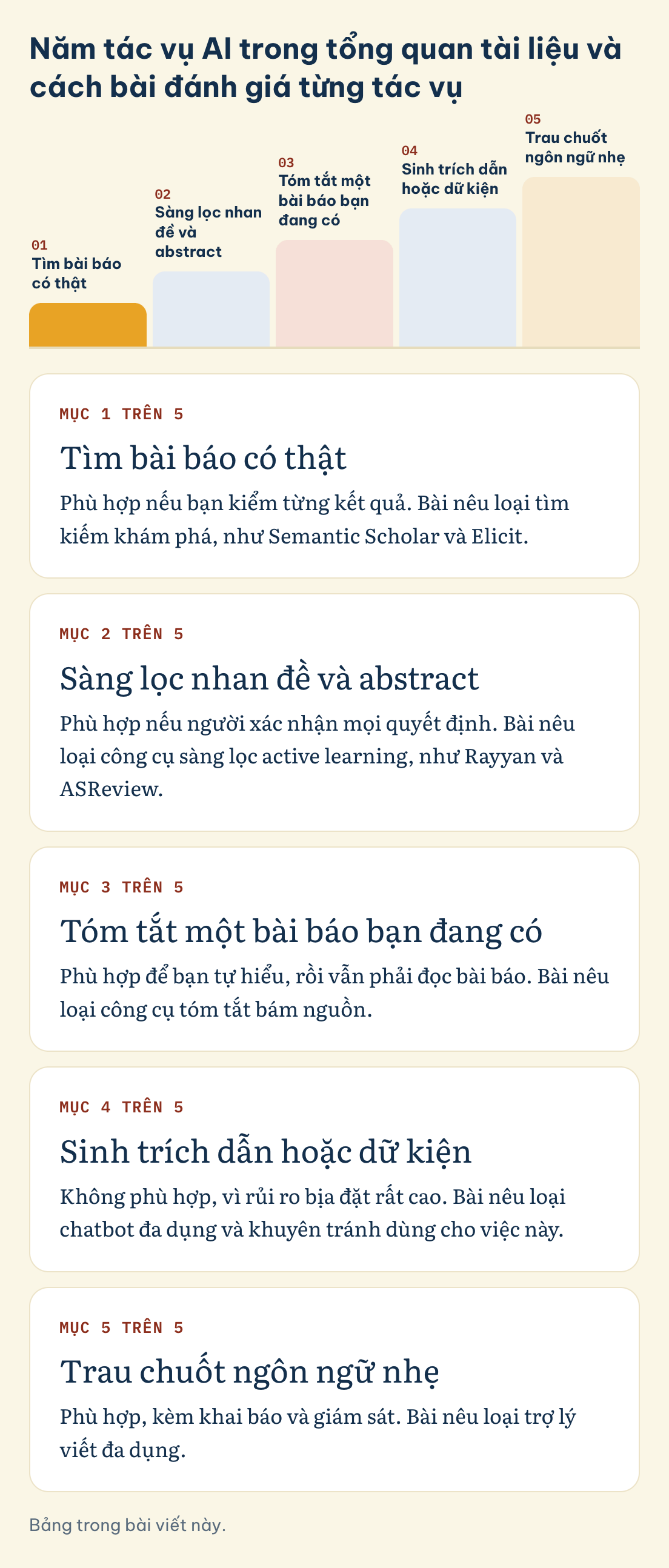
Năm tác vụ AI trong tổng quan tài liệu và cách bài đánh giá từng tác vụ
Chạm vào một tác vụ để xem nhận định của bài và loại công cụ bài nêu. Danh sách này không phải một trình tự.
Mục 1 trên 5
Tìm bài báo có thật
Phù hợp nếu bạn kiểm từng kết quả. Bài nêu loại tìm kiếm khám phá, như Semantic Scholar và Elicit.
Mục 2 trên 5
Sàng lọc nhan đề và abstract
Phù hợp nếu người xác nhận mọi quyết định. Bài nêu loại công cụ sàng lọc active learning, như Rayyan và ASReview.
Mục 3 trên 5
Tóm tắt một bài báo bạn đang có
Phù hợp để bạn tự hiểu, rồi vẫn phải đọc bài báo. Bài nêu loại công cụ tóm tắt bám nguồn.
Mục 4 trên 5
Sinh trích dẫn hoặc dữ kiện
Không phù hợp, vì rủi ro bịa đặt rất cao. Bài nêu loại chatbot đa dụng và khuyên tránh dùng cho việc này.
Mục 5 trên 5
Trau chuốt ngôn ngữ nhẹ
Phù hợp, kèm khai báo và giám sát. Bài nêu loại trợ lý viết đa dụng.
Lưu hình này
Elicit nối các nhận định với trích dẫn ở cấp câu trong những bài báo có thật, còn Semantic Scholar, do tổ chức phi lợi nhuận Allen Institute for AI vận hành, lập chỉ mục hơn 200 triệu bài báo với tìm kiếm ngữ nghĩa. Ở khâu sàng lọc, Ouzzani và cộng sự (2016) cho biết Rayyan dùng active learning và người trả lời khảo sát báo cáo tiết kiệm khoảng 40% thời gian. Boesen và cộng sự (2025), khi thử ASReview mã nguồn mở, thấy công cụ này xếp thứ tự ưu tiên các bản ghi hiệu quả, nhưng lưu ý rằng phải đặt quy trình từ trước thì cách làm mới minh bạch và tái lập được.
| Tác vụ AI trong tổng quan tài liệu | Dùng thế nào là phù hợp | Loại công cụ / ví dụ |
|---|---|---|
| Tìm bài báo có thật | Có, kiểm từng kết quả | Tìm kiếm khám phá (Semantic Scholar, Elicit) |
| Sàng lọc nhan đề và abstract | Có, người xác nhận mọi quyết định | Công cụ sàng lọc active learning (Rayyan, ASReview) |
| Tóm tắt một bài báo bạn đang có | Có, để bạn tự hiểu, rồi vẫn phải đọc | Công cụ tóm tắt bám nguồn |
| Sinh trích dẫn hoặc "dữ kiện" | Không, rủi ro bịa đặt rất cao | Chatbot đa dụng (tránh dùng cho việc này) |
| Trau chuốt ngôn ngữ nhẹ cho bài của bạn | Có, kèm khai báo và giám sát | Trợ lý viết đa dụng |
Một tác giả ngành khoa học sức khoẻ do MAAS đồng hành đã thay thói quen "hỏi ChatGPT xin nguồn" bằng một quy trình dùng Semantic Scholar để khám phá và Rayyan để sàng lọc. Việc tìm kiếm của chị trở nên tái lập được, vì chị chỉ ra được chính xác các bài đã được tìm và chọn ra sao, và bản thân điều đó là một tín hiệu chất lượng mà người bình duyệt Q1 coi trọng.
◆ Câu hỏi 5 / 7 · Khai báo
Bạn có phải khai báo việc dùng AI không, và khai ở đâu?
Trả lời thẳng: Có, bất cứ khi nào AI hỗ trợ đáng kể. Bạn khai báo lúc nộp bài, nêu tên công cụ và cách dùng, rồi đặt phần khai báo đúng chỗ tạp chí yêu cầu, thường là mục lời cảm ơn cho phần hỗ trợ viết và mục phương pháp cho phần sàng lọc, dữ liệu hay phân tích. Kiểm tra ngữ pháp thường ngày hay được miễn, nhưng khai báo vẫn an toàn hơn.
ICMJE khuyến nghị tác giả khai báo ngay khi nộp bài rằng có dùng công nghệ hỗ trợ AI hay không, mô tả cách dùng trong thư gửi kèm và trong mục tương ứng, tức lời cảm ơn cho phần hỗ trợ viết và phương pháp cho phần xử lý dữ liệu (ICMJE, n.d.). Tuyên bố lập trường chung năm 2025 do Cochrane dẫn dắt cũng yêu cầu mọi hoạt động AI và tự động hoá trong tổng hợp bằng chứng phải được khai báo và có lý do chính đáng (Flemyng và cộng sự, 2025).
Một nhà nghiên cứu người Việt từng dùng ASReview để xếp thứ tự ưu tiên sàng lọc cho một scoping review. Mentor MAAS giúp chị viết một đoạn khai báo hai câu trong phần phương pháp, nêu rõ công cụ, phiên bản và cách người rà soát đã kiểm lại thứ hạng do công cụ đưa ra, biến một yêu cầu tuân thủ thành bằng chứng cho một quy trình chặt chẽ và minh bạch.
◆ Câu hỏi 6 / 7 · Tải bài lên
Tải bài báo hoặc bản thảo lên công cụ AI có an toàn không?
Trả lời thẳng: Bạn hãy rất cẩn trọng. Tải một bản thảo chưa công bố, bộ dữ liệu bảo mật hay bài bạn đang bình duyệt lên công cụ AI công cộng có thể vi phạm quy định bảo mật, sở hữu trí tuệ và quyền riêng tư dữ liệu, kể cả khi công cụ tự nhận "riêng tư". Với tư liệu nhạy cảm, hãy mặc định mọi thứ tải lên đều có thể bị lưu lại hoặc tái dùng.
Chính sách của Elsevier nêu rằng bản thảo đã nộp là tài liệu bảo mật, và việc tải bản thảo hoặc bất kỳ phần nào của nó lên một công cụ AI có thể xâm phạm quyền bảo mật cùng quyền sở hữu trí tuệ của tác giả, bởi nhiều công cụ giữ lại hoặc tái sử dụng nội dung được tải lên (Elsevier, n.d.). Cũng chính sách đó nói rõ ranh giới ngay cả với những cách dùng được phép: "These tools must never be used as a substitute for human critical thinking, expertise and evaluation" (Elsevier, n.d.). Lô gích tương tự áp cho các bản thảo bạn đang bình duyệt cho một tạp chí.
Một tác giả do MAAS đồng hành từng muốn "để AI tóm tắt" một bản nháp bảo mật của cộng sự. Mentor cảnh báo rủi ro sở hữu trí tuệ, và hai bên chuyển sang làm việc từ ghi chú của chính chị cùng các nguồn đã công bố. Phần tổng quan vẫn vững, và không có công trình chưa công bố nào rời khỏi tầm kiểm soát của chị.
◆ Câu hỏi 7 / 7 · Giữ trong ranh giới
Nhà nghiên cứu Việt Nam và người dùng tiếng Anh như ngoại ngữ dùng AI thế nào cho khỏi vượt ranh giới?
Trả lời thẳng: Hãy để AI giảm gánh nặng cơ học khi tìm, sắp xếp và trau chuốt ngôn ngữ, còn phần trí tuệ gồm đọc, phán đoán, trích dẫn và lập luận thì giữ cho mình. Với người viết tiếng Anh như ngoại ngữ, hỗ trợ ngôn ngữ từ AI là chính đáng khi nó biên tập văn bản bạn viết và bạn khai báo. Nó thành vấn đề khi sinh ra nhận định hoặc nguồn bạn chưa kiểm.
Chiến lược khoa học quốc gia của Việt Nam đặt mục tiêu tăng 15 tới 20% mỗi năm số công bố WoS, Scopus và Q1, đồng thời gắn tiến độ đào tạo tiến sĩ với công bố quốc tế, nên việc dùng AI cho đúng càng quan trọng. Các hướng dẫn báo cáo và chính sách của nhà xuất bản đều hội tụ về cùng một nguyên tắc: minh bạch cộng với trách nhiệm của con người thì việc dùng AI vẫn giữ được tính đạo đức. Điều này thấy rõ ở tuyên bố của Committee on Publication Ethics (2023), ở khuyến nghị của ICMJE (n.d.) và ở tuyên bố lập trường của Flemyng và cộng sự (2025).
Một mentor MAAS từng đồng hành cùng một nhà nghiên cứu Việt Nam theo mô hình từng giai đoạn và giữ AI đúng vai của nó. Ở giai đoạn dựng đề cương, AI hỗ trợ khám phá và sàng lọc. Ở giai đoạn viết nháp, phần phân tích là của chính nghiên cứu sinh. Ở giai đoạn hoàn thiện, AI chỉ trau chuốt ngôn ngữ và việc đó được khai báo. Chị giữ vai tác giả xuyên suốt, còn mentor tư vấn ở từng bước chứ không bao giờ viết thay.
Câu hỏi thường gặp
Dùng AI trong tổng quan tài liệu có phải gian lận không?
Tự nó thì không. Dùng AI để tìm, sàng lọc hoặc sắp xếp tài liệu có thật, kèm khai báo và kiểm chứng, là chính đáng ở phần lớn trường và tạp chí. Nó thành vi phạm khi bạn trình văn bản do AI sinh ra hoặc trích dẫn chưa kiểm như thể đó là công việc bạn đã tự xác minh, hoặc khi bạn giấu việc dùng AI lúc được yêu cầu khai báo.
Công cụ phát hiện AI của trường hay tạp chí có nhận ra văn bản do AI viết không?
Công cụ phát hiện có tồn tại nhưng không hoàn hảo và tạo ra kết quả dương tính giả, nên đừng trông vào việc "vượt qua" chúng. Lá chắn thật sự là làm việc cho đúng cách, tức tự viết phần phân tích của mình, kiểm từng nguồn và khai báo phần hỗ trợ từ AI. Chuẩn mực mà biên tập viên áp dụng là liêm chính, không phải né tránh.
Công cụ AI nào tốt nhất để tìm nguồn?
Hãy ưu tiên công cụ học thuật bám nguồn như Semantic Scholar hoặc Elicit, nơi mỗi kết quả đều trỏ về một công trình đã xuất bản và tra cứu được, thay vì các chatbot mở vốn có thể bịa ra tài liệu tham khảo. Dù dùng công cụ nào, hãy xác nhận từng bài trên một cơ sở dữ liệu như Scopus trước khi trích dẫn.
Tôi có phải khai báo việc dùng AI nếu chỉ dùng cho ngữ pháp không?
Kiểm tra ngữ pháp và chính tả thường ngày hay được miễn, nhưng chính sách khác nhau theo từng tạp chí. Khi còn phân vân, hãy thêm một đoạn khai báo ngắn, vì việc đó không tốn gì mà lại bảo vệ bạn. Việc viết lại ngôn ngữ ở mức đáng kể hoặc sinh ra nội dung thì luôn phải khai báo.
AI có viết tổng quan tài liệu thay tôi được không?
Không, và bạn cũng không nên muốn thế. Tổng quan tài liệu là phần tổng hợp và lập luận của riêng bạn, điều mà người bình duyệt trông đợi đến từ chính bạn. AI có thể hỗ trợ tìm kiếm, sàng lọc và ngôn ngữ, nhưng phần đọc phê phán và suy luận phải là của bạn thì mới trụ được trước bình duyệt và mới đúng về đạo đức.
MAAS có giúp tôi dùng AI có trách nhiệm trong nghiên cứu không?
Có. Dịch vụ Publishing Advisory của MAAS đồng hành cùng nhà nghiên cứu Việt Nam trong việc tích hợp công cụ tìm kiếm và sàng lọc bằng AI, viết đoạn khai báo, và dựng phương pháp đạt chuẩn của tạp chí lẫn chuẩn liêm chính, theo mô hình từng giai đoạn. Đặt lịch tư vấn qua trang liên hệ.
Sẵn sàng dựng một tổng quan có AI hỗ trợ mà vẫn qua được bình duyệt?
Dùng khéo thì AI làm tổng quan tài liệu của bạn nhanh hơn và dễ tái lập hơn, còn dùng cẩu thả thì nó mang vào những trích dẫn bịa đặt và rủi ro liêm chính đủ sức đánh chìm một bài nộp. Cố vấn Công bố của MAAS có một bước soát trích dẫn và tài liệu để mọi tài liệu tham khảo đều kiểm chứng được, còn hiệu lực và đúng quy chuẩn của tạp chí mục tiêu, bên cạnh phần hướng dẫn trả lời bình duyệt và chiến lược nộp lại. Cố vấn có nhiều bài Q1 hoặc Q2 đứng tên chính mình, và 23% chuyên gia của MAAS có học vị Tiến sĩ. MAAS ghép cố vấn trong vòng 48 giờ khi mạng lưới đã có người phù hợp. Nếu chưa có, MAAS mở một đợt tuyển riêng cho hồ sơ của bạn và việc này thường mất khoảng hai tuần. Hãy bắt đầu bằng một buổi tư vấn miễn phí 20 phút. MAAS cố vấn, còn bạn giữ vai tác giả trong từng bước.
Đặt lịch tư vấn Publishing Advisory với MAAS Academic Mentoring →
Tài nguyên liên quan
- Công cụ AI nghiên cứu khoa học nào hữu ích ở từng bước?: công cụ theo từng bước, kèm giới hạn miễn phí và bằng chứng
- Điểm tương đồng 18% trên Turnitin có cao không, và bao nhiêu là quá cao?: đọc báo cáo tương đồng theo từng match thay vì hoảng vì con số phần trăm
- Vì sao bài do chính bạn viết lại bị gắn cờ là do AI tạo ra?: vì sao bài viết trung thực của người dùng tiếng Anh như ngoại ngữ làm công cụ phát hiện AI báo động, và nên phản hồi thế nào
- Công bố một nghiên cứu AI chẩn đoán hình ảnh y khoa trên tạp chí Q1 thế nào?: chuẩn báo cáo và minh bạch cho nghiên cứu AI trong y tế
- Tránh tạp chí săn mồi khi công bố nghiên cứu bằng cách nào?: kiểm chứng nguồn và nơi công bố trước khi cam kết
- Chọn tạp chí Scopus phù hợp cho bài báo của bạn thế nào?: ghép phần tổng quan đã kiểm chứng với đúng tạp chí đích
- Hub tài nguyên Scopus Publishing: toàn bộ tài nguyên MAAS cho công bố Q1 và Q2
- Dịch vụ Publishing Advisory: hỗ trợ do mentor dẫn dắt xuyên suốt tính khả thi, phương pháp và nộp bài
- Gặp đội ngũ chuyên gia MAAS: những mentor trình độ sau đại học đứng sau mảng cố vấn công bố
Tài liệu tham khảo
- Boesen, K., Hemkens, L. G., Janiaud, P., & Hirt, J. (2025). Machine-learning assisted screening for evidence synthesis: Methodological case study of the ASReview tool. Journal of Clinical and Translational Science. Advance online publication. https://pmc.ncbi.nlm.nih.gov/articles/PMC12695487/
- Clark, J., Barton, B., Albarqouni, L., Byambasuren, O., Jowsey, T., Keogh, J., Liang, T., Moro, C., O'Neill, H., & Jones, M. (2025). Generative artificial intelligence use in evidence synthesis: A systematic review. Research Synthesis Methods. Advance online publication. https://doi.org/10.1017/rsm.2025.16
- Committee on Publication Ethics. (2023). Authorship and AI tools [Position statement]. https://publicationethics.org/guidance/cope-position/authorship-and-ai-tools
- Elsevier. (n.d.). The use of generative AI and AI-assisted technologies in writing for Elsevier. Retrieved June 8, 2026, from https://www.elsevier.com/about/policies-and-standards/the-use-of-generative-ai-and-ai-assisted-technologies-in-writing-for-elsevier
- Flemyng, E., Noel-Storr, A., Macura, B., Gartlehner, G., Thomas, J., Meerpohl, J. J., Jordan, Z., Minx, J., Eisele-Metzger, A., Hamel, C., Jemioło, P., Porritt, K., & Grainger, M. (2025). Position statement on artificial intelligence (AI) use in evidence synthesis across Cochrane, the Campbell Collaboration, JBI, and the Collaboration for Environmental Evidence 2025. Cochrane Database of Systematic Reviews, Article ED000178. https://doi.org/10.1002/14651858.ED000178
- International Committee of Medical Journal Editors (ICMJE). (n.d.). Recommendations for the conduct, reporting, editing, and publication of scholarly work in medical journals. Retrieved June 8, 2026, from https://www.icmje.org/recommendations/browse/manuscript-preparation/preparing-for-submission.html
- Ouzzani, M., Hammady, H., Fedorowicz, Z., & Elmagarmid, A. (2016). Rayyan—a web and mobile app for systematic reviews. Systematic Reviews, 5, Article 210. https://doi.org/10.1186/s13643-016-0384-4
- Walters, W. H., & Wilder, E. I. (2023). Fabrication and errors in the bibliographic citations generated by ChatGPT. Scientific Reports, 13, Article 14045. https://doi.org/10.1038/s41598-023-41032-5
Bài viết này thuộc series MAAS Journal dành cho du học sinh sau đại học và nhà nghiên cứu người Việt. MAAS Publishing Advisory là đối tác cố vấn, đồng hành cùng tác giả theo mô hình từng giai đoạn với phản hồi phát triển từ các mentor trình độ sau đại học đã công bố Scopus. MAAS không viết, không nộp và không cam kết bài được nhận đăng thay cho tác giả.
Một buổi tư vấn miễn phí 20 phút với Cố vấn Công bố của MAAS, để cùng trao đổi về cách bạn dùng AI trong tổng quan tài liệu và cách khai báo.
Đặt buổi tư vấn miễn phí ▸