
◆ Cố vấn công bố
Làm sao để một nghiên cứu AI y tế tái lập được cho tạp chí Q1?
Trả lời thẳng: Một nghiên cứu AI y tế tái lập được khi một nhóm độc lập chạy lại mã nguồn của bạn trên đúng dữ liệu đã nêu và thu được những kết quả bạn báo cáo. Để đạt điều đó, bạn công bố mã nguồn, dữ liệu hoặc mô tả trung thực về dữ liệu, ghi lại môi trường tính toán và hạt giống, nộp bảng kiểm như TRIPOD+AI, và ngăn rò rỉ dữ liệu từ đầu.
Với nhà nghiên cứu Việt Nam đang xây mô hình học máy trong y khoa, y tế công cộng hay khoa học sự sống, các tạp chí thuộc phân vị cao ngày càng coi khả năng tái lập là một điều kiện để công bố, chứ không phải phần phụ bạn lắp thêm sau khi bài được nhận. Cẩm nang này trả lời bảy câu hỏi mà nhà nghiên cứu Việt Nam hay hỏi cố vấn công bố của MAAS nhất khi chuẩn bị một bản thảo học máy trong y tế cho tạp chí Scopus Q1 hoặc Q2.

◆ Câu hỏi 1 / 7 · Nghĩa là gì
Khả năng tái lập nghĩa là gì với một nghiên cứu AI y tế?
Trả lời thẳng: Tái lập được nghĩa là một nhà nghiên cứu khác lấy mã nguồn, dữ liệu và thiết lập đã ghi lại của bạn rồi thu được kết quả nhất quán với bài báo. Nó khác khả năng lặp lại, tức thu dữ liệu mới mà vẫn tới cùng kết luận. Với một mô hình học máy, khả năng tái lập phụ thuộc vào các hiện vật bạn công bố và mức đầy đủ khi bạn mô tả đường ống.
Gundersen và Kjensmo (2018) đưa ra một định nghĩa được trích dẫn rộng rãi, đóng khung khả năng tái lập là việc thu được kết quả nhất quán khi dùng cùng dữ liệu đầu vào, cùng các bước tính toán và cùng mã nguồn, đồng thời tách nó khỏi khả năng lặp lại vốn dùng dữ liệu mới. Nguyên văn các tác giả viết: "Reproducibility in empirical AI research is the ability of an independent research team to produce the same results using the same AI method based on the documentation made by the original research team" (Gundersen & Kjensmo, 2018, p. 1645). Riêng với khoa học sự sống, Heil và cộng sự (2021) đưa ra một khung phân tầng phân biệt các chuẩn đồng, bạc và vàng dựa trên mức độ tác giả công bố dữ liệu, mã nguồn và môi trường phân tích.
Một nghiên cứu sinh người Việt được MAAS đồng hành từng cho rằng khả năng tái lập chỉ có nghĩa là độ chính xác cao. Cố vấn đóng khung lại khái niệm này thành một bảng kiểm những thứ phải công bố, gồm mã nguồn chia sẻ được, một bộ dữ liệu có tài liệu mô tả và các thiết lập cố định, nhờ đó một phần phương pháp còn mơ hồ trở thành một kế hoạch cụ thể và sẵn sàng cho người phản biện.
◆ Câu hỏi 2 / 7 · Vì sao bài bị nhấn chìm
Vì sao thất bại về khả năng tái lập nhấn chìm những bài AI y tế vốn mạnh ở vòng Q1?
Trả lời thẳng: Người phản biện đọc một nghiên cứu không tái lập được như một khẳng định không kiểm được. Nếu họ không thấy một kết quả sinh ra bằng cách nào, họ không thể tin nó khái quát được, nên một mô hình hứa hẹn về phương pháp vẫn bị từ chối theo nguyên tắc. Ở mức Q1, gánh nặng chứng minh nằm ở tác giả, và thiếu hiện vật thì đẩy gánh nặng đó lệch đi.
McDermott và cộng sự (2021) khảo sát 511 bài báo và thấy mảng học máy cho y tế thua kém các nhánh học máy khác ở những chỉ tiêu về khả năng tái lập, chẳng hạn mức truy cập được của dữ liệu và mã nguồn. Stupple và cộng sự (2019) cảnh báo rằng y học số có nguy cơ rơi vào một cuộc khủng hoảng tái lập của riêng nó, trừ khi việc chia sẻ dữ liệu và mã nguồn trở thành thông lệ.
Một tác giả được MAAS đồng hành từng có một mô hình dự đoán đủ sức cạnh tranh, nhưng không có mã nguồn chia sẻ được và bộ dữ liệu chỉ được mô tả trong hai câu mơ hồ. Cố vấn chỉ ra rằng một người phản biện Q1 sẽ khựng lại ở khâu kiểm chứng, nên tác giả dựng một kho mã có tài liệu kèm một tuyên bố dữ liệu rõ ràng theo gợi ý của cố vấn, và một bài nhiều khả năng bị từ chối nhờ vậy vào được tới vòng phản biện đầy đủ.
◆ Câu hỏi 3 / 7 · Chia sẻ những gì
Phải chia sẻ những gì, mã nguồn, dữ liệu hay mô hình, thì mới coi là tái lập được?
Trả lời thẳng: Bạn nên nhắm tới công bố ba hiện vật, gồm mã nguồn chạy trọn đường ống, dữ liệu hoặc mô tả trung thực kèm đường tiếp cận khi chia sẻ bị hạn chế, và mô hình đã huấn luyện cùng tham số then chốt. Khi dữ liệu bệnh nhân không chia sẻ được, minh bạch về lý do, kèm một bản thay thế tổng hợp hoặc tóm lược, vẫn giữ phần lớn giá trị tái lập.
Ba bậc khả năng tái lập
Chạm vào một bậc để xem bạn chia sẻ gì và vì sao người phản biện Q1 coi trọng.
Tối thiểu (đồng)
Bạn chia sẻ: mã nguồn kèm mô tả rõ ràng về dữ liệu và phương pháp. Vì sao người phản biện Q1 coi trọng: cho người phản biện theo được mạch của đường ống.
Mạnh (bạc)
Bạn chia sẻ: mã nguồn có tài liệu, dữ liệu tiếp cận được hoặc dữ liệu tổng hợp, thiết lập cố định. Vì sao người phản biện Q1 coi trọng: cho người phản biện chạy lại phần lớn phân tích.
Đầy đủ (vàng)
Bạn chia sẻ: dữ liệu công khai, mã nguồn, mô hình đã huấn luyện, và môi trường phân tích. Vì sao người phản biện Q1 coi trọng: cho một nhóm độc lập tái lập kết quả từ đầu tới cuối.
Lưu hình này
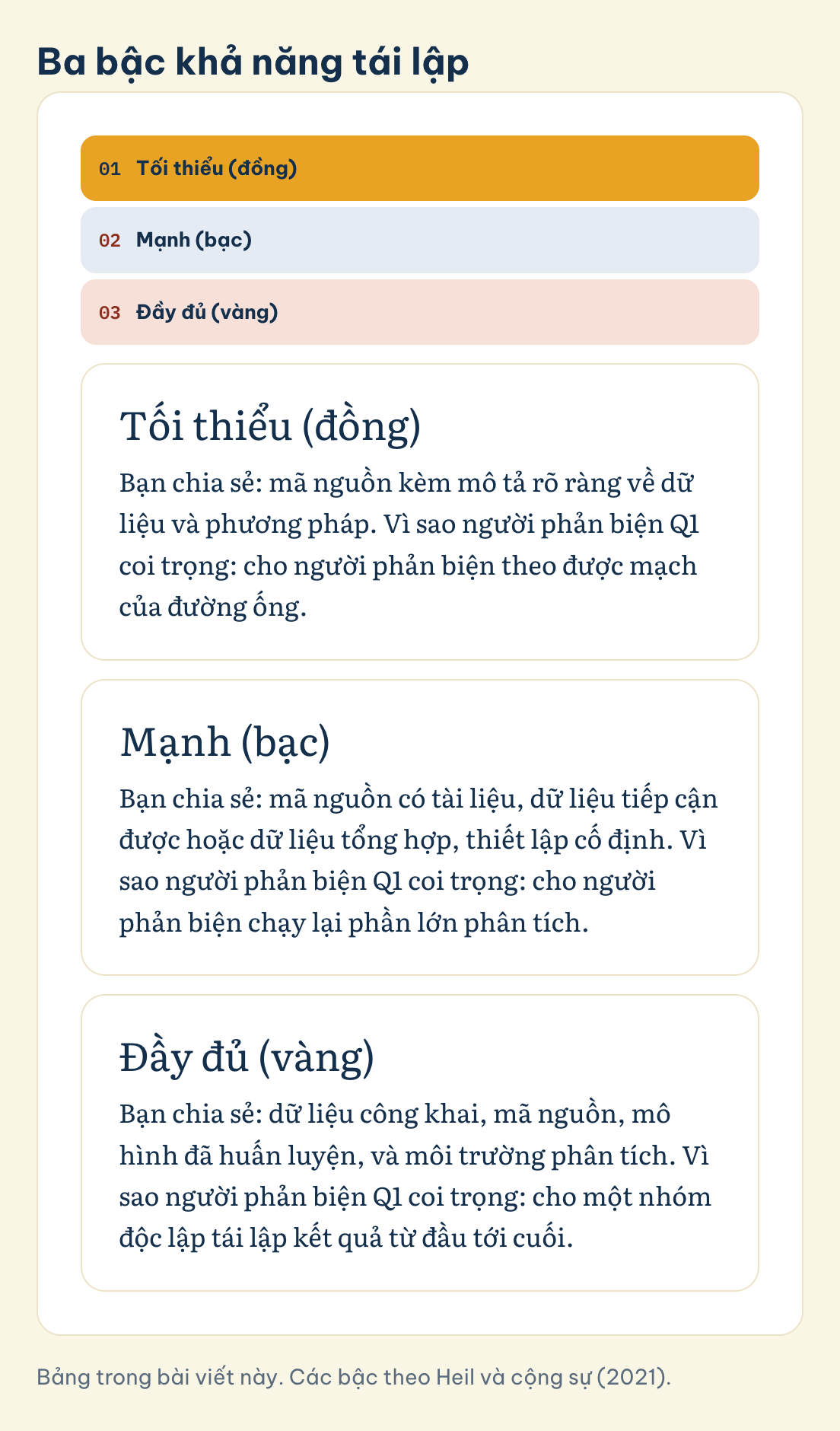
Heil và cộng sự (2021) coi dữ liệu và mã nguồn công khai kèm tài liệu mô tả là các chuẩn cao hơn trong khung phân tầng của khoa học sự sống, còn mức khả dụng một phần là mức tối thiểu. Dữ liệu y tế thường không thể công bố mở, nên Collins và cộng sự (2024) nhấn mạnh vào các tuyên bố tường minh về mức khả dụng của dữ liệu cùng quy trình tiếp cận, thay vì im lặng.
Một nhà nghiên cứu người Việt làm việc với hồ sơ bệnh viện từng lo rằng các quy định về chia sẻ dữ liệu khiến khả năng tái lập trở nên bất khả. Cố vấn MAAS hướng dẫn chị viết một tuyên bố chính xác về mức khả dụng của dữ liệu, chia sẻ phần mã tiền xử lý, và cung cấp một mẫu tổng hợp nhỏ để người phản biện chạy được đường ống mà không chạm vào hồ sơ được bảo vệ.
| Bậc khả năng tái lập | Bạn chia sẻ những gì | Vì sao người phản biện Q1 coi trọng |
|---|---|---|
| Tối thiểu (đồng) | Mã nguồn kèm mô tả rõ ràng về dữ liệu và phương pháp | Cho người phản biện theo được mạch của đường ống |
| Mạnh (bạc) | Mã nguồn có tài liệu, dữ liệu tiếp cận được hoặc dữ liệu tổng hợp, thiết lập cố định | Cho người phản biện chạy lại phần lớn phân tích |
| Đầy đủ (vàng) | Dữ liệu công khai, mã nguồn, mô hình đã huấn luyện, và môi trường phân tích | Cho một nhóm độc lập tái lập kết quả từ đầu tới cuối |
◆ Câu hỏi 4 / 7 · Môi trường và hạt giống
Ghi lại môi trường tính toán và hạt giống ngẫu nhiên bằng cách nào?
Trả lời thẳng: Bạn nên ghim phiên bản phần mềm, ghi lại mọi siêu tham số, và cố định các hạt giống ngẫu nhiên chi phối việc chia dữ liệu, khởi tạo trọng số và xáo trộn. Một lượt chạy tái lập được đòi rằng người cài đúng các phụ thuộc và dùng đúng hạt giống của bạn sẽ rơi vào kết quả nằm trong một biên độ nhỏ đã báo cáo, thay vì ra con số khác mỗi lần.
Theo Pineau và cộng sự (2021), các bảng kiểm về khả năng tái lập của cộng đồng yêu cầu tác giả nêu chính xác các chi tiết huấn luyện, gồm siêu tham số, tài nguyên tính toán, và số lượt chạy kèm thước đo mức dao động, đúng vì các thiết lập không được ghi lại là một lý do phổ biến khiến kết quả không tái lập được. Heil và cộng sự (2021) coi báo cáo môi trường phân tích là một đặc trưng định nghĩa của chuẩn cao nhất trong khoa học sự sống.
Một tác giả ngành kỹ thuật được MAAS đồng hành từng chỉ báo cáo một con số độ chính xác chủ đạo từ một lượt chạy may mắn. Cố vấn gợi ý anh cố định hạt giống, lặp lại thí nghiệm vài lần, rồi báo cáo trung bình kèm một confidence interval cùng tệp mô tả môi trường, và kết quả nhờ vậy vừa tái lập được vừa khó bị gạt đi hơn.
◆ Câu hỏi 5 / 7 · Bảng kiểm nào
Bảng kiểm báo cáo nào làm một nghiên cứu AI y tế tái lập được?
Trả lời thẳng: Bạn nên chọn bảng kiểm khớp nghiên cứu của mình và nộp cùng bản thảo. Với mô hình dự đoán lâm sàng, hãy dùng TRIPOD+AI. Với thiết kế hướng tới mức đáng tin cậy và triển khai được, hãy bám nguyên tắc FUTURE-AI. Hãy ghi mỗi mô hình bằng một model card để mục đích và giới hạn hiện rõ. Nhiều tạp chí y tế Q1 nay yêu cầu một trong số đó khi nộp bài.
Ba tài liệu làm điểm tựa cho việc báo cáo khả năng tái lập
Chạm vào một tài liệu để xem nó dùng để làm gì. Bài nêu chúng cùng nhau, không theo thứ tự cố định.
Mục 1 trên 3
TRIPOD+AI
Dành cho mô hình dự đoán lâm sàng. Một bảng kiểm 27 mục công bố trên The BMJ, chuẩn hoá cách báo cáo cho các mô hình dự đoán xây bằng hồi quy hoặc học máy, theo Collins và cộng sự (2024).
Mục 2 trên 3
FUTURE-AI
Dành cho thiết kế hướng tới mức đáng tin cậy và triển khai được. Nó định ra các nguyên tắc dẫn đường, trong đó có khả năng truy vết và khả năng tái lập cho AI y tế (FUTURE-AI Consortium, 2024).
Mục 3 trên 3
Model card
Ghi mỗi mô hình đã huấn luyện để mục đích sử dụng và giới hạn hiện rõ. Model card là công cụ có cấu trúc để công bố mục đích, dữ liệu và giới hạn của một mô hình, theo Mitchell và cộng sự (2019).
Lưu hình này
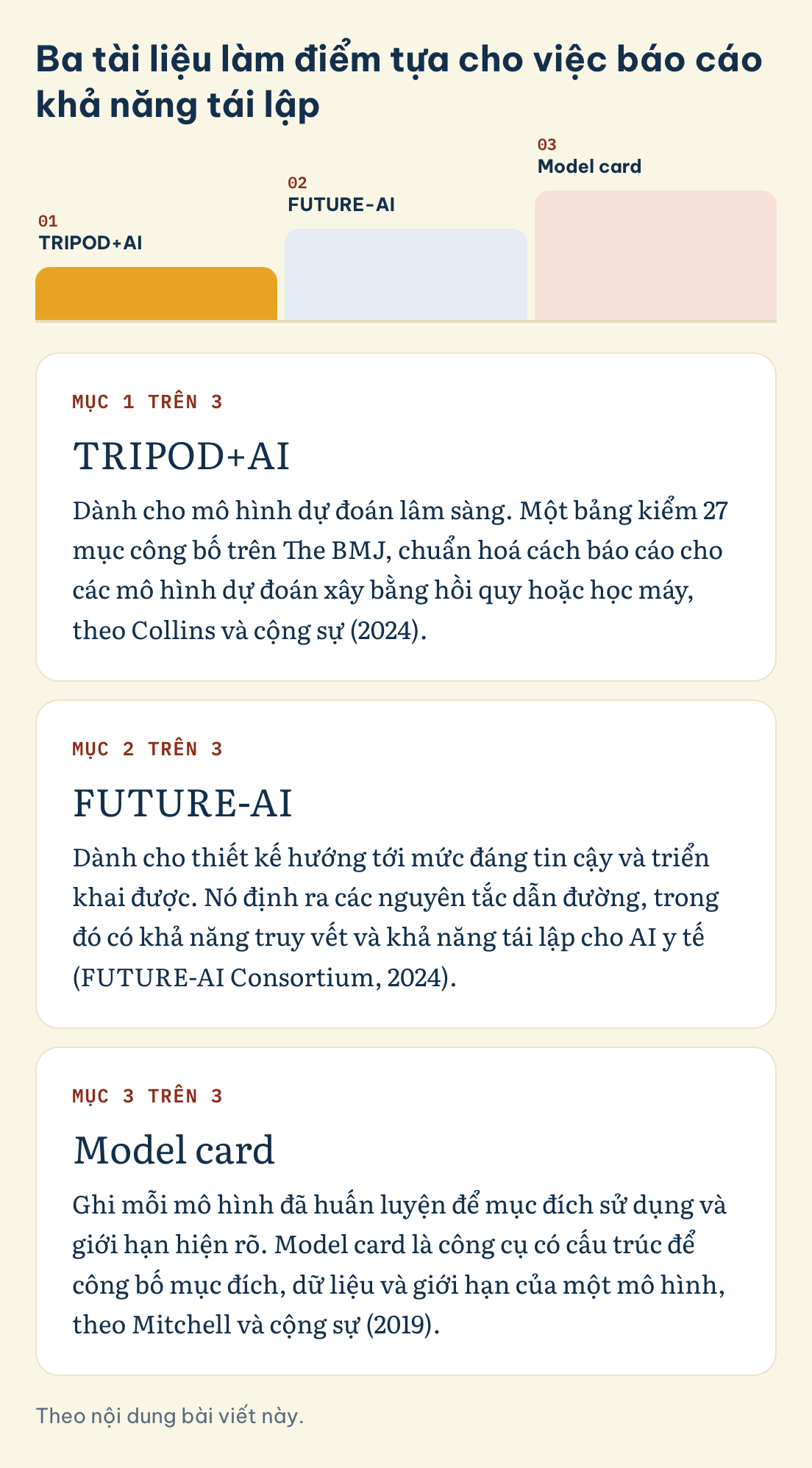
Collins và cộng sự (2024) công bố TRIPOD+AI trên The BMJ, một bảng kiểm 27 mục chuẩn hoá cách báo cáo cho các mô hình dự đoán xây bằng hồi quy hoặc học máy, và bảng kiểm này đòi đúng mức minh bạch làm nền cho khả năng tái lập. FUTURE-AI Consortium (2024) định ra các nguyên tắc dẫn đường, trong đó có khả năng truy vết và khả năng tái lập cho AI y tế, còn Mitchell và cộng sự (2019) đưa ra model card như một cách có cấu trúc để công bố mục đích, dữ liệu và giới hạn của một mô hình.
Một tác giả AI lâm sàng người Việt từng điền TRIPOD+AI theo từng dòng trong lúc viết bản thảo. Ba mục chị chưa trả lời được, gồm hiệu chuẩn, một tập kiểm tra ngoài và một model card, đã trở thành danh sách việc phải sửa của chị, và điều đó làm bài chắc hơn trước cả khi một người phản biện nhìn thấy.
◆ Câu hỏi 6 / 7 · Ngăn rò rỉ
Ngăn rò rỉ dữ liệu làm hỏng khả năng tái lập bằng cách nào?
Trả lời thẳng: Bạn nên tách dữ liệu trước khi chạm vào nó, giữ mọi bước tiền xử lý bên trong fold huấn luyện, và bảo đảm không bệnh nhân hay bản ghi nào xuất hiện ở cả tập huấn luyện lẫn tập kiểm tra. Rò rỉ dữ liệu tạo ra kết quả trông rất đẹp nhưng không tái lập được trên dữ liệu chưa từng thấy, nên kiểm soát nó quan trọng ngang việc chia sẻ mã nguồn.
Pineau và cộng sự (2021) nhấn mạnh việc phân chia dữ liệu cho đúng, kiểm soát rò rỉ, và ước lượng hiệu năng một cách trung thực như những điều cốt lõi của kết quả tái lập được, còn Heil và cộng sự (2021) coi việc ghi chép rõ ràng cách xử lý dữ liệu là một kỳ vọng nền trong khoa học sự sống. Khả năng tái lập mà không kiểm soát rò rỉ thì chỉ tái lập lại một con số đã bị thổi phồng.
Một khách hàng dùng dịch vụ Cố vấn Công bố của MAAS từng chuẩn hoá các đặc trưng trên toàn bộ dữ liệu trước khi chia tập, làm thông tin của tập kiểm tra rò sang tập huấn luyện. Cố vấn hướng dẫn chị dựng lại đường ống sao cho phần tiền xử lý chỉ khớp trên dữ liệu huấn luyện, rồi chạy lại với hạt giống cố định, và kết quả không còn rò rỉ tuy thấp hơn nhưng tái lập được thật.
◆ Câu hỏi 7 / 7 · Xây từ đầu
Nhà nghiên cứu Việt Nam xây khả năng tái lập vào ngay từ đầu bằng cách nào?
Trả lời thẳng: Bạn nên coi khả năng tái lập là một lựa chọn thiết kế, không phải lớp đánh bóng cuối cùng. Hãy dựng mã nguồn có quản lý phiên bản, một kế hoạch quản trị dữ liệu, hạt giống cố định, và bảng kiểm báo cáo bạn nhắm tới ngay từ đầu, rồi ghi chép trong lúc làm. Xây thói quen này sớm thì dễ hơn nhiều so với dựng lại đường ống sau khi đã nộp bài.
Chiến lược nghiên cứu của Việt Nam đặt mục tiêu tăng 15 tới 20% mỗi năm về sản lượng công bố trên WoS, Scopus và nhóm Q1, đồng thời gắn tiến độ đào tạo sau đại học với công bố quốc tế, nên nhu cầu về công trình AI y tế tái lập được đang tăng lên. Nếu đặt khung chuẩn của Heil và cộng sự (2021) cho khoa học sự sống cạnh khảo sát của McDermott và cộng sự (2021) về học máy cho y tế, ta thấy các chuẩn mực về khả năng tái lập ở hai mảng hội tụ về cùng những kỷ luật ban đầu, gồm mã nguồn chia sẻ, dữ liệu có tài liệu mô tả, thiết lập cố định, và báo cáo minh bạch.
Một cố vấn MAAS từng đồng hành cùng một tác giả AI y khoa người Việt theo mô hình đi từng chặng. Ở chặng đầu, đề cương được ánh xạ vào TRIPOD+AI. Ở chặng giữa, bản thảo gồm các thí nghiệm đã cố định hạt giống và không còn rò rỉ cùng một kho mã có tài liệu, và lượt cuối trau chuốt phần khả năng tái lập. Tác giả vẫn là tác giả suốt quá trình, còn cố vấn tư vấn chứ không tạo ra công trình thay.
Câu hỏi thường gặp
Tôi có phải công khai dữ liệu y tế của mình mới được coi là tái lập được không?
Không. Dữ liệu bệnh nhân thường không chia sẻ được, và người phản biện hiểu điều đó. Thứ họ chờ đợi là một tuyên bố rõ ràng về mức khả dụng của dữ liệu, phần mã tiền xử lý và mã phân tích được chia sẻ, và ở đâu có thể thì một mẫu tổng hợp hoặc tóm lược để đường ống chạy được mà không phơi bày hồ sơ được bảo vệ.
Khả năng tái lập và khả năng lặp lại khác nhau ở chỗ nào?
Khả năng tái lập nghĩa là thu được kết quả nhất quán từ cùng dữ liệu và cùng mã nguồn, còn khả năng lặp lại nghĩa là đi tới cùng một kết luận với dữ liệu mới thu thập. Người phản biện Q1 chủ yếu đánh giá khả năng tái lập, vì đó là thứ mà các hiện vật bạn chia sẻ cho phép họ kiểm trực tiếp.
Một mô hình dự đoán bằng AI nên dùng bảng kiểm báo cáo nào?
Với một mô hình dự đoán lâm sàng xây bằng hồi quy hoặc học máy, TRIPOD+AI là bảng kiểm cốt lõi. Bạn nên ghép nó với một model card để ghi lại mục đích sử dụng và các giới hạn, rồi căn chỉnh thiết kế tổng thể theo các nguyên tắc AI đáng tin cậy như FUTURE-AI.
Tôi nên chạy thí nghiệm bao nhiêu lần?
Nhiều hơn một lần. Một lượt chạy duy nhất che mất phần dao động do hạt giống ngẫu nhiên sinh ra, nên bạn hãy lặp lại thí nghiệm vài lần và báo cáo trung bình kèm một thước đo độ phân tán, chẳng hạn một confidence interval, đi cùng cấu hình hạt giống cố định của bạn.
Sửa rò rỉ dữ liệu có làm độ chính xác của tôi giảm không?
Thường là có, và đó chính là điểm mấu chốt. Rò rỉ thổi phồng hiệu năng trên dữ liệu mà mô hình trên thực tế đã nhìn thấy. Một kết quả thấp hơn nhưng không rò rỉ và tái lập được thì đáng tin hơn với người phản biện Q1 so với một con số ấn tượng mà không ai tái lập nổi.
MAAS có giúp tôi làm nghiên cứu AI y tế tái lập được cho tạp chí Q1 không?
Có. Cố vấn Công bố của MAAS đồng hành cùng nhà nghiên cứu Việt Nam qua khâu đánh giá tính khả thi, căn chỉnh phương pháp theo bảng kiểm báo cáo, kiểm soát rò rỉ, và mức sẵn sàng về khả năng tái lập, theo mô hình đi từng chặng. Bạn có thể đặt lịch tư vấn qua trang liên hệ của MAAS.
Sẵn sàng làm nghiên cứu AI y tế của bạn tái lập được và đạt chuẩn Q1?
Một bản thảo học máy trong y tế được đánh giá ở chỗ người phản biện có tin và kiểm chứng được nó hay không. Khả năng tái lập dễ xây vào từ đầu cùng một cố vấn từng công bố trên tạp chí thuộc danh mục hơn là dựng lại sau một lần bị từ chối. Cố vấn Công bố của MAAS giữ bảo mật code, dữ liệu và bản thảo chưa công bố của bạn suốt quá trình hợp tác, một quá trình đi qua năm phase từ kick-off tới trả lời bình duyệt. Cố vấn có nhiều bài Q1 hoặc Q2 đứng tên chính mình, và 23% chuyên gia của MAAS có học vị Tiến sĩ. MAAS ghép cố vấn trong vòng 48 giờ khi mạng lưới đã có người phù hợp. Nếu chưa có, MAAS mở một đợt tuyển riêng cho hồ sơ của bạn và việc này thường mất khoảng hai tuần. Bạn đặt một buổi tư vấn miễn phí 20 phút để bắt đầu. MAAS đồng hành, còn bạn vẫn là tác giả.
Đặt lịch tư vấn Cố vấn Công bố cùng MAAS →
Bài liên quan
- Công bố nghiên cứu AI trong chẩn đoán hình ảnh y khoa trên tạp chí Q1 bằng cách nào?: bảng kiểm sẵn sàng cho Q1 ở phạm vi rộng hơn
- Dùng AI có đạo đức trong phần tổng quan tài liệu như thế nào?: giữ cho việc dùng AI minh bạch và có ghi chép
- Thiết kế một tổng quan hệ thống trong khoa học sức khoẻ thế nào?: một lối vào công bố đầu tiên cần ít dữ liệu
- Công bố việc dùng AI trong một bài nghiên cứu ra sao?: tuyên bố minh bạch mà người phản biện nay chờ đợi
- Chọn đúng kiểm định thống kê cho một bài Q1 bằng cách nào?: những quyết định phân tích mà người phản biện đòi bạn biện minh
- Bộ hướng dẫn báo cáo nào hợp với bài nghiên cứu của bạn?: TRIPOD+AI, PRISMA và các bảng kiểm neo giữ khả năng tái lập
- Dịch vụ Cố vấn Công bố: các bậc dịch vụ đầy đủ cho phần hỗ trợ Scopus Q1 và Q2
- Trang tài nguyên công bố Scopus: lộ trình công bố đầy đủ
- Gặp gỡ đội ngũ chuyên gia MAAS: những cố vấn trình độ sau đại học đứng sau phần cố vấn của MAAS
References
- Collins, G. S., Moons, K. G. M., Dhiman, P., Riley, R. D., Beam, A. L., Van Calster, B., Ghassemi, M., Liu, X., Reitsma, J. B., van Smeden, M., Boulesteix, A. L., Camaradou, J. C., Celi, L. A., Denaxas, S., Denniston, A. K., Glocker, B., Golub, R. M., Harvey, H., Heinze, G. ... Logullo, P. (2024). TRIPOD+AI statement: Updated guidance for reporting clinical prediction models that use regression or machine learning methods. BMJ, 385, Article e078378. https://doi.org/10.1136/bmj-2023-078378
- FUTURE-AI Consortium. (2024). FUTURE-AI: International consensus guideline for trustworthy and deployable artificial intelligence in healthcare [Preprint]. arXiv. https://arxiv.org/abs/2309.12325
- Gundersen, O. E., & Kjensmo, S. (2018). State of the art: Reproducibility in artificial intelligence. Proceedings of the AAAI Conference on Artificial Intelligence, 32(1), 1644–1651. https://doi.org/10.1609/aaai.v32i1.11503
- Heil, B. J., Hoffman, M. M., Markowetz, F., Lee, S. I., Greene, C. S., & Hicks, S. C. (2021). Reproducibility standards for machine learning in the life sciences. Nature Methods, 18(10), 1132–1135. https://doi.org/10.1038/s41592-021-01256-7
- McDermott, M. B. A., Wang, S., Marinsek, N., Ranganath, R., Foschini, L., & Ghassemi, M. (2021). Reproducibility in machine learning for health research: Still a ways to go. Science Translational Medicine, 13(586), Article eabb1655. https://doi.org/10.1126/scitranslmed.abb1655
- Mitchell, M., Wu, S., Zaldivar, A., Barnes, P., Vasserman, L., Hutchinson, B., Spitzer, E., Raji, I. D., & Gebru, T. (2019). Model cards for model reporting. In Proceedings of the Conference on Fairness, Accountability, and Transparency (pp. 220–229). Association for Computing Machinery. https://doi.org/10.1145/3287560.3287596
- Pineau, J., Vincent-Lamarre, P., Sinha, K., Larivière, V., Beygelzimer, A. d'Alché-Buc, F. Fox, E., & Larochelle, H. (2021). Improving reproducibility in machine learning research: A report from the NeurIPS 2019 reproducibility program. Journal of Machine Learning Research, 22(164), 1–20.
- Stupple, A., Singerman, D., & Celi, L. A. (2019). The reproducibility crisis in the age of digital medicine. npj Digital Medicine, 2, Article 2. https://doi.org/10.1038/s41746-019-0079-z
Bài viết này thuộc chuỗi MAAS Journal dành cho học viên cao học và nhà nghiên cứu Việt Nam đang học tập ở nước ngoài. Cố vấn Công bố của MAAS là một đối tác cố vấn, MAAS đồng hành cùng tác giả theo mô hình bàn giao đi từng chặng, với phản hồi phát triển từ các cố vấn trình độ sau đại học đã công bố trên Scopus. MAAS không viết thay tác giả, không nộp bài thay tác giả và không bảo đảm bài được chấp nhận.
Một buổi tư vấn miễn phí 20 phút với cố vấn công bố của MAAS, để cùng xem nghiên cứu học máy trong y tế của bạn tái lập được tới đâu trước khi nộp bài.
Đặt buổi tư vấn miễn phí ▸