
◆ Research Methods
Which qualitative research methods fit your research question?
Category: research-methods
Last updated: 2026-10-20

Choosing among qualitative research methods is easier once you stop asking which one is best and ask which one can answer your question. Interviews, focus groups, ethnography and case studies all collect words and observations, yet they collect different kinds of them, from different numbers of people, over very different stretches of time. This guide compares those four ways of collecting data so you can match one to your question before your supervisor asks you to defend the choice. If you are still deciding whether a qualitative design is right at all, start with our overview of qualitative vs quantitative vs mixed methods.
◆ Question 1 / 8 · Main types
What are the main types of qualitative research methods?
Direct answer: There is no single official list, which is why searches return three, five, seven or eight "types". This guide takes four common choices: three ways of collecting data (semi-structured interviews, focus groups, and ethnography with participant observation) and the case study design. This guide compares those four, and the analysis step comes afterwards.
People searching Google for the field ask about three types, five methods, seven types and eight types, and the answers differ because authors draw the boundaries in different places. Some lists mix ways of collecting data (interviews), ways of designing a study (case study), and ways of analysing it (thematic analysis). Busetto et al. (2020) make the useful point that "each choice of single or combined methods has to be based on the research question that needs to be answered and a critical assessment with regard to whether or to what extent the chosen method can accomplish this".
For a postgraduate thesis in Australia or the UK, the practical move is to shortlist the methods that produce the kind of data your question needs. A question about how people experience something points to interviews. A question about how a group reasons together points to focus groups. A question about what a community actually does points to ethnography, and a question about one bounded situation in its real setting points to a case study. Vietnamese international students at Australian and UK universities, writing a first qualitative methodology chapter, may arrive with a long list copied from a textbook, and the quickest improvement is to cut that list to the one or two methods the question supports.
◆ Question 2 / 8 · Interviews
How do semi-structured interviews work, and how many do you need?
Direct answer: A semi-structured interview uses open-ended questions and a topic guide that you adapt as you learn. It suits questions about experiences, views and reasons. Guest et al. (2006) found saturation within twelve interviews in one homogeneous study, and Hennink and Kaiser (2022) report 9 to 17 interviews across their review.
Busetto et al. (2020) describe semi-structured interviews as "characterized by open-ended questions and the use of an interview guide (or topic guide/list) in which the broad areas of interest, sometimes including sub-questions, are defined". The guide is not a script. The same authors note that the topic list "is usually adapted and improved at the start of the data collection process as the interviewer learns more about the field". In practice that means your first two or three interviews also test your questions, and you may reorder or rewrite them before you continue.
The data you get is talk: audio that becomes a transcript, one participant at a time. That one-to-one setting suits topics people would hesitate to raise in a group, which is the limit Busetto et al. (2020) note for focus groups. It also limits them, since you hear what people say about their practice and do not see the practice itself.
Sample size is where students most often lose marks by guessing. Guest et al. (2006) coded sixty interviews with women in two West African countries and report that "data saturation had for the most part occurred by the time we had analyzed twelve interviews" (Guest et al., 2006, p. 74). After twelve interviews they had created 92% of the codes in the thirty Ghanaian transcripts (100 of 109 codes). The authors also warn that "twelve interviews will likely not be enough if a selected group is relatively heterogeneous, the data quality is poor, and the domain of inquiry is diffuse and/or vague" (Guest et al., 2006, p. 79). Hennink and Kaiser (2022) reviewed 23 studies that tested saturation (17 empirical and 6 statistical modelling) and found that the studies using empirical data reached it within 9 to 17 interviews, particularly for relatively homogeneous populations and narrowly defined aims. They add that the few outliers, such as multi-country research, needed larger samples. Guest et al. (2006) also report that basic elements for metathemes were present as early as six interviews (p. 59), and that after all sixty interviews across two countries the codebook held 114 codes, 88% of which existed after twelve (p. 74). Busetto et al. (2020) add that qualitative research does not require a sample size set in advance.
These sources come from different fields and journals: Busetto et al. (2020) in Neurological Research and Practice, Guest et al. (2006) in Field Methods, Hennink and Kaiser (2022) in Social Science & Medicine, and Kitzinger (1995) in the BMJ. Check that the norms of your own discipline fit before you borrow a number. Read those figures as evidence for your justification, not as a target. A narrow question put to one fairly uniform group, for example international master's students in one programme, can make a small sample defensible. A question across several countries or several types of participant makes it harder to defend, and you should say so in your methodology chapter.
◆ Question 3 / 8 · Focus groups
When do focus groups work better than interviews?
Direct answer: Choose a focus group when the interaction between participants is part of what you want to study. Kitzinger (1995) defines it as a group interview that uses communication between participants to generate data. Be cautious with sensitive topics, where some people may not disclose in front of others (Busetto et al., 2020).
Kitzinger (1995, p. 299) describes focus groups as "a form of group interview that capitalises on communication between research participants in order to generate data", and states that "focus groups explicitly use group interaction as part of the method." The same page explains why that matters: the method can "examine not only what people think but how they think and why they think that way." A group can challenge, prompt and correct each other in ways a lone interviewee cannot.
Kitzinger (1995) also names the trade-off, warning that the norms a group expresses can silence individual voices of dissent. If you suspect that a minority view matters to your question, a focus group may hide it. Busetto et al. (2020) make a related point, saying focus groups can be less appropriate for sensitive topics that participants may be reluctant to disclose in a group.
On numbers, sources disagree slightly, and you should say which one you follow. Busetto et al. (2020) write that groups usually consist of 6 to 8 people, while the Monash guide by Ayton et al. (2023) suggests 1 to 2 focus groups of 4 to 6 participants for describing a phenomenon, and Hennink and Kaiser (2022) found saturation within 4 to 8 focus group discussions. Those figures count groups, not people, so a study with six groups of six already involves thirty-six participants. A quick way to use this: if your question is about how a team or class talks through a problem, plan several groups of about six people each. If it is about one person's private decision, use interviews.
◆ Question 4 / 8 · Ethnography
What does ethnography ask of you?
Direct answer: Ethnography studies the culture of a group by observing it, and often joining it. Participant observation is its hallmark method. It is time-intensive, with fieldwork that Ayton et al. (2023) describe as ranging from short sessions over months or years to living in the community.
The University of Cambridge School of Technology (n.d.), writing for technology researchers in the UK, describes ethnography as aiming "to produce a detailed description of how a particular social group operates, based on observation of, and often participation in, the group", possibly supplemented by interviews and documents. Ayton et al. (2023) say that "participant observation is a hallmark method" and that it involves "participating as a member of the community or culture, to gain first-hand experience of daily life in the research setting". The focus, they add, is on culture and on "behaviours, experiences and meanings at the group level".
The data is therefore field notes first, with interview transcripts and documents alongside. You see what people do as well as what they say, which is the reason to choose ethnography when a gap between the two matters to your question. A thesis on how Vietnamese international students form study groups on an Australian campus is the kind of question observation can answer and interviews alone may not.
The cost is time and access. Ayton et al. (2023), whose open textbook comes from Monash University and the CAUL Open Educational Resources Collective, list ethnography as time-intensive, needing personnel for observation, interviews and analysis, with an indicative sample of 50 to 150. Those figures come from a health and social care textbook and the authors state that sample sizes are not prescriptive, so treat them as a guide for your ethics application and not a rule. For a one-year master's dissertation, ethnography usually has to be scaled down, which is a choice you will need to justify openly.
◆ Question 5 / 8 · Case study
When is a case study the right choice?
Direct answer: Use a case study when you want to understand one bounded case, such as a person, programme, organisation or process, within its real-life setting, using several sources of evidence. The definition reproduced by Ayton et al. (2023) from Yin stresses a contemporary phenomenon in its context.
Ayton et al. (2023) reproduce a definition of a case study from page 13 of a 2002 text by Yin, as an "empirical inquiry that investigates a contemporary phenomenon within its real-life context" that "relies on multiple sources of evidence". A case study is therefore a design that can use interviews, focus groups, documents and observation together, not a rival to them. Ayton et al. (2023) set the definitions of three well-known case study authors side by side in Table 8.1, which tells you that "case study" is defined differently by different authors, so name the one you follow.
The first decision is what your case is. Ayton et al. (2023) advise deciding at the outset "who or what is your case", which "can be a person, program, organisation or group, or a process", and stating the phenomenon of interest. Then comes the practical risk the same authors flag: "it can be challenging to define the boundaries of the case and to gain appropriate access to the case for the 'deep dive' form of analysis." If you cannot get access to the organisation you want, the design fails before the first interview.
Sample size depends on the design. A single case needs no participant target in the usual sense, because the case is the unit. For a multiple case study the Monash guide suggests an indicative 30 to 100 participants, with representatives of different stakeholder groups (Ayton et al., 2023). As with ethnography, that range is indicative for health and social care and not a rule.
◆ Question 6 / 8 · Choosing
How do you choose between the four methods?
Direct answer: Start from the question, then compare what data each method produces, how many people it needs, and how much time it takes. Interviews fit experiences, focus groups fit shared reasoning, ethnography fits what people actually do, and case study fits one bounded situation in context.
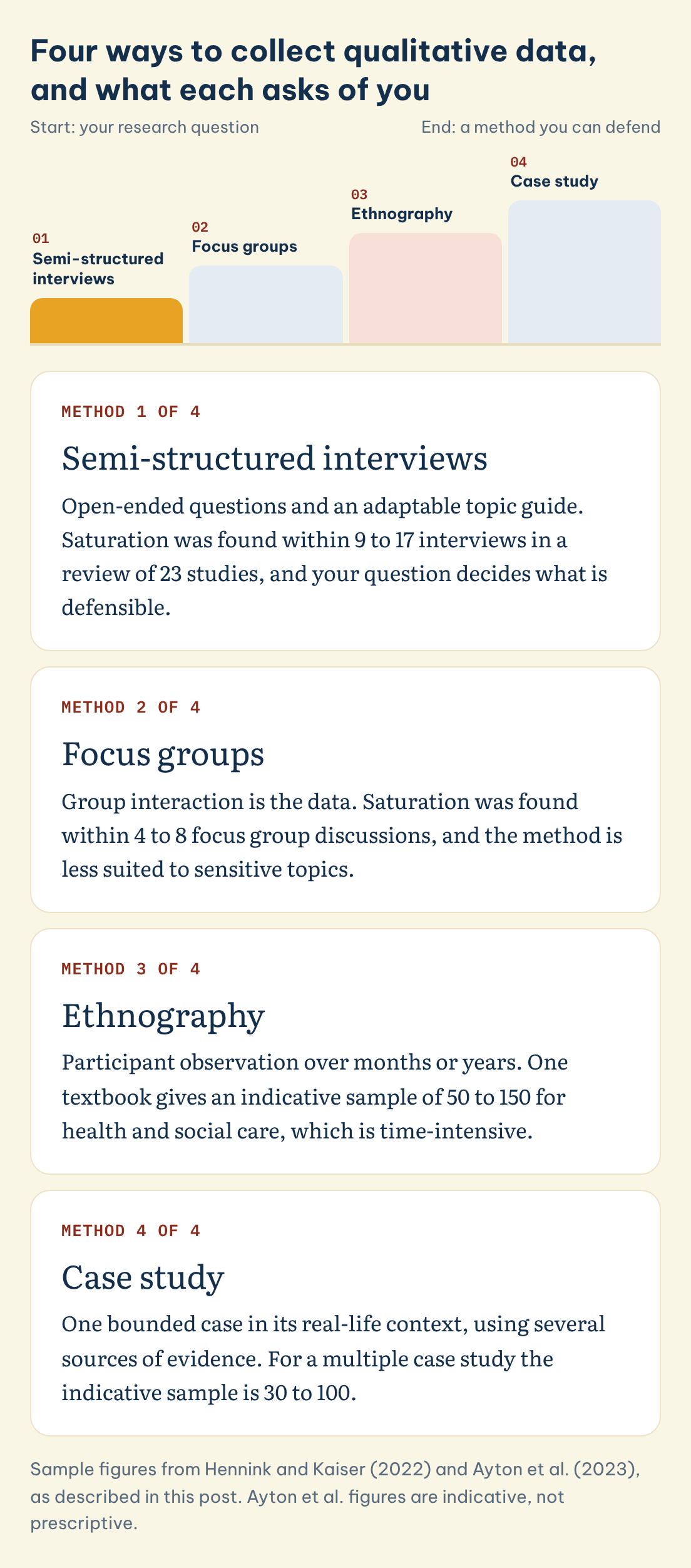
Four ways to collect qualitative data, and what each asks of you
Tap a method to see its typical sample and what it suits.
Method 1 of 4
Semi-structured interviews
Open-ended questions and an adaptable topic guide. Saturation was found within 9 to 17 interviews in a review of 23 studies, and your question decides what is defensible.
Method 2 of 4
Focus groups
Group interaction is the data. Saturation was found within 4 to 8 focus group discussions, and the method is less suited to sensitive topics.
Method 3 of 4
Ethnography
Participant observation over months or years. One textbook gives an indicative sample of 50 to 150 for health and social care, which is time-intensive.
Method 4 of 4
Case study
One bounded case in its real-life context, using several sources of evidence. For a multiple case study the indicative sample is 30 to 100.
Save this figure
| Method | Data it produces | Typical sample per our sources | Time and access | Best for |
|---|---|---|---|---|
| Semi-structured interviews | Spoken accounts, transcribed one participant at a time | 9 to 17 for saturation (Hennink & Kaiser, 2022); 3 to 20 as a planning range for descriptive studies (Ayton et al., 2023) | Sources give no hours; no extended fieldwork period | Experiences, views, reasons, sensitive topics |
| Focus groups | Group talk, including disagreement and prompting | 4 to 8 groups for saturation (Hennink & Kaiser, 2022); about 6 people each | Sources give no hours; needs a moderator and a group that can meet | How people discuss and justify a view together |
| Ethnography | Field notes from participant observation, plus interviews and documents | 50 to 150, indicative, health and social care (Ayton et al., 2023) | Months or years of fieldwork; time-intensive | What a group does in daily life, culture and norms |
| Case study | Several sources of evidence about one bounded case | Multiple case: 30 to 100, indicative (Ayton et al., 2023) | Access to the case can be hard to secure | One person, programme or organisation in context |
The ranges in the table differ because they measure different things. Hennink and Kaiser (2022) report where saturation was reached in the 17 empirical studies among the 23 they reviewed. Ayton et al. (2023) give planning figures, for example to inform grant and ethics applications. When you write your methodology chapter, cite one source for your number and explain that you are following it, so that your examiner can see the reasoning.
A short worked example shows the logic. Suppose your question is "How do first-year international students decide whether to ask a lecturer for help?" Interviews fit because the decision is private. A focus group might surface what students say to each other about asking for help, but it could silence the student who does not ask (Kitzinger, 1995). Ethnography would let you watch consultation hours, though it is a heavy load for a short project (Ayton et al., 2023). A case study would suit a question about one department's help-seeking system. All four can be defended, and the question tells you which defence is easiest.
◆ Question 7 / 8 · Advantages
What are the advantages of qualitative research methods?
Direct answer: The main advantage is depth: you learn how and why people think or act as they do, not only how many do. Kitzinger (1995) says focus groups can show "how they think and why they think that way", and Busetto et al. (2020) describe interviews as suited to subjective experience.
The advantages are tied to the method, so state them method by method in your thesis. Interviews give access to individual accounts of experience (Busetto et al., 2020). Focus groups show how views form in conversation (Kitzinger, 1995). Ethnography shows behaviour in its setting (Ayton et al., 2023), and case study keeps the context that a survey would strip away. The limits mirror these strengths: samples are small, so you describe and explain rather than generalise to a whole population.
◆ Question 8 / 8 · Analysis
Which analysis methods follow data collection?
Direct answer: Collection and analysis are separate decisions. Once you hold transcripts, notes or documents, you code them, and thematic analysis is a common route for postgraduate students. Software can store and retrieve your codes but does not decide what your data mean.
Our guide on how to do a thematic analysis walks through the coding steps, and which qualitative data analysis software fits your thesis compares the programs that hold your codes. Plan the analysis while you plan the collection, because the method you choose shapes what the transcripts or field notes look like when you start.
Frequently asked questions
What are the main types of qualitative research methods?
No single list is official. This guide compares four ways of collecting data: interviews, focus groups, ethnography and case study. Other lists mix in analysis approaches such as thematic analysis, so online counts range from 3 to 8 types.
How many interviews are enough for a qualitative study?
It depends on how uniform your participants are. Guest et al. (2006) found saturation within twelve interviews in one study, and Hennink and Kaiser (2022) report 9 to 17 across the 17 empirical studies in their review. Heterogeneous groups usually need more, so justify your number in the methodology chapter.
Are focus groups better than interviews?
Neither is better. Focus groups use interaction between participants as data (Kitzinger, 1995), which suits shared reasoning. Interviews suit private or sensitive topics. Choose by what your research question needs to see.
Can I combine several qualitative methods in one thesis?
Yes. A case study often uses interviews, documents and observation together (Ayton et al., 2023). Each added method costs time and words, so combine only when the question needs it, and say why in your methodology.
How long does ethnography take?
Ayton et al. (2023) describe fieldwork ranging from short sessions of observation over months or years to living in the community. For a one-year master's project, plan a scaled-down version and discuss the limits with your supervisor.
Do I need a fixed sample size before I start?
Busetto et al. (2020) state that qualitative research does not require a sample size set in advance. Many universities still ask for an estimate in the ethics application, so give a planning range, cite your source for it, and explain how you will judge saturation.
Need help matching a method to your question?
If your research question is clear but the method is not, a conversation with someone experienced in qualitative research can save weeks. MAAS Academic Mentoring places you with a mentor from your own discipline who coaches you through your methodology chapter, your sampling justification and your write-up, and talks through the options in this guide. You do the work, and the choices and every sentence stay yours. The mentoring does not set grade targets, promise a result or offer refunds tied to outcomes. Matching usually takes up to 48 hours where our network already covers the field, and a dedicated recruitment round elsewhere can take about two weeks, with 23% of MAAS experts holding a PhD. A free 20-minute consultation is the easiest first step.
Explore Academic Mentoring with MAAS → or talk to us through the contact page.
Related guides
- Qualitative vs quantitative vs mixed methods: the overview that comes before choosing a collection method
- How do you do a thematic analysis?: the coding step that follows collection
- Which qualitative data analysis software fits your thesis?: tools for storing and retrieving your codes
- How do you calculate sample size for a research study?: sampling in the quantitative case
- How to write a methodology in an essay: putting your method choice on the page
- Academic Mentoring service: one-to-one coaching for your thesis or dissertation
References
- Ayton, D., Tsindos, T., & Berkovic, D. (2023). Qualitative research: A practical guide for health and social care researchers and practitioners. Monash University Library. https://doi.org/10.60754/chqr-dn78
- Busetto, L., Wick, W., & Gumbinger, C. (2020). How to use and assess qualitative research methods. Neurological Research and Practice, 2, Article 14. https://doi.org/10.1186/s42466-020-00059-z
- Guest, G., Bunce, A., & Johnson, L. (2006). How many interviews are enough? An experiment with data saturation and variability. Field Methods, 18(1), 59-82. https://doi.org/10.1177/1525822X05279903
- Hennink, M., & Kaiser, B. N. (2022). Sample sizes for saturation in qualitative research: A systematic review of empirical tests. Social Science & Medicine, 292, Article 114523. https://doi.org/10.1016/j.socscimed.2021.114523
- Kitzinger, J. (1995). Qualitative research: Introducing focus groups. BMJ, 311(7000), 299-302. https://doi.org/10.1136/bmj.311.7000.299
- University of Cambridge, School of Technology. (n.d.). Ethnographic and field study techniques. https://www.tech.cam.ac.uk/ethnographic-and-field-study-techniques
This article is part of the MAAS Journal series for Vietnamese international postgraduate students and researchers. MAAS Academic Mentoring is an advisory service; we coach students through a phase-by-phase process with feedback from discipline-matched experts. We do not write, submit, or guarantee the outcome of work on a student's behalf.
Not sure how this guide applies to your own case? Talk it through with MAAS in a free 20-minute consultation.
contact page ▸