
◆ Research Methods
Which qualitative data analysis software fits your thesis?
Category: research-methods
Last updated: 2026-10-03
Choosing qualitative data analysis software feels like a decision about analysis, yet it is mostly a decision about housekeeping. The program will hold your transcripts, keep your codes tidy and find every passage you tagged, and the thinking that turns those passages into findings stays with you. This guide compares the programs students meet most often and says plainly what each one leaves undone. It sits inside our wider guide to AI and research tools at each stage of a project, which covers the other stages of the workflow.
◆ Question 1 / 5 · What the software can do
What can qualitative data analysis software do, and what can it not do?
Direct answer: Qualitative data analysis software stores, codes, searches and retrieves your material, and it does not decide what your data mean. Zamawe (2015) states that the main function of this kind of software is to aid the analysis process while the researcher stays in control. Treat it as an organised filing system for your own interpretation.
The programs in this family are usually called CAQDAS, short for computer-assisted qualitative data analysis software. Zamawe (2015) reflects on NVivo in the Malawi Medical Journal, and the abstract draws a line between this software and the statistical packages that many students know. The abstract states that "unlike statistical software, the main function of CAQDAS is not to analyse data but rather to aid the analysis process, which the researcher must always remain in control of" (Zamawe, 2015, p. 13). For the statistical side that CAQDAS is contrasted with, SPSS data analysis support is the relevant MAAS service.
The distinction matters for a thesis, because a statistics package can produce a result from a dataset, whereas a coding program cannot produce a theme from a transcript. You create the codes, you decide when two passages belong together, and you defend the interpretation to your examiners. Brailas et al. (2023), who describe the open-source program QualCoder, reach the same conclusion in their introduction to coding: no program can stand in for the quality of the study or of the person doing it. Our separate guide to using SPSS software from data entry to output goes into this in more detail.
The limits of coding software do not make it pointless. St. John and Johnson (2000), in a paper in the Journal of Nursing Scholarship, list the advantages as freedom from clerical tasks, time saved and better auditability, and the concerns as a bias towards coding and retrieval and a distraction from the real work of analysis. A program can make a large body of interviews manageable, keep a trail of how your codes developed, and let you pull every passage on one idea within seconds. The cost is time spent learning the interface and the risk of mistaking a tidy code tree for a finished analysis.
If you have not yet fixed your method, settle that first. How to do a thematic analysis walks through the coding steps the software will later hold, and qualitative vs quantitative vs mixed methods helps you decide whether a qualitative design is the right one at all. Once the design is settled, qualitative research methods compared explains how interviews, focus groups, ethnography and case studies differ in the data they produce.
◆ Question 2 / 5 · How the tools differ
How do NVivo, ATLAS.ti, MAXQDA and the free tools differ?
Direct answer: NVivo, ATLAS.ti and MAXQDA are paid programs, usually reached through a university licence or a student licence, while Taguette and QualCoder are free and open source. Taguette only tags text, and QualCoder also codes images, audio and video. Compare your data types, team size and supervisor expectations before comparing feature lists.
The table below summarises what our sources say about six tools. "Free access" here means what you can use without paying, and for the paid programs it records the licence route instead. Everything was read from vendor pages and library guides on 3 October 2026 and can change, so recheck before you commit.
| Tool | What it does | Free access, checked 3 October 2026 | Evidence |
|---|---|---|---|
| NVivo | Coding and retrieval software from Lumivero | Paid annual subscription; Lumivero says it is moving away from perpetual licences to annual subscriptions only | Zamawe (2015) |
| ATLAS.ti | Coding software, one package on Windows, Mac and web | Student licence needs proof of enrolment | Library guide from Temple University |
| MAXQDA | Coding software from VERBI, identical on Windows and Mac | Student licences run for 6 or 12 months | Vendor statement |
| Taguette | Open-source tagging of text | Free (BSD licence); tagging only, no visualisation | Rampin & Rampin (2021) |
| QualCoder | Open-source desktop coding of text, images, audio and video | Free; single user, no real-time collaboration | Brailas et al. (2023) |
| Delve | Web-based coding tool | A 14-day trial, then paid | Vendor statement |
Three points follow from the table. First, none of our sources ranks one paid program above another. Zamawe (2015) writes about NVivo only, so that evidence says nothing about whether NVivo beats ATLAS.ti or MAXQDA, and a vendor's own description of its product is a claim rather than a comparison. Second, licensing is changing under your feet. Lumivero's own community post says it is transitioning away from perpetual NVivo licences, so a copy that a lab bought years ago may not be the model your university offers today. Third, cost is rarely the first filter in practice, because many universities already license one program and your supervisor may expect you to use it.
Platform is the other practical filter. The Temple University guide describes ATLAS.ti as a single package with all features on Windows, Mac and the web, and MAXQDA states that its Windows and Mac versions are identical. If you work on a Mac, read the vendor's system page for any other program on your shortlist, since our sources do not cover it. For a side-by-side view across more programs, the guides from Temple University, University of Delaware and New York University, listed under Tools & resources below, keep their own comparison tables. The MAXQDA student licence periods of 6 or 12 months and the Delve trial of 14 days are the time limits in our table, so note their dates in your project plan.
◆ Question 3 / 5 · Free software
Is there free qualitative data analysis software?
Direct answer: Yes. Taguette and QualCoder are free, open-source programs for coding qualitative data, and both are described in peer-reviewed articles. They suit smaller projects and solo researchers. Before you rely on one, confirm that your department accepts it and read the licence terms of the version you download.
Rampin and Rampin (2021) present Taguette in the Journal of Open Source Software as open-source qualitative data analysis. The Temple University and University of Delaware guides add the limit that matters in practice: it tags text and offers no visualisation. That is enough if your work is a set of interview transcripts and your analysis happens in your own memos and notes, and it is thin if you want to map codes visually.
QualCoder is described by Brailas et al. (2023) in the American Journal of Qualitative Research. It runs on the desktop and codes text, images, audio and video, which suits projects that include photographs or recordings. The Temple guide notes that it is a single-user tool without real-time collaboration, so a team coding the same project would need a different arrangement. One detail is worth checking yourself: the project documentation gives the licence as LGPL v3, while the paper on version 3.2 gives it as MIT. Our sources do not settle the difference, so read the licence file that ships with the version you install if licence terms matter to your institution.
A free program is still a real commitment of time. Coding a dozen transcripts in a tool, then discovering that your examiners expect a different workflow, is expensive. Ask your supervisor early whether a free tool is acceptable, and if you plan to publish, check whether your target journal expects any particular software to be named in the methods section.
◆ Question 4 / 5 · AI features on interview data
Is it safe to use AI features on interview data?
Direct answer: Check before you switch on any AI feature. A Temple University guide says the generative AI features in ATLAS.ti send data to OpenAI servers. Interview transcripts often contain personal details, so confirm that your ethics approval and your university's rules allow external processing before you upload anything.
Several qualitative programs now advertise AI-assisted coding or summarising. Our sources do not evaluate how well any of these features work, so there is no independent evidence to weigh them against hand coding. What the sources do establish is a data-flow fact: the Temple guide reports that ATLAS.ti sends data from its generative AI features to OpenAI servers. That fact deserves more attention than the feature list, because your participants agreed to a specific use of their words.
Start with the documents you already hold. Your ethics approval and your participant information sheet describe where data are stored and who can see them, and your consent form describes what participants agreed to. If a cloud feature would move transcripts outside the arrangement those documents describe, the feature is not yours to use until you have asked. Raise it with your supervisor or your university's ethics office, and ask for the answer in writing. Removing names and identifying details before any upload is a sensible habit, but it does not replace asking, because what counts as acceptable is set by your approval and your institution, not by the software vendor.
For the wider question of which AI tools your university permits, which AI tools are allowed in university work explains how to find the rule that applies to you. Most programs let you leave AI features switched off, and doing that costs you nothing if the analysis is yours to begin with.
◆ Question 5 / 5 · Choosing for your thesis
How do you choose software for your thesis?
Direct answer: Start from your supervisor, your data and your licence rather than from a feature list. Ask what your department already licenses, list the data types you will code, check licence terms and AI features against your ethics approval, and test the program on a single transcript before you commit your whole dataset.
Choosing qualitative data analysis software for a thesis
Select a step to read what to check at that point. The analysis stays in your own hands throughout.
Step 1 of 5
Supervisor
Ask what your department already licenses. Your supervisor and department know what has been used successfully for examined work in your field, and a licence that the university already pays for removes the cost question.
Step 2 of 5
Data types
List the data types you will code. Text-only interviews fit almost any tool, whereas photographs, audio or video narrow the field to programs that code them, such as QualCoder.
Step 3 of 5
Licence
Check the licence terms. A student licence that needs proof of enrolment, or one that runs for 6 or 12 months, can expire before a long thesis does, so work out the timeline against your submission date.
Step 4 of 5
AI features
Check any AI features against your ethics approval. If a cloud feature would move transcripts outside the arrangement those documents describe, the feature is not yours to use until you have asked.
Step 5 of 5
One transcript
Test the program on a single transcript before you commit your whole dataset. Code it, export the result and see whether you can find your way back to a passage from a code.
Save this figure
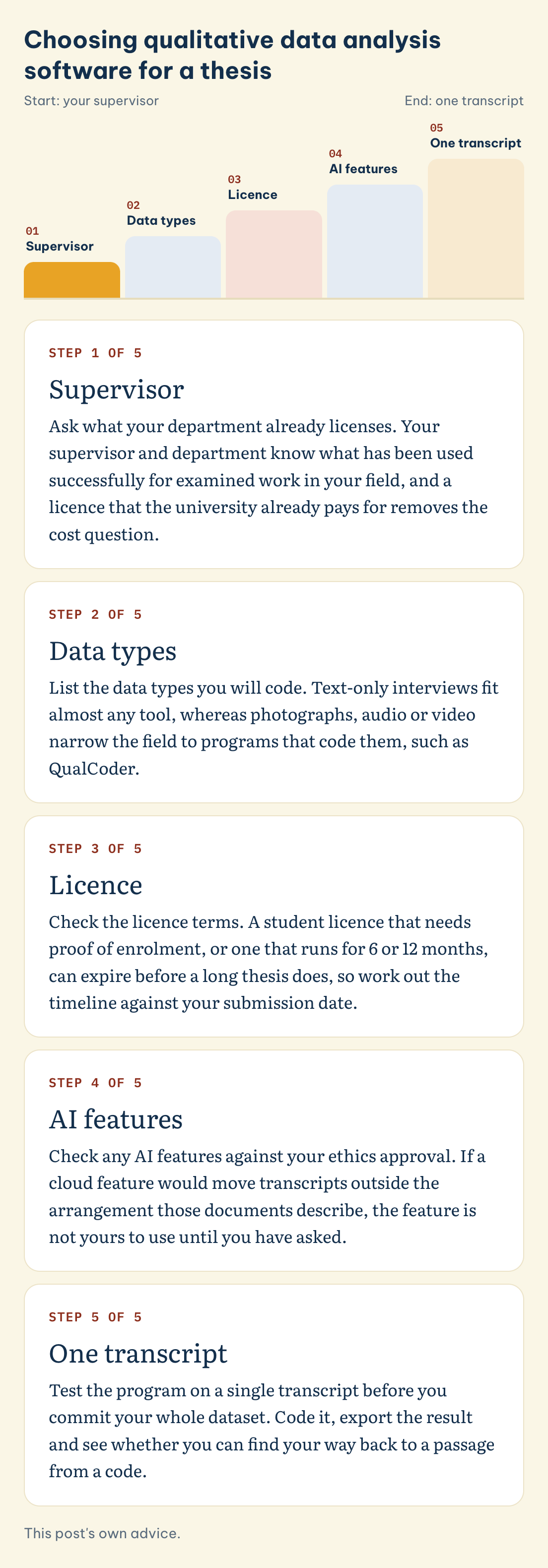
The order matters. Your supervisor and department come first because they know what has been used successfully for examined work in your field, and because a licence that the university already pays for removes the cost question. Your data types come second: text-only interviews fit almost any tool, whereas photographs, audio or video narrow the field to programs that code them, such as QualCoder in our table. If you plan to code interviews in a structured way, our guide to Braun and Clarke thematic analysis explains the reflexive approach before you open any software.
Licence terms come third. A student licence that needs proof of enrolment, or one that runs for 6 or 12 months, can expire before a long thesis does, so work out the timeline against your submission date. The AI check comes fourth, as described above. The test on one transcript comes last, and it is the cheapest way to learn whether the interface suits you. Code that single transcript, export the result, and see whether you can find your way back to a passage from a code.
Throughout, keep the analysis in your own hands. Software can tell you which passages carry a code, but whether the code is right, whether two codes should merge and whether a theme is supported by the evidence are judgments that Zamawe (2015) places with the researcher, and your examiners will expect the same.
Frequently asked questions
Is NVivo better than ATLAS.ti or MAXQDA?
Our sources do not rank them. Zamawe (2015) reflects on NVivo alone, and the other two are described by library guides and vendors, which are not head-to-head tests. Choose by what your university licenses, the data you will code and the platform you use.
Is there free qualitative data analysis software?
Yes. Taguette and QualCoder are free and open source, as described by Rampin and Rampin (2021) and Brailas et al. (2023). Taguette tags text and has no visualisation, while QualCoder codes text, images, audio and video for a single user. Confirm with your supervisor that a free tool is acceptable for your thesis.
Can qualitative software analyse the data for me?
No. Zamawe (2015, p. 13) states that the main function of this software is to aid the analysis process, with the researcher remaining in control. The program organises and retrieves your coding, and the interpretation stays yours.
Which qualitative software works on Mac?
A Temple University guide describes ATLAS.ti as one package on Windows, Mac and the web, and MAXQDA states that its Windows and Mac versions are identical, with student licences of 6 or 12 months. For any other program, read the vendor's system requirements before you install.
Is it safe to use AI features on interview data?
Check first. The Temple University guide reports that ATLAS.ti passes data to OpenAI servers when its generative AI is used, so confirm that your ethics approval and university rules allow that before uploading interview transcripts. If the answer is unclear, ask your supervisor or ethics office.
Need a second pair of eyes on your qualitative design?
If your method and data plan are still loose, settle those before the software, and a conversation with someone who has supervised qualitative work will speed that up. MAAS Academic Mentoring places you with a mentor from your own discipline who coaches you through methodology, coding and write-up, and can talk through which tools suit your project and your university's rules. The coding, the interpretation and every sentence remain yours. 23% of MAAS experts hold a PhD. Matching usually takes up to 48 hours where our network already covers the field, and a dedicated recruitment round elsewhere can take about two weeks. A free 20-minute consultation is the easiest first step.
Explore Academic Mentoring with MAAS → or talk to us through the contact page.
Related guides
- Which AI and research tools help at each stage of a project?: the full workflow this guide belongs to
- Which AI tools can help with a literature review, and at which step?: the six steps of a review, tool by tool
- Which reference management software should you use for a thesis?: Zotero, Mendeley, EndNote and JabRef compared
- How do you do a thematic analysis?: the coding method your software holds
- Qualitative vs quantitative vs mixed methods: choosing the design before the tool
- Which AI tools are allowed in university work?: finding your institution's rule
- Academic Mentoring service: one-to-one coaching for your thesis or dissertation
Tools & resources
- Temple University Libraries, qualitative data analysis software guide: https://guides.temple.edu/qda/choosing
- University of Delaware Library, qualitative data analysis tools: https://guides.lib.udel.edu/qda/tools
- New York University Libraries, qualitative data analysis comparison: https://guides.nyu.edu/QDA/comparison
References
- Brailas, A., Tragou, E., & Papachristopoulos, K. (2023). Introduction to qualitative data analysis and coding with QualCoder. American Journal of Qualitative Research, 7(3), 19–31. https://doi.org/10.29333/ajqr/13230
- Rampin, R., & Rampin, V. (2021). Taguette: Open-source qualitative data analysis. Journal of Open Source Software, 6(68), 3522. https://doi.org/10.21105/joss.03522
- St. John, W., & Johnson, P. (2000). The pros and cons of data analysis software for qualitative research. Journal of Nursing Scholarship, 32(4), 393–397. https://doi.org/10.1111/j.1547-5069.2000.00393.x
- Zamawe, F. C. (2015). The implication of using NVivo software in qualitative data analysis: Evidence-based reflections. Malawi Medical Journal, 27(1), 13–15. https://doi.org/10.4314/mmj.v27i1.4
This article is part of the MAAS Journal series for Vietnamese international postgraduate students and researchers. MAAS Academic Mentoring is an advisory service; we coach students through a phase-by-phase process with feedback from discipline-matched experts. We do not write, submit, or guarantee the outcome of work on a student's behalf.
A free 20-minute consultation is a conversation about your situation and the qualitative design, data plan and software you are weighing up.
Book a free consultation ▸