
◆ Research Methods
How do you design semi-structured interviews for a dissertation?
You design semi-structured interviews for a dissertation by building an interview guide in five phases: check that interviews fit your question, review what is already known, draft open questions with probes, pilot the guide, and present the final version. Kallio et al. (2016) set out these five phases, and your methodology chapter should explain how you followed them.
◆ Question 1 / 8 · Why the name
Why is it called a semi-structured interview?
Direct answer: The name describes a middle position. DiCicco-Bloom and Crabtree (2006) explain that these interviews are organised around predetermined open-ended questions, while other questions emerge from the dialogue. You fix the topics in advance, but the wording, order and follow-up questions can change during each conversation.
DiCicco-Bloom and Crabtree (2006) note that qualitative interviews are usually sorted into unstructured, semi-structured and structured formats. In a dissertation, the format gives you comparable data across participants without forcing everyone through an identical script. The same authors add that semi-structured interviews are often the only data source in a qualitative project and usually take between 30 minutes and several hours. Berkovic (2023) describes the aim as exploring a few issues in moderate detail, and recommends an interview guide with targeted open questions to direct the conversation. That balance is the practical meaning of "semi": enough structure that your supervisor can see how each question maps to a research question, and enough freedom that a participant can raise something you had not anticipated. If your project needs neither comparability nor flexibility, another method may suit it better, which our comparison of qualitative research methods covers.
◆ Question 2 / 8 · Three formats
What is the difference between structured, semi-structured and unstructured interviews?
Direct answer: Structured interviews ask every participant the same questions in the same order, often producing data that can be counted. Unstructured interviews are close to guided conversations. Semi-structured interviews sit between them, with a fixed list of topics and open questions but room to follow the participant.
Structured, semi-structured and unstructured interviews
Tap a format to see how its questions and data differ.
Structured
Fixed wording and order. Data are often quantitative.
Semi-structured
Predetermined open questions, adapted in each interview, with follow-ups from the dialogue. Often the sole data source.
Unstructured
Few or no questions fixed in advance. Questions emerge over time.
Save this figure
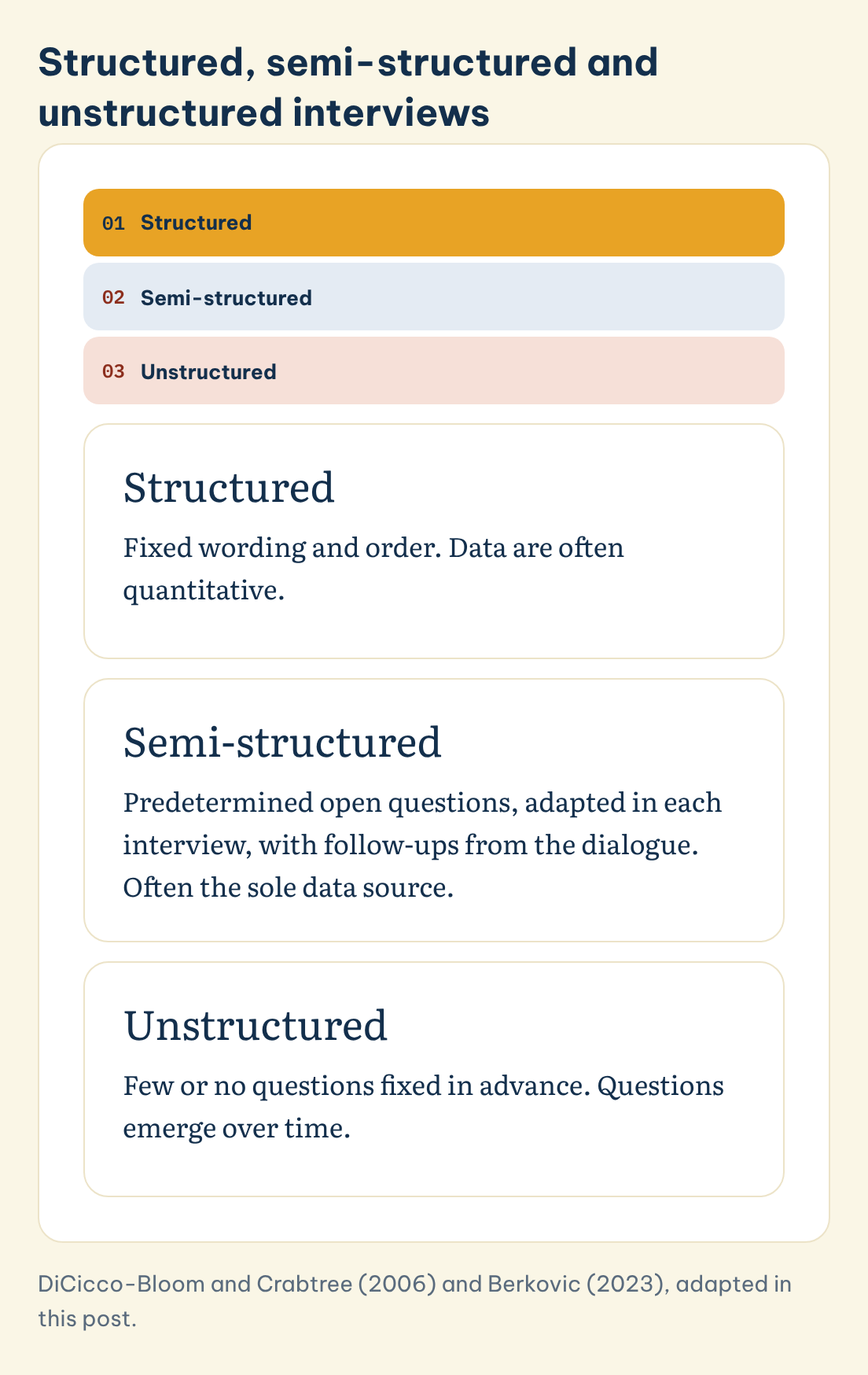
The table below summarises how the three formats differ, adapted from the descriptions in DiCicco-Bloom and Crabtree (2006) and Berkovic (2023).
| Feature | Structured | Semi-structured | Unstructured |
|---|---|---|---|
| Question list | Fixed wording and order | Predetermined open questions, adapted in each interview | Few or none fixed in advance |
| Follow-up questions | Not part of the format | Expected, from the dialogue | Emerge over time |
| Typical data | Often quantitative | Qualitative, comparable across participants | Qualitative |
| Typical use | Set aside by DiCicco-Bloom and Crabtree (2006) as often quantitative | Sole data source in many qualitative projects | Less structured exploration |
DiCicco-Bloom and Crabtree (2006) say they set structured interviews aside in their own review because these often produce quantitative data. For a dissertation, the practical test is what your research question asks. A question about how often something happens, or how many people hold a view, points towards a questionnaire. A question about how people experience, interpret or decide something points towards semi-structured interviews, because only open questions let participants explain their reasons in their own words. Berkovic (2023) adds that semi-structured interviews suit descriptive studies, while in-depth interviews suit phenomenological studies.
◆ Question 3 / 8 · Advantages
What are the advantages of semi-structured interviews?
Direct answer: Semi-structured interviews let you compare answers across participants while still capturing their own explanations. Berkovic (2023) says they help the researcher remain reasonably objective. They also work as the sole data source, which keeps a dissertation project manageable within the time and word limits most students face.
The main advantage for a student is that one well-designed guide can carry the whole data collection. DiCicco-Bloom and Crabtree (2006) describe semi-structured interviews as the most widely used interviewing format in qualitative research, so examiners know what good practice looks like and you can cite established guidance for every decision. A second advantage is flexibility. DiCicco-Bloom and Crabtree (2006) advise that the interviewer should be ready to depart from the planned itinerary, so a guide should not stop you following a useful answer. A third advantage is that the format combines well with other methods: Berkovic (2023) notes that semi-structured interviews can accompany a trial, which is useful in mixed methods research designs. The limits are just as real. Interviews take time to arrange, record and transcribe, and the quality of your data depends on your questioning skills, so piloting is worth the time.
◆ Question 4 / 8 · Five phases
What are the steps to conduct a semi-structured interview study?
Direct answer: Follow the five phases of Kallio et al. (2016): identify the prerequisites, retrieve previous knowledge, formulate a preliminary guide, pilot test it, and present the complete guide. Then recruit participants, record and transcribe each interview, and analyse the transcripts, often with thematic analysis.
Kallio et al. (2016) screened 2,703 titles and abstracts, and selected 10 papers to build their framework. Their first phase asks whether semi-structured interviews suit your topic at all. The second phase means reading the literature so that your topics rest on existing knowledge. Berkovic (2023) gives the same advice: map topics and questions to your research questions and develop the guide well before data collection starts. The third phase produces the draft guide. The fourth tests it, and the fifth presents the final version in your methodology chapter or appendix. Kallio et al. (2016) argue that a rigorous guide makes results more plausible, and a clear account of how you built the guide is what a marker looks for in a methods chapter.
◆ Question 5 / 8 · Questions and probes
How do you write questions and probes for the interview guide?
Direct answer: Start with one broad, non-threatening question, then add a small set of specific open questions, each with probes. DiCicco-Bloom and Crabtree (2006) say 5 to 10 specific questions are usually developed. Avoid yes or no questions, and phrase prompts as "describe" or "how".
DiCicco-Bloom and Crabtree (2006) say that between 5 and 10 more specific questions usually follow the basic research question. Berkovic (2023) advises avoiding yes or no questions and gives a clear contrast: "Did you have this experience?" invites a single word, while "Describe your experience" invites a story. Berkovic (2023) also states the general rule that the interviewee should speak for about 80 per cent of the interview. Probes are the follow-ups you prepare under each main question, such as asking for an example or for what happened next. DiCicco-Bloom and Crabtree (2006) recommend prompts that repeat the participant's own words, which asks the participant to say more about their own point. A short worked example appears below.
| Research question | Main interview question | Probes |
|---|---|---|
| How do first-year international students experience feedback on assessed work? | Can you describe the last piece of feedback you received on an assignment? | What did you do next? Can you give an example of a comment that helped? |
| How do you decide which comments to act on? | You said some comments felt "unclear". What made them unclear? |
◆ Question 6 / 8 · Piloting
How do you pilot a semi-structured interview guide?
Direct answer: Run a practice interview before data collection. Berkovic (2023) suggests piloting with someone unfamiliar with the topic, to check the language and clarity of your questions and the order and flow of the guide. Record every change the pilot prompts.
Piloting is the fourth phase in Kallio et al. (2016), and it often changes more than students expect. An outsider shows you quickly whether ordinary participants will understand your wording. Watch for questions that produce short answers, for topics that participants raise before you reach them, and for timing. Berkovic (2023) notes that a semi-structured interview may need no longer than 30 minutes, or up to one hour, so if the pilot runs far past your planned length, check whether the guide has too many questions. Record what you changed and why. DiCicco-Bloom and Crabtree (2006) observe that questions which do not elicit the information you need can be dropped and new ones added as analysis begins, so the guide can keep developing after the pilot, provided your ethics approval allows it and you report the changes.
◆ Question 7 / 8 · Sample and analysis
How many interviews do you need, and how do you analyse them?
Direct answer: Hennink and Kaiser (2022) found that studies testing saturation with empirical data reached saturation within 9 to 17 interviews, mostly with homogeneous samples and narrow aims. Many dissertations then use thematic analysis, which Braun and Clarke (2006) define as a method for finding patterns across the data.
Guest et al. (2006) analysed sixty interviews and reported that "data saturation had for the most part occurred by the time we had analyzed twelve interviews" (Guest et al., 2006, p. 74). Hennink and Kaiser (2022) reviewed 23 studies and add that outliers, such as multi-country research, needed larger samples, so a varied sample needs a stronger justification than a number copied from a paper. For analysis, Braun and Clarke (2006, p. 79) describe thematic analysis as "a method for identifying, analysing and reporting patterns (themes) within data". Their six phases run from familiarisation and coding, through searching for, reviewing, defining and naming themes, to producing the report, so your transcripts need to be accurate and complete before coding starts. In the methodology chapter, report how many interviews you conducted, how long they lasted, how they were recorded and transcribed, and how you decided you had enough data.
◆ Question 8 / 8 · Writing it up
What does a semi-structured interview look like in a dissertation methodology chapter?
Direct answer: A good write-up states why interviews suit the research question, how the guide was developed and piloted, how participants were sampled and recruited, how consent and recording were handled, and how the data were analysed. Put the full guide in an appendix.
Kallio et al. (2016) treat presenting the complete guide as a phase of its own, which is a useful reminder that examiners want to see the instrument, not just a description of it. A clear methodology section usually follows the sequence of decisions: method choice, guide development, pilot, sampling and recruitment, ethics, data collection, transcription and analysis. Students at Australian and UK universities need ethics approval before recruiting participants, and the exact forms and storage rules depend on their own university, so check the local research ethics guidance before the pilot. If you want an expert to review your interview guide, sampling plan or ethics documents before submission, MAAS offers research data collection support, where a MAAS expert helps design the questionnaire or interview guide and the sampling plan, and you keep the decisions your ethics protocol assigns to you.
Frequently asked questions
Can I change my interview questions after I start?
Usually yes, within your ethics approval. DiCicco-Bloom and Crabtree (2006) note that ineffective questions can be dropped and new ones added as analysis begins. Report the changes in your methodology chapter.
How long should a semi-structured interview last?
Berkovic (2023) suggests a semi-structured interview may need no longer than 30 minutes, or up to one hour. DiCicco-Bloom and Crabtree (2006) give a wider range, from 30 minutes to several hours.
How many questions should an interview guide have?
DiCicco-Bloom and Crabtree (2006) say that between 5 and 10 specific questions are usually developed after the opening question, each with prepared probes.
Is 10 interviews enough for a dissertation?
Possibly, for a homogeneous sample and a narrow question. Hennink and Kaiser (2022) report saturation within 9 to 17 interviews in studies with such samples, but you must justify your number.
Do I need to transcribe every interview?
For thematic analysis, transcripts are usually the practical way to do the familiarisation and coding that Braun and Clarke (2006) describe. Check your university's rules on transcription tools and data storage.
Can I use semi-structured interviews in a mixed methods dissertation?
Yes. Berkovic (2023) notes that semi-structured interviews can accompany other designs, such as trial participation in mixed methods research.
Related guides
References
Berkovic, D. (2023). Chapter 13: Interviews. In D. Ayton, T. Tsindos, & D. Berkovic (Eds.), Qualitative research: A practical guide for health and social care researchers and practitioners. CAUL OER Collective. https://oercollective.caul.edu.au/qualitative-research/chapter/13/
Braun, V., & Clarke, V. (2006). Using thematic analysis in psychology. Qualitative Research in Psychology, 3(2), 77–101. https://doi.org/10.1191/1478088706qp063oa
DiCicco-Bloom, B., & Crabtree, B. F. (2006). The qualitative research interview. Medical Education, 40(4), 314–321. https://doi.org/10.1111/j.1365-2929.2006.02418.x
Guest, G., Bunce, A., & Johnson, L. (2006). How many interviews are enough? An experiment with data saturation and variability. Field Methods, 18(1), 59–82. https://doi.org/10.1177/1525822X05279903
Hennink, M., & Kaiser, B. N. (2022). Sample sizes for saturation in qualitative research: A systematic review of empirical tests. Social Science & Medicine, 292, Article 114523. https://doi.org/10.1016/j.socscimed.2021.114523
Kallio, H., Pietilä, A.-M., Johnson, M., & Kangasniemi, M. (2016). Systematic methodological review: Developing a framework for a qualitative semi-structured interview guide. Journal of Advanced Nursing, 72(12), 2954–2965. https://doi.org/10.1111/jan.13031
Not sure how this guide applies to your own case? Talk it through with MAAS in a free 20-minute consultation.
Book a free consultation ▸