
◆ Research Methods
How do you write research recommendations in a paper or thesis?
Category: research-methods
Last updated: 2026-09-04
Knowing how to write research recommendations matters when a supervisor returns a thesis draft with one comment against the final chapter: your recommendations are just your findings again, written as instructions. The student rewrites them three times and the comment does not change. Nothing is wrong with the research. The problem is that a recommendation is a different kind of claim from a finding, and nobody had said so.
Direct answer: A recommendation states what someone should now do differently because of your results. A finding states what you observed, and an implication states what your results mean for the field. Recommendations name an actor, a specific action, and the finding that licenses it.
The three-part chain in one paragraph. Findings report what the data showed. Implications interpret what those findings mean for people working in the area. Recommendations convert that meaning into action for a named audience. National University (n.d.) separates the last two by the question each answers: implications ask "What do your findings suggest to those working in the field?" while recommendations ask "what specific actions should be taken to address the problem?"; verified on 4 September 2026.
This guide covers where recommendations sit in a paper and in a thesis chapter, the six moves that make one defensible, how to write them for three different audiences, and the four failure patterns that draw supervisor comments.
◆ Question 1 / 4 · Where recommendations belong
Where do recommendations belong, in a paper and in a thesis?
Direct answer: In a journal article, recommendations usually close the discussion or sit in a short final subsection. In a thesis, they occupy their own part of the concluding chapter, which many programmes number as Chapter 5, alongside a summary of findings, conclusions, and suggestions for further research.
The thesis conclusion has a documented internal structure rather than a free-form ending. Bunton (2005), writing in the Journal of English for Academic Purposes, analysed the conclusion chapters of 45 doctoral theses across 8 disciplines at one university and identified a recurring sequence of moves in which restated findings are followed by evaluation, then by practical and research recommendations. Bunton (2005) found the practical and research recommendation moves present in most of the science and technology theses in that corpus, so an examiner reads for them.
Nguyen and Pramoolsook (2016), in the Global Journal of Foreign Language Teaching, examined TESOL master's thesis conclusion chapters written by Vietnamese postgraduates and reported that recommendation moves were among those most often shortened or omitted, even where the research supported them. An omitted move reads to an examiner as an unfinished argument rather than as modesty, and Swales and Feak (2012) make the same point about move completeness.
Journal articles compress the same logic into less space. Annesley (2010), writing in Clinical Chemistry, describes the discussion as a closing argument in which the writer moves from what was found to what follows from it, and Docherty and Smith (1999) argued in the BMJ for structuring that movement explicitly so a reader can locate each step. Ghasemi et al. (2019) set out the same closing sequence for biomedical papers, ending in a statement about practice or future work rather than a restatement of results.
Where the recommendations sit also depends on the marking system you are writing under. A UK master's dissertation rubric typically assesses the conclusion as a single band covering synthesis and implications, while many Australian rubrics list contribution and application as separate criteria, which rewards splitting practice recommendations from research recommendations on the page. Our guide to UK and Australian dissertation rubrics sets out that difference in full, and Paltridge and Starfield (2019) note that examiners in both systems read the concluding chapter for evidence that the writer understood the limits of their own study.
◆ Question 2 / 4 · The six moves
What are the six moves of a defensible recommendation?
Direct answer: Summarise the finding, connect it to the research question, state the implication and its limits, name the actor and the action, calibrate strength to evidence, and separate practice recommendations from research recommendations. Each move answers a question an examiner would otherwise write in the margin.
Moves 1 to 3 establish that the recommendation is earned, by restating the finding it rests on, showing that finding answers a question you set, and stating the conditions under which it holds. Ioannidis (2007) examined 400 published articles drawn from 4 general medical journals and 4 specialty journals and found limitations frequently unacknowledged, which matters here because a recommendation resting on an unstated limitation is the easiest one for an examiner to reject.
Move 4 is where most drafts fail, because a recommendation without a named actor cannot be acted on. So "further attention should be paid to teacher training" does less work than "faculty programme leads should add a 2-hour feedback-literacy session to first-semester induction". National University (n.d.) frames the section as a place to "provide examples of practical actions and suggestions for additional research", and both halves need a grammatical subject.
Moves 5 and 6 control scope. Strength should track evidence, so a single-site qualitative study running 12 interviews over 6 weeks supports "these findings suggest that programmes with similar intakes may benefit from" rather than "programmes should". Keeping practice recommendations separate from research recommendations also helps the examiner, because Bunton (2005) treats them as distinct moves judged against different standards, one against feasibility and one against the gap identified in the literature review.
◆ Question 3 / 4 · Three audiences
How do you write recommendations for three different audiences?
Direct answer: Write a separate recommendation for each audience who could act, and phrase each in that audience's vocabulary. Practitioners need an action and a condition. Policymakers need a decision and a trade-off. Researchers need a design and a gap. One finding can license three different recommendations.
What a recommendation needs for each audience
Each row names one audience and what a recommendation written for it needs.
Audience
What it needs
Practitioners
The recommendation needs an action and a condition.
Policymakers
The recommendation needs a decision and a trade-off.
Researchers
The recommendation needs a design and a gap.
Save this figure
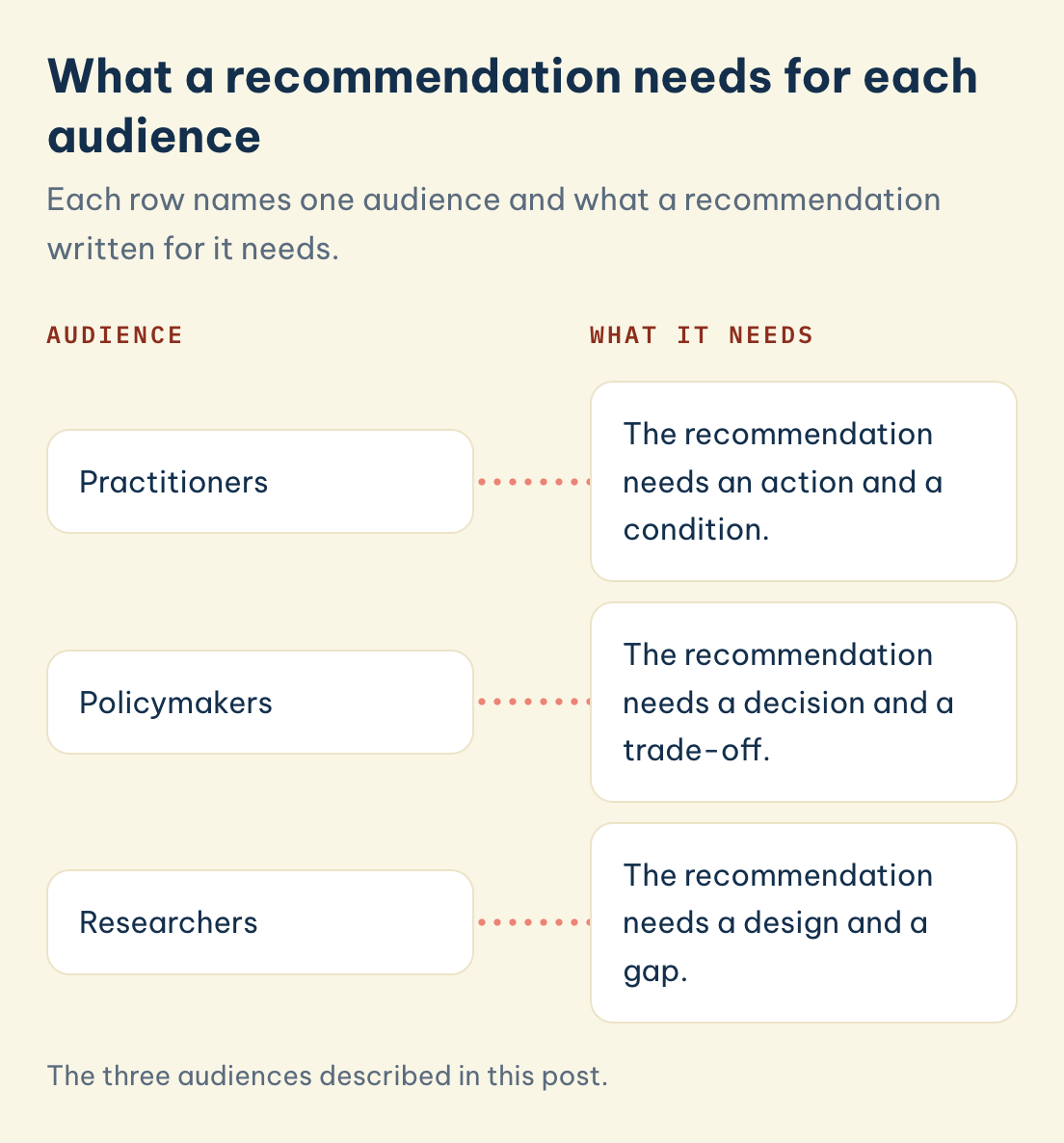
A single finding about assessment feedback in a Business School can support 3 recommendations at once: one to lecturers about when feedback arrives, one to programme leads about how training is resourced, and one to researchers about testing the effect at scale. Swales and Feak (2012), published by the University of Michigan Press, treat this audience calibration as a core feature of graduate academic writing rather than a stylistic preference, and Annesley (2010) makes the parallel point for journal discussions.
Practitioners respond to actions bounded by time and resource, policymakers to trade-offs, researchers to designs closing a gap. Paltridge and Starfield (2019) note that second-language thesis writers often hold a single formal register across the whole conclusion, which flattens these 3 distinctions and makes every recommendation read as advice addressed to nobody.
Number your recommendations once there are more than 3, and keep each to 1 action. A numbered list lets an examiner check each item against its supporting finding, and a recommendation joining 2 actions with "and" usually proves defensible in one half only. Nguyen and Pramoolsook (2016) found that Vietnamese TESOL writers who did number their recommendations produced conclusion chapters closer to the expected move structure.
◆ Question 4 / 4 · Four failure patterns
What are the four failure patterns supervisors flag most?
Direct answer: Four patterns account for most rewrite requests: recycling findings as instructions, recommending beyond what the data support, writing recommendations with no actor, and listing further research that does not follow from the gap you identified. Each has a specific and mechanical fix.
Recycling is the opening scenario. A recommendation beginning "it is recommended that students experience difficulty with referencing" is a finding wearing a different verb. Every recommendation needs a verb of action performed by somebody, and if you cannot name who performs it, you wrote an implication.
Overreach survives longest because it feels generous. Docherty and Smith (1999) argued for structured discussions so claims stay tethered to their evidence, and Ioannidis (2007) showed how often that tether goes unstated across 400 published articles. A study running 30 interviews at 1 institution over 8 weeks does not license a national recommendation, and an examiner who spots 1 such overreach reads the remaining recommendations more sceptically.
Suggestions for future work are credible only when they close the gap named in your literature review, so "further research is needed" without a design is filler. Ghasemi et al. (2019) require specificity in these closing moves for exactly this reason, and a useful test is whether another researcher could draft a 2-page proposal from your sentence in under 30 minutes without asking you what you meant.
Frequently asked questions
How many recommendations should a thesis chapter contain?
The count follows from your findings. Between 3 and 6 is common in a master's thesis, whose concluding chapter often runs 1,500 to 2,000 words. A list of 12 usually means findings were split rather than that more was discovered.
Can I recommend something my data did not test?
Not as a practice recommendation. Raise it under further research, labelled untested. An examiner reading an untested claim in the practice list will question the tested ones too.
Should recommendations appear in the abstract?
Usually 1, the strongest. Abstracts carry limits of often 250 to 300 words, and 1 actionable sentence signals the work reached a conclusion. The APA 7th manual sets its own abstract conventions, so check your programme handbook for the required elements.
Is "recommendations" the same as "implications"?
No, and conflating the 2 is the most common structural error in this chapter. Implications describe meaning for the field, recommendations describe action for named people. A conclusion chapter usually needs both, written as separate moves (Bunton, 2005).
Related resources
- How to write the discussion section of a research paper: the section recommendations grow out of
- How to write a dissertation conclusion: the full move structure of the concluding chapter
- How to write the results section: reporting findings before you interpret them
- How to write research questions and objectives: the questions your recommendations must trace back to
- Publishing Advisory service: guidance on preparing a manuscript for international journals
Ready to start? Book a free 20-minute consultation. Bring your findings chapter and your research questions. MAAS matches you to a mentor in your discipline within 48 hours when our network already covers that field. If it does not, MAAS opens a dedicated recruitment round for your case, which usually takes about two weeks.
References
- Annesley, T. M. (2010). The discussion section: Your closing argument. Clinical Chemistry, 56(11), 1671–1674. https://doi.org/10.1373/clinchem.2010.155358
- Bunton, D. (2005). The structure of PhD conclusion chapters. Journal of English for Academic Purposes, 4(3), 207–224. https://doi.org/10.1016/j.jeap.2005.03.004
- Docherty, M., & Smith, R. (1999). The case for structuring the discussion of scientific papers: Much the same as that for structuring abstracts. BMJ, 318(7193), 1224–1225. https://doi.org/10.1136/bmj.318.7193.1224
- Ghasemi, A., Bahadoran, Z., Mirmiran, P., Hosseinpanah, F., Shiva, N., & Zadeh-Vakili, A. (2019). The principles of biomedical scientific writing: Discussion. International Journal of Endocrinology and Metabolism, 17(3), Article e95415. https://doi.org/10.5812/ijem.95415
- Ioannidis, J. P. A. (2007). Limitations are not properly acknowledged in the scientific literature. Journal of Clinical Epidemiology, 60(4), 324–329. https://doi.org/10.1016/j.jclinepi.2006.09.011
- National University. (n.d.). Findings, evaluation, implications, and recommendations for research. Retrieved September 4, 2026, from https://resources.nu.edu/c.php?g=1013606&p=8464839
- Nguyen, T. T. L., & Pramoolsook, I. (2016). A move-based analysis of TESOL master's thesis conclusion chapters by Vietnamese postgraduates. Global Journal of Foreign Language Teaching, 6(1), 2–12.
- Paltridge, B., & Starfield, S. (2019). Thesis and dissertation writing in a second language: A handbook for students and their supervisors (2nd ed.). Routledge.
- Swales, J. M., & Feak, C. B. (2012). Academic writing for graduate students: Essential tasks and skills (3rd ed.). University of Michigan Press.
This article is part of the MAAS Journal series for Vietnamese international students. MAAS Publishing Advisory guides researchers through preparing and submitting work to international journals, and MAAS Academic Mentoring guides thesis projects phase by phase while you research and write every chapter yourself. We guide researchers phase by phase and comment on their drafts so they write their own chapters, and we do not write papers or theses on researchers' behalf.
A free 20-minute consultation is a conversation about your situation.
Book a free 20-minute consultation ▸