
◆ Thesis and dissertation
What does a capstone project actually have to contain?
Category: thesis-dissertation
Last updated: 2026-09-04
A final-year student is told the capstone is worth 6 credits and runs across 2 semesters, then opens the unit outline and finds a repository, an audit, a poster, a pitch and 2 reflections. Nobody has said which of those is the actual project. The confusion is real and it is structural, because capstone is a category rather than a document.
Direct answer: A capstone is a final-year unit where you apply what your degree taught you to a real problem. It is a category, not a fixed document, so the required contents come from your own unit outline rather than from a general template.
The distinction that clears up most of the confusion. A dissertation is one kind of capstone, not the opposite of one. The University of Liverpool puts it plainly: "When many people think of capstone projects, they think of a dissertation which is one of many examples of a research-based learning project varying by disciplines" (O'Brien, n.d.). Your programme picked one example from that family.
This guide covers what a capstone is, how it differs from a dissertation, the components that recur across institutions, the word counts and source counts real programmes publish, and how group capstones are marked.
◆ Question 1 / 5 · What a capstone is
What is a capstone project, and why does your programme set one?
Direct answer: A capstone is a culminating unit in the final year that asks you to apply your whole degree to one problem. UNSW Sydney (n.d.) defines it as "an authentic, project-based activity that closely relates to professional work in the field". The emphasis is application, not new knowledge.
That professional orientation is the point. UNSW Sydney (n.d.) adds that students "must apply the discipline knowledge and capabilities they have learned, as well as generic skills", which is why a capstone brief usually names a client, a site or a real dataset rather than a gap in the literature.
The format is much newer than students assume. The Center for Engaged Learning notes that "historically, capstone experiences took the form of a culminating examination, testing a student's accumulated knowledge" (Center for Engaged Learning, n.d.), so the project-shaped capstone replaced an exam rather than replacing a thesis. Kirkscey et al. (2021), writing in Teaching and Learning Inquiry, report growth from 3% of surveyed institutions in 1978 to 89% by 2011.
The American Association of Colleges and Universities lists capstones among its high-impact practices, noting that "whether they're called 'senior capstones' or some other name, these culminating experiences require students nearing the end of their college years to create a project of some sort that integrates and applies what they've learned" (American Association of Colleges and Universities, n.d.).
◆ Question 2 / 5 · Versus a dissertation
How is a capstone different from a dissertation?
Direct answer: They differ in purpose rather than in rigour. A dissertation is judged on contribution to knowledge, while a capstone is judged on integration and application. At many universities the dissertation is simply the research-shaped option inside the capstone requirement, which is why the 2 words appear together.
The University of Leeds shows the relationship on the page. Its Faculty of Biological Sciences states that "at the University of Leeds, all undergraduate students regardless of discipline, must complete a substantial research-based or capstone project in their final year", then offers capstone projects "as an alternative" for students who want applied experience rather than laboratory research (University of Leeds, n.d.).
The University of Liverpool describes capstones as designed so that students "can demonstrate their breadth of learning across a programme by applying knowledge to a project, topic, piece of research or 'real world' issue" (University of Liverpool, n.d.). Breadth is the operative word, and it is the opposite of the narrow depth a doctoral thesis is judged on.
The practical consequence is that you should stop asking what a capstone is in general and start reading what yours is specifically. Our guides to writing a dissertation proposal and planning a dissertation timeline apply directly if your programme chose the research-shaped option.
◆ Question 3 / 5 · Recurring components
Which components recur across capstone programmes?
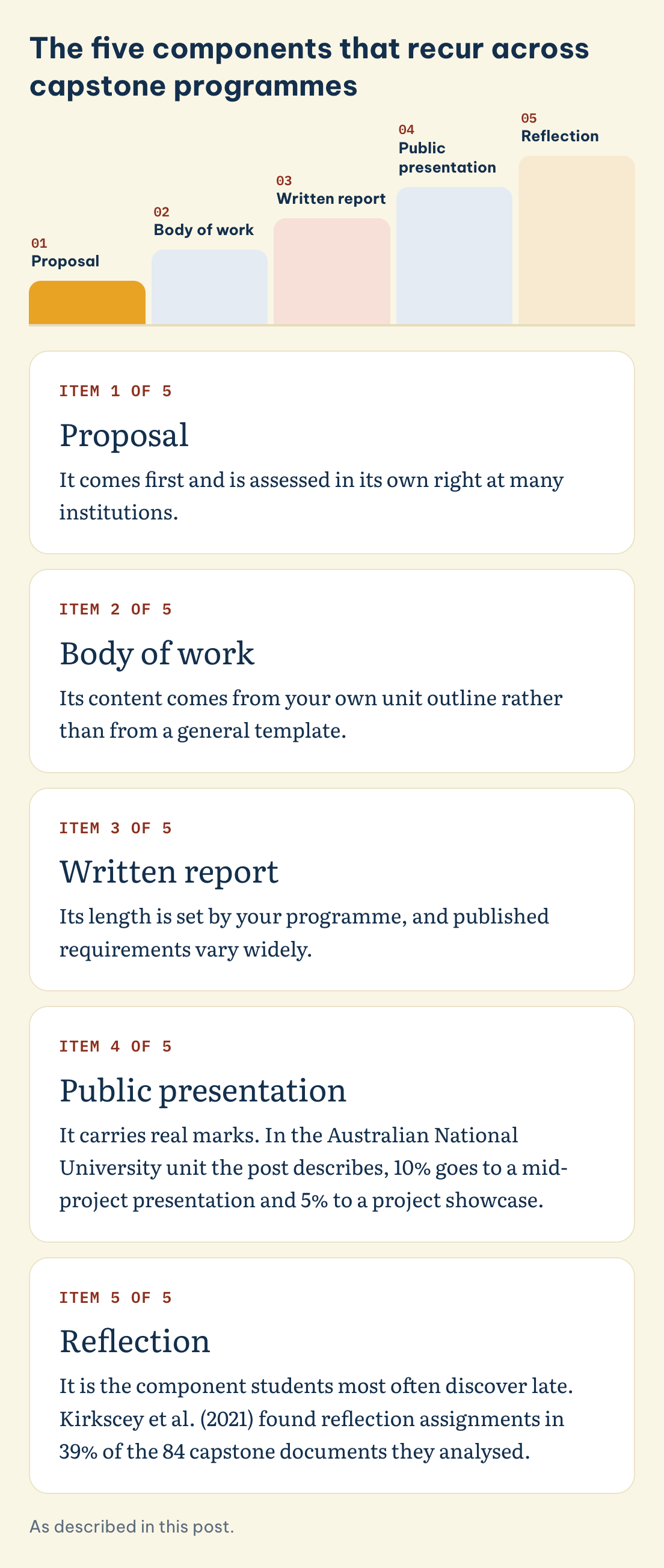
Direct answer: Five components recur, namely a proposal, a body of work, a written report, a public presentation, and a reflection. No single institution requires all 5, and the mix is set by your unit outline. The reflection is the component students most often discover late.
The five components that recur across capstone programmes
Tap a component to see what the post says about it.
Item 1 of 5
Proposal
It comes first and is assessed in its own right at many institutions.
Item 2 of 5
Body of work
Its content comes from your own unit outline rather than from a general template.
Item 3 of 5
Written report
Its length is set by your programme, and published requirements vary widely.
Item 4 of 5
Public presentation
It carries real marks. In the Australian National University unit the post describes, 10% goes to a mid-project presentation and 5% to a project showcase.
Item 5 of 5
Reflection
It is the component students most often discover late. Kirkscey et al. (2021) found reflection assignments in 39% of the 84 capstone documents they analysed.
Save this figure
The proposal comes first and is assessed in its own right at many institutions. New Mexico State University's honours capstone proposal format asks for a plan that names sources before the work starts, and the university requires a minimum of 5 sources in the proposal alone (New Mexico State University, n.d.).
The reflection is the surprise. Utah State University requires that "all capstone projects must include 1000-1500 words (approximately 2-3 double-spaced pages) of reflective writing that describes and evaluates the process of completing the written and any non-written parts of the capstone project" (Utah State University, n.d.). Note the verb evaluates, because a reflection that only narrates what happened does not meet that brief.
Kirkscey et al. (2021) analysed 84 capstone documents across institutions and disciplines and found reflection assignments in 39% of them, which makes it common without being universal. That figure is why you check your own outline rather than assuming.
The public presentation is the fifth component and it carries real marks. The Australian National University's engineering capstone allocates 10% to a mid-project presentation and 5% to a project showcase built around a pitch and a poster (Australian National University, n.d.).
◆ Question 4 / 5 · Length and sources
How long is a capstone, and how many sources does it need?
Direct answer: Published requirements range from roughly 12 pages to 30 pages, with source counts from 12 to more than 40. The range is genuinely that wide because disciplines differ, so treat any single number you read online as one institution's rule rather than as a standard.
Two published examples show the spread. The College of Staten Island requires that "your capstone must be at least 12 double-spaced typed pages with standard margins" and "at least 12 relevant scholarly, peer-reviewed references" (College of Staten Island, n.d.). Yale's Education Studies programme sets a different bar, expecting capstones to be "at least 30 pages (the typical article-length study)" engaging "approximately 40+ secondary sources" (Yale University, n.d.).
Some programmes decline to set a page limit at all. New Mexico State University states that "although there is not formal page limit, almost all capstone papers will be 10+ pages in length but this is dependant on the discipline and the proposal" (New Mexico State University, n.d.), and its examples run from a mathematical proof to 100 pages of a novel.
Workload is the number worth planning around. Utah State University attaches 3 credits to the honours capstone at roughly 10 hours per week, and a creative capstone at Yale still carries a written essay of at least 15 pages alongside the artefact (Utah State University, n.d.; Yale University, n.d.). A product does not exempt you from writing.
◆ Question 5 / 5 · Group marking
How are group capstones marked fairly?
Direct answer: Most engineering and computing capstones run in teams of 4 to 6, and institutions separate group marks from individual marks using peer assessment and individually submitted audits. Your individual grade is usually a group mark adjusted by a contribution factor, so the audit is where your own marks live.
The Australian National University forms "teams of 4-6 students through mutual agreement with the host, convener, and accounting for tutorial availability" (Australian National University, n.d.), and it runs the capstone across 2 semesters rather than one. That length changes how you plan, because a project audit falls in each semester rather than once at the end.
The mechanism for fairness is worth understanding before week 1. The ANU project audit "contains three elements", namely a project repository holding the evidence, an individual project review, and an evaluation of the relative contributions of your team (Australian National University, n.d.). The third element is a peer rating, and it feeds a contribution factor applied to the group mark.
The weighting shows where the marks actually sit. In that unit, project audits and reviews carry 65%, the mid-project presentation 10%, the showcase 5%, and 2 individual professional reflections 20% (Australian National University, n.d.). A team that produces an excellent artefact and neglects the audit is optimising the wrong 65%.
Frequently asked questions
Do I need a research question for a capstone?
Only if yours is research-shaped. An applied capstone is usually framed by a client brief or a design problem instead. Read the assessment criteria first, and if they reward contribution to knowledge, our guide to writing research questions and objectives applies.
Can a capstone be a product rather than a paper?
Yes at many institutions, and a portfolio, performance, exhibit or software build all appear in published lists. The written component rarely disappears, though. Yale still requires a minimum 15-page essay alongside a 2-part creative project.
Is a capstone easier than a dissertation?
Not reliably. One published capstone module at the University of Kent carries 300 total study hours against only 4 contact hours (University of Kent, n.d.), which means the work is largely self-directed. That is a single module rather than a sector norm, but it shows how difficulty shifts from literature depth to project management rather than falling.
When should I start the proposal?
Before the teaching period, if your programme runs project selection in advance. Where a capstone spans 2 semesters, the topic and the team are usually fixed in the first weeks, and a late start costs you the pick of projects rather than costing you marks directly.
Related resources
What does a graded presentation rubric measure?: where the marks sit when a capstone is presented rather than only submitted
How to write a dissertation proposal: the research-shaped option, in full
How to plan a dissertation timeline: mapping a long project across semesters
How to choose a dissertation topic: narrowing a brief into something doable
Dissertation chapter word count breakdown: how long each part should run
Academic Mentoring service: phase-by-phase guidance while you do the work
Ready to start? Book a free 20-minute consultation. Bring your unit outline and your assessment criteria, and we will match you to a mentor in your discipline within 48 hours.
References
- American Association of Colleges and Universities. (n.d.). High-impact practices. Retrieved September 4, 2026, from https://www.aacu.org/trending-topics/high-impact
- Australian National University, School of Engineering. (n.d.). Assessment guide: Capstone project. Retrieved September 4, 2026, from https://eng.anu.edu.au/engage/capstone-design-project/information-students/assessment-guide-capstone-project
- College of Staten Island, City University of New York. (n.d.). Capstone project. Retrieved September 4, 2026, from https://www.csi.cuny.edu/academics-and-research/specialized-programs/honors-programs/verrazano-school/program-requirements/capstone-project
- Kirkscey, R., Vale, J., Hill, J., & Weiss, J. M. (2021). Capstone experience purposes: An international, multidisciplinary study. Teaching and Learning Inquiry, 9(2), Article 19. https://doi.org/10.20343/teachlearninqu.9.2.19
- New Mexico State University Honors College. (n.d.). Recommended capstone project proposal format. Retrieved September 4, 2026, from https://honors.nmsu.edu/capstone-project-proposal.html
- O'Brien, R. (n.d.). Capstone projects. University of Liverpool, Centre for Innovation in Education. Retrieved September 4, 2026, from https://www.liverpool.ac.uk/centre-for-innovation-in-education/resources/all-resources/capstone-projects.html
- University of Kent. (n.d.). Capstone project (CLAS6002). Retrieved September 4, 2026, from https://www.kent.ac.uk/courses/modules/module/CLAS6002
- University of Leeds, Faculty of Biological Sciences. (n.d.). Capstone and research projects. Retrieved September 4, 2026, from https://biologicalsciences.leeds.ac.uk/undergrad-final-year-projects
- University of Liverpool, Centre for Innovation in Education. (n.d.). Capstone research and enquiry projects [Infographic]. Retrieved September 4, 2026, from https://www.liverpool.ac.uk/media/livacuk/centre-for-innovation-in-education/staff-guides/capstone-projects/capstone-projects-infographic.pdf
- UNSW Sydney. (n.d.). Assessing by capstone project. UNSW Staff Teaching Gateway. Retrieved September 4, 2026, from https://www.teaching.unsw.edu.au/capstone-project
- Utah State University Honors Program. (n.d.). Requirements for honors capstone projects. Retrieved September 4, 2026, from https://www.usu.edu/honors/capstone/requirements
- Center for Engaged Learning. (n.d.). Capstone experiences. Elon University. Retrieved September 4, 2026, from https://www.centerforengagedlearning.org/resources/capstone-experiences/
- Yale University, Education Studies. (n.d.). Senior capstone guidelines. Retrieved September 4, 2026, from https://educationstudies.yale.edu/programs/scholar-intensive-certificate/senior-capstone/senior-capstone-guidelines
This article is part of the MAAS Journal series for Vietnamese international students. We guide students through worked examples, drafts and feedback so they plan and write their own capstone, and we do not write capstone projects on students' behalf.
A free 20-minute consultation with MAAS Academic Mentoring, to look at your unit outline and assessment criteria together.
Book Free Discovery ▸