
EDUC9144 Assessment for Pedagogical and Learning Excellence rewards students who design assessment that produces evidence of learning and use it, not those who describe assessment types. Most students who struggle with this education topic are not short on classroom commitment. They explain formative and summative assessment correctly, then propose a task without saying what learning it makes visible or how a teacher would use the results. This guide answers the seven questions Vietnamese students ask MAAS mentors.
Author: MAAS Editorial Team
Last updated: 2026-07-20
Category: health-education

What is EDUC9144 Assessment for Pedagogical and Learning Excellence about?
Direct answer: EDUC9144 is a postgraduate education topic about designing, using, and evaluating assessment to improve teaching and learning. It covers assessment for, as, and of learning, alignment between outcomes and tasks, validity and fairness, rubric design, actionable feedback, and moderation of teacher judgement. The topic assesses whether you can design assessment that changes teaching, not just measures students.
Evidence: The teaching frame rests on established assessment scholarship. Black and Wiliam (1998) put it plainly: "Several studies show firm evidence that innovations designed to strengthen the frequent feedback that students receive about their learning yield substantial learning gains" (Black & Wiliam, 1998, p. 7). That synthesis established the effect of formative assessment on attainment, Sadler's (1989) account of formative assessment explains why feedback only works when the learner can close the gap, Biggs and Tang's (2011) constructive alignment connects outcomes, teaching, and tasks, and Hattie and Timperley's (2007) model of feedback distinguishes the levels at which feedback operates. Wiliam (2011) later translated that research base into five classroom strategies, among them engineering effective classroom discussion and activating learners as owners of their own learning, which is the practical bridge between the theory above and the task you actually design.
Example: A Vietnamese student in Australia arrived at MAAS with a plan for an end of unit test and a paragraph saying it would show what students had learned. Her mentor asked what she would do on the Monday after marking it. Once the design included a mid unit checkpoint and a planned response to each likely misconception, her mark moved from a Pass level draft to a Distinction.
What assessment does the EDUC9144 assignment usually involve?
Direct answer: Topics of this type are commonly assessed through a designed assessment task with a rationale, a critical analysis of an existing assessment practice, a moderation or judgement exercise, and a reflective piece connecting theory to your own teaching context. You are typically asked to justify design choices against assessment principles, show alignment with curriculum outcomes, and explain how the evidence produced would inform teaching. Confirm the exact task, word count, and weighting in your own topic outline, because structure varies by provider and by teaching period.
Evidence: Australian higher education assessment in this field is criterion referenced, meaning marks are awarded against published rubric criteria rather than by ranking students against each other. That is why reading the rubric closely matters far more than the number of assessment types you can name.
Example: A Vietnamese student spent half of a 2,000 word assignment defining assessment terminology. Her MAAS mentor cut the definitions to a short paragraph and reallocated the words to the alignment argument and the feedback design. Same task, same word count, and the design led version earned a clear Distinction.
How is the EDUC9144 assignment graded, and what does the rubric reward?
Direct answer: Assessment topic rubrics reward four things, roughly in this order: alignment, meaning the task genuinely elicits the intended learning outcome, justification of design choices against validity, reliability, and fairness, feedback and use, meaning you show what learners and teachers do with the evidence, and critical engagement with equity, workload, and context, plus academic writing and referencing. A well written task with no alignment argument is the classic Credit level submission.
Evidence: Criterion bands typically run Pass, Credit, Distinction, and High Distinction, and the jump from Credit to Distinction is usually defined by the words critical and justified, meaning justified design decisions and critical awareness of what the assessment cannot show.
Example: A MAAS mentor marked one Vietnamese student's draft by asking of each design decision which outcome it served and how the evidence would be judged. Half the decisions had no answer. After a rewrite that mapped each task element to an outcome and a criterion, the same assignment moved up two full rubric bands.
Which frameworks should you use in EDUC9144?
Direct answer: Use a small set of frameworks that carry the design. Constructive alignment connects intended outcomes, learning activities, and assessment tasks so the task cannot drift from the outcome. Assessment for, as, and of learning clarifies the purpose of each task in a sequence. Validity, reliability, and fairness give you the criteria to defend design choices.
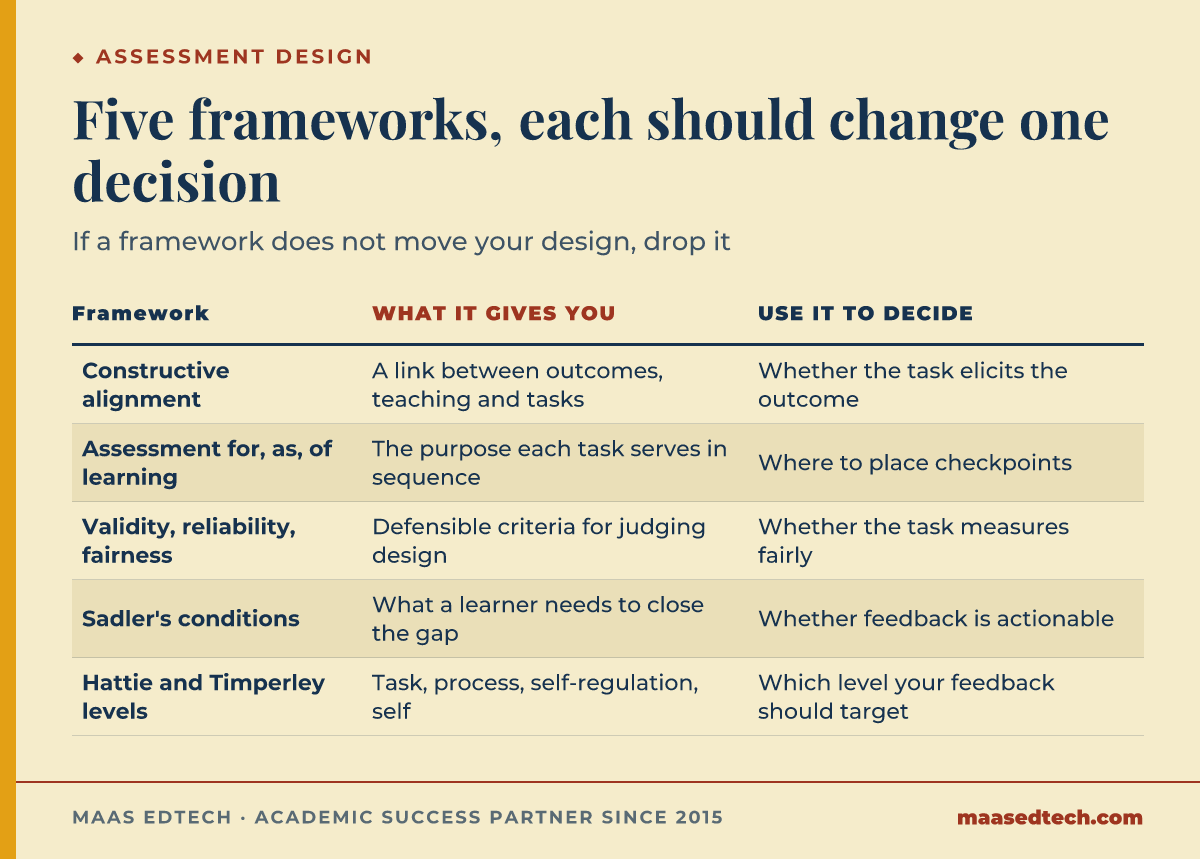
Sadler's conditions specify what feedback must include for a learner to close the gap. Hattie and Timperley's levels remind you that feedback about the task, the process, and self regulation are different things and that praise about the self is the least useful. Every framework should change a decision in your design.
| Framework | What it gives you | Use it to decide |
|---|---|---|
| Constructive alignment (Biggs) | A link between outcomes, teaching, and tasks | Whether the task actually elicits the intended outcome |
| Assessment for, as, and of learning | The purpose each task serves in a sequence | Where to place checkpoints rather than only a final task |
| Validity, reliability, fairness | Defensible criteria for judging a design | Whether the task measures what it claims, consistently and equitably |
| Sadler's conditions for formative feedback | What a learner needs to close the gap | Whether your feedback is actionable or merely evaluative |
| Hattie and Timperley feedback levels | Task, process, self regulation, and self | Which level your feedback should target and which to avoid |
Evidence: These five frameworks are examiner recognised foundations. Black and Wiliam (1998) for the formative assessment evidence base, Sadler (1989) for the conditions under which feedback improves learning, Biggs and Tang (2011) for constructive alignment, and Hattie and Timperley (2007) for the feedback model. Note the standard caution that the size of formative assessment effects is contested and depends heavily on implementation quality, so a Distinction level answer treats formative assessment as a design problem rather than a guaranteed gain.
Example: A Vietnamese student proposed weekly quizzes as formative assessment with marks recorded each week. Her MAAS mentor asked whether a recorded mark leaves room for a learner to act on the feedback. The revised design ran the same quizzes ungraded with a targeted reteach cycle, and the justification of that change earned the marks.
How should you structure the EDUC9144 assignment?
Direct answer: Use a design led structure. State the learning context and the intended outcomes precisely. Present the assessment design, including the task, the criteria or rubric, and the timing within the teaching sequence. Justify each significant choice against validity, reliability, fairness, and alignment. Explain the feedback process, what learners receive, when, and what they do with it.
Evaluate critically, naming what this assessment cannot show, the workload it creates, and its equity implications for learners with different backgrounds or needs. Put the full rubric and task materials in appendices and keep the body for justification.
Evidence: Criterion referenced rubrics weight alignment, justification, and critical evaluation far above description of assessment types. Matching your word budget to the rubric weighting is the most reliable way to lift a grade without redesigning the task.
Example: A Vietnamese student submitted an assignment with a detailed task sheet and two sentences of rationale. Her MAAS mentor moved the task sheet to an appendix and expanded the justification, mapping each criterion to an outcome and naming what the task would miss. Same design, and the assignment moved from a borderline Credit to a Distinction.
What are the most common mistakes that lose marks in EDUC9144?
Direct answer: Three recurring mistakes show up across MAAS education coaching. First, a task that is well written but not aligned, assessing something adjacent to the stated outcome rather than the outcome itself. Second, feedback that only evaluates, telling the learner how well they did without telling them what to do next, which fails Sadler's condition.
Third, no critical limits, meaning no acknowledgement of what the assessment cannot show, what it costs teachers in time, or how it disadvantages some learners. Fixing these three lifts most drafts by at least one rubric band.
Evidence: Across MAAS education coaching, marker feedback before intervention clusters heavily on alignment not demonstrated and feedback not actionable, the two phrases that most often separate a Credit from a Distinction in assessment topic rubrics.
Example: A Vietnamese student designed a group presentation to assess an individual analytical outcome. Her MAAS mentor asked how an individual mark could be defended when the artefact is collective. The revised design kept the group task for a collaboration outcome and added a short individual component for the analytical one, and that reasoning earned full marks on the validity criterion.
How long is the EDUC9144 assignment and what referencing style does it use?
Direct answer: Confirm the exact word count and style in your topic outline. Postgraduate education assignments at this level commonly sit between 2,000 and 3,000 words, with appendices, rubrics, and reference lists usually excluded from the count. APA 7th is the most common style in Australian education programs, though some providers specify Harvard, so use whichever your outline names and apply it consistently. Cite assessment scholarship from journals and books rather than teaching blogs, and reference any curriculum document or professional standard you align to, with its version and year.
Evidence: Australian education programs typically nominate a single referencing style in the topic outline and mark consistency as part of academic writing criteria. Markers routinely deduct marks for secondary citations of Black and Wiliam (1998) or Sadler (1989), uncited curriculum references, or reference lists that do not match in text citations.
Example: A Vietnamese student lost marks because she cited formative assessment research through a professional development slide deck and referenced a curriculum outcome with no version or year. A MAAS pre submission audit closed both gaps in under an hour. On her next assignment, clean sourcing recovered marks on a criterion that requires no extra design work at all.
Frequently asked questions
Is EDUC9144 a hard topic?
It is conceptually demanding rather than technically hard. The vocabulary feels familiar to practising teachers, and that familiarity is the trap, because the topic marks justification against principles rather than practical experience alone.
Can I use my own classroom or school context?
Usually yes, and it strengthens the assignment because the design becomes concrete. Anonymise the school and any student, and check your provider's requirements before including student work samples or data.
Do I need to include a full rubric?
Check your brief. Where a rubric is required, the marks come from the alignment between criteria, standards, and outcomes rather than from formatting. A short rubric that discriminates clearly between standards beats a long one with vague descriptors.
Can I write about assessment in the Vietnamese education system?
Often yes, if the brief allows your own context, and the comparison can be analytically productive. Be explicit about the curriculum framework you are working within, because alignment arguments only make sense against a stated set of outcomes.
What referencing style does EDUC9144 use?
APA 7th is most common in Australian education programs, with some providers specifying Harvard. Use the style named in your topic outline, applied consistently, including for curriculum and policy documents.
Can MAAS help me with EDUC9144?
Yes. MAAS Assignment & Essay Support coaches you through the assignment with the Outline, Draft, Final model, covering alignment, rubric design, making feedback actionable, and a pre submission referencing audit, all with PhD level mentors. We coach your work and we do not write it for you.
Ready to approach EDUC9144 with a clear strategy?
If you have the task but not the justification, that is exactly where a discipline-matched expert helps most. MAAS Assignment & Essay Support is an academic support partner. We work alongside you through Outline, Draft, Final so the design stays yours and the structure earns the marks.
Bring your EDUC9144 brief and we will match you to an education mentor, and 23% of our 100+ experts hold a PhD, within 48 hours when our network already covers that field. If it does not, MAAS opens a dedicated recruitment round for your case, which usually takes about 2 weeks.
Book a free 15-minute EDUC9144 consultation with MAAS Assignment & Essay Support
Related guides
- EDUC9511 assignment: how do you approach Complex Communication Needs and AAC? is a sibling postgraduate education guide
- ECE6011 assignment: how do you approach Languages of Children? covers linking theory to real observation
- Assignment command words explained covers what evaluate, analyse, and justify actually require
- MAAS Academic Mentoring service offers 1:1 coaching with PhD level mentors in your discipline
- Course-code assignment coaching is the pillar guide on tackling any unit assignment with a MAAS mentor
References
- Biggs, J., & Tang, C. (2011). Teaching for quality learning at university (4th ed.). Open University Press.
- Black, P., & Wiliam, D. (1998). Assessment and classroom learning. Assessment in Education: Principles, Policy and Practice, 5(1), 7-74. https://doi.org/10.1080/0969595980050102
- Hattie, J., & Timperley, H. (2007). The power of feedback. Review of Educational Research, 77(1), 81-112. https://doi.org/10.3102/003465430298487
- Sadler, D. R. (1989). Formative assessment and the design of instructional systems. Instructional Science, 18(2), 119-144. https://doi.org/10.1007/BF00117714
- Wiliam, D. (2011). Embedded formative assessment. Solution Tree Press.
Tools and resources
- Tertiary Education Quality and Standards Agency. (n.d.). Higher education good practice hub. Retrieved July 20, 2026, from https://www.teqsa.gov.au/guides-resources/higher-education-good-practice-hub
This article is part of the MAAS Journal series for Vietnamese international students. MAAS Assignment & Essay Support is an academic support partner. We coach students through the Outline, Draft, Final delivery model with developmental feedback from discipline-matched experts. We do not write or submit work on a student's behalf.