
◆ Health & Education
What are the six co-teaching models, and when should you use each?
Direct answer: The six co-teaching models are one teach, one observe; station teaching; parallel teaching; alternative teaching; teaming; and one teach, one assist. Two teachers share one class and choose the model that fits the students' needs and the purpose of the lesson. No single model is best for every lesson.
◆ Question 1 / 8 · Meaning
What is the meaning of co-teaching?
Direct answer: Co-teaching means two qualified professionals plan and deliver instruction together for one shared class. A typical pair is a subject teacher and a specialist who work in the same room at the same time. Teaching assistants, volunteers and trainees usually fall outside the term.
Friend and colleagues define it as "the partnering of a general education teacher and a special education teacher or another specialist for the purpose of jointly delivering instruction to a diverse group of students, including those with disabilities or other special needs, in a general education setting and in a way that flexibly and deliberately meets their learning needs" (Friend et al., 2010, p. 11). The same article notes that co-teaching "has been referred to as a professional marriage" and that pairing a teacher with a paraprofessional, a volunteer or a student teacher generally falls outside the term (Friend et al., 2010, p. 11). Applications also exist for English language learners and gifted students (Friend et al., 2010, p. 11), so the idea is wider than special education, although that article considers only students with disabilities.
◆ Question 2 / 8 · The six models
What are the 6 co-teaching models, and what does each teacher do?
Direct answer: The six models differ in who leads, how the class is grouped and what the second teacher does. Friend et al. (2010) describe them as approaches to be chosen "based on student needs and instructional intent". The table below summarises the roles and the lesson types where each tends to fit.
The article presents the models as six approaches and variations of them, selected "based on student needs and instructional intent" (Friend et al., 2010, p. 11). The table follows Friend et al. (2010, p. 12), and the final column is our own plain-language reading of when each fits, not a finding from the research.
| Model | What each teacher does | Best use (our reading) |
|---|---|---|
| One teach, one observe | One leads large-group instruction while the other gathers academic, behavioural or social data on specific students or the class | When you need evidence about one student or a routine before changing a plan |
| Station teaching | The lesson is split into three non-sequential parts; groups rotate, teachers run two stations and students work independently at the third | When content divides into separate chunks and you want small groups |
| Parallel teaching | Each teacher takes half the class and presents the same material, to foster differentiation and increase participation | When discussion or practice needs a smaller group |
| Alternative teaching | One teacher works with most students while the other works with a small group for remediation, enrichment, assessment, preteaching or another purpose | When a few students need something different from the rest |
| Teaming | Both teachers lead the large group, for example lecturing, arguing opposing views in a debate or showing two ways to solve a problem | When two voices make the content clearer |
| One teach, one assist | One teacher leads while the other circulates offering individual assistance | When the lesson is mostly direct instruction and students need quick help |
Source: Friend et al. (2010, p. 12), summarised; the last column is the editors' reading.
◆ Question 3 / 8 · Examples
What are some examples of co-teaching in a real classroom?
Direct answer: Each model can be pictured with a simple lesson. The scenarios below, which follow the six roles in Friend et al. (2010, p. 12), are invented illustrations written for this guide, not case studies, and they show how the same pair of teachers might switch models across a unit depending on what the students need on a given day.
Imagine a secondary English class of 28 students studying a short story, taught by two teachers for a 60-minute lesson. In one teach, one observe, the English teacher introduces the text while her colleague records which students volunteer ideas. In station teaching, with three groups of about nine, one station covers vocabulary, one covers a character map and the third is silent reading. In parallel teaching, each teacher runs the same discussion with 14 students so more students speak. In alternative teaching, the specialist pre-teaches five key words to four students while the other 24 begin a draft. In teaming, the two teachers act out two readings of a character's motive and invite the class to judge. In one teach, one assist, the specialist circulates during a writing task and prompts students who stall. Our guide to the graded presentation rubric shows a task where two assessors could split observation and feedback roles.
◆ Question 4 / 8 · Seven models?
Are there 7 models of co-teaching?
Direct answer: The sources checked for this guide describe six approaches, not seven. Some practitioner lists count variations as separate models, which can produce a longer list. We have not verified any single seven-model framework, so treat the six from Friend et al. (2010) as the checked baseline.
Friend and colleagues themselves speak of "six approaches and variations of them" (Friend et al., 2010, p. 11), which may explain why some lists arrive at a different count. When you meet a seven-model list in a handbook or training deck, ask whether the extra item is a different division of roles or a variation of one of the six. If you are writing an assignment, cite the list you actually read.
◆ Question 5 / 8 · The evidence
What does the evidence say about co-teaching?
Direct answer: The evidence is positive but thin and uneven. Meta-analyses report moderate average gains for students with disabilities, yet the underlying studies often fail to name the model used or check that it was delivered as planned. Treat the effect sizes as encouraging, not as proof that co-teaching works everywhere.
Co-teaching effect size by subject
Students with disabilities, compared with special education settings.
Subject
Effect size (Hedges g)
Language arts and literacy
0.60
Mathematics
0.42
Other subjects
0.08
Save this figure
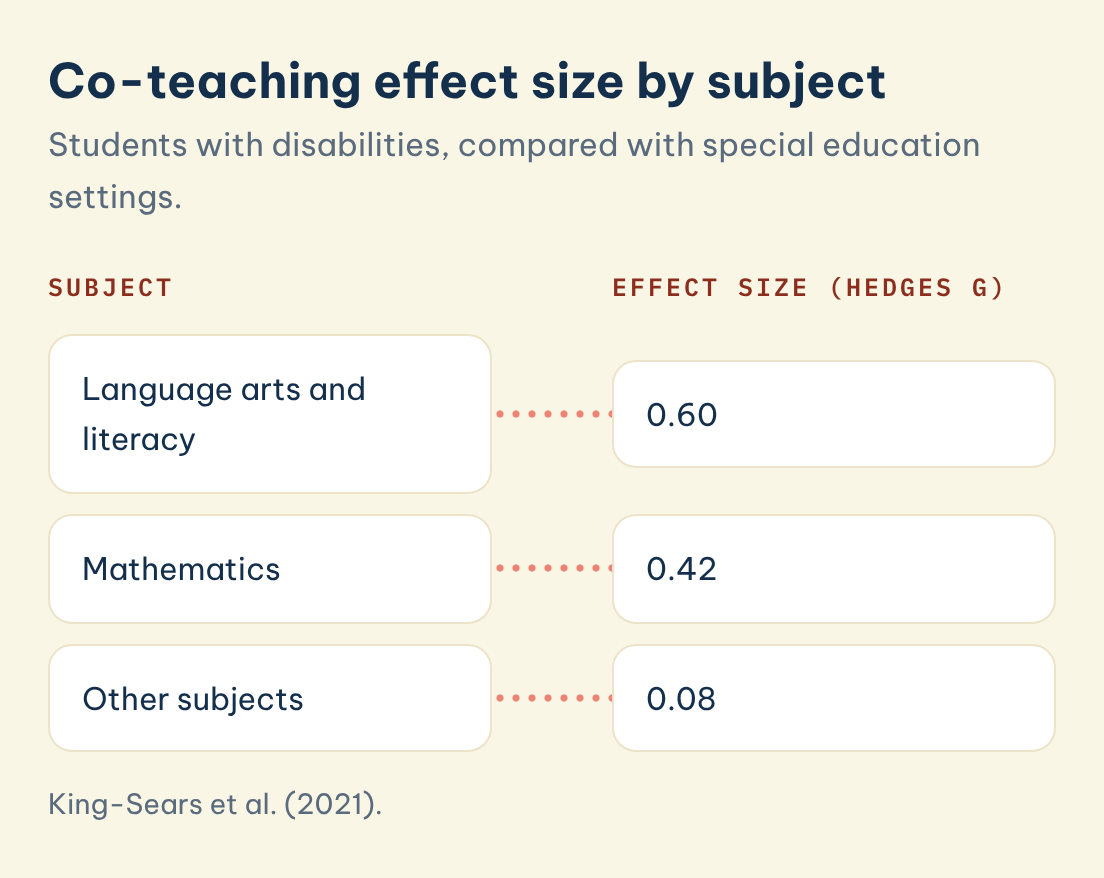
An early meta-analysis found that only 6 of 89 articles had enough data to analyse, with study effect sizes from 0.24 to 0.95 and an average total effect size of 0.40 (Murawski & Swanson, 2001). A more recent review of 26 studies covering 3,714 students with disabilities, of whom 1,975 were co-taught and 1,739 were in special education settings, found g = 0.47 in favour of co-teaching (King-Sears et al., 2021). Effects differed by grade, with elementary g = 0.25, middle g = 0.56 and high school g = 0.52, and by subject, with language arts and literacy g = 0.60, mathematics g = 0.42 and other subjects g = 0.08, which the authors treat as no effect. The same review reports that models were identified in only 23% of studies and that 92% omitted fidelity entirely (King-Sears et al., 2021). Friend et al. (2010, p. 17) had already noted that "Co-teaching research to date has paid only scant direct attention to outcomes for students with disabilities".
◆ Question 6 / 8 · Special education
How is co-teaching used in special education and inclusion?
Direct answer: Co-teaching is mostly studied as an inclusion strategy. A special education teacher joins the general classroom so students with disabilities learn the same curriculum alongside peers, rather than in a separate room. The models give the pair a menu for sharing instruction, grouping and support within that single setting.
Friend et al. (2010) frame the approach as a way of meeting learning needs "flexibly and deliberately" in a general education setting. The King-Sears review compares co-taught students with those taught in special education settings, which is why its findings speak directly to inclusion decisions (King-Sears et al., 2021). The two groups were of similar size, 1,975 co-taught students against 1,739 in special education settings, out of 3,714 in total, and the review covers 26 studies. Putting the numbers side by side makes the pattern clearer. Only 6 of 89 articles (about 7%) in the 2001 analysis had usable data, whereas the 2021 review pooled 26 studies, 20 years later. Within the newer review the middle school estimate (g = 0.56) is 0.31 higher than the elementary estimate (g = 0.25), and language arts and literacy (g = 0.60) sits 0.52 above other subjects (g = 0.08). Because 92% of studies omitted fidelity, only about 8% reported whether the model was delivered as planned. A fair reading is that co-teaching can help, especially in language arts and in the middle and upper school years, but that the gain depends on how well the pair plan and divide their roles. See our comparison of the EdD and PhD in education, which explains the research routes open to practising teachers.
◆ Question 7 / 8 · Benefits and pitfalls
What are the benefits and pitfalls of co-teaching?
Direct answer: The main benefit is access to two professional perspectives for the same students, with more flexible grouping. The main pitfalls are unequal roles and too little shared planning. When one teacher always leads, the arrangement turns into a main teacher and an assistant, and the benefits shrink.
Parity is the recurring concern in this literature (Scruggs et al., 2007; King-Sears et al., 2021). King-Sears et al. (2021) report that general educators frequently lead most instruction, a point they attribute to Scruggs et al. (2007), and they add that effective co-teaching must be preceded by sufficient co-planning. A simple habit helps: agree before each lesson which model you will use and who leads which segment. Fidelity matters too. If a pair never records which model they used, they cannot learn which one is working, which mirrors the research gap described above, where 92% of studies omitted fidelity (King-Sears et al., 2021).
◆ Question 8 / 8 · Machine learning
Does co-teaching in machine learning mean the same thing?
Direct answer: No. In machine learning, "co-teaching" is a training method for neural networks, unrelated to classrooms. Two networks are trained together and each selects the data it considers likely to have correct labels, passing it to its peer (Han et al., 2018). Searches for the phrase often return both meanings.
Han et al. (2018) introduced the method at NeurIPS 2018 (volume 31) for training deep networks on data with extremely noisy labels. The shared word is the only link: two networks exchange selected examples inside a mini-batch, and no teacher or student is involved. If you are an education student who found a machine learning paper while searching, check the field before you cite it. The classroom definition in this guide comes from a 2010 special education article, and the machine learning sense belongs to computer science.
Frequently asked questions
What is co-teaching in simple terms?
Two qualified professionals share the planning and delivery of lessons for one class in one room (Friend et al., 2010).
What are the six co-teaching models?
Friend et al. (2010) list one teach one observe, station, parallel, alternative, teaming and one teach one assist.
Are there seven models of co-teaching?
The sources checked here describe six approaches, set out on page 12 of Friend et al. (2010). Some lists split variations into extra models, so ask what the seventh item is before you cite it.
Does co-teaching improve results for students with disabilities?
A 2021 meta-analysis of 26 studies and 3,714 students reports g = 0.47 against special education settings, but only 23% of studies identified the model and 92% omitted fidelity (King-Sears et al., 2021).
Does co-teaching work equally well in every subject?
Not in the 26 studies reviewed. Language arts and literacy showed g = 0.60 and mathematics g = 0.42, while other subjects showed g = 0.08 (King-Sears et al., 2021).
What makes co-teaching fail?
The sources point to unequal roles and too little co-planning. King-Sears et al. (2021) say effective co-teaching must be preceded by sufficient co-planning.
Does co-teaching in machine learning mean the same thing?
No. It is a method for training neural networks on noisy labels (Han et al., 2018).
Join the MAAS expert network
Experienced teachers know how co-teaching looks in a real classroom. If you have taught in a secondary school or university, you can apply through our become an expert page to join the MAAS expert network as a tutor or adviser. Experts guide students through their own work with explanations, feedback and study planning, and students stay the authors of what they submit. Students who want subject help from an experienced teacher can also see our 1-on-1 university subject tutoring.
Related guides
- EdD vs PhD in education: research routes for practising teachers
- Graded presentation rubric: how a presentation task is marked
- Become an expert: join the MAAS tutor and adviser network
References
- Friend, M., Cook, L., Hurley-Chamberlain, D., & Shamberger, C. (2010). Co-teaching: An illustration of the complexity of collaboration in special education. Journal of Educational and Psychological Consultation, 20(1), 9-27. https://doi.org/10.1080/10474410903535380
- Han, B., Yao, Q., Yu, X., Niu, G., Xu, M., Hu, W., Tsang, I., & Sugiyama, M. (2018). Co-teaching: Robust training of deep neural networks with extremely noisy labels. In Advances in Neural Information Processing Systems 31 (NeurIPS 2018). https://doi.org/10.48550/arXiv.1804.06872
- King-Sears, M. E., Stefanidis, A., Berkeley, S. L., & Strogilos, V. (2021). Does co-teaching improve academic achievement for students with disabilities? A meta-analysis. Educational Research Review, 34, Article 100405. https://doi.org/10.1016/j.edurev.2021.100405
- Murawski, W. W., & Swanson, H. L. (2001). A meta-analysis of co-teaching research: Where are the data? Remedial and Special Education, 22(5), 258-267. https://doi.org/10.1177/074193250102200501
- Scruggs, T. E., Mastropieri, M. A., & McDuffie, K. A. (2007). Co-teaching in inclusive classrooms: A metasynthesis of qualitative research. Exceptional Children, 73(4), 392-416. https://doi.org/10.1177/001440290707300401
This article is part of the MAAS Journal series for educators and students. MAAS is an academic support partner: experts guide students through each stage of their own work, and we do not complete assessed work on a student's behalf.
Not sure how this guide applies to your own case? Talk it through with MAAS in a free 20-minute consultation.
Book a free consultation ▸