
◆ Student Success
Which teaching strategies for teachers have the best evidence?
The teaching strategies with the strongest evidence are the ones that make students retrieve, practise and explain ideas for themselves: daily review, explicit instruction with modelling, feedback, metacognition and active learning. This guide reads the original sources behind each one, including the Education Endowment Foundation toolkit, Rosenshine's principles of instruction and two large reviews, so that secondary and university teachers can see what the numbers do and do not show.
◆ Question 1 / 7 · Five strategies
What are the 5 teaching strategies with the strongest evidence?
Direct answer: No single list of five is official, so this guide groups the research into five: retrieval and daily review, explicit instruction with modelling, feedback, metacognition, and checking understanding. Each has support from a named source, and active learning in university lectures adds a sixth for higher education.
Searches such as "what are the 5 teaching strategies" and "best teaching strategies for teachers" suggest that many teachers want a short list, and a short list is useful as long as you know where it comes from. The five groups here were chosen because each one is backed by a source a teacher can open. Retrieval practice rests on a systematic review of classroom studies (Agarwal et al., 2021). Explicit instruction and daily review come from Rosenshine's (2012) principles. Feedback and metacognition are strands of the Education Endowment Foundation toolkit (Education Endowment Foundation, n.d.), and checking understanding is the core of assessment for learning (Cambridge University Press & Assessment, 2025).
The strands differ in how strong their evidence is, and the toolkit says so openly. It labels metacognition and feedback as "High impact for very low cost based on extensive evidence", while mastery learning is "Moderate impact for very low cost based on limited evidence" (Education Endowment Foundation, n.d.). Reading that label before the headline figure is the habit this whole guide tries to build.
◆ Question 2 / 7 · Daily review
How do daily review and retrieval practice work in a classroom?
Direct answer: Open each lesson with a short review of earlier material, and make students pull answers from memory instead of rereading. Rosenshine (2012) lists this as his first principle, and a review of 50 classroom experiments found retrieval practice helped learners at many education levels (Agarwal et al., 2021).
Rosenshine put the first principle in one sentence: "Daily review can strengthen previous learning and can lead to fluent recall." (Rosenshine, 2012, p. 13). His list of ten principles begins with a short review of previous learning and ends with weekly and monthly review, so revisiting content is built into the start and the end of the learning cycle. A practical version is a five-question quiz at the start of a lesson, answered without notes, followed by a quick check of the answers. The aim is recall, not marks.
The wider evidence points the same way. Dunlosky et al. (2013) reviewed ten learning techniques and rated practice testing and distributed practice as high utility, while summarising, highlighting and rereading were rated low, and they concluded that "practice testing instead of rereading" is the better choice. Agarwal et al. (2021) screened about 2,000 abstracts, coded 50 experiments with 5,374 participants, and found that 57% of the 49 effect sizes showed medium or large benefits. They also noted that only 6% of the experiments came from non-WEIRD countries, so the evidence comes mostly from Western school settings. If you want the student side of the same idea, see our guide to revising for exams effectively.
◆ Question 3 / 7 · Explaining and modelling
What do effective teachers do when they explain and model?
Direct answer: They teach new material in small steps, give worked models, and let students practise after each step. Rosenshine (2012) built this from three bodies of research: cognitive science, observation of master teachers and research on cognitive supports, which is why the same routines recur across his ten principles.
Rosenshine (2012, p. 12) wrote that "the most effective teachers ensured that their students efficiently acquired, rehearsed, and connected background knowledge by providing a good deal of instructional support". The ten principles turn that sentence into routines: present new material in small steps with student practice after each step, ask a large number of questions, provide models, guide student practice, provide scaffolds for difficult tasks, and require and monitor independent practice. None of these asks a teacher to lecture for a whole period. They ask the teacher to alternate between explaining and having students do something with the explanation.
The same logic appears in the metacognition guidance. Quigley et al. (2018) advise teachers to model their own thinking, and their summary gives example prompts such as "What do I know about problems like this?" and "What ways of solving them have I used before?" A modelled solution is more useful when the teacher says why each step was chosen, because the reasoning is the part students cannot see.
◆ Question 4 / 7 · Feedback and metacognition
Which feedback and metacognition strategies help most?
Direct answer: The Education Endowment Foundation toolkit rates metacognition and feedback among its higher-impact approaches, at very low cost and based on extensive evidence. The effect depends on how the strategy is taught, so the details of delivery matter more than the label.
| EEF toolkit strand | How the toolkit describes it |
|---|---|
| Metacognition and self-regulation | High impact for very low cost based on extensive evidence |
| Feedback | High impact for very low cost based on extensive evidence |
| Mastery learning | Moderate impact for very low cost based on limited evidence |
| Collaborative learning, homework, reducing class size | Check each strand page for the current months of progress, cost and evidence rating |
Source: Education Endowment Foundation (n.d.), strand pages. Ratings are averages from the toolkit, not predictions for one classroom.
On feedback, the toolkit's strand page gives a practical rule: "It is particularly important to provide feedback when work is correct, rather than just using it to identify errors." (Education Endowment Foundation, n.d.). On metacognition, the same source says the approaches work best when they are applied to the usual curriculum content rather than taught as separate thinking skills lessons. Quigley et al. (2018) set out seven recommendations, including explicitly teaching pupils to plan, monitor and evaluate their learning and promoting metacognitive talk in the classroom.
Read the table with care. Collaborative learning works best when groups are small and share a goal, and homework quality matters more than quantity. Reducing class size is costly, and smaller classes help only when the teacher also teaches differently. A teacher choosing between strategies should weigh cost and evidence quality, not only the headline number of months.
◆ Question 5 / 7 · Checking understanding
How do you check understanding during a lesson?
Direct answer: Ask a question that every student must answer at the same moment, then change what you do next based on the answers. Cambridge's assessment for learning brief suggests mini-whiteboards so that every student answers a hinge-point question at once, and the teacher sees the whole room's thinking.
Assessment for learning is organised around three questions about the learner: where they are going, where they are now, and how they can get there (Cambridge University Press & Assessment, 2025). A mini-whiteboard question works because it gives you evidence from the whole room instead of from the two students who always volunteer. If most answers are wrong, you reteach; if most are right, you move on and spend the saved minutes on harder practice. Rosenshine (2012) makes the same point by asking teachers to check the responses of all students and to check for understanding before students begin independent work.
Checking is also where feedback begins. A wrong answer on a whiteboard is a more precise signal than a quiet room. For a closer look at how assessment design connects to teaching, our guide to the EDUC9144 assessment assignment explains how formative evidence is used to change instruction.
◆ Question 6 / 7 · University lectures
Which classroom teaching strategies work in university lectures?
Direct answer: Active learning has the clearest evidence in undergraduate science, engineering and mathematics. A meta-analysis of 225 studies found that students in active learning classes scored higher and failed less often than those in traditional lectures, though the studies were all in STEM subjects.
Active learning against traditional lecturing
Each row sets a result for active learning beside the result for lecturing.
Active learning
Traditional lecturing
Failure rate of 21.8%
Failure rate of 33.8%
Exam scores about 6% higher
Exam scores at baseline
Average effect of 0.47 standard deviations across 158 studies
Odds ratio of failing 1.95 across 67 studies
Save this figure
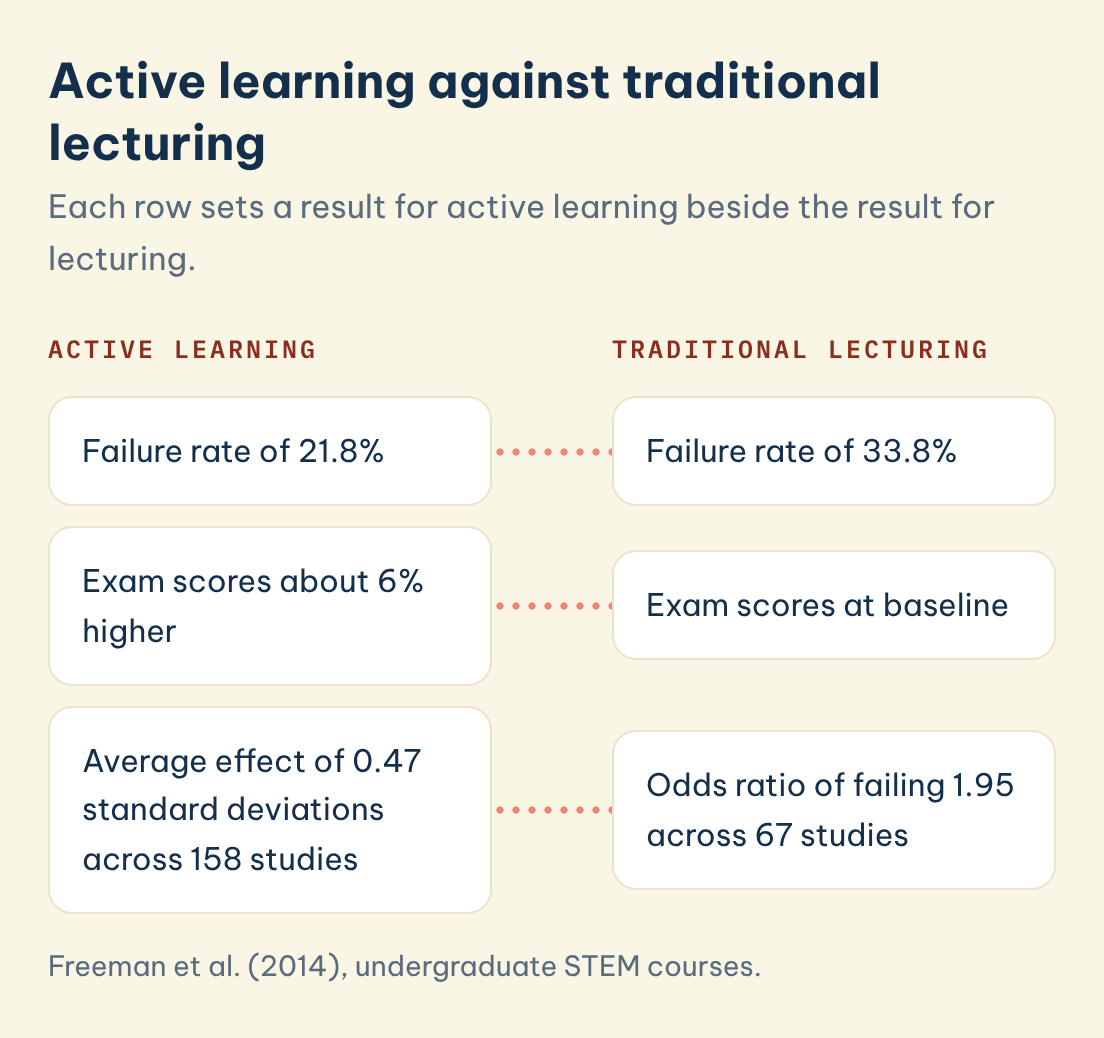
Freeman et al. (2014) analysed 225 studies of undergraduate STEM courses. Across 158 studies of exam and concept inventory scores the average effect was 0.47 standard deviations, and the odds ratio of failing under traditional lecturing was 1.95 across 67 studies. The authors found the effects were greatest in small classes of 50 students or fewer.
| Measure | Active learning | Traditional lecturing |
|---|---|---|
| Failure rate | 21.8% | 33.8% |
| Exam scores | About 6% higher | Baseline |
Source: Freeman et al. (2014), undergraduate STEM courses.
Two limits apply. The evidence covers STEM undergraduates only, so a lecturer in law or history should treat it as a prompt to experiment, not as proof. And published letters in the same journal questioned the lecture-control designs, so treat the size of the effect with caution. The practical lesson for a university teacher is modest: break a lecture with a question students answer and discuss, then use retrieval and checking exactly as a school teacher would.
◆ Question 7 / 7 · Secondary and university
How do secondary and university teaching differ in what the evidence shows?
Direct answer: The evidence base is much larger for schools than for universities. The toolkit reports separate secondary figures for several strands, while the strongest university evidence here is the STEM active learning review, so university teachers extend school findings with more caution.
The toolkit reports primary and secondary results separately for several strands. For mastery learning it adds that mastery bars are usually set at 80 to 90% and that the approach is less effective when pupils work at their own pace (Education Endowment Foundation, n.d.). A secondary teacher should read the secondary figure on each strand page rather than the all-age average.
University teaching has fewer comparable summaries. Retrieval practice benefits were reported across education levels in the school and classroom studies reviewed by Agarwal et al. (2021), and the learning-technique ratings of Dunlosky et al. (2013) came from cognitive and educational psychology, but neither is a toolkit for lecturers. Treat them as well-tested starting points and keep your own notes on what works in your discipline.
Frequently asked questions
What are the best teaching strategies for teachers?
The best-supported strategies are daily review and retrieval practice, explicit instruction with modelling, feedback, metacognition and checking understanding. The toolkit rates metacognition and feedback as high impact for very low cost (Education Endowment Foundation, n.d.).
What is the single most effective teaching strategy?
No source in this guide ranks one strategy above all others for every class. The toolkit rates metacognition among its higher-impact approaches, but the effect depends on teaching it within normal curriculum content.
Are there teaching strategies with examples I can try tomorrow?
Yes. Start a lesson with five recall questions answered without notes, model one problem aloud while explaining your choices, and use mini-whiteboards to check every student's answer before moving on.
Do these strategies work in primary school and secondary school?
Mostly yes, but the sizes differ. The toolkit gives separate primary and secondary figures for strands such as mastery learning and homework, so check the phase that matches your class (Education Endowment Foundation, n.d.).
Is there a teaching strategies PDF I can read?
Rosenshine's (2012) article is freely available as a PDF from the American Federation of Teachers, and the metacognition guidance report is also published as a PDF (Quigley et al., 2018).
Does lecturing still have a place at university?
Yes, but Freeman et al. (2014) found fewer failures and higher exam scores in active learning classes in STEM. A short lecture broken up by questions is a safer design than a full hour of talk.
How much does class size matter?
The toolkit rates reducing class size as a high-cost approach and says smaller classes help only if the teacher uses the smaller numbers to teach differently (Education Endowment Foundation, n.d.).
Join the MAAS expert network
If you are an experienced secondary or university teacher or academic, MAAS is looking for experts who can give developmental feedback to students in their discipline. You stay in control of how you coach, and students remain responsible for their own work. To find out how the network works, see become an expert.
Related MAAS guides
- How do you revise for exams effectively? covers retrieval and spacing from the student side
- How to approach the EDUC9144 assessment assignment shows how formative evidence feeds teaching decisions
- Tutoring offers 1:1 sessions of 60 or 90 minutes with a matched subject expert who teaches the approach to coursework rather than doing it
- Become an expert explains how teachers and academics join the MAAS network
References
Agarwal, P. K., Nunes, L. D., & Blunt, J. R. (2021). Retrieval practice consistently benefits student learning: A systematic review of applied research in schools and classrooms. Educational Psychology Review, 33(4), 1409-1453. https://doi.org/10.1007/s10648-021-09595-9
Cambridge University Press & Assessment. (2025). Education brief: Assessment for learning. https://www.cambridgeinternational.org/Images/271179-assessment-for-learning.pdf
Dunlosky, J., Rawson, K. A., Marsh, E. J., Nathan, M. J., & Willingham, D. T. (2013). Improving students' learning with effective learning techniques: Promising directions from cognitive and educational psychology. Psychological Science in the Public Interest, 14(1), 4-58. https://doi.org/10.1177/1529100612453266
Education Endowment Foundation. (n.d.). Teaching and Learning Toolkit. Retrieved October 23, 2026, from https://educationendowmentfoundation.org.uk/education-evidence/teaching-learning-toolkit
Freeman, S., Eddy, S. L., McDonough, M., Smith, M. K., Okoroafor, N., Jordt, H., & Wenderoth, M. P. (2014). Active learning increases student performance in science, engineering, and mathematics. Proceedings of the National Academy of Sciences, 111(23), 8410-8415. https://doi.org/10.1073/pnas.1319030111
Quigley, A., Muijs, D., & Stringer, E. (2018). Metacognition and self-regulated learning: Guidance report. Education Endowment Foundation. https://files.eric.ed.gov/fulltext/ED612285.pdf
Rosenshine, B. (2012). Principles of instruction: Research-based strategies that all teachers should know. American Educator, 36(1), 12-19, 39. https://www.aft.org/sites/default/files/periodicals/Rosenshine.pdf
This guide summarises published research as read on 23 October 2026. Toolkit figures are averages and are updated over time, so check the current strand pages before you quote them.
Not sure how this guide applies to your own case? Talk it through with MAAS in a free 20-minute consultation.
Book a free consultation ▸