
Category: admissions
Last updated: 2026-10-11
Asked on 11 October 2026, Perplexity answered in its first line that Vietnamese students are not eligible, because Vietnam is not a Commonwealth country and is not on the Commission's list of eligible countries. Google showed no AI Overview, only a list of related searches about the 2027 deadline and the stipend. Several pages in the results still describe the scholarship as one Vietnamese students can win, so the quickest way to settle it is to read the scheme's own page.
Direct answer: No. The Commonwealth PhD Scholarships name seventeen eligible countries, and Vietnam is not one of them. Eligibility depends on citizenship or refugee status in a listed country, and also on permanent residence there. A strong research proposal cannot change that, so check the list before you spend time on the application.
The reading behind this guide covers one source in full: the Commonwealth Scholarship Commission in the UK (CSC) page for the Commonwealth PhD Scholarships, checked on 11 October 2026, with the Commonwealth Secretariat's list of member countries beside it. It does not cover other UK schemes.
Who is eligible to receive a Commonwealth PhD scholarship?
Direct answer: The CSC page says applicants must be a citizen of, or have refugee status in, an eligible Commonwealth country, or be a British Protected Person, and must be permanently resident in an eligible country. They must also hold at least an upper second-class (2:1) first degree by September 2027 and be unable to afford UK study without the award.
The same page sets four more conditions. The candidate must be available to start in the UK academic year beginning September 2027, must not have been registered for a PhD, or an MPhil leading to one, before September or October 2026, and must supply all supporting documents in the required format. A lower second-class degree can be accepted if it is paired with a relevant postgraduate qualification, usually a Master's degree (Commonwealth Scholarship Commission in the UK, n.d.).
The scheme is for "least developed countries and vulnerable states", as classified by the OECD Development Assistance Committee (Commonwealth Scholarship Commission in the UK, n.d.). That wording explains the shape of the list: it follows a development classification, not the quality of a candidate's research record. The CSC also requires scholars to commit to returning home, and switching to a graduate or other UK visa is not permitted.
Which countries are eligible for the Commonwealth PhD scholarship?
Direct answer: The page lists seventeen: Bangladesh, The Gambia, Kiribati, Lesotho, Malawi, Mozambique, Nigeria, Pakistan, Rwanda, Sierra Leone, the Solomon Islands, Sri Lanka, Tanzania, Togo, Tuvalu, Uganda and Zambia. The CSC says only candidates from these countries can apply (Commonwealth Scholarship Commission in the UK, n.d.).
The CSC may update the list of 17 countries for each round, so re-read it when you apply. The list is a short subset of a larger group. The Commonwealth Secretariat describes the Commonwealth as 56 independent countries (The Commonwealth, n.d.), and its member page lists Zambia, for example, but not Vietnam.
The gap between the two tests is why a search for the scholarship returns pages with different answers. Membership of the Commonwealth is the outer test, and the CSC list of eligible countries is the inner one. A country can pass the first and fail the second, and Vietnam fails the first as well.
Can Vietnamese students apply for the Commonwealth PhD scholarship?
Direct answer: Not on the strength of a Vietnamese passport. Vietnam does not appear on the CSC list of eligible countries or on the Secretariat's page of member countries. A Vietnamese national who holds refugee status in a listed country is a different case.
The second sentence needs care. The CSC conditions join citizenship or refugee status with permanent residence in an eligible country (Commonwealth Scholarship Commission in the UK, n.d.). A Vietnamese national who has refugee status in a listed country and lives there permanently would meet both conditions on paper, though the CSC and the nominator decide each case. Residence alone, such as a work or study visa, does not meet the citizenship or refugee condition.
For most readers of this guide the practical result is simple: the Commonwealth PhD Scholarship is not a route for a Vietnamese applicant living in Vietnam. Funding routes that Vietnamese applicants do use are covered in Who screens a PhD scholarship first in Australia and in Taiwan? and in What do PhD scholarship eligibility rules describe?.
How does the application work if you are eligible?
Direct answer: The applicant applies twice: to the CSC through its online system, CSC Central, and to a nominator. The CSC states that it does not accept direct applications, so the nominator, usually a national nominating agency, puts candidates forward in December 2026 and results follow by July 2027 (Commonwealth Scholarship Commission in the UK, n.d.).
The closing date for the 2027/28 round is 16:00 BST on Tuesday 20 October, and the CSC says it cannot accept late applications. Nominators may set earlier dates and add eligibility criteria of their own. The CSC states the rule in one sentence: “The CSC does not accept direct applications for these scholarships” (Commonwealth Scholarship Commission in the UK, n.d.).
Two requirements catch applicants who start late. A supporting statement from a named supervisor at one of the UK universities is required, and the CSC will not change a provisionally selected candidate's university or supervisor after selection except in exceptional cases. Applicants are told to list three universities and supervisors in order of preference. A nomination is, in the CSC's words, "no guarantee of selection" (Commonwealth Scholarship Commission in the UK, n.d.).
How much does the Commonwealth PhD scholarship pay?
Direct answer: The stipend is £1,712 per month, or £2,000 per month at universities in the London metropolitan area. The award also covers full tuition fees, approved return airfare and a study travel grant, and it can include one fieldwork airfare where approved (Commonwealth Scholarship Commission in the UK, n.d.).
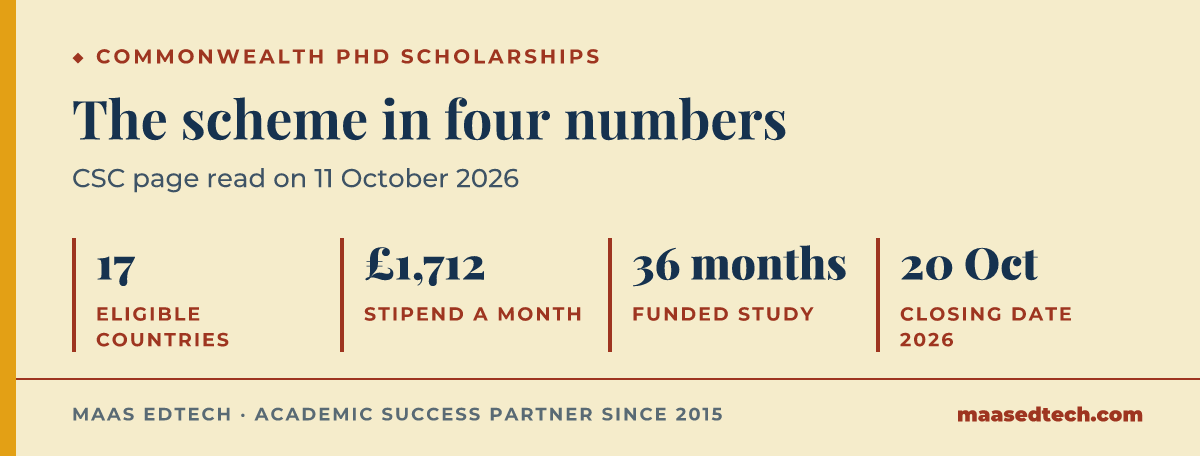
The award runs for 36 months of full-time study, and the CSC does not support four-year PhDs. Family allowances are separate. A scholar with a spouse receives £313 per month for up to nine months, and a child allowance of £313 per month for the first child applies when spouse and children live together in the UK. The CSC calls these a contribution only and says the true cost is likely to be considerably higher, so scholars must be able to supplement them (Commonwealth Scholarship Commission in the UK, n.d.).
The figures above are the rates quoted on the page at the time of checking. They are quoted "at current levels", so confirm them on the page before you plan a budget.
What should you check before starting an application?
Direct answer: Open the scheme page and read the eligible-country list first, then the conditions on citizenship and residence, then the nominator's page for your country. Do these three checks in order before you draft anything. A failed first check ends the process; a failed third check usually only changes the dates.
If Vietnam is your country of citizenship and residence, stop at the first check and look at schemes whose list includes Vietnam. MAAS prepares drafts of research proposals, CVs and motivation letters from the candidate's own account of their work for schemes where the candidate is eligible; the candidate reads, edits, approves and submits every document personally. See PhD Application Strategy and Execution for what the service covers, and PhD application resources for the wider guide.
Frequently asked questions
Can Vietnamese students apply for the Commonwealth PhD scholarship?
Not with Vietnamese citizenship and residence in Vietnam, because the CSC's own list of eligible countries leaves Vietnam out (Commonwealth Scholarship Commission in the UK, n.d.).
Which countries are eligible for the Commonwealth PhD scholarship?
Seventeen, running alphabetically from Bangladesh to Zambia. The full list sits on the CSC page, which the CSC revises for each round (Commonwealth Scholarship Commission in the UK, n.d.).
Can I apply to the CSC directly?
No. The CSC does not accept direct applications; candidates apply to a nominator as well as to the CSC (Commonwealth Scholarship Commission in the UK, n.d.).
How much does it pay each month?
£1,712, or £2,000 in the London metropolitan area, plus tuition fees and airfare (Commonwealth Scholarship Commission in the UK, n.d.).
What is the deadline?
16:00 BST on Tuesday 20 October for study from September or October 2027; nominators may close earlier (Commonwealth Scholarship Commission in the UK, n.d.).
Related MAAS guides
- Who screens a PhD scholarship first in Australia and in Taiwan?
- What do PhD scholarship eligibility rules describe?
- Scholarship, fellowship, studentship or assistantship: what is the difference?
- Why do PhD scholarship deadlines come before the programme deadline?
- PhD application resources
- PhD Application Strategy and Execution
References
Commonwealth Scholarship Commission in the UK. (n.d.). Commonwealth PhD Scholarships. Retrieved October 11, 2026, from https://cscuk.fcdo.gov.uk/scholarships/commonwealth-phd-scholarships-for-least-developed-countries-and-fragile-states/
The Commonwealth. (n.d.). Member countries. Retrieved October 11, 2026, from https://thecommonwealth.org/our-member-countries
Tools & resources
- CSC page for the Commonwealth PhD Scholarships: https://cscuk.fcdo.gov.uk/scholarships/commonwealth-phd-scholarships-for-least-developed-countries-and-fragile-states/