
◆ Admissions
Who is eligible for Chevening, and what do the essays ask?
Chevening is the UK Government's scholarship for one-year master's degrees, and most of the confusion around it comes from mixing two different questions: whether you are allowed to apply, and whether your application is strong enough to reach interview. The first is a checklist on the Chevening website. The second is decided by four essay answers read by independent committees. This guide takes the two questions in that order, using only Chevening's own pages and a UK Government review, all read on 22 October 2026.
Direct answer: You are eligible if you are a citizen of a Chevening-eligible country, will return home for at least two years after the award, have at least 2,800 hours of work experience after your first degree, hold a degree that qualifies you for a UK master's, and apply to three different eligible UK courses (Chevening, n.d.-b).
◆ Question 1 / 7 · Eligibility
Who is eligible for the Chevening Scholarship?
Direct answer: Chevening (n.d.-b) lists five conditions an applicant must meet and five situations that make an applicant ineligible. Ineligible applications are rejected before anyone reads the essays, so the checklist is the first filter, not a formality. Read both lists against your own record before you start any essay.
The five conditions are citizenship of a Chevening-eligible country or territory, a commitment to return to the country of award for at least two years after the scholarship ends, at least two years of work experience equivalent to 2,800 hours, an undergraduate degree that qualifies the applicant for a UK master's programme, and applications to three different eligible UK courses (Chevening, n.d.-b). The degree must have been finished at least two years before the application deadline, and the certificate is needed by the time of the interview, even if it has not yet arrived when the applicant submits.
The exclusions matter as much as the conditions. Chevening (n.d.-b) rules out holders of British or dual British citizenship, with narrow exceptions, people resident in the UK at the time of application, employees and recent former employees of a UK government department, the British Council or a partner UK university, together with their immediate relatives, anyone who has already studied in the UK on a UK government-funded scholarship, and anyone with refugee status in a country that is not Chevening-eligible. A master's degree already completed does not block a second one.
| Check | What Chevening asks | Where it is tested |
|---|---|---|
| Citizenship | Citizen of a Chevening-eligible country or territory | Eligibility checker |
| Return home | At least two years in the country of award after the scholarship | Declaration on the form |
| Work experience | At least 2,800 hours, gained after the first degree | Calculated by the form |
| Degree | Qualifies for a UK master's, finished two years before the deadline | Certificate checked before interview |
| Courses | Three different eligible UK courses, one unconditional offer by the deadline | Course choices and offer upload |
Sources: Chevening (n.d.-b), Chevening (n.d.-c), Chevening (n.d.-f).
◆ Question 2 / 7 · Age limit
Is there a Chevening Scholarship age limit?
Direct answer: No. Chevening (n.d.-a) states that gender, age, marriage or parenthood status and other personal attributes do not matter, and adds that "there is no upper age limit". What is checked instead is work experience gained after the first degree.
The absence of an age limit does not mean the scheme suits a fresh graduate. Because the 2,800 hours must be gained after the undergraduate degree and over at least two years, a final-year student cannot apply in the same cycle (Chevening, n.d.-c). The work experience page explains that the online form multiplies the number of weeks worked by the hours per week for each entry, accepts up to fifteen separate periods of employment, and counts paid or unpaid internships among the eligible types.
Chevening (n.d.-e) lists the common mistakes in this section as not meeting the minimum hours, entering the number of weeks wrongly, entering the same job more than once, and giving unrealistic weekly hours. An applicant who is close to the threshold should count the hours before starting the essays, because a shortfall ends the application regardless of essay quality.
◆ Question 3 / 7 · Countries and Vietnam
Which countries are eligible for Chevening, and is Vietnam one of them?
Direct answer: Chevening runs country by country, and Vietnam has its own award page. Applicants must apply from their country of citizenship, wherever they currently live, so a Vietnamese citizen working abroad still applies through the Vietnam page, and each country page carries its own deadline (Chevening, n.d.-f; Chevening, n.d.-g).
Chevening (n.d.-e) puts the rule plainly: "You must apply from your country of citizenship, regardless of where you currently live." A Vietnamese citizen working in Singapore therefore applies through the Vietnam scheme, not the Singapore one. The eligibility page adds a separate residence condition for awards from ODA-eligible countries, which is that the applicant must live in an ODA-eligible country, though not necessarily the country of citizenship (Chevening, n.d.-b).
When checked on 22 October 2026, the Vietnam page stated that applications for the 2027 to 2028 scholarships were closed (Chevening, n.d.-g). The UK Government's 2023 review response describes Chevening as covering "around 140 countries" and reports 1,400 scholarships across 160 countries and territories in 2022 to 2023 (Foreign, Commonwealth & Development Office [FCDO], 2023, p. 3). The two figures measure different things, so the safest check is whether your own country has a page on chevening.org. A comparison with a scheme that does not include Vietnam is in Can Vietnamese students apply for a Commonwealth PhD scholarship?.
◆ Question 4 / 7 · Deadlines
When is the Chevening Scholarship deadline?
Direct answer: The 2027 to 2028 window ran from August to October 2026, closing at 11:00 UTC on a date set by each country page. Successful candidates hear in mid-June 2027, about eight months after the application window closes (Chevening, n.d.-f).
The timeline after submission is long. Chevening (n.d.-f) describes an eligibility sift from October 2026, reading committee assessments from mid-October 2026 to January 2027, interview shortlists in mid-February 2027, and interviews at British embassies and high commissions in March and April 2027. Shortlisted candidates must upload photo ID, their degree certificate and reference letters at least seven working days before the interview.
The last gate is the university offer. Chevening (n.d.-f) sets 17:00 BST on 8 July 2027 as the deadline to submit at least one unconditional offer from a UK university, and studies begin in September or October 2027. In practice, an applicant who cannot meet a university's conditions by that date risks losing the award, so the university applications run in parallel with the Chevening process rather than after it.
◆ Question 5 / 7 · The four essays
What do the four Chevening essays ask?
Direct answer: The form has four essay questions, on leadership and influencing, on building professional relationships, on the choice of course, and on the career plan. Chevening (n.d.-d) says applicants are assessed against their ability to answer questions in each of these four areas.
The four Chevening essay areas
Tap an area to see what Chevening looks for.
Leadership
Examples of taking the lead and influencing others, with clear results.
Relationships
How collaboration led to real, measurable outcomes.
Course choice
Research into all three courses, with the answer focused on the first choice and its modules.
Career plan
Short, mid and long-term goals that are clear and measurable.
Save this figure
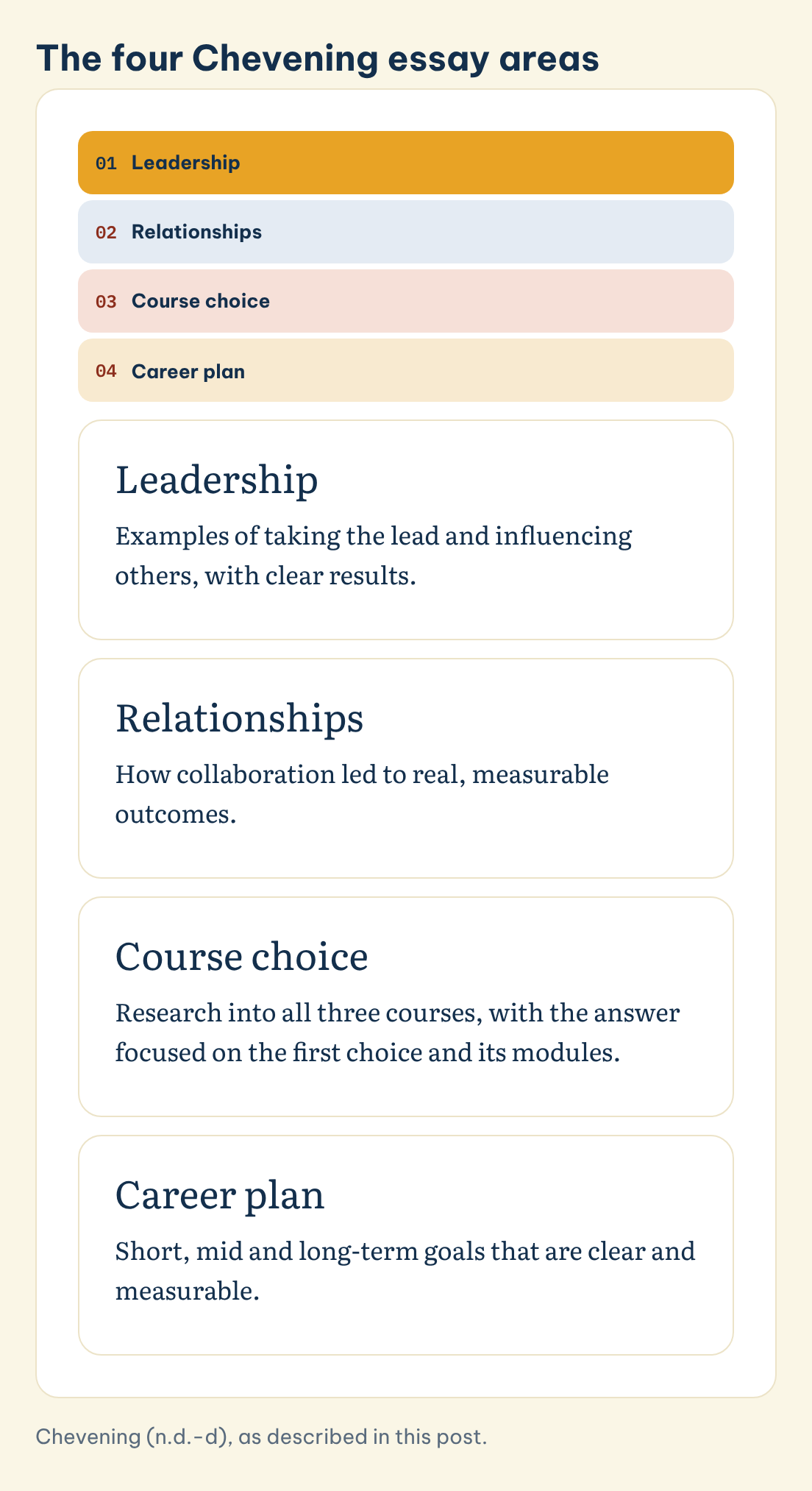
Chevening (n.d.-d) describes what a strong answer contains in each area. For leadership, it looks for examples with clear results, such as driving change in a community or organisation or delivering a project with tangible impact. For relationships, it asks how collaboration led to "real, measurable outcomes". For the course, applicants must show research into all three choices but focus the answer only on the first, naming specific modules. For the career plan, it asks for short, mid and long-term goals that are clear and measurable.
| Essay area | What Chevening looks for | Common weak answer |
|---|---|---|
| Leadership and influencing | Examples of taking the lead with clear results | A job description with no outcome |
| Professional relationships | Collaboration that led to measurable outcomes | A list of contacts or events attended |
| Course choice | First-choice course linked to background and goals, with named modules | Praise for the university's ranking |
| Career plan | Short, mid and long-term goals that are measurable | A vague wish to "give back" |
Source: Chevening (n.d.-d). The right-hand column is MAAS's reading of what falls short of those criteria, not Chevening's wording.
The course and career answers are also asked to connect with UK priority areas. Chevening (n.d.-d) names promoting growth and prosperity, building climate resilience, strengthening security and stability, and supporting development for more inclusive and effective societies. In MAAS's reading, an answer does not need to cover all four, but the link between the applicant's own work and at least one of them should be visible.
◆ Question 6 / 7 · AI and paid help
Can you use AI or paid help to write the Chevening essays?
Direct answer: Not to write the answers. Chevening (n.d.-d) states that "The use of AI software to generate answers in Chevening applications is strictly prohibited" and that it uses tools to detect fraud, plagiarism and AI-generated text. Fraudulent or copied applications are disqualified (Chevening, n.d.-e).
The same page reminds applicants that applying is free and that Chevening does not endorse or work with third parties who charge for application support (Chevening, n.d.-d). The essays are meant to show the applicant's own judgement and English, and Chevening (n.d.-e) adds that strong English is needed for the interview and the UK course, even though no test score is required at the application stage.
What remains legitimate is feedback on a draft the applicant wrote: whether an example has a measurable result, whether the course answer names modules, whether the career plan has a timeline. MAAS works this way on statements of purpose, reading the candidate's own draft and asking questions, while the candidate writes and submits every word. See Study Abroad SOP Consulting for what the service covers.
◆ Question 7 / 7 · How hard it is
Is it difficult to get a Chevening Scholarship?
Direct answer: Yes. Places are limited and Chevening does not publish a per-country acceptance rate, so treat any single success-rate figure with caution. The scheme's own advice is to wait a cycle if you cannot yet write a competitive application in your own words (Chevening, n.d.-d).
The FCDO review response states the purpose behind the selection: "Chevening, established in 1983, is an internal FCDO programme, which covers around 140 countries, is mainly ODA-funded and is for graduates who have leadership ambitions" (FCDO, 2023, p. 3). That description explains why the essays weigh leadership and career plans more than grades. A high GPA alone does not answer any of the four questions. For scale, the same document reports an allocation of £59.4m in 2022 to 2023 (FCDO, 2023, p. 3).
Chevening (n.d.-e) advises applicants who do not yet feel they have enough experience to wait for a future cycle rather than apply weakly. In practice, an extra year of work that produces one clear, measurable result can change two of the four essays.
Frequently asked questions
Who is eligible for the Chevening Scholarship?
Citizens of a Chevening-eligible country with at least 2,800 hours of post-degree work experience, a qualifying degree, three eligible UK course choices and a commitment to return home for two years (Chevening, n.d.-b).
Is there an age limit for Chevening?
No. Chevening (n.d.-a) says there is no upper age limit.
Do I need an IELTS score to apply?
Not at the application stage, but Chevening (n.d.-e) says strong English is needed, and your UK university will set its own English requirement.
Can I apply to Chevening from a country I live in but am not a citizen of?
No. You apply through the scheme for your country of citizenship, wherever you live (Chevening, n.d.-e).
When are interviews and results?
Interviews run from March to April 2027 and results come from mid-June 2027 for the 2027 to 2028 cycle (Chevening, n.d.-f).
Can I use ChatGPT to write my essays?
No. Chevening (n.d.-d) prohibits AI-generated answers and checks applications for them.
Related MAAS guides
References
Chevening. (n.d.-a). Who can apply for a Chevening Scholarship? Retrieved October 22, 2026, from https://www.chevening.org/scholarships/who-can-apply/
Chevening. (n.d.-b). Chevening eligibility criteria. Retrieved October 22, 2026, from https://www.chevening.org/scholarships/who-can-apply/eligibility/
Chevening. (n.d.-c). Work experience. Retrieved October 22, 2026, from https://www.chevening.org/scholarships/who-can-apply/work-experience/
Chevening. (n.d.-d). Chevening application criteria. Retrieved October 22, 2026, from https://www.chevening.org/resource-hub/guidance/application-criteria/
Chevening. (n.d.-e). Common application errors. Retrieved October 22, 2026, from https://www.chevening.org/resource-hub/guidance/common-errors/
Chevening. (n.d.-f). Application timeline. Retrieved October 22, 2026, from https://www.chevening.org/scholarships/application-timeline/
Chevening. (n.d.-g). Chevening in Vietnam. Retrieved October 22, 2026, from https://www.chevening.org/scholarship/vietnam/
Foreign, Commonwealth & Development Office. (2023). Response to the independent review of FCDO funded scholarship schemes. GOV.UK. https://assets.publishing.service.gov.uk/media/657055ac739135000db03ba1/Response_to_the_Independent_Review_of_FCDO_Funded_Scholarship_Schemes.pdf
This guide is general information about the Chevening Scholarship. Rules and dates change each cycle, so check your own country page on chevening.org before you apply.
Not sure how this guide applies to your own case? Talk it through with MAAS in a free 20-minute consultation.
Book a free consultation ▸