
◆ Scholarships
Who qualifies for the Fulbright scholarship as a Vietnamese student?
Category: admissions
Last updated: 2026-10-22
Searched on 22 October 2026, Google showed no AI Overview for "fulbright scholarship", only questions about how hard the award is to win and who qualifies, and the organic results led with the UK commission and the U.S. programme sites. Those pages describe different national competitions. A Vietnamese applicant enters one competition only, run by the U.S. Mission in Vietnam, and its rules are narrower than the general descriptions suggest.
Direct answer: A Vietnamese applicant to the Fulbright Master's programme must meet four minimums set by the U.S. Mission in Vietnam: single Vietnamese citizenship and residence at home, a first degree, two years of work since graduating, and a recent English test at the stated band. A separate ineligibility list can stop an application before any essay is read.
The reading behind this guide covers the U.S. Mission in Vietnam pages for the Fulbright Vietnamese Student Program, its 2027-2028 announcement and its applicant FAQ, the Mission's pages for the Visiting Scholar and Visiting Student Researcher programmes, and the Institute of International Education (IIE) guide on the home-residency rule, all checked on 22 October 2026. It does not cover the Fulbright programmes that other countries run for their own citizens.
◆ Question 1 / 7 · Who qualifies
Who qualifies for the Fulbright scholarship?
Direct answer: The applicant must be a Vietnamese citizen with no second citizenship, living in Vietnam, holding a first degree, with two years of work since graduation and a valid English score at the stated minimum. For engineering and physical sciences, the undergraduate field must correspond with or relate to the planned Master's field (U.S. Mission Vietnam, n.d.-b).
The work-experience rule is counted in a way that surprises applicants. The applicant FAQ explains that the programme counts experience from the date of issuance of the first Bachelor's degree, so full-time work done before graduation "may make you more competitive overall, but does not necessarily meet this requirement" (U.S. Mission Vietnam, n.d.-a). A candidate who graduated in mid-2024 cannot meet a two-year rule for an April 2026 deadline, however long they worked while studying.
The ineligibility list is just as decisive. The programme page excludes candidates who already received a Fulbright Student grant, candidates "currently living or studying in the United States and overseas", holders of a U.S. Bachelor's or Master's degree earned within the last three years, and anyone who received a fully funded scholarship for graduate study abroad within the past five years, "regardless of source of funding" (U.S. Mission Vietnam, n.d.-b). That last rule matters for applicants who also hold, for example, a fully funded Master's award from another government.
Two things the programme does not require are worth knowing. There is no minimum GPA, though applicants are told to check the admission requirements of likely host universities, and there is no age limit (U.S. Mission Vietnam, n.d.-a). All fields are eligible except medicine, dentistry and nursing; public health without clinical practice is eligible (U.S. Mission Vietnam, n.d.-b).
| Requirement | What the U.S. Mission in Vietnam states |
|---|---|
| Citizenship and residence | Vietnamese citizen, no dual citizenship, living in Vietnam through application and selection |
| Degree | At least one undergraduate degree; related field for engineering and physical sciences |
| Work experience | At least two years, counted from the date of the first Bachelor's degree |
| English | TOEFL iBT 80, IELTS 6.5, Duolingo 110 or TOEFL Essentials 8.5, test taken after 15 April 2024 |
| Excluded | Prior Fulbright Student grant, living abroad now, recent U.S. degree, fully funded graduate award abroad in the past five years |
Source: U.S. Mission Vietnam (n.d.-b), checked on 22 October 2026.
◆ Question 2 / 7 · How hard and how rare
How hard is a Fulbright scholarship to get, and how rare is it?
Direct answer: The Mission does not publish an applicant count or an acceptance rate for Vietnam. Its 2026-2027 applicant FAQ frames the odds: the Mission usually interviews about 45 to 50 applicants a year, and that "Up to 20 new grantees go to the U.S. each year" (U.S. Mission Vietnam, n.d.-a, p. 1).
Without the number of applications, any acceptance rate for Vietnam is a guess, so treat percentages quoted on agency pages with caution. What the two official numbers do show is the shape of the funnel: a written round that cuts the field to an interview list of about 45 to 50, then an interview round that removes more than half of that list, leaving 20 or fewer. The number of awards also moves with funding, because it "depends on the amount of funding allocated by the US Department of State", and there is no quota by field (U.S. Mission Vietnam, n.d.-a).
The written round is judged on essays, experience and leadership, not on test scores alone. The programme page asks for a clear link between study objectives and future goals "through a compelling set of essays", depth of work experience in the intended field, leadership potential, and "dedication to Vietnam and potential to make a positive impact upon return" (U.S. Mission Vietnam, n.d.-b). It also states that preference goes to candidates without recent or substantial experience of living, studying or working in the United States.
◆ Question 3 / 7 · Is it a big deal
Is a Fulbright scholarship a big deal?
Direct answer: The award is fully funded and carries a lasting condition. The grant covers tuition and fees, a monthly living stipend, health and accident insurance and round-trip airfare (U.S. Mission Vietnam, n.d.-b), and every grantee is subject to a two-year home-country residency requirement after the grant ends.
The residency rule is the part to weigh before applying. The applicant FAQ states that grantees "may not apply for a work or immigrant visa to the U.S. until after two years of residence in Vietnam" after completing the grant, while visits on non-immigrant visas remain possible (U.S. Mission Vietnam, n.d.-a). IIE's guide for visiting scholars, written for the same J-1 rule, adds that grounds for a waiver "are extremely limited, and approval of waiver requests is rare" (Institute of International Education, n.d.). An applicant whose real plan is to stay and work in the United States straight after the degree is choosing the wrong award.
The scale behind the name is large. The Fulbright Foreign Scholarship Board (2026) reports that "Today, the Program enjoys partnerships with more than 160 countries" (p. 4), and its 2024 tables count 3,497 student awards to foreign nationals, 634 of them in East Asia and the Pacific (p. 27). Against that total, up to 20 places a year for Vietnam is a small national allocation.
Placement also works differently from a normal admission. Applicants do not need a university offer before applying; finalists are placed by the Fulbright Program and the Bureau of Educational and Cultural Affairs, and the programme will try to honour the three or four universities named in the application but may place a grantee elsewhere (U.S. Mission Vietnam, n.d.-a). Deferral to a later year is not allowed.
◆ Question 4 / 7 · Deadline for Vietnam
When is the Fulbright scholarship deadline for Vietnam?
Direct answer: For study starting in academic year 2027-2028, the deadline was 17:00 Vietnam time on 15 April 2026, through the online system at apply.iie.org (U.S. Mission Vietnam, 2026). The Mission announces each round in January, so the next round's date will appear on its programme page.
The timetable after the 15 April 2026 deadline (17:00 Vietnam time) runs for more than a year. The programme page lists application review and the interview list from May to July 2026, interviews in August or September, test retakes for shortlisted candidates in September and October, university applications from November 2026 to March 2027, placement confirmation in April or May 2027, and departure in July or August 2027 (U.S. Mission Vietnam, n.d.-b). Finalists usually sit the official TOEFL and the GRE or GMAT, with test vouchers provided by the programme (U.S. Mission Vietnam, n.d.-a).
The written package is fixed: the online form, two essays (a study objectives essay and a personal statement), three letters of recommendation, transcripts and degrees, English score reports and a CV (U.S. Mission Vietnam, n.d.-b). The 2027-2028 announcement adds that diplomas and transcripts need notarised English translations (U.S. Mission Vietnam, 2026).
◆ Question 5 / 7 · After a Master's or PhD
Is there a Fulbright route after a Master's or for postdoctoral research?
Direct answer: The U.S. Mission in Vietnam lists no degree-funding Fulbright PhD or postdoc scholarship. Holders of an MA or PhD can apply to the non-degree Visiting Scholar Program, and doctoral students enrolled in Vietnam in science and technology can apply to the Visiting Student Researcher Program (U.S. Mission Vietnam, n.d.-c, n.d.-d).
The Visiting Scholar Program funds five or nine months of research or teaching at a U.S. institution, not a degree. Applicants should be university faculty, government officials, private sector or think-tank professionals "with a significant record of scholarly or professional accomplishments", and they submit a project proposal of 3 to 5 single-spaced pages with a bibliography, a CV and three letters (U.S. Mission Vietnam, n.d.-c). The page also notes that over 160 Vietnamese scholars have taken part since 1998.
The Visiting Student Researcher Program is non-degree as well, with up to five fully funded places, lasting 6 to 10 months, for doctoral students enrolled at a university in Vietnam in science and technology. Researchers are attached to a faculty member at the host institution and do not take credit-bearing classes (U.S. Mission Vietnam, n.d.-d).
◆ Question 6 / 7 · Fulbright in the UK
What about the Fulbright scholarship in the UK?
Direct answer: The US-UK Fulbright Commission runs awards for UK citizens and says it is "unable to accept applications from non-UK citizens on a student visa" (US-UK Fulbright Commission, n.d.). For a Vietnamese student on a UK student visa, the realistic route is the competition at home.
The Commission does consider non-UK citizens based in the UK and committed to a life and career there, but only if their home Commission or post will not accept them because of their UK residency, and only with evidence of settled status or similar leave (US-UK Fulbright Commission, n.d.). The Vietnam competition, for its part, excludes candidates who are living or studying abroad (U.S. Mission Vietnam, n.d.-b).
Each Fulbright competition is national: a candidate applies through their own country, under the rules of its commission or U.S. embassy. For a Vietnamese student finishing a degree in the UK or Australia, the practical sequence is to return, live in Vietnam through the application and selection process, and build the two years of post-graduation work the rules count. The documents themselves overlap with other awards; how Chevening, Australia Awards and Fulbright differ in referee counts is compared in Statement of purpose vs motivation letter: what is the difference?.
◆ Question 7 / 7 · What to check first
What should you check before starting an application?
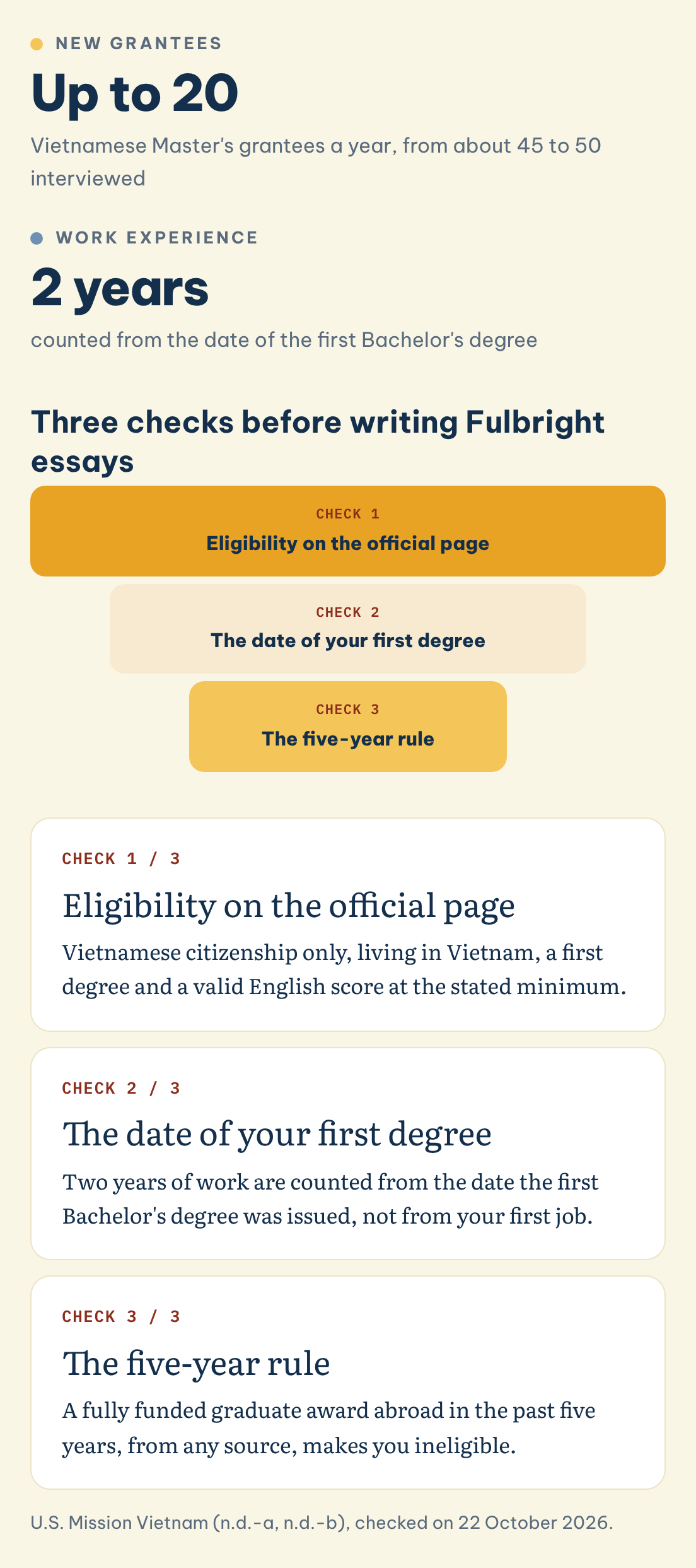
Direct answer: Check eligibility against the official page first, then the date of your first degree, then the five-year rule on other funded awards. Draft the two essays only after all three pass, because none of them can be fixed by better writing.
New grantees
Up to 20
Vietnamese Master's grantees a year, from about 45 to 50 interviewed
Work experience
2 years
counted from the date of the first Bachelor's degree
Three checks before writing Fulbright essays
Tap a check to see what it covers.
Check 1 / 3
Eligibility on the official page
Vietnamese citizenship only, living in Vietnam, a first degree and a valid English score at the stated minimum.
Check 2 / 3
The date of your first degree
Two years of work are counted from the date the first Bachelor's degree was issued, not from your first job.
Check 3 / 3
The five-year rule
A fully funded graduate award abroad in the past five years, from any source, makes you ineligible.
Save this figure
If all three pass, the essays carry the application. The study objectives essay has to connect a specific Master's field with a specific role in Vietnam afterwards, and the personal statement has to show the leadership and exchange record the selection criteria name. MAAS consultants work through study objectives, personal statements and CVs with applicants in one-to-one sessions; the applicant writes, owns and submits every document. See Admissions Consulting for what the service covers.
Frequently asked questions
Who qualifies for the Fulbright scholarship in Vietnam?
A Vietnamese citizen without dual citizenship, living in Vietnam, with a first degree, two years of post-graduation work and TOEFL iBT 80, IELTS 6.5, Duolingo 110 or TOEFL Essentials 8.5 (U.S. Mission Vietnam, n.d.-b).
Is there a minimum GPA or age limit?
No to both, though the Mission advises checking the admission requirements of likely host universities (U.S. Mission Vietnam, n.d.-a).
How many Vietnamese students win Fulbright each year?
Up to 20 new grantees a year, from about 45 to 50 interviewed applicants; the Mission does not publish an acceptance rate (U.S. Mission Vietnam, n.d.-a).
Can I stay in the United States to work after Fulbright?
Not straight away. Grantees must spend two years in Vietnam before applying for a U.S. work or immigrant visa, and waivers are described as rare in IIE guidance for the same J-1 rule (U.S. Mission Vietnam, n.d.-a; Institute of International Education, n.d.).
Does Fulbright Vietnam fund a PhD?
The Mission lists no PhD degree route. Doctoral and postdoctoral candidates can look at the non-degree Visiting Scholar and Visiting Student Researcher programmes (U.S. Mission Vietnam, n.d.-c, n.d.-d).
Related MAAS guides
References
Fulbright Foreign Scholarship Board. (2026). 2024 annual report [PDF]. U.S. Department of State. https://www.state.gov/wp-content/uploads/2026/09/FFSB-2024-Report-1.pdf
Institute of International Education. (n.d.). Completing your program. Fulbright Scholar Program. Retrieved October 22, 2026, from https://fulbrightscholars.org/visiting-scholars/guide/completing-your-program
U.S. Mission Vietnam. (n.d.-a). Frequently asked questions: Fulbright Vietnamese Student Program, academic year 2026-2027 [PDF]. U.S. Embassy & Consulate in Vietnam. Retrieved October 22, 2026, from https://vn.usembassy.gov/wp-content/uploads/sites/124/2023/12/FAQs_AY26-27_FINAL.pdf
U.S. Mission Vietnam. (n.d.-b). Fulbright Vietnamese Student Program. U.S. Embassy & Consulate in Vietnam. Retrieved October 22, 2026, from https://vn.usembassy.gov/fulbright-vietnamese-student-program/
U.S. Mission Vietnam. (n.d.-c). Fulbright Vietnamese Visiting Scholar Program. U.S. Embassy & Consulate in Vietnam. Retrieved October 22, 2026, from https://vn.usembassy.gov/fulbright-vietnamese-visiting-scholar-program/
U.S. Mission Vietnam. (n.d.-d). Fulbright Vietnamese Visiting Student Researcher Program. U.S. Embassy & Consulate in Vietnam. Retrieved October 22, 2026, from https://vn.usembassy.gov/fulbright-vietnamese-visiting-student-researcher-program/
U.S. Mission Vietnam. (2026, January 14). Fulbright Vietnamese Student Program academic year 2027-2028. U.S. Embassy & Consulate in Vietnam. https://vn.usembassy.gov/fulbright-vietnamese-student-program-academic-year-2027-2028/
US-UK Fulbright Commission. (n.d.). UK postgraduate. Retrieved October 22, 2026, from https://fulbright.org.uk/our-programmes/fulbright-scholarships-to-the-usa/uk-postgraduate/
Tools & resources
- Fulbright Vietnamese Student Program page: https://vn.usembassy.gov/fulbright-vietnamese-student-program/
- Online application system: https://apply.iie.org/
Not sure how this guide applies to your own case? Talk it through with MAAS in a free 20-minute consultation.
Book a free consultation ▸