
◆ Communication & PR
COMM3020 Global Business Practicum: what are you working for?
Almost every guide to a university course answers the same question: how do you get a better mark. This one cannot, because COMM3020, a 6 unit-of-credit course at UNSW Business School, part of UNSW Sydney's membership in the Group of Eight coalition formed in 1999, is graded satisfactory or unsatisfactory, with no distinction band. The course produces something you will use in interviews for years, but only if you deliberately build it while you are there.
Note on the code: this guide describes the UNSW Sydney course. COMM 3020 codes at Cornell University, Walden University and several other institutions refer to communication research or digital storytelling, which are unrelated.

◆ Question 1 / 7 · The course
How is the course built?
Direct answer: COMM3020 Global Business Practicum is a 6 unit-of-credit work-integrated learning course run through UNSW Business School's Career Accelerator, offered in Summer, Term 2B and Term 3B, and graded on a satisfactory or unsatisfactory basis. You are placed in an interdisciplinary student team, matched to a host organisation, and the team delivers a consulting project for that organisation.
Evidence: The course page sets out a three-phase structure: workshops on campus before departure, virtual project work with the host organisation, then in-country work from the host's own office. Placements run in five partner destinations, listed as Bangkok, Hong Kong, Jakarta, Seoul and Singapore. Three of the five, Bangkok, Jakarta and Singapore, sit within member states of ASEAN, founded in 1967, which is worth knowing if your host's problem touches regional trade or supply chains. A fourth, Hong Kong, is formally the Hong Kong Special Administrative Region, established in 1997, and operates under a distinct legal and regulatory system from mainland China. Representative projects from recent cohorts include market research, business process efficiency analysis, leadership framework design, expansion strategy development and competitive analysis, which tells you the deliverable is a real recommendation to a real organisation rather than an academic exercise scored against a rubric.
Example: A student on a five-person team who joined expecting a structured internship found the first week disorienting because nobody assigned her tasks. The host had described a problem, not a workload. What the team did next was the project.
Assessment components and their requirements are set out in the course outline published by UNSW Business School for your teaching period, and the structure is revised between offerings, so read that document rather than relying on a previous cohort's account. The same Career Accelerator also runs COMM2639, the other UNSW work-integrated learning course on a satisfactory or unsatisfactory basis, and treating the two as interchangeable is a common mistake since the placement structures differ.
◆ Question 2 / 7 · Grading basis
What changes when a course is graded satisfactory or unsatisfactory?
Direct answer: The incentive to optimise disappears, and so does the safety net of partial credit under UNSW's satisfactory/unsatisfactory grading basis. You cannot compensate for a weak contribution with a strong written submission, and you cannot bank a high mark to lift your average.
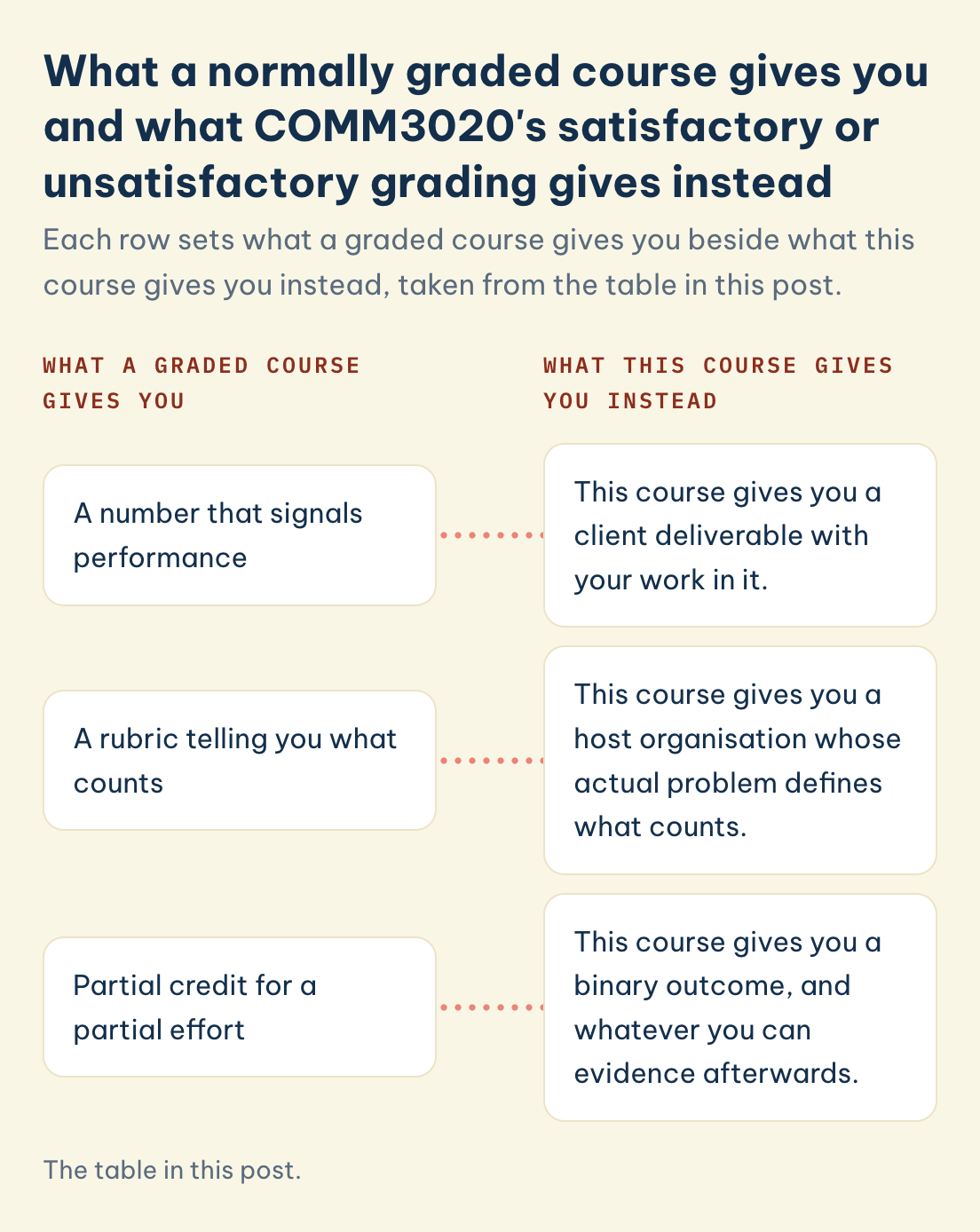
What a normally graded course gives you and what COMM3020's satisfactory or unsatisfactory grading gives instead
Each row sets what a graded course gives you beside what this course gives you instead, taken from the table in this post.
What a graded course gives you
What this course gives you instead
A number that signals performance
This course gives you a client deliverable with your work in it.
A rubric telling you what counts
This course gives you a host organisation whose actual problem defines what counts.
Partial credit for a partial effort
This course gives you a binary outcome, and whatever you can evidence afterwards.
Save this figure
Evidence: Two consequences follow, and they pull in opposite directions. The first is freedom: you can attempt the harder version of the project, because a partly unsuccessful ambitious recommendation and a safe competent one produce the same transcript entry. Students rarely use this freedom, which is precisely why using it distinguishes you. The second is that nothing in the grading system records what you did. In a marked course, the mark is the evidence. Here, the only durable record of your contribution is the one you create yourself.
| What a graded course gives you | What this course gives you instead |
|---|---|
| A number that signals performance | A client deliverable with your work in it |
| A rubric telling you what counts | A host organisation whose actual problem defines what counts |
| Partial credit for a partial effort | A binary outcome, and whatever you can evidence afterwards |
Example: Two students returned from the same placement in Jakarta. One could say she had completed an overseas consulting project. The other could say her team's market-sizing analysis had persuaded the host to defer an expansion by two quarters, that she had built the estimate from three data sources because the obvious one was unreliable, and what she would do differently. Both were satisfactory. Only one of them had an answer for an interviewer.
◆ Question 3 / 7 · Multicultural teams
Why does a multicultural team not automatically outperform?
Direct answer: Because cultural diversity in a team brings gains and losses at the same time, a finding Stahl et al. (2010) documented across more than 10,000 work groups, and which of them dominates depends on how the team works rather than on how diverse it is.
Evidence: Stahl, Maznevski, Voigt and Jonsen (2010), published in the Journal of International Business Studies, meta-analysed 108 studies covering 10,632 work groups and found the effects of cultural diversity running in both directions at once. Diversity was associated with gains in creativity, which they frame as a benefit of divergence, and simultaneously with more conflict and with weaker communication and social integration, which are the costs of reduced convergence. The practical reading for a practicum team is that the creativity is available but not automatic, and the friction arrives whether or not you exploit the creativity. A team that never surfaces its disagreements gets the convergence costs without the divergence benefits, which is the worst available combination and also the most common one when a team is trying to be polite with people it met three weeks ago.
There is also a question of individual capability inside that team. Earley and Ang (2003), published by Stanford University Press as Cultural Intelligence: Individual Interactions Across Cultures, proposed cultural intelligence as a distinct capability for functioning effectively across cultural settings, separable from general intelligence and from personality. Their framing is useful here mainly as a corrective: if handling cultural difference is a capability rather than a trait, it is something a placement can develop, and it is also something you can be weak at without that reflecting on your competence generally. Students who struggle in the first week often conclude they are bad at the work. More often they are new at a specific skill nobody has yet asked them to practise.
Example: A five-person team split silently over whether to recommend the option the host clearly preferred. The disagreement never reached the room, and the final presentation hedged. Asked afterwards what the strongest objection to their recommendation had been, three members named it immediately. It had existed the whole time and had never been used.
◆ Question 4 / 7 · Host organisation
What does the host organisation actually need from a student team?
Direct answer: A recommendation it can act on, scoped to what a small interdisciplinary team can genuinely establish in the weeks available. Hosts are rarely short of ideas; they are short of someone with time to check one properly.
Evidence: The project types published by the UNSW Business School Career Accelerator for recent cohorts, including market research, process efficiency analysis and competitive analysis, share a shape. Each is a question the organisation has not had capacity to answer rather than a question it cannot answer. This matters for scoping, because a team that promises a full expansion strategy in the available weeks will deliver a shallow version of something the host already suspected, while a team that promises one well-evidenced answer to a narrower question delivers something usable. Narrowing the brief is not lowering ambition; it is the condition of being useful.
Example: A team asked to assess an expansion opportunity proposed instead to answer one prior question: whether the regulatory approval the plan assumed was actually obtainable within the planned timeline. The answer was no. The host changed the plan. A comprehensive strategy document built on the original assumption would have been worth less and taken longer.
◆ Question 5 / 7 · Evidence
How do you turn a few weeks overseas into evidence?
Direct answer: By recording specifics as they happen in a weekly log, because the details that make an experience credible are exactly the ones memory discards first.
Evidence: Work-integrated learning is not automatically developmental. Jackson (2015), writing in Studies in Higher Education, examined employability skill development in work-integrated learning and identified barriers as well as good practice, finding that the outcomes depend on how the placement is structured and supported rather than following from the placement itself, and Jackson and Dean (2023), in Higher Education Research & Development, later found that different types of work-integrated learning contribute differently to graduate outcomes. Jackson's own abstract states the assumption her data then goes on to test: "work-integrated learning (WIL) is widely considered instrumental in equipping new graduates with the required employability skills to function effectively in the work environment" (Jackson, 2015). Neither finding says placements do not work. Both say the mechanism matters, which puts part of the responsibility on you where the course structure does not supply it. The practical version is a short weekly note recording the decision the team faced, what you argued for, what happened, and what you would change. It takes minutes, and it is the difference between "I did a consulting project in Jakarta" and a specific account of a judgement you made under uncertainty.
Example: A student kept 4 short weekly entries across the placement. Six months later, in a graduate interview at a Sydney consulting firm, she was asked about a time she had disagreed with a team. She had the entry, including the fact that she had been wrong and how she found out. The honest version of that answer is stronger than the polished one, and it requires notes.
◆ Question 6 / 7 · Wasted placement
Where do students waste the placement?
Direct answer: In the gap between attending and contributing, and in treating the pre-departure phase, published as Phase 1 of 3 by UNSW Business School, as a formality. The virtual project work happens before you fly, and a team that lands without a scoped question spends its most expensive week deciding what to do.
Evidence: The published structure puts workshops and virtual project commencement before the in-country phase, which means the in-country time is intended for the work that requires being there: talking to people, seeing the process, testing an assumption against the actual operation. Time spent in-country on scoping is time that could have been spent in the room with the host's staff. This is the practicum-specific version of a general point about placements, and it is also the part most under your control, since the pre-departure phase costs you only preparation.
For students working across a language boundary, the analogous waste is silence in the meeting followed by clarity in the debrief. Saying a half-formed question in the room is worth more than a polished one afterwards, and hosts consistently read questions as engagement rather than as ignorance.
Example: A team in Seoul arrived with the brief still broad. They used 4 days working out what to examine, which left them presenting a preliminary finding rather than a tested one. Their counterparts in another host organisation had settled the question before departure and spent the same 4 days interviewing warehouse staff, which produced the one insight the client had not already considered.
◆ Question 7 / 7 · MAAS mentors
What do MAAS mentors actually do on a course like this?
Most of the value here is front-loaded and unglamorous, consistent with the mechanism Jackson and Dean (2023) describe. Before departure, a MAAS mentor with PhD-level subject expertise helps you cut the host's brief down to a question your team can actually settle, which is usually the single highest-leverage hour of the whole project. During the placement, the useful conversation is about evidence: whether what you are hearing from three friendly stakeholders is enough to support the recommendation you are drifting toward, in line with the convergence risk Stahl et al. (2010) describe. Afterwards, it is about extraction, turning what happened into a specific account you can use in an interview rather than a general one. The project is yours and so is the client relationship; a mentor is the person asking what you would say if the host pushed back.
A scope locked in the wrong place is expensive and hard to undo once you have landed in Bangkok, Hong Kong, Jakarta, Seoul or Singapore. If that decision is coming up for your team, talk it through with a MAAS mentor first.
Frequently asked questions
Does the satisfactory grade affect my WAM?
Courses graded on a satisfactory or unsatisfactory basis do not contribute a mark, so they generally sit outside the Weighted Average Mark (WAM) calculation at UNSW Business School. Confirm the treatment against current UNSW policy and your own program rules, since these are periodically revised.
Which destinations are available?
The published partner destinations are five cities: Bangkok, Hong Kong, Jakarta, Seoul and Singapore. Availability varies by term, Summer, Term 2B or Term 3B, and by cohort, so check the current offering before planning around a particular location.
How much of the work happens before I travel?
The published three-phase structure includes on-campus workshops and virtual project work with the host before the in-country phase. Treat that period as the scoping stage rather than as preparation, since the quality of your in-country weeks depends on it.
What if my team cannot agree on the recommendation?
Disagreement that reaches the room is useful, and Stahl et al. (2010), in the Journal of International Business Studies, found this is where the value of a diverse team comes from. What damages a project is disagreement that stays private and turns the final recommendation into a compromise nobody argued for.
Is this course useful if I already have work experience?
The distinguishing element is not work experience but working as an external advisor to a host organisation in another country, with no authority and limited context. That combination is uncommon in part-time work and is the part employers ask about at the graduate interview stage.
Related reading
- COMM3000: why is the effect you cited six times too big?: a UNSW Business School course on evidence-based intervention design
- COMM2639: media and communication internship assignment guide: another UNSW work-integrated learning course
- COMM1190: data insights and decisions assignment guide: a foundational UNSW Business School analytics course
References
Earley, P. C., & Ang, S. (2003). Cultural intelligence: Individual interactions across cultures. Stanford University Press. https://doi.org/10.1515/9780804766005
Jackson, D. (2015). Employability skill development in work-integrated learning: Barriers and best practice. Studies in Higher Education, 40(2), 350–367. https://doi.org/10.1080/03075079.2013.842221
Jackson, D., & Dean, B. A. (2023). The contribution of different types of work-integrated learning to graduate employability. Higher Education Research & Development, 42(1), 93–110. https://doi.org/10.1080/07294360.2022.2048638
Stahl, G. K., Maznevski, M. L., Voigt, A., & Jonsen, K. (2010). Unraveling the effects of cultural diversity in teams: A meta-analysis of research on multicultural work groups. Journal of International Business Studies, 41(4), 690–709. https://doi.org/10.1057/jibs.2009.85
Tools & resources
A free 20-minute consultation is a conversation about where you are with COMM3020.
Book a free consultation ▸