
◆ Communication & PR
COMM2639 Media and Communication Internship: how do you write it?
"My internship was all admin work. I have nothing to write about." MAAS mentors hear this almost every consultation, usually two weeks before the assignment is due. It is the wrong diagnosis. Research on workplace learning shows that most of what people learn at work is never formally taught, and that newcomers begin at the edge of the real work by design. The problem is almost never that nothing happened; it is that nobody wrote it down.

◆ Question 1 / 7 · The course
What is COMM2639 and which campus is it?
Direct answer: COMM2639 is the RMIT course code for Media and Communication Internship delivered to undergraduates at the Melbourne City Campus. This matters here because the equivalent courses at RMIT Vietnam carry different codes: COMM2695 at Saigon South and COMM2774 at Hanoi. If you study in Melbourne, COMM2639 is your code, and Vietnam-offering material may not match your placement requirements.
Evidence: In the RMIT Handbook the course sits under record 050204, Media and Communication Internship, which lists COMM2639 at City Campus, COMM2695 at RMIT Vietnam Saigon South and COMM2774 at RMIT Vietnam Hanoi Campus, all at undergraduate level.
Example: A student in Melbourne downloaded a reflective assignment template a friend at Saigon South had used. The structure looked convincing, so she wrote to it. Her mentor caught the mismatch at outline stage: her own course guide required documentation of placement hours and supervisor engagement that the template did not include. Fifteen minutes of checking saved a rewrite.
◆ Question 2 / 7 · Internship writing
What kind of course is an internship course, and why does that change the writing?
Direct answer: An internship course is a Work Integrated Learning course, which means your knowledge and skills are applied and assessed in a real workplace and feedback from industry is part of the assessment design. RMIT's professional practice courses in this family typically involve a placement of roughly 80 to 120 hours with a local or international employer, supported by learning activities that push you to reflect critically on the experience. Practically, that changes the genre: you are not marked on how impressive your placement was, you are marked on the quality of the reasoning you build from it.
Evidence: RMIT describes courses in this family as designated Work Integrated Learning courses in which knowledge and skills are applied and assessed in a real or simulated workplace context, with industry feedback integral to the experience, and states that internships in these courses run between 80 and 120 hours. Assessment may include essays, reports, reflective papers and creative projects.
Example: Two students from the same cohort had very different placements, one at a large agency, one at a small non-profit with almost no budget. The non-profit student scored higher. Her placement gave her a genuine constraint to analyse: how a communication team reaches an audience with no paid media at all. Interesting analysis beat impressive brand name.
◆ Question 3 / 7 · Admin work
Why "I only did admin work" is a diagnosis, not a fact
Direct answer: Junior tasks are how organisations onboard newcomers, and they are full of analysable material. Scheduling posts tells you how the content calendar is governed. Formatting a media list tells you who the organisation thinks its publics are. Sitting silently in a client meeting tells you how account managers handle disagreement. The task is low status; the evidence is not. Your job in the assignment is to treat routine work as data about how communication is actually produced.
Evidence: Lave and Wenger (1991) described newcomers' apparently peripheral tasks as legitimate peripheral participation, a structured route into a community of practice rather than a waste of time. Eraut (2004) found that most workplace learning is informal and largely unrecognised by learners themselves, which is precisely why students report having learned nothing while having learned a great deal.
Example: A student spent his placement transcribing interviews and thought it was worthless. His mentor asked what he had noticed about which quotes made it into the final article. He had, in fact, noticed a pattern: quotes with concrete numbers survived editing, quotes with adjectives did not. That observation became the analytical spine of his reflective report.
◆ Question 4 / 7 · Week one
What should you do in week one that saves you in week ten?
Direct answer: Keep a structured log from your first shift, and keep it in four columns rather than as a diary. Column one, what happened, with the date. Column two, what I did. Column three, what surprised me or did not go as expected. Column four, the concept or unit reading this connects to.
Ten minutes at the end of each day is enough. Specific detail is what earns marks in reflective assessment, and specific detail decays fast; by week ten you will remember that a meeting was tense but not what was actually said.
Evidence: Reflective frameworks used in higher education are staged rather than free-form, moving from description through analysis to an action plan, with the marks concentrated in the later stages (Gibbs, 1988). Those later stages need concrete raw material, which is exactly what an unrecorded memory cannot supply.
Example: A student who kept no notes wrote a reflective report full of phrases like "I improved my communication skills". Her mentor could not help her evidence any of it, because the incidents were gone. The student who logged daily wrote about a specific moment when a client rejected a headline, quoting the reason, and analysed it against audience theory. Same length, two different bands.
◆ Question 5 / 7 · Critical writing
How do you write critically about a supervisor or an employer without being unprofessional?
Direct answer: Analyse the practice, not the person. "My supervisor was disorganised" is a complaint and a professional risk. "Briefs arrived without a stated audience, which meant drafts were revised late in the process" is an observation about a workflow, and it can be analysed and improved. Keep names and identifying detail out unless your brief requires them, describe what you observed rather than what you assume people intended, and remember your reflective work may be read by people who know the organisation.
Evidence: Work-integrated learning is understood in the literature as a site for forming professional identity, not only for skill acquisition. Trede (2012) argues that "WIL is an ideal space to develop professional identity and professionalism because it is the space that occupies both learning and work" (Trede, 2012, p. 159). The register you use about colleagues is part of what markers read as evidence of that professional identity.
Example: A student wrote that the team "did not care about quality". Her mentor asked what she had actually seen. She had seen approvals happening in a group chat with no version control, which produced conflicting edits. Reframed that way, the same observation became a workflow analysis with a defensible recommendation, and it read as professional rather than aggrieved.
◆ Question 6 / 7 · Theory
Which theory should an internship reflection actually use?
Direct answer: Two kinds, and students usually bring only one. The first is communication theory from your major, audience, framing, media relations, content strategy, applied to what you saw produced. The second is learning and professional practice theory, used to analyse your own development. Bringing only the first produces a workplace report; bringing only the second produces a self-help essay. Bringing both lets you argue that a specific experience changed a specific professional judgement.
Five things a COMM2639 internship reflection analyses and the lens for each
Each row sets one thing you are analysing beside the useful lens and the claim that lens supports, taken from the table in this post.
What you are analysing
Useful lens, and the claim it supports
Why routine tasks still taught you something
Legitimate peripheral participation (Lave & Wenger, 1991). It supports the claim that peripheral work is structured entry, not wasted time.
Skills nobody formally taught you
Informal workplace learning (Eraut, 2004). It supports the claim that much of your learning was tacit and needs deliberate articulation.
What you adjusted mid-task
Reflection-in-action (Schön, 1983). It supports the claim that you exercised professional judgement, not just followed instructions.
Whether the placement built employability
WIL and employability skills (Jackson, 2015). It supports the claim about which skills transferred, and which the placement design did not develop.
Quality of the placement itself
WIL curriculum quality framework (Smith, 2012). It supports evaluating the experience rather than only reporting it.
Save this figure
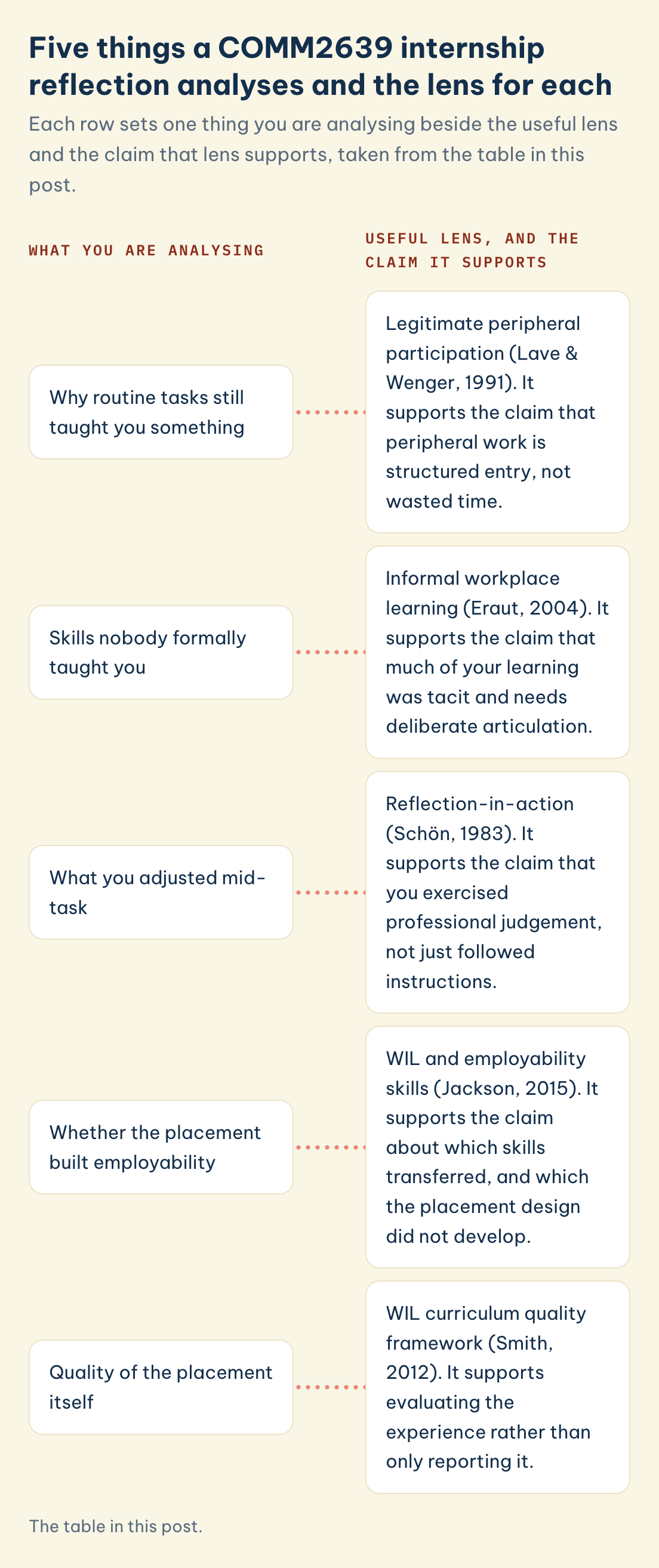
| What you are analysing | Useful lens | The claim it supports |
|---|---|---|
| Why routine tasks still taught you something | Legitimate peripheral participation (Lave & Wenger, 1991) | Peripheral work is structured entry, not wasted time |
| Skills nobody formally taught you | Informal workplace learning (Eraut, 2004) | Much of your learning was tacit and needs deliberate articulation |
| What you adjusted mid-task | Reflection-in-action (Schön, 1983) | You exercised professional judgement, not just followed instructions |
| Whether the placement built employability | WIL and employability skills (Jackson, 2015) | Which skills transferred, and which the placement design did not develop |
| Quality of the placement itself | WIL curriculum quality framework (Smith, 2012) | Evaluating the experience rather than only reporting it |
Evidence: Billett (2009) argued that workplace experience only realises its educational worth when it is deliberately integrated with academic learning rather than left to stand alone. Jackson (2015) found employability skill development in WIL is uneven and shaped by placement design, which gives you licence to evaluate your placement critically rather than thank it politely.
Example: A student's draft cited framing theory competently for the campaign work she observed, but described her own growth in generic terms. Her mentor suggested one addition: Eraut on informal learning. It gave her the vocabulary to explain what she had absorbed without being taught, and the personal section stopped sounding like a cover letter.
◆ Question 7 / 7 · Report structure
How should you structure the reflective report, and what gets cut?
Direct answer: Follow your own brief first. Where you have discretion, a reliable shape is: a short introduction naming the professional question the placement raised; brief placement context, kept under ten percent of the word count; two or three analytical sections, each built on one specific incident and one concept; an evaluation of your development against the course outcomes; and a forward-looking conclusion stating what you will do differently. What gets cut is almost always the same thing, the chronological account of the whole placement. A week-by-week narrative is the single most common reason a well-written internship report lands mid-band.
Evidence: Reflective assessment rubrics concentrate marks in analysis, evaluation and action planning rather than description (Gibbs, 1988). Chronology invites description by default, whereas organising by incident forces analysis.
Example: A student submitted a draft organised as ten weekly sections. His mentor asked him to pick the three moments that had actually changed how he worked. The other seven weeks compressed into two sentences of context, and the freed word count went into analysing those three incidents properly.
Frequently asked questions
Is COMM2639 the same course as COMM2695 or COMM2774?
They are the same course record in the RMIT Handbook with different delivery codes by campus. COMM2639 is the Melbourne City Campus offering, COMM2695 is RMIT Vietnam Saigon South and COMM2774 is RMIT Vietnam Hanoi. Requirements and documentation can differ by offering, so always work from your own course guide and Canvas shell.
What if my placement goes badly or gets cut short?
Tell your course coordinator early rather than at submission time; placement problems are a known part of WIL and there are usually processes for it. Academically, a difficult placement is not a lost cause. An honest, well-evidenced analysis of why a placement did not work can meet the learning outcomes as fully as a smooth one.
Can I write in first person?
Yes. Reflective assessment expects it. First person is a genre convention here, not informality, so keep the register academic and let every personal statement carry analytical weight.
How many references does a reflective internship report need?
Your course guide is the authority. As a working guide, expect roughly six to twelve quality sources for a reflective report at this level, drawn from both your communication major and the workplace learning literature. Reflective does not mean unreferenced.
Can I include work I produced during the placement?
Often yes, and it strengthens the evidence, but check two things first: whether your brief allows an appendix, and whether the material is confidential or client-owned. When in doubt, ask your workplace supervisor before including anything, and anonymise client details.
How MAAS mentors support COMM2639 students
MAAS works as an academic advisor, not a writing service. For an internship course that usually means helping you set up a usable log in the first week, choosing which incidents will carry analysis, checking your outline against your own course guide, and giving feedback that shows where narrative should become evaluation. You do the placement and write the report; the mentor helps you see the material you already have.
If you are studying related communication and business courses, our guides to COMM2789 Digital Content Creation and BUSM2716 Managing Multinational Enterprises cover neighbouring rubrics. You can also read how our academic support service works before you get in touch.
References
Billett, S. (2009). Realising the educational worth of integrating work experiences in higher education. Studies in Higher Education, 34(7), 827–843. https://doi.org/10.1080/03075070802706561
Eraut, M. (2004). Informal learning in the workplace. Studies in Continuing Education, 26(2), 247–273. https://doi.org/10.1080/158037042000225245
Gibbs, G. (1988). Learning by doing: A guide to teaching and learning methods. Further Education Unit, Oxford Polytechnic.
Jackson, D. (2015). Employability skill development in work-integrated learning: Barriers and best practice. Studies in Higher Education, 40(2), 350–367. https://doi.org/10.1080/03075079.2013.842221
Lave, J., & Wenger, E. (1991). Situated learning: Legitimate peripheral participation. Cambridge University Press.
Schön, D. A. (1983). The reflective practitioner: How professionals think in action. Basic Books.
Smith, C. (2012). Evaluating the quality of work-integrated learning curricula: A comprehensive framework. Higher Education Research & Development, 31(2), 247–262. https://doi.org/10.1080/07294360.2011.558072
Trede, F. (2012). Role of work-integrated learning in developing professionalism and professional identity. Asia-Pacific Journal of Cooperative Education, 13(3), 159–167.
Tools & resources
- RMIT Handbook course record for Media and Communication Internship (course 050204), for course learning outcomes and the delivery code attached to each campus.
- Your Canvas course shell and course guide, the only authoritative source for placement documentation, assessment tasks and due dates.
- RMIT Career Development and WIL support, for placement agreements, insurance documentation and issues arising during a placement.
- A simple four-column log kept from week one, the single most useful tool for this course.
A free 20-minute consultation is a conversation about where you are with COMM2639.
Book a free consultation ▸