
COMM2789 Digital Content Creation at RMIT asks you to plan, produce, and defend content for a client, and the rubric rewards strategy far more than polish. Most students who struggle are not short on creativity; they produce attractive posts that answer no brief, chase no objective, and cannot be measured. This guide answers the seven questions Vietnamese students at RMIT ask MAAS mentors most often before they start COMM2789.
Author: MAAS Editorial Team · Reviewed by a Senior Communications mentor (content strategy)
Last updated: 2026-07-23
Category: communication-pr

What is COMM2789 Digital Content Creation about?
Direct answer: COMM2789 is an RMIT undergraduate course (offered at RMIT Vietnam) teaching you to build a content strategy that engages a defined audience across digital platforms, the channel spread Tuten and Solomon (2018) treat as one integrated system. The course wants a content strategist who ties every piece to a business objective, not a poster who publishes on schedule.
Evidence: The course learning outcomes are explicit about strategy over craft: understanding how each platform fits a company's strategic plan, adapting materials to each digital environment, creating content that fits a client's communication strategy, and measuring the effectiveness of that content. Creativity is expected, but it is assessed as a means to an engagement objective, not as decoration.
Example: A Vietnamese RMIT student came to MAAS convinced COMM2789 was "just making nice Instagram posts". Her mentor reframed it: every post is a bet that a specific audience will engage for a specific reason, and the assignment is about arguing that bet. Once she wrote the objective and the audience insight above each draft post, her work moved from a Pass level to a Distinction, because the marker could finally see the strategy behind the visuals.
What assessment does the COMM2789 assignment usually involve?
Direct answer: COMM2789 is typically assessed through three linked tasks built around a simulated client: (1) a content pillar and one-month content calendar, (2) written and image content produced to that calendar, and (3) a digital video, often as a group. The tasks build on each other, so a weak strategy in Task 1 undermines everything that follows. Always confirm the exact brief, weighting, and requirements in your own Canvas shell, because assessment detail changes by semester.
Evidence: RMIT assessment is criterion-referenced, meaning your work is marked against published rubric criteria rather than ranked against classmates. Because the tasks are sequential, the criteria reward internal consistency, the same tone of voice, look and feel, and mandatory elements (tagline, hashtags) carried coherently from the calendar through to the video.
Example: A Vietnamese student produced three polished but unrelated deliverables, a calendar for one idea, posts for another, a video for a third. His MAAS mentor pointed to the rubric line on consistency and alignment, which he had ignored. The individual pieces were good; the missing thread through them cost him a full band.
How is the COMM2789 assignment graded, what does the rubric actually reward?
Direct answer: COMM2789 rubrics reward four things, in roughly this order: (1) a clear, justified content strategy (pillars tied to audience and objective), (2) consistency and alignment across the deliverables, (3) craft and platform-appropriate execution, and (4) the ability to defend and measure your choices. Attractive content that answers no strategy earns little; a well-argued strategy executed simply earns more. The jump from Credit to Distinction is almost always the word "justified", not "prettier".
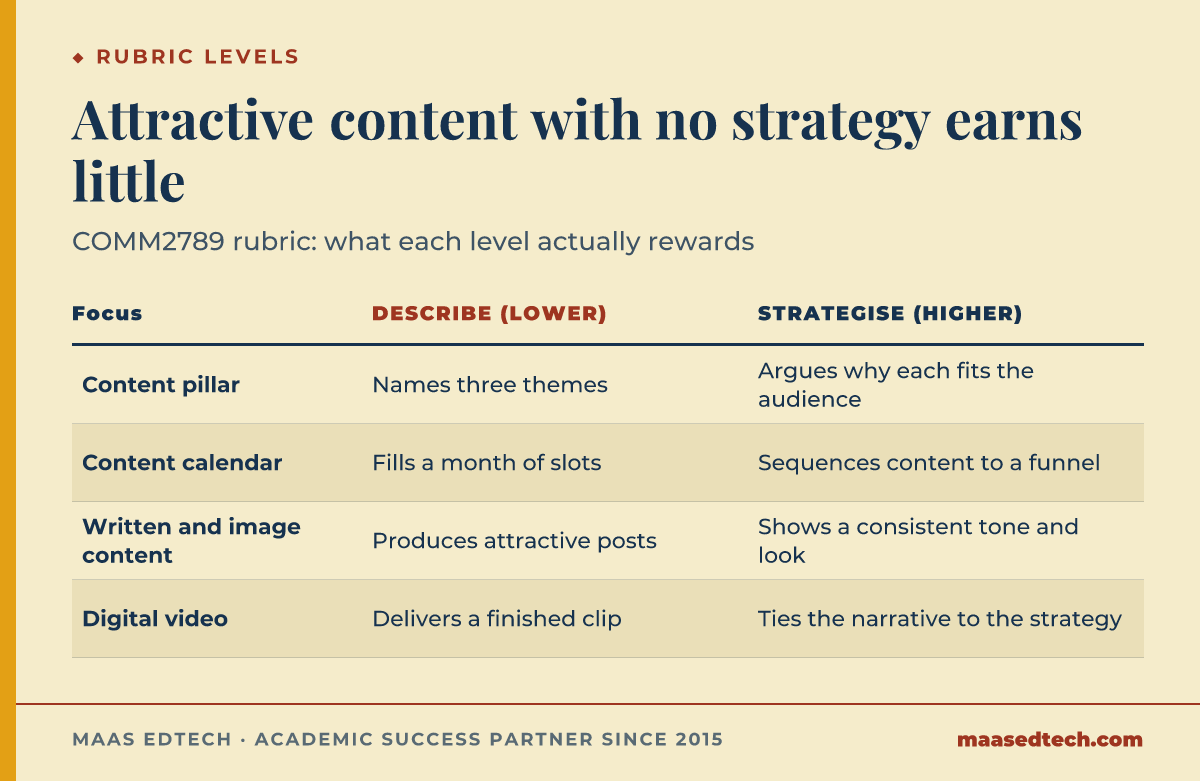
Evidence: RMIT business and communication rubrics use criterion bands (Pass / Credit / Distinction / High Distinction), and the higher bands are defined by evaluative language, "critically justifies", "aligns content to strategy", "evaluates effectiveness", the same engagement-first standard Ashley and Tuten (2015) apply when judging branded social content. Their study found that "several creative strategies were associated with customer engagement, specifically experiential, image, and exclusivity messages" (Ashley & Tuten, 2015). A student who lists content ideas without linking them to an objective or a metric cannot reach those bands, however skilled the design.
| Rubric focus | Describe (lower band) | Strategise and justify (higher band) |
|---|---|---|
| Content pillar | Names three themes | Argues why each theme fits the audience and the big idea |
| Content calendar | Fills a month of slots | Sequences content to a funnel and a measurable objective |
| Written and image content | Produces attractive posts | Shows consistent tone, look and feel aligned to the pillar |
| Digital video | Delivers a finished clip | Ties the narrative to the strategy and a target engagement outcome |
Example: A MAAS mentor colour-coded a student's calendar, green for a slot with a stated objective, red for a slot that was just "post something". The calendar was mostly red. After one pass that gave each slot an objective and an audience reason, the same content moved up two full bands.
Which frameworks and concepts should you use in COMM2789?
Direct answer: Anchor your work in a few established content concepts rather than improvising. The most useful for COMM2789 are: content pillars (a small set of recurring themes that express the brand's value to its audience, the term Pulizzi (2014) built an entire content marketing methodology around), the audience persona and its pain points, a content funnel (awareness, consideration, conversion) to sequence the calendar, tone of voice as a consistency device, and content KPIs (reach, engagement rate, saves, click-through) to define success. Choose the concepts that fit your simulated client's objective; do not list them all.
Evidence: These concepts are examiner-recognised because they force strategy, not decoration. A content pillar, for instance, is only useful when you can defend why that theme serves the audience, so the interesting work is the justification, not the label. Likewise a KPI matters only when it is chosen before the content, so it can actually judge it, which is exactly the discipline Hemann and Burbary (2018) apply to turning raw platform data into a decision.
Example: A Vietnamese RMIT student building a calendar for a coffee brand listed nine content ideas with no structure. Her MAAS mentor cut them to three pillars, each with an audience reason, and sequenced them across an awareness-to-conversion funnel. Fewer ideas, a defensible structure, a higher mark.
How should you structure the COMM2789 deliverables?
Direct answer: Treat the three tasks as one connected argument. In Task 1, state the client objective and audience, justify three content pillars, then lay them into a calendar sequenced to a funnel. In Task 2, produce written and image content that visibly executes those pillars, with a consistent tone of voice and the mandatory elements. In Task 3, build a video whose narrative extends the same strategy toward a stated engagement outcome. The single biggest fix is making the thread from strategy to execution explicit at every step.
Evidence: RMIT rewards "logical, well-supported reasoning", which a strategy-to-execution thread produces directly, the same integration Smith and Zook (2020) describe as the point of marketing communications planning in the first place. It also protects you against the most common COMM2789 failure: three good-looking pieces that a marker cannot connect, because the strategy that should link them was left implicit.
Example: A student's three deliverables were strong individually but read as three separate projects. His mentor kept the creative work untouched but added a short rationale to each, which pillar it executed and which objective it served. The content did not change; the coherence and the mark both jumped.
What are the most common mistakes Vietnamese students make in COMM2789?
Direct answer: The recurring mistakes are: designing attractive content with no stated objective; choosing content pillars that describe the brand rather than serve the audience; letting tone of voice and visual style drift between deliverables; ignoring the KPIs that would prove the content worked; and treating the video as a standalone creative piece disconnected from the calendar. Each of these loses marks even when the craft is strong.
Evidence: Because the subject is criterion-referenced and strategy-led, the marker penalises content that cannot be tied to an objective or an audience, and rewards the reasoning that connects a post to a purpose. A student who produces a beautiful video that serves no pillar has done the craft without earning the strategy marks.
Example: A Vietnamese student delivered a genuinely impressive video that had nothing to do with her content pillars. Her MAAS mentor did not restyle it; she asked one question, "which pillar does this video advance, and how would you measure that?", and let the student rework the framing herself. The fix stuck because she reasoned to it.
How can a MAAS mentor help you approach COMM2789 without crossing the line?
Direct answer: A MAAS mentor works alongside you, not instead of you. The mentor helps you decode the brief and rubric, pressure-tests your content pillars against the audience, reviews a draft calendar and points to where objectives are missing, and models how a strategist defends a creative choice. You keep authorship of every pillar, post, and frame; the mentor raises the ceiling of what you can justify on your own.
Evidence: Because COMM2789 is graded on justified strategy rather than surface polish, the durable gain comes from understanding content pillars, funnels, and KPIs well enough to reapply them in a capstone, an internship, or a job. Coaching that builds that reasoning is what moves marks and, more importantly, what survives into your portfolio.
Example: A Vietnamese RMIT student arrived able to design but unable to explain why any of it should exist. Over a few sessions her MAAS mentor had her state the objective and audience reason for each deliverable until the justification became automatic. She produced and submitted the assignment herself. The mark rose, and so did the strength of the work she could show an employer.
Frequently asked questions
Is COMM2789 hard for international students?
The craft is manageable; the difficulty is strategy. Many students produce attractive content but lose marks because it answers no objective and cannot be measured. Building the habit of stating an objective and an audience reason for each piece closes most of that gap.
What are content pillars in COMM2789?
Content pillars are a small set of recurring themes that express a brand's value to its audience and give a content calendar structure. A strong pillar is justified by an audience need, not just a topic the brand likes.
How do I make my three COMM2789 deliverables consistent?
Carry the same tone of voice, look and feel, and mandatory elements (tagline, hashtags) from the calendar through the written content to the video, and tie each back to the same pillars and objective. Consistency is an explicit rubric criterion.
Does MAAS write the COMM2789 assignment for me?
No. MAAS provides mentoring and review. A mentor helps you decode the rubric, sharpen your strategy, and strengthen your own drafts, but you remain the author of every pillar, post, and video you submit.
How do I choose KPIs for the content?
Pick metrics that match the objective before you create the content, reach and impressions for awareness, engagement rate and saves for consideration, click-through for conversion, so the metric can actually judge whether the content worked.
Can I use MAAS if I only need help with Task 1?
Yes. Many students book a short session to pressure-test their content pillars and calendar, then produce the written content and video on their own.
How MAAS mentors support COMM2789 students
If you are approaching the COMM2789 Digital Content Creation assignment and want a clearer path, MAAS offers a free 20-minute consultation to review your brief and map your approach. Bring your assignment brief and we will match you with a subject mentor within 48 hours when our network already covers that field. If it does not, MAAS opens a dedicated recruitment round for your case, which usually takes about 2 weeks. Around 23% of MAAS experts hold a PhD, and our communication mentors are experienced practitioners who work with you to raise what you can defend on your own, never to write the work for you.
Related reading: see our guides to COMM2694 Professional Communication Studio and MKTG1419 Social Media and Mobile Marketing, and our academic support service for how mentoring works end to end.
References
Ashley, C., & Tuten, T. (2015). Creative strategies in social media marketing: An exploratory study of branded social content and consumer engagement. Psychology & Marketing, 32(1), 15–27. https://doi.org/10.1002/mar.20761
Pulizzi, J. (2014). Epic content marketing: How to tell a different story, break through the clutter, and win more customers by marketing less. McGraw-Hill.
Smith, P. R., & Zook, Z. (2020). Marketing communications: Integrating online and offline, customer engagement and digital technologies (7th ed.). Kogan Page.
Tuten, T. L., & Solomon, M. R. (2018). Social media marketing (3rd ed.). Sage.
Hemann, C., & Burbary, K. (2018). Digital marketing analytics: Making sense of consumer data in a digital world (2nd ed.). Que Publishing.