
◆ Communication & PR
COMM2694 assignment: how to approach Professional Communication Studio?
COMM2694 Professional Communication Studio asks you to work like a practising communicator on a live brief, not to write a conventional academic essay. Most students who struggle with this RMIT course are capable writers who treat the Studio as a produce-the-deliverable task: they polish an artefact but never show the professional reasoning, iteration, and reflection the studio model is built to assess. This guide answers the seven questions Vietnamese students at RMIT ask MAAS mentors most often.

◆ Question 1 / 7 · The course
What is COMM2694 Professional Communication Studio about?
Direct answer: COMM2694 Professional Communication Studio is a project-based RMIT course where you respond to an industry brief, producing communication deliverables and justifying your choices. A "studio" course borrows its method from design education: you work iteratively, prototype, and treat each draft as a step in a process. The course assesses how you practise communication, not just whether your document reads well.
Evidence: Studio pedagogy is grounded in the experiential learning tradition, Kolb's (2015) cycle of concrete experience, reflection, conceptualisation, and active experimentation and in Schön's (1983) idea of the "reflective practitioner" who thinks in action while working. RMIT communication studios apply these ideas directly: the brief is the concrete experience, the critiques are the reflection, and your rationale is where you conceptualise what you did and why.
Example: A Vietnamese student at RMIT came to MAAS believing the COMM2694 task was "make a campaign deck that looks professional." Her mentor reframed it: the studio was really assessing whether she could read a client problem, choose a strategy, test it through iteration, and defend it. Once she stopped treating the deck as the assignment and started treating it as evidence of a process, her rationale and her grade, moved from a Pass toward a Distinction.
◆ Question 2 / 7 · Assessments
What assessments does the COMM2694 assignment usually involve?
Direct answer: Studio courses at this level are typically assessed through a staged project portfolio rather than a single essay. A common pattern is an early brief-analysis or audience-research task, a major piece of professional communication output (a strategy, campaign, pitch, or client deliverable), an in-progress critique or studio presentation, and a reflective component that explains your process and decisions. Always confirm the exact components and weighting in your own Canvas shell, because the brief, the client scenario, and the deliverable change every semester.
Evidence: RMIT assessment is criterion-referenced, your work is marked against published rubric criteria, not ranked against classmates (RMIT University, n.d.). RMIT's own student guidance explains why the rubric exists at all: it says rubrics "provide a clear set of goalposts for students and ensure assignments are marked consistently and fairly" (RMIT University, n.d.). In a studio, that means a visually polished artefact with no documented process can score below a plainer one that clearly shows research, iteration, and a defensible strategy.
Example: A Vietnamese RMIT student spent almost all of his time perfecting the visual design of his deliverable and wrote his reflection the night before submission. His MAAS mentor flagged that the reflective and rationale components usually carry a large share of the analytical marks. Reallocating effort to the reasoning, with the same artefact, lifted his result by a full band.
◆ Question 3 / 7 · Grading
How is the COMM2694 assignment graded, what does the rubric reward?
Direct answer: Professional communication studio rubrics reward four things, roughly in this order: (1) strategic fit, does your deliverable solve the brief's actual communication problem for its audience; (2) professional craft, is the artefact at industry standard for its genre; (3) evidence of process, research, iteration, and response to critique; and (4) critical reflection and correct referencing. The deliverable is the visible output, but the marks live in the reasoning that connects the brief, the audience, the strategy, and the result.
Evidence: RMIT communication rubrics use criterion bands (Pass / Credit / Distinction / High Distinction), and the jump from Credit to Distinction is almost always defined by the word "critical", critical analysis of the brief, critical application of theory, and critical reflection on your own practice, rather than by adding more polish (Cornelissen, 2023).
Example: A MAAS mentor asked one Vietnamese student to label each slide of her studio deck as either "shows what I made" or "shows why it works for this audience." Roughly 80% was "what I made." After one restructuring pass that rebalanced the deck toward strategic justification, the same campaign idea moved up two rubric bands.
◆ Question 4 / 7 · Studio process
How do you approach the COMM2694 client brief, what does the studio process look like?
Direct answer: Treat the brief as a professional problem, not a prompt. Work through it in stages: decode what the client actually needs, research the audience and context, set a measurable communication objective, generate and prototype options, test them against the objective, refine after critique, and finalise the deliverable with a rationale. Document each stage, that documentation is a graded part of the studio.
Evidence: This iterative loop mirrors the design-thinking process popularised by Brown and Katz (2019): understand, ideate, prototype, test, refine. In a communication studio, the same loop produces both a stronger artefact and the process evidence the rubric demands.
The table below maps each studio stage to what assessors reward and the common slip at each stage.
| Studio stage | What it produces | What the rubric rewards | Common slip |
|---|---|---|---|
| Decode the brief | Problem statement + scope | Reading the real communication need, not the surface task | Restating the brief instead of interpreting it |
| Research audience & context | Audience insight, situational analysis | Evidence-based audience targeting | Generic "the public" with no segmentation |
| Set the objective | One measurable communication goal | A goal you can later evaluate against | Vague aims like "raise awareness" |
| Prototype options | Drafts, concepts, mock deliverables | Range of thinking, not one safe idea | Committing to the first idea |
| Critique & iterate | Revised drafts + notes on changes | Visible response to feedback | Ignoring critique; no record of changes |
| Finalise + rationale | Polished deliverable + justification | Strategy-to-output coherence | A great artefact with no "why" |
Example: A Vietnamese student treated the brief as "design a poster series." His mentor walked him back to the decode stage, where the real client problem turned out to be low event attendance among a specific student segment. That reframing changed the deliverable and gave him a measurable objective to reflect against.
◆ Question 5 / 7 · Frameworks
Which frameworks and theories should you use in COMM2694?
Direct answer: Choose two or three frameworks and apply them deeply rather than name-dropping many. For strategy, use a recognised planning model such as the RACE/ROSTIR approach or Silverman and Smith's (2024) strategic planning steps. For audience and channel choice, the PESO model (paid, earned, shared, owned media) helps you justify where your message lives. For evaluation, draw on Macnamara's (2018) work on measuring communication outcomes. For the reflective layer, use Schön (1983) or a structured model like Gibbs (1988).
Evidence: RMIT communication assessments reward explicit, applied theory: the rubric jump to Distinction is defined by critical application, which means using a framework to make and defend a decision, not merely describing the framework (Cornelissen, 2023). A strategy planned through ROSTIR and a channel mix justified through PESO give markers a visible chain of reasoning from objective to output.
Example: A Vietnamese MAAS student had listed five theories in her introduction and used none of them in her decisions. Her mentor cut the list to two, a planning model and PESO and asked her to cite each one at the exact point a choice was made. The deck became shorter, the reasoning became visible, and the strategic-fit criterion lifted a full band.
◆ Question 6 / 7 · Reflection
How do you write the reflective component in COMM2694?
Direct answer: Write the reflection as evidence of professional learning, not a diary. Pick a structured model, walk through a specific moment in your studio process, and end with what you would do differently and why. Reflection that names a concrete decision, evaluates it against your objective, and links it to theory scores far higher than a general "I learned a lot."
Three reflective models for the COMM2694 reflective component
Each row sets one reflective model beside what the post says it is best for and its core moves, taken from the table in this post.
Reflective model
Best for, and core moves
Gibbs (1988) reflective cycle
Best for reflecting on one critique or event in detail. Its core moves are description → feelings → evaluation → analysis → conclusion → action plan.
Kolb (2015) experiential cycle
Best for linking a studio experience to a concept and a next experiment. Its core moves are experience → reflection → conceptualisation → experimentation.
Schön (1983) reflective practitioner
Best for showing in-the-moment professional judgement. Its core moves are reflection-in-action and reflection-on-action.
Save this figure
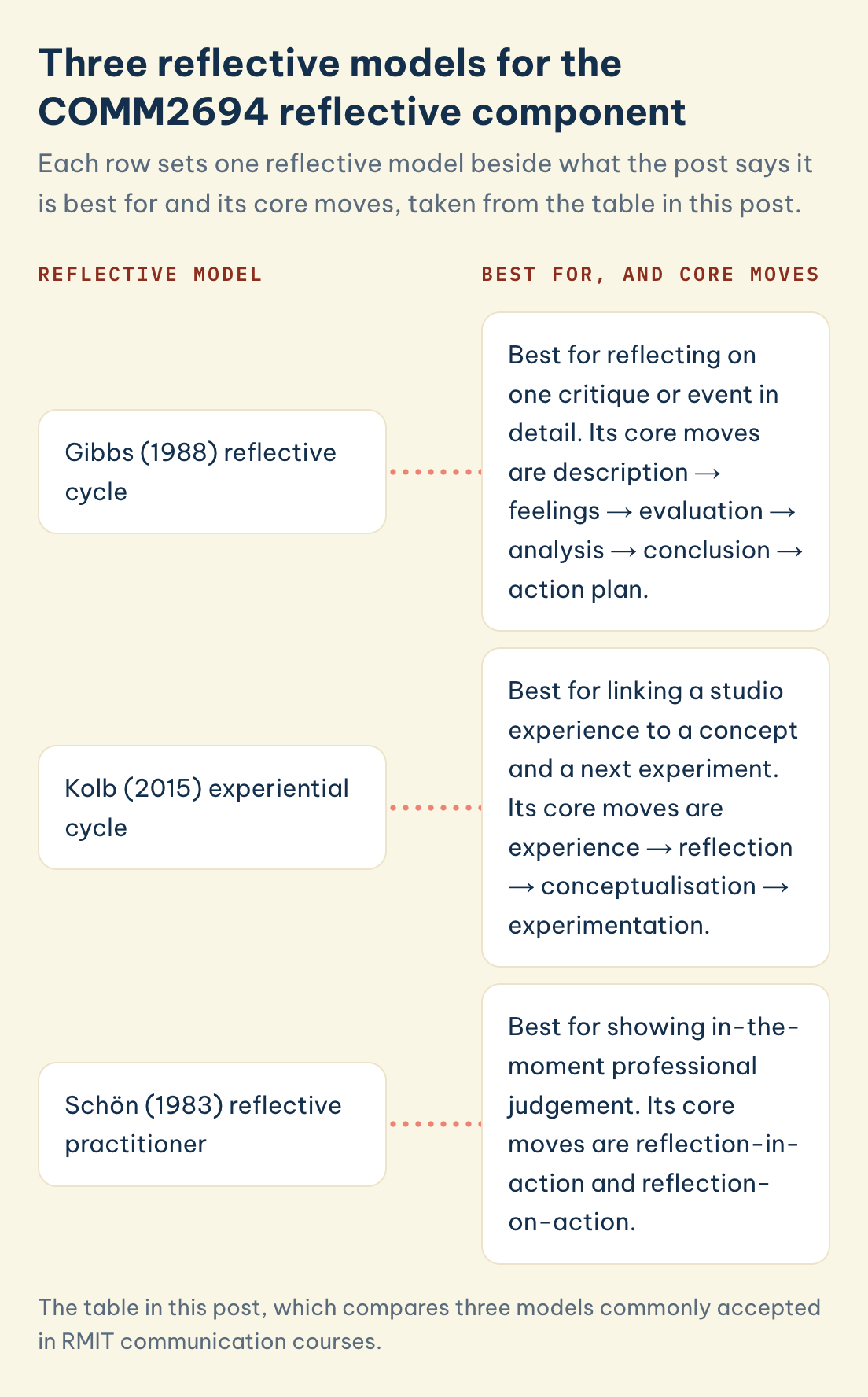
Evidence: Structured reflective models give markers the analytical depth they reward. The table below compares three models commonly accepted in RMIT communication courses so you can choose the one that fits your evidence.
| Reflective model | Best for | Core moves |
|---|---|---|
| Gibbs (1988) reflective cycle | Reflecting on one critique or event in detail | Description → feelings → evaluation → analysis → conclusion → action plan |
| Kolb (2015) experiential cycle | Linking a studio experience to a concept and a next experiment | Experience → reflection → conceptualisation → experimentation |
| Schön (1983) reflective practitioner | Showing in-the-moment professional judgement | Reflection-in-action and reflection-on-action |
Example: A Vietnamese student's first reflection was a timeline of what he did each week. His MAAS mentor had him rewrite it through the Gibbs (1988) cycle around a single critique session, the moment a tutor questioned his channel choice. The rewrite traced his reasoning, the change he made, and the theory behind it, and it read as professional learning rather than a log.
◆ Question 7 / 7 · Common mistakes
What mistakes do Vietnamese students most often make in COMM2694?
Direct answer: The four recurring mistakes are: treating the deliverable as the whole assignment and under-investing in process and reflection; targeting a vague audience instead of a defined segment; listing theory in the introduction but not using it to make decisions; and leaving the reflection until last so it reads as a summary rather than analysis. Each one is a strategy-and-reasoning gap, not a language gap and each is fixable before submission.
Evidence: Because RMIT marking is criterion-referenced (RMIT University, n.d.), these gaps cost marks even when the English is strong: the rubric awards strategic fit, process evidence, and critical reflection, none of which improve by polishing prose alone.
Example: Across several COMM2694 engagements, MAAS mentors found the highest-leverage fix was rebalancing time away from final polish and toward audience definition and reflection, a shift that consistently moved students up at least one band without changing their core idea.
Frequently asked questions
Is COMM2694 a hard course?
It is process-heavy rather than technically hard. The writing volume is moderate, but the studio expects you to document research, iteration, and reflection, students who treat it as "make one polished deliverable" tend to underperform those who treat it as a professional process with evidence attached.
What is the difference between COMM2694 and COMM2773?
They are the same Professional Communication Studio course on different RMIT campuses, COMM2694 at RMIT Vietnam, COMM2773 at Melbourne. The brief varies by semester, so always work from your own Canvas shell.
How much does the reflection count in COMM2694?
Weighting changes each semester, but the reflective and rationale components usually carry a significant share of the analytical marks. Treat the reflection as a graded deliverable in its own right, not an afterthought.
Which referencing style does COMM2694 use?
RMIT Harvard is the default for communication courses. Confirm in your own brief and use RMIT's Easy Cite tool to keep your in-text citations and reference list consistent.
How many frameworks should I apply in COMM2694?
Two or three, applied deeply. A planning model plus the PESO model is usually enough to justify a strategy and a channel mix; depth of application beats breadth of name-dropping.
Can MAAS help me with COMM2694?
Yes. MAAS Assignment & Essay Support coaches you through the assignment with the Outline, Draft, Final model, brief decoding, audience strategy, draft critique, reflection coaching, and a pre-submission referencing audit with PhD-level mentors. We coach your work; we do not write it for you.
Ready to approach COMM2694 like a professional communicator?
If you can produce a clean deliverable but are not yet sure how to show the strategy and reflection behind it, that is exactly where a discipline-matched expert helps most. MAAS Assignment & Essay Support is an academic support partner; we work alongside you through Outline, Draft, Final so the creative idea and the artefact stay yours while the professional reasoning earns the marks.
Bring your COMM2694 brief and we will match you to a professional communication mentor, 23% of our 100+ experts hold a PhD, within 48 hours when our network already covers that field, or in about two weeks if MAAS has to recruit for it, after a free 20-minute consultation.
Book a free 20-minute COMM2694 consultation with MAAS Assignment & Essay Support →
Related guides
- COMM2829 assignment: how do you approach Genre and Historical Movements?: sibling RMIT screen-studies guide on analysing film genres and historical movements
- How do you approach the COMM2921 Contemporary Media Relations assignment?: sibling RMIT PR course guide on earning media coverage and pitching journalists
- How do you approach the COMM2920 Advocacy and Voice in Public Relations assignment?: sibling RMIT PR course guide on advocacy campaign strategy
- How do you approach the MKTG1419 Social Media and Mobile Marketing assignment?: sibling RMIT communication course guide on planning audience-led campaigns
- How do you approach the BUSM2412 Marketing for Managers assignment?: for the strategy-and-audience half of any campaign brief
- How to write a reflection essay: for the reflective component of any studio course
- MAAS Academic Mentoring service: 1:1 coaching with PhD-level mentors in your discipline
- Tutoring service: 1:1 subject tutoring in 60- or 90-minute sessions with an expert matched on your course code, always inside your discipline
- Presentation & design support: slide decks, speaker scripts, and academic posters coached from outline to final
- Course-code assignment coaching: pillar guide on tackling any unit assignment with a MAAS mentor
References
- Brown, T., & Katz, B. (2019). Change by design: How design thinking transforms organizations and inspires innovation (Rev. ed.). Harper Business.
- Cornelissen, J. P. (2023). Corporate communication: A guide to theory and practice (7th ed.). SAGE.
- Gibbs, G. (1988). Learning by doing: A guide to teaching and learning methods. Further Education Unit.
- Kolb, D. A. (2015). Experiential learning: Experience as the source of learning and development (2nd ed.). Pearson FT Press.
- Macnamara, J. (2018). Evaluating public communication: Exploring new models, standards, and best practice. Routledge.
- RMIT University. (n.d.). Assessment and exams. Retrieved June 24, 2026, from https://www.rmit.edu.au/students/student-essentials/assessment-and-exams
- Schön, D. A. (1983). The reflective practitioner: How professionals think in action. Basic Books.
- Silverman, D. A., & Smith, R. D. (2024). Strategic planning for public relations (7th ed.). Routledge.
Tools & resources
- RMIT University. (n.d.). Easy Cite referencing tool. Retrieved June 24, 2026, from https://www.rmit.edu.au/library/study/referencing
This article is part of the MAAS Journal series for Vietnamese international students. MAAS Assignment & Essay Support is an academic support partner; we coach students through the Outline, Draft, Final delivery model with developmental feedback from discipline-matched experts. We do not write or submit work on a student's behalf.
A free 20-minute consultation is a conversation about where you are with COMM2694.
Book a free consultation ▸