
◆ Communication & PR
COMM2829 assignment: how do you approach Genre and Historical Movements?
COMM2829 Genre and Historical Movements asks you to analyse how film genres evolve, the rubric rewards critical argument over plot summary. Most students who struggle with this RMIT screen-studies course are not short on films watched; they describe what happens on screen but never argue why a genre or movement looks the way it does under particular industrial and historical conditions. This guide answers the seven questions Vietnamese students at RMIT ask MAAS mentors most often before they start COMM2829.

◆ Question 1 / 7 · The course
What is COMM2829 Genre and Historical Movements about?
Direct answer: COMM2829 is an RMIT screen and media studies course examining how film and screen genres form, harden into conventions, and change across time, and how historical movements emerge from technological, industrial, and cultural conditions. It treats genre as a dynamic, contested system, not a fixed list of features. You analyse texts to argue about meaning and context, not recap plots.
Evidence: Genre study in film scholarship has long rejected the idea that a genre is simply a checklist of motifs. Altman (1999) describes genres as the product of an ongoing negotiation between studios, critics, and audiences, while Neale (2000) frames genre as a process of "repetition and difference" rather than a static category, both ideas sit at the centre of how a course like COMM2829 expects you to think, and both are anthologised alongside the field's other foundational essays in Grant's (2012) genre-theory reader. Film scholarship pushes this further for the historical side of the course too: Sinnerbrink (2016) argues that a genre's historical setting is not just backdrop but an intrinsic, sometimes stylised feature of the cinematic world a genre builds, noting that "in many cases, historical setting is intrinsic to the genre, or at least a variable that needs to be present even if it can be manipulated or adapted in various ways" (Sinnerbrink, 2016), which is why COMM2829 expects you to analyse the mood a movement constructs, not just the period it depicts.
Example: A Vietnamese RMIT student came to MAAS sure that COMM2829 was "just watching films and naming the genre". Her mentor reframed the unit: the question is never which genre a film belongs to, but what work the genre does and how the movement around it shaped the film. Once she analysed each text as evidence for an argument about historical context, her draft stopped summarising scenes and started building a thesis and her mark moved from a Pass-level draft toward a Distinction.
◆ Question 2 / 7 · Assessment
What assessment does the COMM2829 assignment usually involve?
Direct answer: Screen-studies courses of this type are typically assessed through a sequence of tasks rather than one essay: a shorter individual textual analysis early on, a larger individual research-led report or essay as the main piece, and a group presentation. A common pattern is an analysis task worth around a quarter of the mark, a major report worth around half, and a group presentation worth the remaining quarter. Always confirm the exact tasks, weightings, and brief in your own Canvas shell, because the structure changes by semester and teaching team.
Evidence: RMIT assessments are criterion-referenced, meaning each task is marked against published criteria rather than ranked against classmates. This is set out in RMIT's assessment policy, which is why decoding the criteria of each separate task (next section) matters more than producing a single polished artefact.
Example: A Vietnamese RMIT student treated the major COMM2829 report as a long plot description of three films in one movement. His MAAS mentor cut the description to roughly 15% of the word count and reallocated the rest to a comparative argument about how the movement's production conditions explained the films' shared style. Same three films, same word count, the analysis-led version earned a clear Distinction.
◆ Question 3 / 7 · Grading
How is the COMM2829 assignment graded, what does the rubric actually reward?
Direct answer: Screen-studies rubrics at this level reward four things, roughly in this order: (1) depth of critical analysis and the strength of your central argument, (2) correct and explicit use of genre theory and film-history concepts, (3) close textual evidence drawn from specific scenes, sequences, or stylistic choices, and (4) academic writing and consistent referencing.
How Pass-level and Distinction-level COMM2829 work differ on five rubric criteria
Each row sets one rubric criterion beside what Pass-level work does and what Distinction-level work does, taken from the table in this post.
Rubric criterion
What Pass-level work does and what Distinction-level work does
Argument
Pass-level work names a genre or movement. Distinction-level work argues what the genre/movement does and why.
Use of theory
Pass-level work mentions a theorist's name. Distinction-level work uses the concept to reach a judgement about a film.
Textual evidence
Pass-level work summarises the plot. Distinction-level work analyses specific scenes, framing, editing, or sound.
Historical context
Pass-level work states the period. Distinction-level work links style to industrial, technological, cultural conditions.
Referencing
Pass-level work has inconsistent citations. Distinction-level work is accurate and consistent in-text and in the reference list.
Save this figure
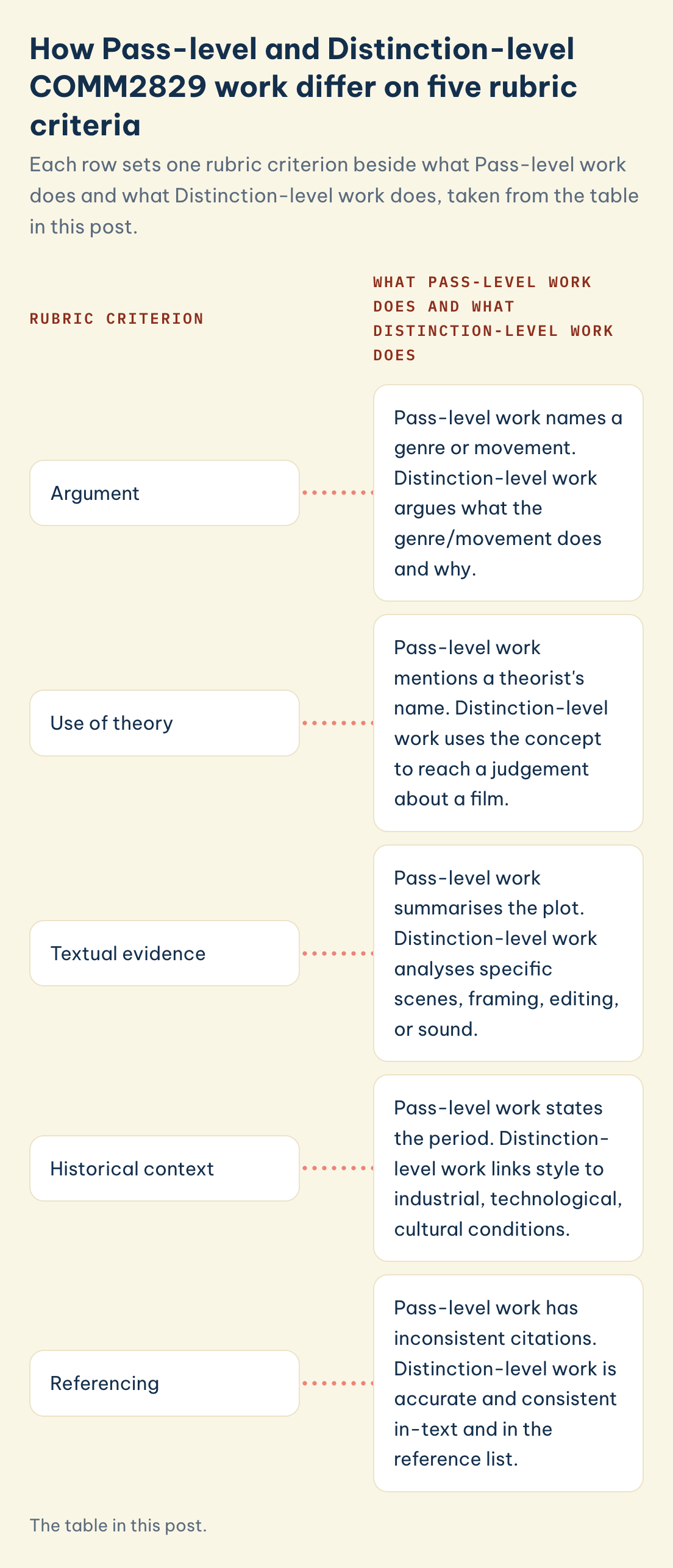
Recapping a plot earns almost no marks on its own, the marks live in why a film works the way it does and what it means in its historical moment. If you can replace a descriptive sentence with an analytical one, do it every time.
Evidence: RMIT rubrics use criterion bands (Pass / Credit / Distinction / High Distinction). Across screen-studies marking, the jump from Credit to Distinction is almost always defined by the word "critical", critical analysis, critical use of theory, critical judgement, not by describing more films or adding more scenes.
| Rubric criterion | Pass-level work | Distinction-level work |
|---|---|---|
| Argument | Names a genre or movement | Argues what the genre/movement does and why |
| Use of theory | Mentions a theorist's name | Uses the concept to reach a judgement about a film |
| Textual evidence | Summarises the plot | Analyses specific scenes, framing, editing, or sound |
| Historical context | States the period | Links style to industrial, technological, cultural conditions |
| Referencing | Inconsistent citations | Accurate, consistent in-text and reference list |
Example: A MAAS mentor mapped one Vietnamese student's draft sentence by sentence and colour-coded each as "describe" or "analyse". The draft was roughly 75% describe. After a single restructuring pass that flipped the ratio toward analysis, the same films and the same evidence moved the mark up two full bands.
◆ Question 4 / 7 · Theories
Which genre theories and frameworks should you use in COMM2829?
Direct answer: Anchor your analysis in two or three established frameworks rather than name-dropping many. The most useful for COMM2829 are: Altman's semantic/syntactic (and later pragmatic) approach, which separates a genre's recurring elements from the structures that organise them; Neale's idea of genre as process built on repetition and difference; and Schatz's account of how a genre evolves through a life cycle from experimental to self-reflexive. For the movements half of the course, pair these with film-history concepts such as mode of production, national cinema, and the relationship between style and industrial context. Choose frameworks that fit the films you are actually analysing, do not force all of them in.
| Framework | What it helps you argue | Best used for |
|---|---|---|
| Altman, semantic/syntactic/pragmatic | How recurring elements vs deep structures define a genre | Defining and complicating a genre |
| Neale, repetition and difference | Why genres change while staying recognisable | Tracking genre evolution over time |
| Schatz, genre life cycle | How a genre moves from experimental to self-reflexive | Situating a film within a genre's history |
| Mode of production / national cinema | How industry and context shape film style | Explaining a historical movement |
Evidence: Altman (1999) formalised the semantic/syntactic model that still underpins genre definition; Neale (2000) established the "repetition and difference" logic for genre as process; Schatz (1981) mapped the evolutionary cycle that helps locate a film within a genre's development. These are foundational, examiner-recognised sources, not blog-level references and using them to reach a judgement, rather than to label a film, is what lifts a grade. Turning that judgement into close textual evidence still relies on standard film-form vocabulary, framing, editing, sound, mise-en-scène, drawn from a text such as Bordwell, Thompson and Smith (2019).
Example: A Vietnamese RMIT student analysing the western tried to apply five theorists and explained each shallowly. Her MAAS mentor cut it to two, Altman to show how the genre's semantic elements were reorganised by a later film, and Schatz to argue the film sat in the genre's self-reflexive late phase. Fewer frameworks, deeper application, higher mark.
◆ Question 5 / 7 · Report structure
How should you structure the COMM2829 analysis or report?
Direct answer: Use an argument-led structure: (1) a short introduction that states your thesis and names the genre or movement and the films you will analyse, (2) a concise framing of the theory and historical context (keep description under about 15% of the word count), (3) the body, organised by analytical point rather than by film, where each paragraph uses textual evidence to advance the argument, (4) a synthesis that draws the comparison together, and (5) a conclusion that returns to the thesis. The single biggest structural fix is organising the body around ideas, not walking through one film, then the next and shrinking the summary sections where marks are thin.
Evidence: Criterion-referenced rubrics weight "analysis and use of theory" and "argument and evidence" far above "context and background". Structuring your word budget and your paragraph logic to match the rubric weighting is the most reliable way to lift a grade without watching more films.
Example: A Vietnamese student submitted a COMM2829 draft built as three film-by-film summaries with a short comparison bolted on the end. His MAAS mentor reorganised it around three analytical claims, each supported by evidence from all three films. Same films, same sources, the idea-led version moved from a borderline Credit to a Distinction because the argument was finally visible from start to finish.
◆ Question 6 / 7 · Common mistakes
What are the most common mistakes that lose marks in COMM2829?
Direct answer: Three recurring mistakes show up across MAAS screen-studies coaching. First, students describe instead of analyse, plot summary crowds out the argument. Second, students use theory as a label rather than a tool; they name Altman or Schatz but never use the concept to reach a judgement about a film. Third, students treat genre as a fixed checklist and ignore the historical movement, so they miss the industrial and cultural conditions that the course is actually testing. Fixing these three lifts most drafts by at least one rubric band.
Evidence: Across MAAS screen-studies coaching, marker feedback before intervention clusters heavily on "more critical analysis needed" and "engage more closely with the films and the theory", the phrases that most often separate a Credit from a Distinction in RMIT rubrics.
Example: A Vietnamese student wrote that a film "is a horror film because it has a monster and dark lighting". His MAAS mentor pushed him to specify: which scene, which stylistic choice (low-key lighting in a particular sequence), which concept (how the genre's syntactic structure organised the audience's fear), and what it meant in the film's production context. The specific, analysed version earned full marks on the analysis criterion.
◆ Question 7 / 7 · Referencing
What referencing style and word count does COMM2829 use?
Direct answer: Confirm the exact word count and style in your assessment brief, screen-studies essays and reports at this level commonly sit between 1,500 and 2,500 words per task and use a referencing style your teaching team specifies, frequently RMIT Harvard for communication courses.
Stay within the 10% tolerance band, cite every theoretical claim and every film, and make sure your reference list and in-text citations match exactly, including correct formatting for films and audiovisual sources. Reference accuracy is a quick, reliable source of marks that many students leave on the table.
Evidence: RMIT's communication programs use RMIT Harvard as a common referencing style, documented in RMIT's Easy Cite referencing tool, which also shows how to cite films, television, and other audiovisual material. Markers routinely deduct marks for inconsistent referencing, especially mishandled film citations, even when the analysis is strong.
Example: A Vietnamese RMIT student lost several marks across two tasks for mismatched in-text citations and incorrectly formatted film references. A MAAS pre-submission audit caught the errors in an hour. On her next COMM2829 task, clean referencing recovered the marks she had previously been losing on a criterion that requires no extra analysis at all.
Frequently asked questions
Is COMM2829 a hard course?
It is conceptually demanding rather than technically hard; there is no production work, but the course expects critical, theory-led analysis instead of plot recall. Students who treat it as "describe films and name the genre" struggle; students who treat it as "argue what a genre and movement mean" do well.
Do I need to watch films outside the set list?
Focus first on the prescribed films and screenings, because the rubric rewards close analysis of texts the teaching team knows well. Bring in extra films only when they strengthen a comparison, depth of analysis beats breadth of viewing.
How many genre theories should I use in the assignment?
Two or three, applied deeply, beats five applied shallowly. Examiners reward critical application, using a concept to reach a judgement, not the number of theorists you can name.
How do I write about a historical movement without just listing facts?
Link style to conditions. Instead of stating when a movement happened, argue how its industrial, technological, or cultural context produced its recurring stylistic choices, and support that with evidence from specific films.
What referencing style does COMM2829 use?
RMIT Harvard is common for communication courses, but always confirm in your own brief, and use RMIT's Easy Cite tool to format film and audiovisual citations correctly.
Can MAAS help me with COMM2829?
Yes. MAAS Assignment & Essay Support coaches you through the assignment with the Outline, Draft, Final model, decoding each task's criteria, choosing genre frameworks, sharpening your argument, giving draft feedback, and running a pre-submission referencing audit, all with discipline-matched experts. We coach your work; we do not write it for you.
Ready to approach COMM2829 with a clear argument?
If you have the films but not the thesis, that is exactly where a discipline-matched expert helps most. MAAS Assignment & Essay Support is an academic support partner; we work alongside you through Outline, Draft, Final so the analysis stays yours and the structure earns the marks.
Bring your COMM2829 brief and we will match you to a screen and media studies mentor, 23% of our 100+ experts hold a PhD, within 48 hours when our network already covers that field. If it does not, MAAS opens a dedicated recruitment round for your case, which usually takes about two weeks.
Book a free 20-minute COMM2829 consultation with MAAS Assignment & Essay Support →
Related guides
- How to approach the COMM2694 Professional Communication Studio assignment?: sibling RMIT communication course guide on the studio brief and reflective practice
- How do you approach the COMM2920 Advocacy and Voice in Public Relations assignment?: sibling RMIT communication course guide on advocacy campaign strategy
- How do you approach the COMM2921 Contemporary Media Relations assignment?: sibling RMIT communication course guide on earning media coverage and pitching journalists
- How do you approach the MKTG1419 Social Media and Mobile Marketing assignment?: sibling RMIT communication course guide on planning audience-led campaigns
- How to write a theoretical framework: for applying genre and film theory with academic depth
- How to write a reflection essay: useful if COMM2829 includes a reflective component
- MAAS Academic Mentoring service: 1:1 coaching with PhD-level mentors in your discipline
- Tutoring service: 1:1 subject tutoring in 60- or 90-minute sessions with an expert matched on your course code, always inside your discipline
- Course-code assignment coaching: pillar guide on tackling any unit assignment with a MAAS mentor
References
- Altman, R. (1999). Film/genre. British Film Institute.
- Bordwell, D., Thompson, K., & Smith, J. (2019). Film art: An introduction (12th ed.). McGraw-Hill Education.
- Grant, B. K. (Ed.). (2012). Film genre reader IV. University of Texas Press.
- Neale, S. (2000). Genre and Hollywood. Routledge.
- Schatz, T. (1981). Hollywood genres: Formulas, filmmaking, and the studio system. Random House.
- Sinnerbrink, R. (2016). Historical moods in film. Screening the Past, (41). https://www.screeningthepast.com/issue-41-dossier/historical-moods-in-film/
Tools & resources
- RMIT University. (n.d.). Assessment and exams. Retrieved June 26, 2026, from https://www.rmit.edu.au/students/student-essentials/assessment-and-exams
- RMIT University. (n.d.). Easy Cite referencing tool. Retrieved June 26, 2026, from https://www.rmit.edu.au/library/study/referencing
This article is part of the MAAS Journal series for Vietnamese international students. MAAS Assignment & Essay Support is an academic support partner; we coach students through the Outline, Draft, Final delivery model with developmental feedback from discipline-matched experts. We do not write or submit work on a student's behalf.
A free 20-minute consultation is a conversation about where you are with COMM2829.
Book a free consultation ▸