
COMM2920 Advocacy and Voice in Public Relations asks you to build a campaign that moves a real audience to act on an issue, not just to inform them. Most students who struggle with this RMIT course are strong writers who treat advocacy as awareness-raising: they explain a problem clearly but never design the strategic chain that turns attention into policy or behaviour change. This guide answers the seven questions Vietnamese students at RMIT ask MAAS mentors most often.
Author: MAAS Editorial Team · Reviewed by a MAAS subject mentor
Last updated: 2026-07-05
Category: communication-pr

What is COMM2920 Advocacy and Voice in Public Relations about?
Direct answer: COMM2920 is an RMIT communication course examining how public relations practitioners give voice to causes, communities, and organisations to influence public policy, corporate behaviour, or social attitudes. It treats advocacy as strategic, evidence-based communication: analysing an issue, mapping the system sustaining it, and designing campaign content that drives defined change. The course wants a campaign strategist, not a content writer.
Evidence: Advocacy PR sits on a well-established body of theory: Ronald D. Smith's strategic planning model, Mitchell, Agle and Wood's stakeholder salience framework, and the Theory of Change methodology used across the non-profit and policy sector. RMIT communication courses are built around applying these frameworks to a live issue, which is why assessments reward strategy and justification over polished prose alone.
Example: A Vietnamese student at RMIT came to MAAS with a campaign brief on plastic waste, convinced the task was "write a strong press release." Her MAAS mentor reframed it: the assessment was really asking who needs to act, what would move them, and why her chosen channel would reach them. Once she designed backwards from the policy outcome, her press release stopped being a generic announcement and became a targeted advocacy tool and her draft moved from a Pass to a Distinction.
What assessments does the COMM2920 assignment usually involve?
Direct answer: Advocacy PR courses at this level are typically assessed through a staged campaign portfolio rather than a single essay. A common pattern is an early environmental-scanning or stakeholder-analysis task, followed by a campaign-content piece, often a press release, a media pitch email, a Theory of Change or system map, and a short reflective or explanatory script that justifies your strategic choices. Always confirm the exact components and weighting in your own Canvas shell, because the brief changes by semester and campaign theme.
Evidence: RMIT communication assessments are criterion-referenced: marks are awarded against published rubric criteria, not ranked against classmates. This is set out in RMIT's Assessment policy, and it means that a beautifully written press release with no visible strategy can still score below a plainer one that clearly serves a mapped advocacy goal.
Example: A Vietnamese RMIT student spent most of his word count perfecting the wording of a press release and barely sketched the explanatory script. His MAAS mentor flagged that the script, where you prove why your content works, usually carries the analytical marks. Reallocating effort to the justification, with the same campaign idea, lifted his result by a full band.
How is the COMM2920 assignment graded, what does the rubric reward?
Direct answer: Advocacy PR rubrics at this level reward four things, roughly in this order: (1) strategic coherence, does every piece of content serve a clearly defined advocacy goal; (2) correct, explicit use of communication and advocacy theory; (3) audience and stakeholder insight, have you targeted the people who can actually create change; and (4) professional execution and Harvard referencing.
Producing campaign assets is the easy part; the marks live in the reasoning that connects them. If you can replace a "what I made" sentence with a "why it works" sentence, do it every time.
Evidence: RMIT communication rubrics use criterion bands (Pass / Credit / Distinction / High Distinction), and the jump from Credit to Distinction is almost always defined by the word "critical", critical analysis of the issue, critical application of theory, critical justification of strategy, rather than by adding more content.
Example: A MAAS mentor colour-coded one Vietnamese student's draft sentence by sentence as either "describe the campaign" or "justify the strategy." The draft was 75% describe. After one restructuring pass that flipped the ratio, the same campaign and the same assets moved up two rubric bands.
Which frameworks should you use in COMM2920?
Direct answer: Anchor your campaign in two or three established frameworks rather than name-dropping many. The most useful for COMM2920 are stakeholder salience (to decide whose voice to amplify and whom to influence), Theory of Change (to map how your actions lead to the outcome), and a strategic PR planning model such as Smith's RACE/ROPE-style process (to keep research, objectives, strategy, and evaluation aligned). Choose frameworks that fit your actual issue, do not force all of them in.
| Framework | What it does | Use it for |
|---|---|---|
| Stakeholder salience (Mitchell, Agle & Wood, 1997) | Ranks stakeholders by power, legitimacy, and urgency | Deciding which audience your press release and pitch must reach |
| Theory of Change | Maps the causal chain from activities to the desired outcome | Showing how your campaign content produces policy or behaviour change |
| System mapping | Visualises the actors and feedback loops sustaining the problem | Diagnosing root causes so your "advocacy ask" targets the right lever |
| Strategic PR planning (Smith) | Structures research → objectives → strategy → tactics → evaluation | Keeping every campaign asset tied to a measurable objective |
Evidence: Mitchell, Agle and Wood (1997) introduced the power–legitimacy–urgency model that still underpins stakeholder prioritisation; the Theory of Change methodology was formalised by ActKnowledge and the Center for Theory of Change for exactly this kind of outcome-led campaign design, defined as "a comprehensive description and illustration of how and why a desired change is expected to happen in a particular context" (Center for Theory of Change, n.d.); and Smith's (2020) Strategic Planning for Public Relations is a standard text for structuring PR campaigns. These are examiner-recognised sources, not blog-level references.
Example: A Vietnamese RMIT student tried to apply five models to a climate-communication campaign and explained each shallowly. Her MAAS mentor cut it to two, stakeholder salience to justify targeting a specific decision-maker, and a Theory of Change to link her press release to the policy ask. Fewer frameworks, deeper application, higher mark.
How should you structure the COMM2920 campaign deliverables?
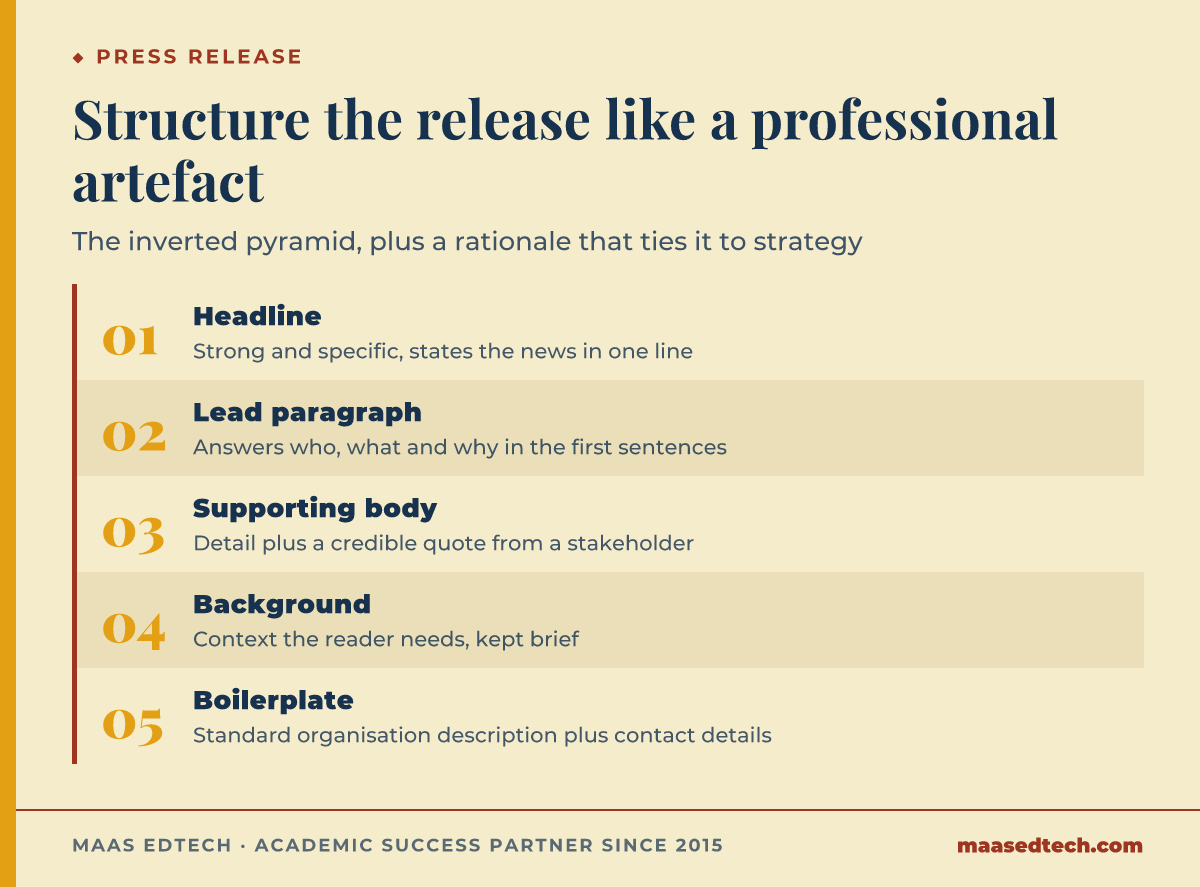
Direct answer: Treat each asset as a professional artefact with a known structure, then tie them together with explicit strategy. A press release follows the inverted-pyramid format: a strong headline, a lead paragraph answering who/what/why, supporting body with a credible quote, background, and a boilerplate with contact details.
A pitch email is short (around 150–250 words), addressed to a named, well-matched journalist, and argues why the story fits their beat. The explanatory script or rationale is where you connect these assets back to your stakeholder analysis and Theory of Change. The biggest structural fix is expanding the justification, where the analytical marks concentrate.
Evidence: Standard PR texts such as Cutlip, Center and Broom's (2013) Effective Public Relations codify the inverted-pyramid release and targeted-pitch conventions that markers expect; deviating from them reads as inexperience even when the writing is good. Criterion-referenced rubrics weight "strategy and justification" far above "content production," so structuring your word budget toward the rationale is the most reliable way to lift a grade.
Example: A Vietnamese MAAS student wrote a polished press release but pitched it to a general news desk with no rationale. Her mentor had her name a specific environment reporter and add two sentences explaining the fit based on the reporter's recent coverage. Same release, a targeted pitch and a clear rationale, full marks on the audience-insight criterion.
What are the most common mistakes that lose marks in COMM2920?
Direct answer: Three recurring mistakes show up across MAAS advocacy-PR coaching. First, students confuse awareness with advocacy; they raise an issue but never specify a concrete "ask" or who must act on it. Second, they produce content without strategy, a press release and pitch that are not visibly connected to a stakeholder analysis or Theory of Change. Third, pitches and releases are generic, addressed to "the media" rather than a named, well-matched journalist with a reason to care. Fixing these three lifts most drafts by at least one rubric band.
Evidence: Across MAAS advocacy-PR coaching, marker feedback before intervention clusters on "needs a clearer advocacy objective" and "strategy not sufficiently justified", the two phrases that most often separate a Credit from a Distinction in RMIT communication rubrics.
Example: One Vietnamese student's campaign aim read "raise awareness of food waste." His MAAS mentor pushed him to make it an advocacy ask: which decision-maker (a local council), what specific change (a mandatory composting bylaw), and what evidence supports it. The sharpened objective made every downstream asset stronger and earned full marks on the strategy criterion.
How long is the COMM2920 assignment and what referencing style does it use?
Direct answer: Confirm the exact word count and style in your assessment brief, advocacy-PR portfolios at this level commonly sit around 1,500–2,000 words across the combined components and use Harvard referencing, RMIT's default for communication courses. Stay within the 10% tolerance band, cite every theoretical claim and any data you use to justify your ask, and make sure in-text citations and the reference list match exactly. Reference accuracy is a quick, reliable source of marks that many students leave on the table.
Evidence: RMIT uses RMIT Harvard as its standard referencing style, documented in RMIT's Easy Cite tool. Markers routinely deduct marks for inconsistent or incomplete referencing even when the campaign strategy is strong.
Example: A Vietnamese RMIT student lost marks across two tasks for mismatched in-text citations and reference-list entries. A MAAS pre-submission audit caught the errors in under an hour. On her next COMM2920 component, clean Harvard referencing recovered marks she had been losing on a criterion that requires no extra research at all.
Frequently asked questions
Is COMM2920 a hard course?
It is strategically demanding rather than technically hard; there is no maths, but the course expects you to design a coherent campaign and justify every choice, not just write well. Students who treat it as "produce content" struggle; students who treat it as "design and defend a strategy" do well.
What is the difference between advocacy and awareness in COMM2920?
Awareness aims to inform; advocacy aims to change something specific, a policy, a corporate practice, or a behaviour. A strong COMM2920 campaign always names a concrete "advocacy ask" and the decision-maker who can grant it.
How many frameworks should I use in the assignment?
Two or three, applied deeply, beats five applied shallowly. Examiners reward critical application, using a framework to reach a strategic judgement, not the number of models you can name.
How do I write a media pitch that gets noticed?
Keep it short, address a named journalist whose recent work fits your issue, and lead with why the story matters to their audience. A targeted pitch with a clear rationale outscores a polished but generic one.
What referencing style does COMM2920 use?
RMIT Harvard is the default for communication courses. Always confirm in your own brief and use RMIT's Easy Cite tool to format entries consistently.
Can MAAS help me with COMM2920?
Yes. MAAS Assignment & Essay Support coaches you through the assignment with the Outline, Draft, Final model, issue analysis, stakeholder mapping, draft feedback, and a pre-submission referencing audit, all with discipline-matched experts. We coach your work; we do not write it for you.
Ready to approach COMM2920 with a clear strategy?
If you have a cause but not yet a campaign strategy, that is exactly where a discipline-matched expert helps most. MAAS Assignment & Essay Support is an academic support partner; we work alongside you through Outline, Draft, Final so the argument and the assets stay yours while the strategy earns the marks.
Bring your COMM2920 brief and we will match you to a Public Relations and advocacy mentor, 23% of our 100+ experts hold a PhD, within 48 hours when our network already covers that field. If it does not, MAAS opens a dedicated recruitment round for your case, which usually takes about two weeks.
Book a free 15-minute COMM2920 consultation with MAAS Assignment & Essay Support →
Related guides
- COMM2829 assignment: how do you approach Genre and Historical Movements?: sibling RMIT screen-studies guide on analysing film genres and historical movements
- How to approach the COMM2694 Professional Communication Studio assignment?: sibling RMIT communication course guide on the studio brief and reflective practice
- How do you approach the BUSM2617 Managing People for the Future assignment?: sibling RMIT business course guide on managing people through change
- How do you approach the BUSM4187 International HRM assignment?: sibling RMIT business course guide on managing people globally
- How do you approach the COMM2921 Contemporary Media Relations assignment?: the sibling RMIT PR course guide on earning media coverage and pitching journalists
- How do you approach the MKTG1419 Social Media and Mobile Marketing assignment?: sibling RMIT communication course guide on planning audience-led campaigns
- How do you approach the BUSM2412 Marketing for Managers assignment?: for the strategy-and-audience half of any campaign report
- How to write a reflection essay: useful if COMM2920 includes a reflective or explanatory script component
- How to write a theoretical framework: for applying advocacy frameworks with academic depth
- MAAS Academic Mentoring service: 1:1 coaching with PhD-level mentors in your discipline
- Tutoring service: 1:1 subject tutoring in 60- or 90-minute sessions with an expert matched on your course code, always inside your discipline
- Admissions Consulting service: SOP, personal statement, and application coaching for study-abroad applicants
- Course-code assignment coaching: pillar guide on tackling any unit assignment with a MAAS mentor
References
- Center for Theory of Change. (n.d.). What is Theory of Change? Retrieved June 8, 2026, from https://www.theoryofchange.org/what-is-theory-of-change/
- Cutlip, S. M., Center, A. H., & Broom, G. M. (2013). Effective public relations. Pearson.
- Mitchell, R. K., Agle, B. R., & Wood, D. J. (1997). Toward a theory of stakeholder identification and salience. Academy of Management Review, 22(4), 853–886.
- Smith, R. D. (2020). Strategic planning for public relations. Routledge.
Tools & resources
- RMIT University. (n.d.). Assessment and exams. Retrieved June 8, 2026, from https://www.rmit.edu.au/students/student-essentials/assessment-and-exams
- RMIT University. (n.d.). Easy Cite referencing tool. Retrieved June 8, 2026, from https://www.rmit.edu.au/library/study/referencing
This article is part of the MAAS Journal series for Vietnamese international students. MAAS Assignment & Essay Support is an academic support partner; we coach students through the Outline, Draft, Final delivery model with developmental feedback from discipline-matched experts. We do not write or submit work on a student's behalf.