
COMM2921 Contemporary Media Relations asks you to earn real media coverage in a fragmented news cycle, not just to write a tidy press release. Most students who lose marks in this RMIT course treat media relations as document production; they polish a release and a pitch but never show they understand how a time-poor journalist decides what becomes news. This guide answers the seven questions Vietnamese students at RMIT ask MAAS mentors most often before they start COMM2921.
Author: MAAS Editorial Team · Reviewed by a MAAS subject mentor
Last updated: 2026-07-05
Category: communication-pr

What is COMM2921 Contemporary Media Relations about?
Direct answer: COMM2921 is an RMIT communication course in the public relations pathway examining how practitioners build relationships with journalists and editors in today's converged media environment. It covers how newsrooms work under commercial pressure, what makes a story newsworthy, how to pitch across earned, owned and social channels, and how to manage reputation when the news cycle turns against you.
Evidence: The intellectual core of the course sits on established media and PR scholarship: news values research from Galtung and Ruge (1965) through Harcup and O'Neill's 2017 revision, agenda-setting theory (McCombs & Shaw, 1972), framing (Entman, 1993), and Grunig and Hunt's (1984) models of public relations practice. RMIT communication assessments reward students who use these frameworks to justify media strategy, not just to define them.
Example: A Vietnamese student at RMIT came to MAAS believing her COMM2921 task was "write a press release about an event." Her MAAS mentor reframed the brief: the real question was which outlets and journalists would treat the event as news, and why. Once she researched three named journalists' recent coverage and rebuilt the release around a genuine news hook, the same event story moved from a Pass-band draft to a Distinction-band submission.
What assessments does the COMM2921 assignment usually involve?
Direct answer: Media relations courses at this level are typically assessed through applied, portfolio-style tasks rather than a single essay. A common pattern is an early media-analysis task (analysing how an issue or organisation is covered across outlets), followed by a media-relations package, a press release, a targeted pitch to named journalists, a media list with selection rationale, and a short strategic rationale that justifies your choices using theory. Always confirm the exact components, weightings, and word counts in your own Canvas shell, because briefs change by semester and case focus.
Evidence: RMIT assessment is criterion-referenced: marks are awarded against published rubric criteria rather than by ranking students against each other, as set out in RMIT's Assessment policy. In practice this means a beautifully written release with no visible audience logic can score below a plainer one that demonstrably matches a named outlet's news agenda.
Example: One Vietnamese RMIT student spent nearly all his time perfecting release wording and submitted a media list that was just ten outlet names with no rationale. His MAAS mentor flagged that the list and rationale carry the analytical marks; they prove you understand the media landscape. Rebuilding the list around beat relevance and audience fit, with two sentences of justification per outlet, lifted his result a full band with the same release.
How is the COMM2921 assignment graded, what does the rubric reward?
Direct answer: Media relations rubrics at this level reward four things, roughly in order: (1) news judgement, can you identify and construct a genuine news hook rather than an advertisement; (2) audience and outlet insight, have you matched the story to journalists who plausibly cover it; (3) explicit, correct use of media and PR theory to justify strategy; and (4) professional execution, release conventions, pitch craft, and clean Harvard referencing. The marks concentrate in the reasoning, not the artefacts. Whenever you can replace a "what I made" sentence with a "why this works for this outlet" sentence, do it.
Evidence: RMIT communication rubrics use criterion bands (Pass / Credit / Distinction / High Distinction), and the step from Credit to Distinction is consistently defined by critical application, critical analysis of the media environment, critical justification of outlet and angle choices, rather than by producing more content.
Example: A MAAS mentor coded a Vietnamese student's draft rationale sentence by sentence as either "describes the deliverable" or "justifies the strategy." It was 80% description. One restructuring pass that flipped the ratio, same release, same pitch, same media list, moved the submission up two rubric bands.
Which frameworks and concepts should you use in COMM2921?
Direct answer: Anchor your package in two or three established frameworks applied deeply, rather than name-checking many. The most useful set for COMM2921: news values (to prove your story is actually newsworthy), agenda-setting and framing (to explain what coverage you want and how the story should be told), the PESO model (to position earned media within a wider channel strategy), and Grunig and Hunt's two-way symmetrical model (to frame media relations as relationship-building rather than publicity). Choose the ones that fit your specific case, forcing all of them in reads as listing, not analysis.
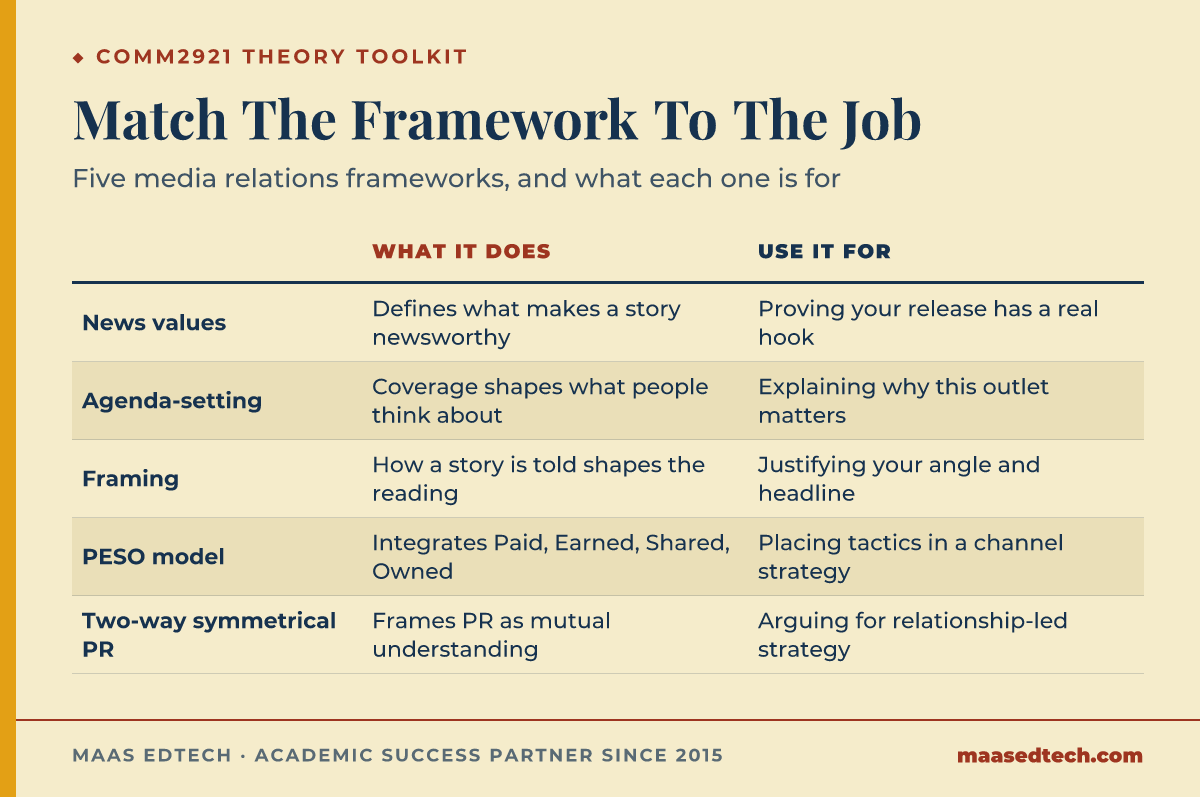
| Framework | What it does | Use it for |
|---|---|---|
| News values (Galtung & Ruge, 1965; Harcup & O'Neill, 2017) | Defines the criteria journalists use to judge newsworthiness | Proving your release has a real hook, timeliness, conflict, proximity, human interest |
| Agenda-setting (McCombs & Shaw, 1972) | Media coverage shapes what the public thinks about | Explaining why earned coverage in specific outlets serves your communication objective |
| Framing (Entman, 1993) | How a story is told shapes how it is interpreted | Justifying your chosen angle and headline over the alternatives |
| PESO model (Dietrich, 2014) | Integrates Paid, Earned, Shared, Owned channels | Positioning your media relations tactics inside a coherent channel strategy |
| Two-way symmetrical PR (Grunig & Hunt, 1984) | Frames PR as mutual understanding, not one-way publicity | Arguing for relationship-led media strategy in your rationale |
Evidence: Harcup and O'Neill's "What is news?" (2017, Journalism Studies) updated the classic Galtung and Ruge taxonomy with values such as shareability and is the standard contemporary citation for newsworthiness. Galtung and Ruge's original taxonomy had defined newsworthiness in exactly these terms: "a system of twelve factors describing events is presented that together are used as a definition of 'newsworthiness'" (Galtung & Ruge, 1965, p. 90). McCombs and Shaw's Chapel Hill study (1972, Public Opinion Quarterly) and Entman's framing paper (1993, Journal of Communication) are among the most-cited works in communication research, examiner-recognised sources, not blog-level references.
Example: A Vietnamese student tried to apply six theories to a single product-launch case and explained each in one shallow paragraph. Her MAAS mentor cut it to news values (to test the hook honestly) plus framing (to defend the chosen angle). Fewer frameworks, deeper application and the rationale finally read like analysis instead of a glossary.
How do you build a media list and pitch that actually lands?
Direct answer: Build the list backwards from the story, not forwards from famous outlets. For each target, identify a named journalist, the beat they cover, two or three recent pieces that prove the fit, and the format they prefer. The pitch itself should be short, around 150 to 250 words, personalised in the first line, and led by why the story matters to their audience now, not by who your client is. A targeted pitch to eight well-matched journalists routinely outperforms a blast to eighty, and your rationale should say exactly that, with evidence.
Evidence: Industry research consistently reports that journalists reject most pitches for lack of relevance to their beat, Cision's annual State of the Media survey finds irrelevant pitching is the top reason journalists block PR sources. Standard PR texts such as Effective Public Relations (Cutlip et al., 2013) codify the inverted-pyramid release and the targeted-pitch conventions that markers expect; ignoring them reads as inexperience even when the prose is strong.
Example: A Vietnamese MAAS student pitched a sustainability story to a general news desk and heard nothing. Her mentor had her find an environment reporter at the same masthead, reference the reporter's piece from the previous month in her opening line, and cut the pitch from 400 to 180 words. The revised pitch earned full marks on the audience-insight criterion and a reply from the real journalist she had researched.
What are the most common mistakes that lose marks in COMM2921?
Direct answer: Three recurring mistakes show up across MAAS media-relations coaching. First, students write advertisements instead of news, releases that praise the client but contain no hook a journalist could defend to an editor. Second, the media list is generic, big-name outlets with no named journalists and no beat rationale. Third, the strategic rationale is thin, deliverables are presented without theory, so the marker cannot see the news judgement behind them. Fixing these three problems lifts most drafts by at least one rubric band.
Evidence: Marker feedback that MAAS mentors see on media-relations drafts clusters around "no clear news angle" and "outlet selection not justified", the two phrases that most often separate a Credit from a Distinction in RMIT communication rubrics under criterion-referenced assessment.
Example: One Vietnamese student's release led with "XYZ Company is proud to announce…", a phrase that signals advertising, not news. His MAAS mentor rewrote the test: would a journalist's editor accept this as a story if the company name were removed? Rebuilt around a local-impact statistic and a human case, the same announcement passed the test and scored in the Distinction band.
How long is the COMM2921 assignment and what referencing style does it use?
Direct answer: Confirm the exact word count in your assessment brief, media-relations portfolios at this level commonly sit around 1,500–2,000 words across combined components, with practical artefacts (release, pitch, media list) sometimes counted separately from the rationale. RMIT's default referencing style for communication courses is RMIT Harvard. Stay inside the 10% tolerance band, cite every theoretical claim and any media data you use, and make sure in-text citations match the reference list exactly, referencing accuracy is a quick, reliable source of marks that many students leave on the table.
Evidence: RMIT documents its Harvard style in the Easy Cite referencing tool, and markers routinely deduct marks for inconsistent or incomplete referencing even when the media strategy itself is strong.
Example: A Vietnamese RMIT student lost marks on two consecutive tasks for mismatched citations and missing access dates on news-article references. A MAAS pre-submission audit caught every inconsistency in under an hour, and on the next component clean RMIT Harvard referencing recovered marks on a criterion that requires no extra research at all.
Frequently asked questions
Is COMM2921 a hard course?
It is judgement-heavy rather than technically hard. The writing volume is moderate, but the course expects genuine news sense, knowing what a journalist would run and why. Students who treat it as document production struggle; students who treat it as strategy with artefacts attached do well.
What is the difference between a press release and a media pitch?
A press release is a structured, publishable news document written in inverted-pyramid style; a pitch is a short, personalised email persuading one named journalist that the story fits their beat. In COMM2921 they are assessed together, the pitch shows targeting, the release shows craft.
How many outlets should my media list include?
Quality beats volume: a focused list of six to ten outlets with named journalists, beat evidence, and a sentence of rationale each scores higher than twenty unexplained names. The rationale is where the marks live.
Which theories matter most in COMM2921?
News values and framing carry the most analytical weight, with agenda-setting, PESO, and Grunig and Hunt's models supporting the strategic rationale. Apply two or three deeply rather than listing many.
What referencing style does COMM2921 use?
RMIT Harvard is the default for communication courses. Confirm in your own brief and use RMIT's Easy Cite tool to keep in-text citations and the reference list consistent.
Can MAAS help me with COMM2921?
Yes. MAAS Assignment & Essay Support coaches you through the assignment with the Outline, Draft, Final model, news-angle testing, media-list strategy, draft feedback, and a pre-submission referencing audit with PhD-level mentors. We coach your work; we do not write it for you.
Ready to approach COMM2921 with real news judgement?
If you can write cleanly but are not yet sure what makes a story land with a journalist, that is exactly where a discipline-matched expert helps most. MAAS Assignment & Essay Support is an academic support partner; we work alongside you through Outline, Draft, Final so the story angle and the artefacts stay yours while the strategy earns the marks.
Bring your COMM2921 brief and we will match you to a media relations and PR mentor, 23% of our 100+ experts hold a PhD, within 48 hours when our network already covers that field. If it does not, MAAS opens a dedicated recruitment round for your case, which usually takes about two weeks.
Book a free 15-minute COMM2921 consultation with MAAS Assignment & Essay Support →
Related guides
- COMM2829 assignment: how do you approach Genre and Historical Movements?: sibling RMIT screen-studies guide on analysing film genres and historical movements
- How to approach the COMM2694 Professional Communication Studio assignment?: sibling RMIT communication course guide on the studio brief and reflective practice
- How do you approach the BUSM2617 Managing People for the Future assignment?: sibling RMIT business course guide on managing people through change
- How do you approach the BUSM4187 International HRM assignment?: sibling RMIT business course guide on managing people globally
- How do you approach the COMM2920 Advocacy and Voice in Public Relations assignment?: the sibling RMIT PR course guide on advocacy campaign strategy
- How do you approach the MKTG1419 Social Media and Mobile Marketing assignment?: for the shared/owned channels of your PESO strategy
- How to write a theoretical framework: for applying media theory with academic depth
- MAAS Academic Mentoring service: 1:1 coaching with PhD-level mentors in your discipline
- Tutoring service: 1:1 subject tutoring in 60- or 90-minute sessions with an expert matched on your course code, always inside your discipline
- Course-code assignment coaching: pillar guide on tackling any unit assignment with a MAAS mentor
References
- Cutlip, S. M., Center, A. H., & Broom, G. M. (2013). Effective public relations. Pearson.
- Dietrich, G. (2014). Spin sucks: Communication and reputation management in the digital age. Que Publishing.
- Entman, R. M. (1993). Framing: Toward clarification of a fractured paradigm. Journal of Communication, 43(4), 51–58. https://doi.org/10.1111/j.1460-2466.1993.tb01304.x
- Galtung, J., & Ruge, M. H. (1965). The structure of foreign news. Journal of Peace Research, 2(1), 64–90. https://doi.org/10.1177/002234336500200104
- Grunig, J. E., & Hunt, T. (1984). Managing public relations. Holt, Rinehart and Winston.
- Harcup, T., & O'Neill, D. (2017). What is news? News values revisited (again). Journalism Studies, 18(12), 1470–1488. https://doi.org/10.1080/1461670X.2016.1150193
- McCombs, M. E., & Shaw, D. L. (1972). The agenda-setting function of mass media. Public Opinion Quarterly, 36(2), 176–187. https://doi.org/10.1086/267990
Tools & resources
- RMIT University. (n.d.). Assessment and exams. Retrieved June 8, 2026, from https://www.rmit.edu.au/students/student-essentials/assessment-and-exams
- RMIT University. (n.d.). Easy Cite referencing tool. Retrieved June 8, 2026, from https://www.rmit.edu.au/library/study/referencing
This article is part of the MAAS Journal series for Vietnamese international students. MAAS Assignment & Essay Support is an academic support partner; we coach students through the Outline, Draft, Final delivery model with developmental feedback from discipline-matched experts. We do not write or submit work on a student's behalf.