
◆ Business & Management
BUSM2716 Managing Multinational Enterprises: how do you start?
Most BUSM2716 assignments open by calling the case company "a truly global corporation". That phrase is usually the first thing a marker can challenge, because researchers who tested it against revenue data found only a handful of the world's largest multinationals genuinely global; most earned most of their sales inside their home region. Starting from that finding, not from the assumption it disproves, is what separates a Distinction from a Credit, which the seven questions below work through.

◆ Question 1 / 7 · The module
What is BUSM2716 Managing Multinational Enterprises about?
Direct answer: BUSM2716 is the RMIT course code for Managing Multinational Enterprises delivered to postgraduate students at RMIT Vietnam Saigon South, examining how firms extend across borders and how they are managed once they do, why firms internationalise, how they choose which markets to enter and by what mode, and how headquarters and subsidiaries share power across institutional and cultural distance.
Evidence: In the RMIT Handbook the course sits under record 055678, which attaches different delivery codes to different campuses. BUSM2716 is the RMIT Vietnam Saigon South postgraduate offering, BUSM2717 is the RMIT Vietnam Hanoi offering, and BUSM2668 is the Melbourne City Campus offering. The practical consequence is the same as for any multi-code course: study material you find online may describe a different offering, so take your assessment detail from your own Canvas shell and course guide.
Example: A student built his assignment plan around an assessment structure a classmate in Hanoi had shared. The topics matched; the task weightings did not. His MAAS mentor's first step was to open his own course guide and rebuild the plan against the tasks he would actually be marked on, before a single paragraph was written.
◆ Question 2 / 7 · Opening line
Why is "this is a truly global company" a risky opening line?
Direct answer: Because it is an empirical claim, and the evidence mostly points the other way. Very few large multinationals sell evenly across the world's major regions. Most concentrate their sales in the region where they are headquartered. If you assert global reach without checking the revenue split, you have made an unverified claim in the first paragraph of a postgraduate international business assignment. If instead you check it, you gain an analytical question worth writing about: why has this firm not globalised as far as its brand suggests?
Evidence: Rugman and Verbeke (2004) analysed the regional sales distribution of the world's largest multinationals and found only a very small number met a reasonable definition of global, with sales balanced across the major regions of the world economy. The large majority were home-region oriented. Their finding directly challenges the assumption of borderless global business that most student assignments begin from. As the authors put it, "this paper demonstrates that most of these firms are not 'global' companies, in the sense of having a broad and deep penetration of foreign markets across the world" (Rugman & Verbeke, 2004, p. 3).
Example: A student writing about a Japanese consumer electronics firm described it as a global player, then checked its annual report at her mentor's suggestion. Asia-Pacific accounted for the clear majority of revenue. Her argument changed completely: instead of explaining how the firm managed global operations, she analysed why its European expansion had stalled, which is a far more interesting question and one the rubric could reward.
◆ Question 3 / 7 · Theories
Which theories does a BUSM2716 assignment actually need?
Direct answer: Pick the theory that answers your specific question rather than surveying the field. Most BUSM2716 questions fall into four families, and each has a natural theoretical home.
Four BUSM2716 question families and the theory that fits each
Each row sets one question you may be answering beside the theory that fits it.
The question you are answering
Theory that fits
Why does this firm invest abroad at all?
Eclectic paradigm, ownership-location-internalisation (Dunning, 2000)
Which market, and how should it enter?
Cultural and institutional distance (Kogut & Singh, 1988; Ghemawat, 2001)
Why does it struggle after entry?
Liability of foreignness (Zaheer, 1995)
Why do headquarters and subsidiary clash?
Multiple embeddedness and legitimacy (Kostova & Zaheer, 1999; Meyer et al., 2011)
Save this figure
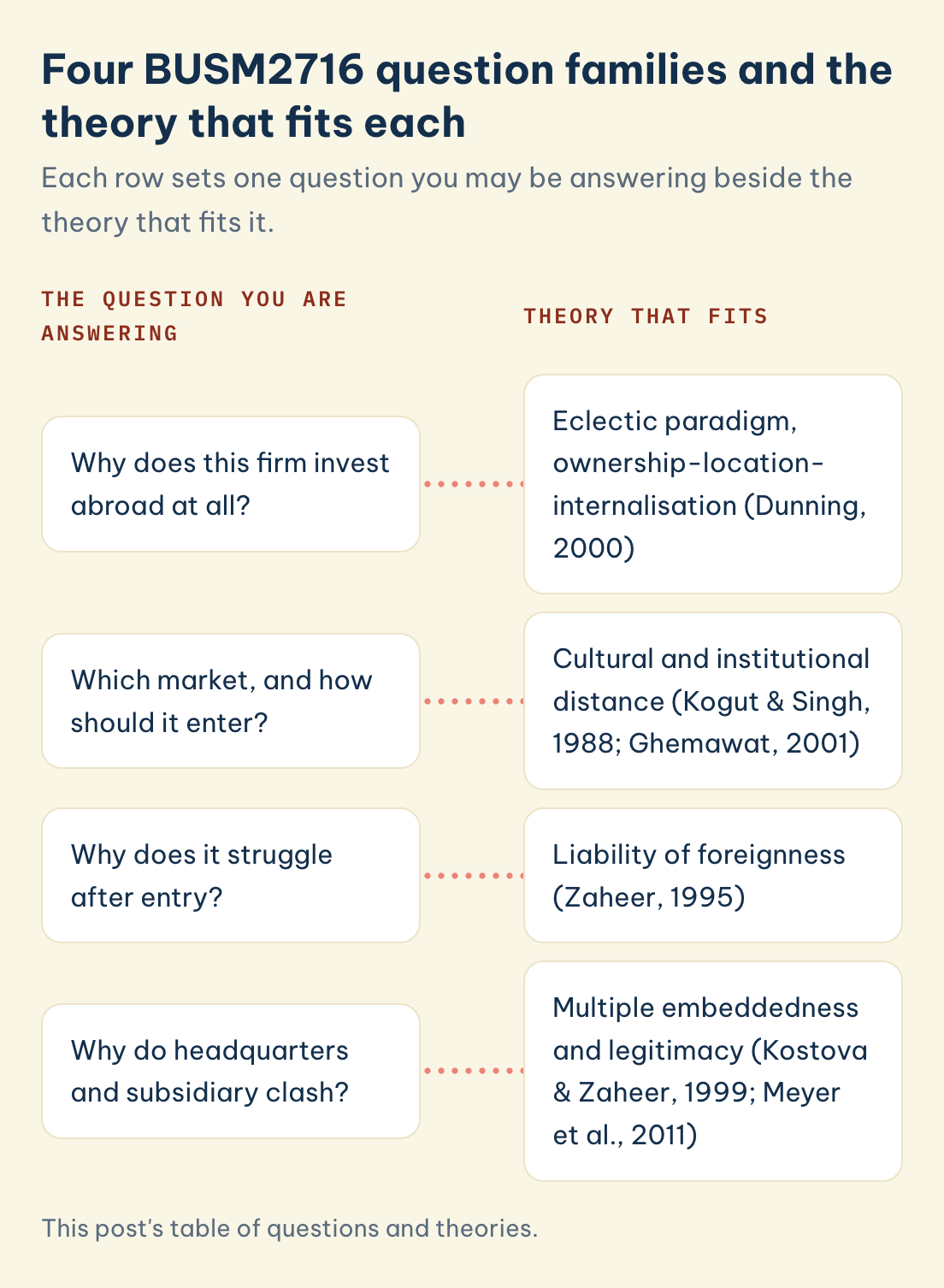
| The question you are answering | Theory that fits | What it lets you argue |
|---|---|---|
| Why does this firm invest abroad at all? | Eclectic paradigm, ownership-location-internalisation (Dunning, 2000) | Whether the firm's advantage justifies owning foreign operations rather than licensing or exporting |
| Which market, and how should it enter? | Cultural and institutional distance (Kogut & Singh, 1988; Ghemawat, 2001) | Why distance pushes towards a joint venture rather than a wholly owned subsidiary, or the reverse |
| Why does it struggle after entry? | Liability of foreignness (Zaheer, 1995) | The specific costs a foreign firm bears that a local rival does not |
| Why do headquarters and subsidiary clash? | Multiple embeddedness and legitimacy (Kostova & Zaheer, 1999; Meyer et al., 2011) | Why a subsidiary must satisfy both its parent and its host environment, and what happens when those demands conflict |
Evidence: These frameworks are complementary rather than competing, which is why selecting deliberately matters. Zaheer (1995) demonstrated that foreign firms carry measurable additional costs simply from being foreign; Kostova and Zaheer (1999) explained why a multinational must build legitimacy separately in every host environment; Ghemawat (2001) organised distance into cultural, administrative, geographic and economic dimensions so it can be assessed rather than gestured at.
Example: A student applied five frameworks to one market-entry decision and explained none of them properly. His mentor asked which question he was actually answering. It was an entry-mode question, so they kept distance and internalisation logic and cut the rest. The draft got shorter and the mark went up.
◆ Question 4 / 7 · Writing about Vietnam
How do you write about Vietnam without falling into the culture trap?
Direct answer: Many BUSM2716 students at RMIT Vietnam choose a multinational operating in Vietnam, which is a strong choice because you can access local evidence. The trap is explaining every outcome by "cultural differences". Culture is one dimension of distance among several, and institutional factors, regulation, enforcement, ownership rules, licensing, supply chain maturity, often explain more of what you observe. The stronger move is to separate the dimensions, then argue which one actually drove the outcome.
Evidence: Ghemawat's (2001) CAGE framework was designed precisely to stop analysts collapsing all difference into culture, by distinguishing cultural, administrative and political, geographic and economic distance. Kogut and Singh (1988) showed cultural distance shapes entry-mode choice, but as one predictor rather than a universal explanation.
Example: A student attributed a retailer's difficulties in Vietnam to Vietnamese consumer culture. Her mentor asked her to test the administrative dimension. Licensing timelines and property leasing rules turned out to explain the delayed rollout far better than any cultural factor. The revised analysis was specific and evidence-based rather than a generalisation about consumers.
◆ Question 5 / 7 · Sources
What sources count as evidence at postgraduate level?
Direct answer: Three tiers, used for three different jobs. Peer-reviewed journal articles supply your theory and your contested claims. Primary corporate documents, annual reports, investor presentations, regulatory filings, supply the facts about your case firm, including the regional revenue split you should check. Reputable industry and institutional sources, such as UNCTAD, the World Bank or established business press, supply context. Consultancy blog posts and summary websites are not evidence at this level; if a claim only appears on such a site, treat it as unverified.
Evidence: One of the four unit-level expectations in international business courses is independent evaluation of information quality, not just retrieval of it. This is why examiners notice reference lists dominated by websites even when the writing is fluent.
Example: A student cited a consulting firm's blog for the claim that a company held "market leadership in Southeast Asia". The annual report showed it was third by revenue in the region. Her mentor's point was not that the blog was dishonest, but that a claim she could have verified in twenty minutes had gone into her argument unchecked.
◆ Question 6 / 7 · Report structure
How should you structure the BUSM2716 report?
Direct answer: Lead with the decision, not the company. A reliable structure: a short introduction stating the specific problem or decision you analyse; a brief case context capped at about ten percent of the word count; the analysis, organised by analytical dimension rather than by chronology; recommendations that name the constraint you are working within; a conclusion that answers the question you set. Organising by dimension, entry mode, subsidiary control, knowledge transfer, is what turns a company profile into an argument.
Evidence: RMIT business assessment is criterion-referenced, meaning your work is measured against published rubric criteria rather than ranked against classmates. Adding a longer company history cannot lift a mark; moving words into the analysis and recommendation criteria can.
Example: A student organised his report as the company's timeline from founding to the present. Every section described; none argued. His mentor had him reorganise around three decisions the firm had faced. Same research, same word count, and the analysis finally had somewhere to live.
◆ Question 7 / 7 · Credit and Distinction
What separates a Credit from a Distinction in this course?
Direct answer: A Credit explains what the firm did and links it correctly to theory. A Distinction says what the firm should have done differently, and defends the alternative against a named constraint. Three habits close that gap: state a verdict at the end of each analytical section rather than only in the conclusion; use at least one source that disagrees with your main framework, so your argument survives a challenge; and make every recommendation specific enough that someone could act on it, including who acts, what changes, and what you are trading away.
Evidence: Postgraduate business rubrics distinguish bands largely through the word "critical", meaning evaluation of the limits of your evidence and framework rather than additional content. Meyer et al. (2011) is useful here because it explicitly frames subsidiary management as a set of trade-offs between competing demands, so it invites judgement rather than description.
Example: A student's draft ended each section by summarising what he had just described. His mentor asked him to add one sentence per section beginning "which means that". Nothing else changed. The examiner's feedback specifically praised the analytical progression.
Frequently asked questions
Is BUSM2716 the same course as BUSM2668 or BUSM2717?
They are the same course in the RMIT Handbook with different delivery codes. BUSM2716 is the postgraduate offering at RMIT Vietnam Saigon South, BUSM2717 is the RMIT Vietnam Hanoi offering, and BUSM2668 is the Melbourne City Campus offering. Content is shared, but assessment tasks and schedules can differ, so use your own course guide and Canvas shell.
Should I choose a large famous multinational or a smaller firm?
Choose the firm you can find primary evidence for. A large listed company gives you annual reports and filings, which is usually the deciding advantage. A smaller firm can work well if you have genuine access, but avoid any case where you would end up relying on secondary summaries.
Can I use my own employer as the case?
Often yes, and it can be a strength. Anonymise the organisation and individuals if the information is not public, keep confidential commercial data out, and remember your experience is evidence to analyse, not authority to assert.
How many references does the assignment need?
Your course guide is the authority. As a working guide for a postgraduate international business report, expect roughly ten to twenty quality sources weighted towards peer-reviewed articles, plus primary company documents for your case facts. Depth beats volume.
Which referencing style should I use?
RMIT business courses commonly use RMIT Harvard, but this varies by school and course. Confirm the required style in your course guide and apply it consistently across in-text citations and the reference list.
How MAAS mentors support BUSM2716 students
MAAS works as an academic advisor, not a writing service. For BUSM2716 that usually means helping you decode your own course guide and rubric, testing whether your chosen case company will yield real evidence before you commit to it, reviewing your outline so the structure argues rather than describes, and giving feedback that shows where description should become evaluation. You write the assignment; the mentor helps you see it the way a marker will.
If you are studying related RMIT courses, our guides to BUSM3250 People and Organisations and BUSM4187 International Human Resource Management cover neighbouring rubrics. You can also read how our academic support service works before you get in touch.
References
Dunning, J. H. (2000). The eclectic paradigm as an envelope for economic and business theories of MNE activity. International Business Review, 9(2), 163–190. https://doi.org/10.1016/S0969-5931(99)00035-9
Ghemawat, P. (2001). Distance still matters: The hard reality of global expansion. Harvard Business Review, 79(8), 137–147.
Kogut, B., & Singh, H. (1988). The effect of national culture on the choice of entry mode. Journal of International Business Studies, 19(3), 411–432. https://doi.org/10.1057/palgrave.jibs.8490394
Kostova, T., & Zaheer, S. (1999). Organizational legitimacy under conditions of complexity: The case of the multinational enterprise. Academy of Management Review, 24(1), 64–81. https://doi.org/10.5465/amr.1999.1580441
Meyer, K. E., Mudambi, R., & Narula, R. (2011). Multinational enterprises and local contexts: The opportunities and challenges of multiple embeddedness. Journal of Management Studies, 48(2), 235–252. https://doi.org/10.1111/j.1467-6486.2010.00968.x
Rugman, A. M., & Verbeke, A. (2004). A perspective on regional and global strategies of multinational enterprises. Journal of International Business Studies, 35(1), 3–18. https://doi.org/10.1057/palgrave.jibs.8400073
Zaheer, S. (1995). Overcoming the liability of foreignness. Academy of Management Journal, 38(2), 341–363. https://doi.org/10.5465/256683
Tools & resources
- RMIT Handbook course record for Managing Multinational Enterprises (course 055678), for course learning outcomes and the delivery code attached to each campus.
- Your Canvas course shell and course guide, the only authoritative source for your assessment tasks, weightings and due dates.
- Annual reports and investor presentations for your case firm, the primary source for regional revenue splits and entry history.
- UNCTAD World Investment Report, for foreign direct investment context by country and sector.
A free 20-minute consultation is a conversation about where you are with BUSM2716.
Book a free consultation ▸