
◆ Business & Management
How do you write the BUSM3250 People and Organisations assignment?
BUSM3250 People and Organisations asks you to act as the manager inside a people problem and justify what you would do, not to summarise what the literature says about motivation. Most postgraduate students who lose marks here write a competent HR essay: accurate definitions, tidy theory, no decision. This guide answers the seven questions Vietnamese students at RMIT Vietnam ask MAAS mentors most often before they start BUSM3250.

◆ Question 1 / 7 · The module
What is BUSM3250 People and Organisations about?
Direct answer: BUSM3250 is the RMIT course code for People and Organisations delivered to postgraduate students at RMIT Vietnam Saigon South, in hybrid blended and online mode. It deepens the link between interpersonal skill and organisational performance, covering delegation, conflict resolution, leading cross-cultural teams, and the systems side of performance: appraisal, 360-degree feedback, reward systems and industrial relations.
Evidence: In the RMIT Handbook, People and Organisations sits under course record 038819, which lists several delivery codes for the same course. BUSM3250 is the RMIT Vietnam Saigon South postgraduate offering; BUSM3249 is the Melbourne City Campus and RMIT Online offering. That matters for you in one practical way: study guides you find online often describe the BUSM3249 version, so check assessment details in your own Canvas shell rather than trusting a code you found in a forum.
Example: A part-time MBA student in Ho Chi Minh City came to MAAS with a BUSM3250 draft built entirely from an RMIT Melbourne assessment brief she had found online. The task weightings did not match her own. Her mentor's first move was not editing prose; it was opening her Canvas assessment page and rebuilding the outline against the brief she was actually being marked on.
◆ Question 2 / 7 · Assessment
What kind of assessment does BUSM3250 usually involve?
Direct answer: Courses of this type are assessed in three moves across the teaching period. An early, low-weight task checks engagement, often a quiz, a discussion contribution, or a peer-feedback exercise. A mid-period task is formative and practice-based, typically an extended case study or a scenario role play in which you respond as a manager. The final task is summative and pulls the course concepts together, usually an integrated report or reflective analysis. Confirm your exact tasks and weightings in Canvas; the postgraduate Vietnam offering can differ from the Australian one.
Evidence: RMIT publishes this three-stage rhythm for the course: a short early assessment driven by peer assessment or objective feedback, a mid-period task with a highly formative purpose such as an extended case study or scenario role play, and a final summative assessment that draws the course's threshold concepts together.
Example: A student treated the mid-period role-play response as a warm-up and spent his energy on the final report. His mentor pointed out the sequence is deliberate: the mid-period task is where you discover whether your analysis converts into a defensible managerial decision. He reworked the earlier task properly, and the reasoning he built there became the backbone of the final submission.
◆ Question 3 / 7 · Why a Credit
Why does a well-written BUSM3250 essay still get a Credit?
Direct answer: Because it explains and never decides. The most common failure in this course is the well-referenced summary: three paragraphs on Herzberg, two on Maslow, a definition of 360-degree feedback, then a recommendation to "improve communication". Postgraduate rubrics at this level reward a defended choice under constraint. The marker wants to see you identify the real problem, choose a course of action, name what you are trading away, and justify the choice with evidence.
Evidence: The course learning outcomes are written in the language of decision, not description. They ask you to apply leadership and management knowledge in an integrated way to design options and suggest solutions to people and organisation issues, and to select, design and implement the organisational model most suitable to the prevailing circumstances. The verbs are apply, design, select, evaluate. None of them is describe.
Example: A MAAS mentor asked a student to highlight every sentence in her draft that contained a decision she had made. Out of 2,000 words, eleven sentences lit up. She kept the same theory and the same case, restructured so each section ended in a justified choice, and the second draft read as a manager's argument rather than a textbook chapter.
◆ Question 4 / 7 · Reflective element
How should you handle the reflective element without writing a diary?
Direct answer: Reflection in BUSM3250 is an analytical genre, not a personal one. A diary reports what happened and how you felt. A reflective analysis explains what you did, tests it against a concept, and states what you would change and why. First person is allowed and often expected, but every personal observation should be doing analytical work. The reliable test: if you delete the theory, does your reflection still make an argument? If yes, the reflection is under-theorised. If deleting the anecdote changes nothing, the experience was decorative.
Evidence: Reflective writing frameworks used across business schools are explicitly staged rather than free-form. Gibbs (1988) moves from description through feelings and evaluation to analysis, conclusion and action plan, with the marks concentrated in the last three stages. Boud et al. (1985) make the same point differently: experience only becomes learning when it is deliberately re-examined. Schön (1983) supplies the vocabulary postgraduate markers reward, reflection-in-action for what you adjusted in the moment, and reflection-on-action for what you reconsidered afterwards.
Example: A student who managed a warehouse team wrote two pages describing a difficult shift handover. His mentor asked one question: which concept explains why that handover failed? He reframed the same incident through role ambiguity and unclear delegation, cut the narrative to a third of its length, and the analysis that replaced it moved the piece up a band.
◆ Question 5 / 7 · Frameworks
Which frameworks earn marks in BUSM3250, and where does each fit?
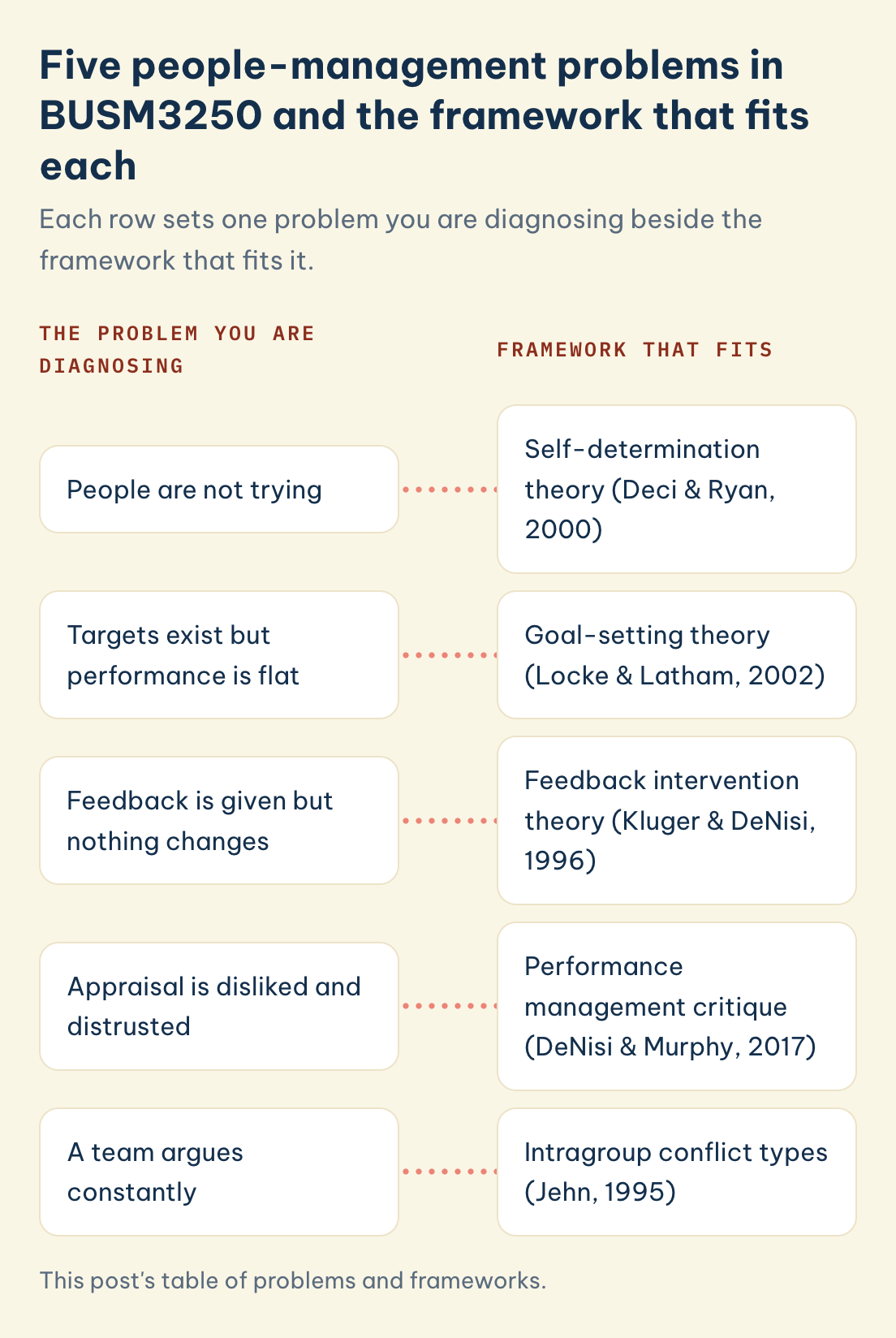
Direct answer: Choose two or three frameworks that fit the specific problem in front of you and apply them properly. Naming eight and explaining none is the classic postgraduate trap. Match the framework to the failure you are diagnosing.
Five people-management problems in BUSM3250 and the framework that fits each
Each row sets one problem you are diagnosing beside the framework that fits it.
The problem you are diagnosing
Framework that fits
People are not trying
Self-determination theory (Deci & Ryan, 2000)
Targets exist but performance is flat
Goal-setting theory (Locke & Latham, 2002)
Feedback is given but nothing changes
Feedback intervention theory (Kluger & DeNisi, 1996)
Appraisal is disliked and distrusted
Performance management critique (DeNisi & Murphy, 2017)
A team argues constantly
Intragroup conflict types (Jehn, 1995)
Save this figure
| The problem you are diagnosing | Framework that fits | What it lets you argue |
|---|---|---|
| People are not trying | Self-determination theory (Deci & Ryan, 2000) | Whether the fix is autonomy, competence or relatedness, not more incentive |
| Targets exist but performance is flat | Goal-setting theory (Locke & Latham, 2002) | Whether goals are specific and difficult enough, and whether feedback closes the loop |
| Feedback is given but nothing changes | Feedback intervention theory (Kluger & DeNisi, 1996) | Why some feedback harms performance by shifting attention to the self |
| Appraisal is disliked and distrusted | Performance management critique (DeNisi & Murphy, 2017) | Whether the rating process or the management process is the real issue |
| A team argues constantly | Intragroup conflict types (Jehn, 1995) | Whether the conflict is about the task or the relationship, which decides the response |
Evidence: These frameworks are contested rather than settled positions, which is exactly why they earn marks. Kluger and DeNisi's (1996) meta-analysis found that over a third of feedback interventions actually reduced performance, a finding that lets you challenge the assumption that more feedback is always better. As Kluger and DeNisi opened the study, "Since the beginning of the century, feedback interventions (FIs) produced negative--but largely ignored--effects on performance" (Kluger & DeNisi, 1996, p. 254). DeNisi and Murphy (2017), reviewing a century of research, concluded that evidence linking appraisal practice to improved firm performance remains weaker than practitioners assume. Citing a tension is stronger than citing a definition.
Example: A student diagnosed a "motivation problem" and recommended a bonus scheme. Her mentor pointed her to the conflict literature; the team's output had dropped after a restructure created overlapping responsibilities. She rediagnosed it as task conflict caused by role overlap, and the recommendation changed from a bonus to a redesign of accountabilities. The evidence was the same; the diagnosis was the difference.
◆ Question 6 / 7 · Workplace experience
How do you use your own workplace experience without breaking academic rules?
Direct answer: Use it, and use it precisely. Many BUSM3250 students at RMIT Vietnam work full time, and that experience is the most valuable material you have. Anonymise the organisation and individuals, describe the situation in enough detail for a marker to follow the causal chain, and keep any confidential commercial data out. Then treat it as evidence rather than authority: your experience shows what happened, the literature explains why, and your analysis links the two.
Evidence: Experiential learning models treat concrete experience as the starting point of a cycle that only produces learning once it passes through reflective observation and abstract conceptualisation (Kolb, 1984). The implication for your draft is direct: an unanalysed workplace story sits at stage one of the cycle and cannot carry postgraduate marks on its own.
Example: A student working in a manufacturing HR team hid her experience because she assumed academic writing had to be impersonal. Her mentor showed her a Distinction-level structure that opened with an anonymised incident, then analysed it against goal-setting and feedback research. The workplace detail made the analysis concrete, and the referencing made it academic.
◆ Question 7 / 7 · Lifting a draft
What is the fastest way to lift a BUSM3250 draft one band?
Direct answer: Rebalance the word count. In weak drafts, description takes sixty percent of the words and analysis takes twenty. Reverse that ratio without adding new content and the mark usually moves. Practically: cut organisational background to under ten percent, end every analytical section with a stated implication, and make sure your recommendations name the constraint you are working within, budget, authority, timeline or culture, since a recommendation with no constraint reads as a wish.
Evidence: RMIT business assessment is criterion-referenced, meaning your work is judged against published rubric criteria rather than ranked against classmates. The practical consequence is that adding volume cannot lift a mark; only moving work into a higher-scoring criterion can.
Example: A student submitted a 3,000-word draft for a 2,500-word task and expected the extra effort to help. His mentor cut 700 words of company background and description, and used 200 of the recovered words to add implications at the end of each section. Shorter draft, higher band.
Frequently asked questions
Is BUSM3250 the same course as BUSM3249?
They are the same course in the RMIT Handbook with different delivery codes. BUSM3250 is the postgraduate offering at RMIT Vietnam Saigon South; BUSM3249 is the Melbourne City Campus and RMIT Online offering. Content and learning outcomes are shared, but assessment details and teaching schedules can differ by offering, so always work from your own Canvas assessment page.
Can I write in first person in BUSM3250?
Yes for reflective tasks, and usually yes for the reflective sections of an integrated report. First person is a genre convention here, not informality. Keep the register academic: "I decided to delegate the audit because" is appropriate; "I was totally stressed out" is not.
How many references does a BUSM3250 assignment need?
Your Canvas brief is the authority. As a working guide for postgraduate business tasks of this length, expect roughly eight to fifteen quality sources, weighted towards peer-reviewed journal articles rather than websites. Depth matters more than count: five sources you argue with beat fifteen you list.
Which referencing style does RMIT use for this course?
RMIT business courses commonly use RMIT Harvard, but styles vary by school and course. Confirm the required style in your course guide and apply it consistently across in-text citations and the reference list.
Do I have to use a real company?
Not always. Many BUSM3250 tasks are scenario-based or drawn from your own workplace. When a scenario is supplied, analyse the scenario rather than substituting a famous company you find easier to research.
How MAAS mentors support BUSM3250 students
MAAS works as an academic advisor, not a writing service. For a course like BUSM3250, that usually means three things: a planning session where a mentor helps you decode your own Canvas brief and rubric, a structural review of your outline before you write, and feedback on your draft that shows where description should become analysis. You write the assignment; the mentor helps you see it the way a marker will.
If you are working through related RMIT management courses, our guides to BUSM4771 Managing Performance in Organisations and BUSM4699 Cross Cultural Management cover neighbouring rubrics. If your own HR course sits in a Canadian rather than an Australian system, our guide to the HRM 200 Basic Human Resources Management case study covers the same diagnostic method under Ontario employment law. You can also read how our academic support service works before you get in touch.
References
Boud, D., Keogh, R., & Walker, D. (1985). Reflection: Turning experience into learning. Kogan Page.
Deci, E. L., & Ryan, R. M. (2000). The "what" and "why" of goal pursuits: Human needs and the self-determination of behavior. Psychological Inquiry, 11(4), 227–268. https://doi.org/10.1207/S15327965PLI1104_01
DeNisi, A. S., & Murphy, K. R. (2017). Performance appraisal and performance management: 100 years of progress? Journal of Applied Psychology, 102(3), 421–433. https://doi.org/10.1037/apl0000085
Gibbs, G. (1988). Learning by doing: A guide to teaching and learning methods. Further Education Unit, Oxford Polytechnic.
Jehn, K. A. (1995). A multimethod examination of the benefits and detriments of intragroup conflict. Administrative Science Quarterly, 40(2), 256–282. https://doi.org/10.2307/2393638
Kluger, A. N., & DeNisi, A. (1996). The effects of feedback interventions on performance: A historical review, a meta-analysis, and a preliminary feedback intervention theory. Psychological Bulletin, 119(2), 254–284. https://doi.org/10.1037/0033-2909.119.2.254
Kolb, D. A. (1984). Experiential learning: Experience as the source of learning and development. Prentice Hall.
Locke, E. A., & Latham, G. P. (2002). Building a practically useful theory of goal setting and task motivation: A 35-year odyssey. American Psychologist, 57(9), 705–717. https://doi.org/10.1037/0003-066X.57.9.705
Schön, D. A. (1983). The reflective practitioner: How professionals think in action. Basic Books.
Tools & resources
- RMIT Handbook course record for People and Organisations (course 038819), for course learning outcomes and the delivery codes attached to each campus.
- Your Canvas course shell, the only authoritative source for your assessment tasks, weightings and due dates.
- RMIT Learning Lab, for reflective writing structures and RMIT Harvard referencing guidance.
A free 20-minute consultation is a conversation about where you are with BUSM3250.
Book a free consultation ▸