
◆ Business & Management
HRM 200 assignment: how do you write the HR case study?
Category: business-management
Last updated: 2026-09-07

HRM 200 Basic Human Resources Management at the University of Waterloo asks you to step out of the student role and answer as an HR consultant advising an employer. That single framing decides most of the mark. Students who summarise the case and then attach a textbook definition tend to land mid-band; students who diagnose a specific people problem, test it against Canadian employment law and HR theory, and defend a costed recommendation move into the top band. This guide answers the questions Vietnamese students at Waterloo bring to MAAS mentors before they open the case file.
◆ Question 1 / 8 · The course
What is HRM 200 at the University of Waterloo about?
Direct answer: HRM 200 is a half-unit University of Waterloo lecture course covering the main areas of human resources administration: recruiting, salary administration, labour relations, benefits administration, employee relations, labour law, and organizational behaviour. It asks how the HR function contributes to the performance of a whole enterprise rather than to a single department.
Evidence: The course carries Course ID 006474 and a weight of 0.50 units, runs in the Fall, Winter and Spring terms, requires Level at least 2A, and is antirequisite to BUS 354W/454W. These details come from Waterloo's own Undergraduate Calendar entry for HRM courses, not from a study-notes site (University of Waterloo, n.d.-a). The HRM program itself sits inside the Department of Psychology in the Faculty of Arts, which explains why the course leans on behavioural evidence as much as on management doctrine. HRM 200 is also the gateway to HRM 301 Strategic Human Resources Planning, so the analytical habits you build here are assessed again later.
Example: A Vietnamese student at Waterloo told her MAAS mentor she had chosen HRM 200 because it "sounded like an easy elective outside her major". Her mentor pointed at the calendar wording, the manner in which human resources executives contribute to the well-being of a total enterprise, and reframed the course around that line. Every case answer she wrote afterwards ended with an organisational consequence rather than an HR activity, and her case-study mark rose by a full band.
◆ Question 2 / 8 · The case study
What does the HRM 200 case study actually ask you to do?
Direct answer: The recurring HRM 200 written assessment is a short case analysis. You act as an HR consultant, get a workplace scenario, and answer a small set of directed questions inside a strict page limit. The task is not to explain what HRM is; it is to tell the employer what is wrong and what to do about it.
Evidence: The brief requires a title page and a separate reference page on top of the capped body. Course materials and published assignment briefs for the course consistently frame the student as an external adviser to the organisation and set tight length limits with a separate references page. Because the page cap is small relative to the number of questions, the assessment is really a test of compression: every sentence that only restates the case is a sentence you cannot spend on analysis. Always confirm the current term's exact questions, page limit and weighting in your own LEARN shell, because instructors and case scenarios rotate between terms and campuses.
Example: One MAAS mentee submitted a draft where 1.5 of his 3 permitted pages retold the scenario. His mentor suggested he cut the retelling to four sentences and use the reclaimed page to apply the Ontario legislation and one HR framework. Same case, same sources, the second version answered every graded criterion instead of two of them.
◆ Question 3 / 8 · HR consultant
What does it mean to write as an HR consultant rather than as a student?
Direct answer: Writing as a consultant means three concrete changes. You address the employer, not the marker. You state a position instead of surveying options. And you accept the constraints a real adviser accepts, budget, legal exposure, timelines and staff capacity, so your recommendation could actually be implemented on Monday.
Evidence: The consultant stance is the practical form of what the HR literature calls the shift from administrative expert to strategic partner, a role framework set out by Ulrich (1997) and still the backbone of introductory Canadian HR texts. The consultant framing is not a style preference; it is the mechanism by which the rubric can distinguish a candidate who understands HRM's strategic contribution from one who has memorised its functions.
Example: A Vietnamese student wrote "the company could consider updating its hiring process". His MAAS mentor asked him a consultant's question: updating it how, at what cost, by when, and what happens legally if they do not? The revised sentence named a structured interview guide, a two-assessor panel, and a four-week rollout before the next hiring cycle. Naming the cost, the owner and the deadline is what turned an observation into advice.
◆ Question 4 / 8 · The HR problem
How do you identify the real HR problem in the case?
Direct answer: Separate symptoms from causes before you write anything. Turnover, grievances, a failed hire and a harassment complaint are symptoms. The cause is almost always a missing or badly designed HR system: no job analysis, unstructured selection, appraisal without documented criteria, or pay with no internal equity. Name one primary cause.
Evidence: The functional chain used in Canadian introductory texts runs job analysis, human resources planning, recruitment, selection, orientation, training, performance management, compensation, health and safety, and labour relations (Dessler & Chhinzer, 2025). Because the chain is sequential, a defect early in it reappears as a symptom late in it, which is why an appraisal problem so often turns out to be a job-analysis problem. Diagnosing upstream is what separates analysis from description.
Example: In a case about repeated poor hires, a student's first draft blamed the interviewers. His MAAS mentor walked the chain backwards and found the employer had no current job description at all, so no interviewer could have assessed against agreed criteria. The final answer treated absent job analysis as the root cause and interviewer inconsistency as a downstream symptom, and it read like a diagnosis rather than a complaint.
◆ Question 5 / 8 · Legal framework
Which legal framework should you apply in a Canadian HRM case?
Direct answer: Identify the jurisdiction first, then cite the governing statute. Most Ontario employers are provincially regulated, so employment standards come from the Employment Standards Act, 2000 and discrimination and harassment obligations come from the Ontario Human Rights Code. Federally regulated employers, banks, airlines, telecommunications and interprovincial transport, fall instead under the Canada Labour Code and the Canadian Human Rights Act.
| Issue in the case | Ontario-regulated employer | Federally regulated employer |
|---|---|---|
| Hours of work, overtime, vacation, termination notice | Employment Standards Act, 2000 | Canada Labour Code |
| Discrimination and harassment in employment | Ontario Human Rights Code | Canadian Human Rights Act |
| Occupational health and safety | Occupational Health and Safety Act (Ontario) | Canada Labour Code, Part II |
| Union certification and bargaining | Labour Relations Act, 1995 (Ontario) | Canada Labour Code, Part I |
Evidence: Under the Employment Standards Act, 2000, overtime pay in Ontario is generally owed at one and one-half times the regular rate after 44 hours in a work week, and the weekly hours limit is 48 with the required written agreement (Government of Ontario, 2000). The Ontario Human Rights Code prohibits discrimination in employment on protected grounds including race, ancestry, place of origin, colour, ethnic origin, citizenship, creed, sex, sexual orientation, gender identity, gender expression, age, record of offences, marital status, family status and disability (Government of Ontario, 1990). Naming the statute and the section beats writing "this is probably illegal".
Example: A student analysing a scheduling dispute wrote that the employer was "being unfair". His mentor asked which of the two jurisdictions applied and which threshold had been crossed. The rewritten paragraph identified a provincially regulated retailer, applied the 44-hour overtime threshold, and quantified the exposure. The claim went from an opinion to a finding.
◆ Question 6 / 8 · Theory and facts
How do you connect a textbook concept to the facts of the case?
Direct answer: Use a three-move pattern in every analytical paragraph. State the concept in one sentence. Quote or paraphrase the specific case fact it explains. Then state what follows for the employer. If a paragraph names a concept but never touches a case fact, it earns nothing, and if it recites case facts without a concept, it earns nothing either.
Evidence: Introductory HR courses are graded on application rather than recall, and the strategic case for HR practice rests on evidence that bundles of practices, not isolated ones, predict organisational outcomes. Huselid (1995) found that high performance work practices were associated with lower employee turnover and higher productivity and financial performance across a sample of nearly one thousand firms, and Combs et al. (2006) confirmed in a meta-analysis that systems of such practices have a larger effect than individual practices do. That is the empirical warrant for arguing that one broken HR system, not one careless manager, is what is damaging the organisation in your case.
Example: A Vietnamese student named the resource-based view in her introduction and never used it again. Barney put the test itself in one sentence: a firm has a sustained competitive advantage "when it is implementing a value creating strategy not simultaneously being implemented by any current or potential competitors and when these other firms are unable to duplicate the benefits of this strategy" (Barney, 1991, p. 102). Her mentor suggested she move the framework to the recommendation section, where she used Barney's criteria to argue that the employer's trained service team, not its equipment, was the resource competitors could not easily imitate, and that cutting training was therefore destroying the firm's only durable advantage. One framework, applied once, in the place where it changed the conclusion.
◆ Question 7 / 8 · Structure
How much of the answer should be summary, and how should you structure it?
Direct answer: Keep the case summary under roughly ten percent of your permitted length. A workable structure for each directed question is: one-sentence answer, diagnosis with evidence, legal or theoretical authority, then recommendation with a timeline and an owner. Answer the questions in the order asked, and label them, because markers score against the brief rather than against your preferred narrative.
A workable four-part structure for each HRM 200 directed question
The four parts run in order for each directed question. The bar heights and colours only mark the order and carry no weight.
Part 1 of 4
One-sentence answer
The answer to the directed question, stated in one sentence.
Part 2 of 4
Diagnosis with evidence
The diagnosis, with the evidence set beside it.
Part 3 of 4
Legal or theoretical authority
The statute or theory the answer rests on.
Part 4 of 4
Recommendation
The recommendation, with a timeline and an owner.
Save this figure
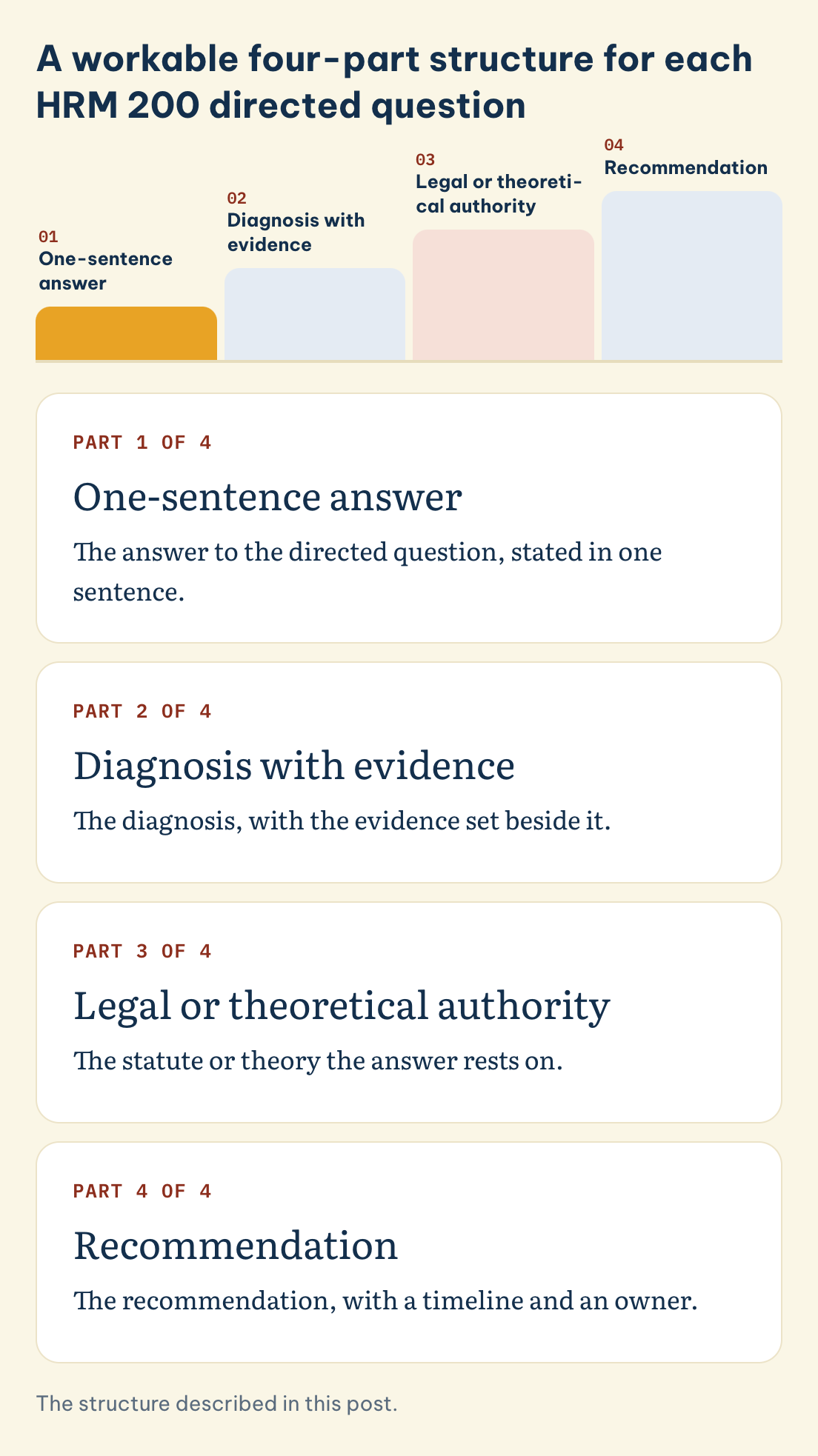
Evidence: The assessment sets a title page, a body of a few pages and a references page, so the body is the only place marks are available, and every graded criterion has to appear inside it. Structuring the body to mirror the brief's own question order is the cheapest available way to make sure no criterion is left unscored, and it is the fix that most reliably lifts a borderline submission.
Example: A student handed in a beautifully written essay that folded three directed questions into a single flowing argument. The marker could not locate the answer to question two and scored it as missing. His MAAS mentor suggested he add three labelled headings and move nothing else. The resubmitted structure recovered the lost criterion in full.
◆ Question 8 / 8 · Referencing
What referencing and integrity rules apply to HRM 200?
Direct answer: Confirm the required style in your own brief; Canadian HR courses most often use APA, and HRM 200 assessments require a separate references page. Cite the statute and the textbook, not a study-notes site. Uploading or downloading a graded case answer from a file-sharing platform is an academic offence at Waterloo regardless of whether you copy from it.
Evidence: Waterloo's Policy 71 governs student discipline, and unauthorised sharing or use of course materials and graded work falls within it. This matters more in HRM 200 than in most courses because the same case scenarios circulate widely on commercial study sites, which makes similarity between submissions easy to detect and hard to explain.
Example: A student came to MAAS after a similarity flag on a case answer she had written herself, having read a posted answer first to "understand the format". Her mentor's advice for the next term was procedural rather than moral: build the answer from the statute, the textbook chapter and the case file only, and keep a dated outline so the drafting history is your own evidence.
Frequently asked questions
Is HRM 200 a difficult course?
It is conceptually straightforward but assessment-heavy on application. There is no mathematics beyond basic compensation arithmetic. Students struggle when they revise definitions instead of practising diagnosis on cases.
Do I need Canadian work experience to do well?
No. The case gives you the workplace facts. What you need is the correct jurisdiction, the right statute, and a clear line from a diagnosed cause to a specific recommendation.
How many HR concepts should one case answer use?
Two or three applied properly beat six mentioned in passing. Markers reward the concept that changes your conclusion, not the number of terms you can name.
Can I use the case answers posted on study-sharing sites?
No. Using them risks an academic offence under Waterloo's Policy 71, and the posted answers are frequently written against an older version of the case.
Can MAAS help me with HRM 200?
Yes. MAAS Assignment & Essay Support coaches you through the case: reading the brief, diagnosing the root HR problem, selecting the right statute and framework, and auditing your referencing before submission. We coach your work; we do not write it for you.
Ready to approach your HRM 200 case with a diagnosis instead of a summary?
If you can retell the case but cannot say what is broken and on what authority, that is exactly the gap a discipline-matched expert closes fastest. MAAS Assignment & Essay Support works alongside you so the argument stays yours while the structure earns the marks.
Bring your HRM 200 brief and we will match you to a human resources mentor, 23% of our 100+ experts hold a PhD, within 48 hours when our network already covers that field. If it does not, MAAS opens a dedicated recruitment round for your case, which usually takes about two weeks.
Book a free 20-minute HRM 200 consultation with MAAS Assignment & Essay Support →
Related guides
- MGMT1007 assignment: how do you approach Introduction to Human Resource Management?: sibling introductory HRM guide on the core functions and their assessment
- BUSM4187 assignment: how do you approach International Human Resource Management?: the cross-border counterpart, useful if your case involves a multinational employer
- BUSM3250 assignment: how do you approach People and Organisations?: companion guide on organisational behaviour evidence in people cases
- How to write a case study analysis: the general method behind every directed-question case assessment
- MAAS Academic Mentoring service: 1:1 coaching with postgraduate-qualified mentors in your discipline
- Course-code assignment coaching: pillar guide on tackling any unit assignment with a MAAS mentor
References
- Barney, J. (1991). Firm resources and sustained competitive advantage. Journal of Management, 17(1), 99–120. https://doi.org/10.1177/014920639101700108
- Combs, J., Liu, Y., Hall, A., & Ketchen, D. (2006). How much do high-performance work practices matter? A meta-analysis of their effects on organizational performance. Personnel Psychology, 59(3), 501–528. https://doi.org/10.1111/j.1744-6570.2006.00045.x
- Dessler, G., & Chhinzer, N. (2025). Human resources management in Canada (16th Canadian ed.). Pearson Canada.
- Government of Ontario. (1990). Human Rights Code, R.S.O. 1990, c. H.19. https://www.ontario.ca/laws/statute/90h19
- Government of Ontario. (2000). Employment Standards Act, 2000, S.O. 2000, c. 41. https://www.ontario.ca/laws/statute/00e41
- Huselid, M. A. (1995). The impact of human resource management practices on turnover, productivity, and corporate financial performance. Academy of Management Journal, 38(3), 635–672. https://doi.org/10.5465/256741
- Ulrich, D. (1997). Human resource champions: The next agenda for adding value and delivering results. Harvard Business School Press.
- University of Waterloo. (n.d.-a). Undergraduate calendar: Human Resources Management courses. https://ucalendar.uwaterloo.ca/2324/COURSE/course-HRM.html
- University of Waterloo. (n.d.-b). Policy 71: Student discipline. https://uwaterloo.ca/secretariat/policies-procedures-guidelines/policy-71
Tools & resources
- Government of Ontario. (n.d.). Your guide to the Employment Standards Act. https://www.ontario.ca/document/your-guide-employment-standards-act-0
- University of Waterloo. (n.d.). Writing and Communication Centre. https://uwaterloo.ca/writing-and-communication-centre/
This article is part of the MAAS Journal series for Vietnamese international students. MAAS Assignment & Essay Support is an academic support partner; we coach students through the Outline, Draft, Final delivery model with developmental feedback from discipline-matched experts. We do not write or submit work on a student's behalf.
A free 20-minute consultation is a conversation about where you are with HRM 200.
Book a free consultation ▸