
◆ Business & Management
MGMT1007: what changes when a unit has no exam and no essay?
Most first-year business units end in an exam, and most of the writing is an essay or a report. This unit has neither. Its three assessments are an evidence-based problem task, an infographic, and a reflection on your own participation, each rewarding a different skill from the one an essay-trained student already has. The unit is not harder than a conventional one, but it is harder to prepare for by habit, which is where the marks are lost.

◆ Section 1 / 7 · Which unit
First, confirm which MGMT1007 you are enrolled in
Direct answer: This guide describes the Macquarie University unit MGMT1007 Introduction to Human Resource Management, a 10 credit point unit at 1000 level, taught by Macquarie Business School. There are no prerequisites, and it carries a not-for-credit-with rule against HRM107, the pre-2020 code for the same material.
Evidence: The 2026 handbook entry lists the unit at Session 1 and Session 2, offered either in person on weekdays at North Ryde or online in scheduled weekday classes. Teaching runs through pre-recorded lectures with a live tutorial, which means the tutorial is the only timetabled contact point and, as the third assessment makes clear, is not optional in practice.
Example: A student who found MGMT1007 material online from a pre-2020 cohort prepared for an exam that no longer exists. The topic list had barely changed. The assessment design had changed completely, which is the part that determines how you study.
Macquarie University itself was established in 1964, considerably younger than most of the sandstone universities Australian HR case studies are drawn from, and North Ryde, the campus where MGMT1007 is mostly taught, has been its home from the start.
◆ Section 2 / 7 · What it covers
What is the unit actually about?
Direct answer: Human resource management in the Australian context, covering human resource planning and staffing, employee training and development, performance appraisal, managing a workforce, and workplace health and safety, together with the environmental influences that shape HR strategy.
Evidence: The workplace health and safety and performance topics both sit inside a specific legal frame in Australia, the Fair Work Act 2009 (Cth), which came into force on 1 July 2009 and still governs the minimum entitlements, unfair dismissal rules and enterprise agreements any HR strategy case study has to work within. The handbook states that on completion you should be able to demonstrate the links between the different areas of HRM and the contribution of HRM in businesses. The operative word is links. The topics are taught in sequence, but the stated outcome is about how they connect, which is the part a topic-by-topic revision approach never builds.
Example: Asked how a performance appraisal system relates to training, a student described both accurately and separately. The stronger answer notes that appraisal generates the training needs analysis that development programmes are supposed to be built on, and that when the two are designed by different teams the link breaks. Same content, connected rather than listed.
| Unit learning outcome | What it asks | Where students under-deliver |
|---|---|---|
| ULO1: identify and investigate key concepts and theories in HRM | Knowing the field and being able to look into it | Stopping at the textbook definition |
| ULO2: explain and analyse the connection between HRM and organisational processes, plans and policies that deliver sustainable organisations | Linking the HR function to the business | Treating HRM as a self-contained topic |
| ULO3: develop and apply effective critical thinking and argument-making, written and verbal | Building an argument in both modes | Preparing only for the written mode |
Notice that ULO3 names verbal argument alongside written. In a unit whose only scheduled contact is the tutorial, that is not decorative.
◆ Section 3 / 7 · Assessments
The three assessments, and why none of them is an essay
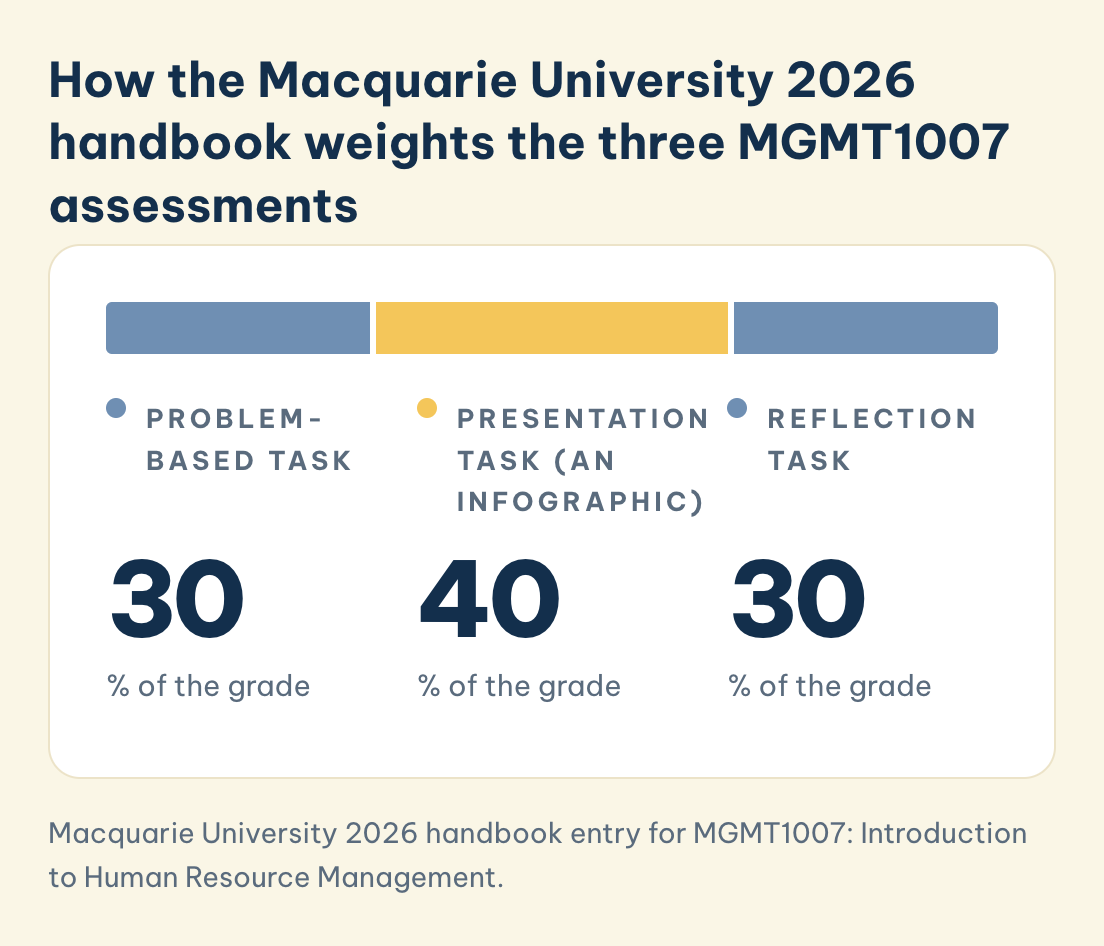
Direct answer: A problem-based task at 30%, a presentation task at 40%, and a reflection task at 30%. The presentation task is the largest single component, and it is an infographic rather than a talk or a paper.
How the Macquarie University 2026 handbook weights the three MGMT1007 assessments
These are the weights the handbook entry lists for the unit, shown as a share of the grade.
Problem-based task
30
% of the grade
Presentation task (an infographic)
40
% of the grade
Reflection task
30
% of the grade
Save this figure
Evidence: The handbook describes each purpose explicitly. The problem-based task asks you to summarise and evaluate a selection of scholarly sources, assessing their quality and relevance, in order to develop the analytical mindset, research literacy and evidence-based approach of modern HR practice. The presentation task asks you to create an infographic that translates HRM theory and evidence into clear visual insights, in the way HR professionals communicate policies to stakeholders. The reflection task asks you to consider your engagement and contributions in tutorials, and how those behaviours relate to expectations of employees.
Example: A student allocated her effort by perceived difficulty, giving most of her time to the source-evaluation task because it looked most academic, and treating the infographic as a design exercise done the night before. The infographic was worth more than either other task. Effort followed familiarity rather than weighting, which is a common and expensive misreading.
◆ Section 4 / 7 · Source evaluation
What does the source evaluation task actually reward?
Direct answer: Judgement about sources, not coverage of them. The task asks you to assess quality and relevance, which means a source you examine and set aside, with a reason, can earn more than a source you summarise approvingly.
Evidence: The stated purpose names an evidence-based approach, and that phrase has a specific meaning in this field. Rousseau and Barends (2011) describe evidence-based HR as combining critical thinking with the best available scientific evidence and organisational information, and their emphasis falls on appraising evidence rather than accumulating it. In their own words, "critical thinking means actively exploring alternatives, seeking understanding and testing assumptions about the effectiveness of one's own professional decisions and activities" (Rousseau & Barends, 2011, p. 221). A practitioner who cites six studies without weighing them has not practised evidence-based HR. The field's own push toward evidence-based practice tracks a broader shift in what HR is expected to be. Ulrich (1997) reframed HR through the business partner model, from an administrative service into a source of strategic argument, and a source-evaluation task is exactly the skill that shift demands.
Example: Two submissions covered the same five articles. The weaker one gave each a paragraph of summary and a sentence of praise. The stronger one grouped them, noted that three were single-organisation case studies and therefore limited in what they could generalise, and said which of the five it would actually rely on for a staffing decision and why. The second student read no more than the first.
A usable structure for each source is three moves: what it claims, how strong the basis for the claim is, and what it would let you decide. If the third move is blank, the source is not yet evaluated.
◆ Section 5 / 7 · The infographic
The infographic is worth 40%, and it is not a design task
Direct answer: The infographic is a translation task. The brief is to turn HRM theory and evidence into something a workplace stakeholder can use, which means the mark rests on whether the ideas survive the compression, not on whether the layout is attractive.
Evidence: The handbook frames it against how HR professionals communicate policies and initiatives, and it sits under a unit outcome about explaining and analysing the connection between HRM and organisational processes. A visually polished piece that conveys a definition has not made that connection. A plain one that shows how a policy affects a process has.
Example: An infographic on workplace health and safety used strong visuals to present the legislative definition and a set of statistics. It was accurate and it was decorative. A stronger version took one idea, that hazard reporting fails when reporting is slower than working around the hazard, and used the whole space to show that mechanism. The second communicated something a manager could act on.
Before you open any design tool, write the single sentence the viewer should be able to repeat afterwards. If you cannot write it, no amount of layout will supply it.
◆ Section 6 / 7 · The reflection
The reflection task cannot be written retroactively
Direct answer: The reflection asks you to consider your engagement and contributions in tutorials and relate them to workplace expectations of professional responsibility and participation. It is worth 30%, and unlike the other two, the raw material has to have been generated weeks earlier.
Evidence: Reflective writing is a taught genre with its own demands rather than a free-form account. The underlying model traces to Kolb (1984), whose experiential learning cycle frames learning as concrete experience feeding into reflective observation and then into a changed way of acting, not experience alone. Ryan (2011) argues that students need an explicit language for reflection, and that the difficulty is usually not honesty but the move from reporting an experience to reasoning about it and then relating it to a broader frame. A reflection that only narrates what happened is doing the first of three steps.
Example: A student who had attended every tutorial but rarely spoke wrote a reflection admitting this and promising to improve. That is narration plus a resolution. A stronger version identified a specific tutorial where she had disagreed with a group's reading and not said so, examined why, and connected that to the professional cost of silent disagreement in an HR role. She was no more engaged than the first student. She reasoned about the same material.
Keep a short note after each tutorial recording one thing you contributed or held back, and why. Ten lines a week makes this assessment straightforward and its absence makes the task considerably harder.
◆ Section 7 / 7 · Six things to do
Six things worth doing in this unit
- Allocate effort by weighting, not by familiarity. The infographic is the largest single component.
- Treat the tutorial as assessed, because through the reflection task it effectively is.
- Keep a running tutorial log from week one. The reflection is the one task you cannot produce from scratch at the end.
- For every source, finish with what it would let you decide. Evaluation ends in a judgement, not a summary.
- Write the infographic's single takeaway sentence before designing anything.
- Practise saying your argument aloud in tutorials. ULO3 names verbal argument, and the unit gives you a weekly place to build it.
Frequently asked questions
Does MGMT1007 have an exam?
No. The 2026 assessment structure is a problem-based task at 30%, a presentation task at 40% and a reflection task at 30%. If you find material describing an exam, check whether it predates the current design or belongs to the older HRM107 code.
What is the relationship between MGMT1007 and HRM107?
HRM107 is listed as not-for-credit-with, meaning it is the earlier code for equivalent material and you cannot count both towards your degree.
Are there prerequisites?
The handbook lists none, which is consistent with a 1000-level introductory unit. It is offered in both Session 1 and Session 2, in person at North Ryde or online in scheduled weekday classes.
How do I write a reflection without simply describing what happened?
Description is the starting point rather than the answer. Move from what happened, to why it happened and what it reveals, to what it means for professional practice. A reflection that stops at the first stage has not yet met the task.
Does the infographic need professional design skills?
The assessment is about translating theory and evidence for a workplace audience, not about visual sophistication. Clarity of the underlying idea is what carries the mark, and a simple layout that communicates one mechanism well outperforms a complex one that presents definitions.
Where MAAS fits
MAAS mentors work alongside students in units like this rather than in place of them. Where a unit replaces the familiar essay with source evaluation, visual translation and reflection, the useful thing a mentor does is help you see what each format is actually testing, so that effort lands where the marks are rather than where the habits are. The work stays yours. If that is useful, our academic support service and our tutoring service are the two places to start.
References
Kolb, D. A. (1984). Experiential learning: Experience as the source of learning and development. Prentice-Hall.
Rousseau, D. M., & Barends, E. G. R. (2011). Becoming an evidence-based HR practitioner. Human Resource Management Journal, 21(3), 221–235. https://doi.org/10.1111/j.1748-8583.2011.00173.x
Ryan, M. (2011). Improving reflective writing in higher education: A social semiotic perspective. Teaching in Higher Education, 16(1), 99–111. https://doi.org/10.1080/13562517.2010.507311
Ulrich, D. (1997). Human resource champions: The next agenda for adding value and delivering results. Harvard Business School Press.
Tools & resources
Macquarie University. (2026). MGMT1007: Introduction to Human Resource Management. https://coursehandbook.mq.edu.au/2026/units/MGMT1007
A free 20-minute consultation is a conversation about where you are with MGMT1007.
Book a free consultation ▸