
◆ Communication & PR
COMM2953 Precision Writing (RMIT): how do you approach the assignment?
COMM2953 Precision Writing for Digital Engagement at RMIT Vietnam is the course where good writing stops being about sounding impressive and starts being about being read. The rubric rewards evidence that you made a deliberate choice at the level of the sentence, the word, and the heading, and that you can explain why that choice suits a specific audience on a specific platform. This guide answers the seven questions Vietnamese students at RMIT ask MAAS mentors most often.

◆ Question 1 / 8 · The course
What is COMM2953 Precision Writing for Digital Engagement about?
Direct answer: COMM2953 is a first-year undergraduate course in RMIT's Bachelor of Professional Communication, taught at RMIT Vietnam Saigon South (also COMM2913 in Melbourne and COMM2954 in Hanoi). It teaches you to write a precise sentence that cuts through to an audience, covering readability, tone and voice, and ethical use of emerging technologies as writing tools.
Evidence: The RMIT course description states the goal explicitly as sharpening writing skills and learning techniques and tools for maximising reader attention and engagement in digital environments. That phrasing matters for your marks. Attention and engagement are measurable outcomes of writing choices, so the assessment is not asking whether your writing is nice; it is asking whether it does a job you can name.
Example: A Vietnamese student came to MAAS with a piece of web copy she described as "well written". Her mentor asked one question: which reader behaviour is each paragraph designed to trigger? She had no answer. Rewriting nothing but the headings and the first sentence of each section, so that the information-carrying words came first, moved her draft from a competent piece to one she could defend against the rubric.
◆ Question 2 / 8 · Assessment
What assessment does the COMM2953 assignment usually involve?
Direct answer: COMM2953 is taught through workshops, tutorials, class discussion and individual and group research, and it is assessed through practical writing tasks rather than a traditional essay. Expect a portfolio of short digital pieces (web copy, social posts, headlines, an email or newsletter), each written for a stated audience and platform, plus a written rationale or reflection explaining your choices, and often a revision exercise where you rewrite a poorly performing text. Always confirm the exact tasks and weightings in your own Canvas shell, because assessment detail changes each semester.
Evidence: RMIT assessment is criterion-referenced, meaning your work is marked against published criteria rather than ranked against classmates. In a precision-writing course, those criteria almost always separate the artefact (the copy itself) from the justification (the rationale). Students routinely put 90% of their effort into the artefact and then write the rationale in the last hour, which inverts where the marks actually sit.
Example: A student submitted three polished social posts and a two-paragraph rationale that said the tone was "friendly and engaging". His mentor pointed out that friendly and engaging are effects, not choices. The rewrite named the choices, short sentences, front-loaded verbs, second-person address, and explained why each suited the platform and audience. Same posts, two bands higher.
◆ Question 3 / 8 · Grading
How is COMM2953 graded, what does the rubric actually reward?
Direct answer: COMM2953 rubrics reward four things, roughly in this order: (1) precision, whether every word earns its place and the sentence carries one clear idea; (2) audience fit, whether tone, voice and register match a defined reader rather than a general one; (3) justified choices, whether your rationale explains the reasoning behind the writing using course concepts; and (4) ethical and correct use of tools, including transparent handling of generative AI. The gap between Credit and Distinction is almost never elegance. It is whether you can explain the mechanism.
How lower-band and higher-band COMM2953 answers differ on five rubric focuses
Each row sets one rubric focus beside what a lower-band answer does and what a higher-band answer does, taken from the table in this post.
Rubric focus
What a lower-band answer does and what a higher-band answer does
Sentence craft
Lower band writes clearly and without errors. Higher band cuts redundancy so each sentence carries one idea for a scanning reader.
Audience
Lower band says the piece is for young people. Higher band defines the reader, context and intent, then adapts register and voice to them.
Structure
Lower band uses headings and paragraphs. Higher band front-loads information-carrying words so meaning survives a five-second scan.
Rationale
Lower band states that the tone is engaging. Higher band names each choice and argues from readability and platform evidence why it works.
Tool use
Lower band mentions that AI was used. Higher band documents what the tool did, what was verified, and why the use was appropriate.
Save this figure
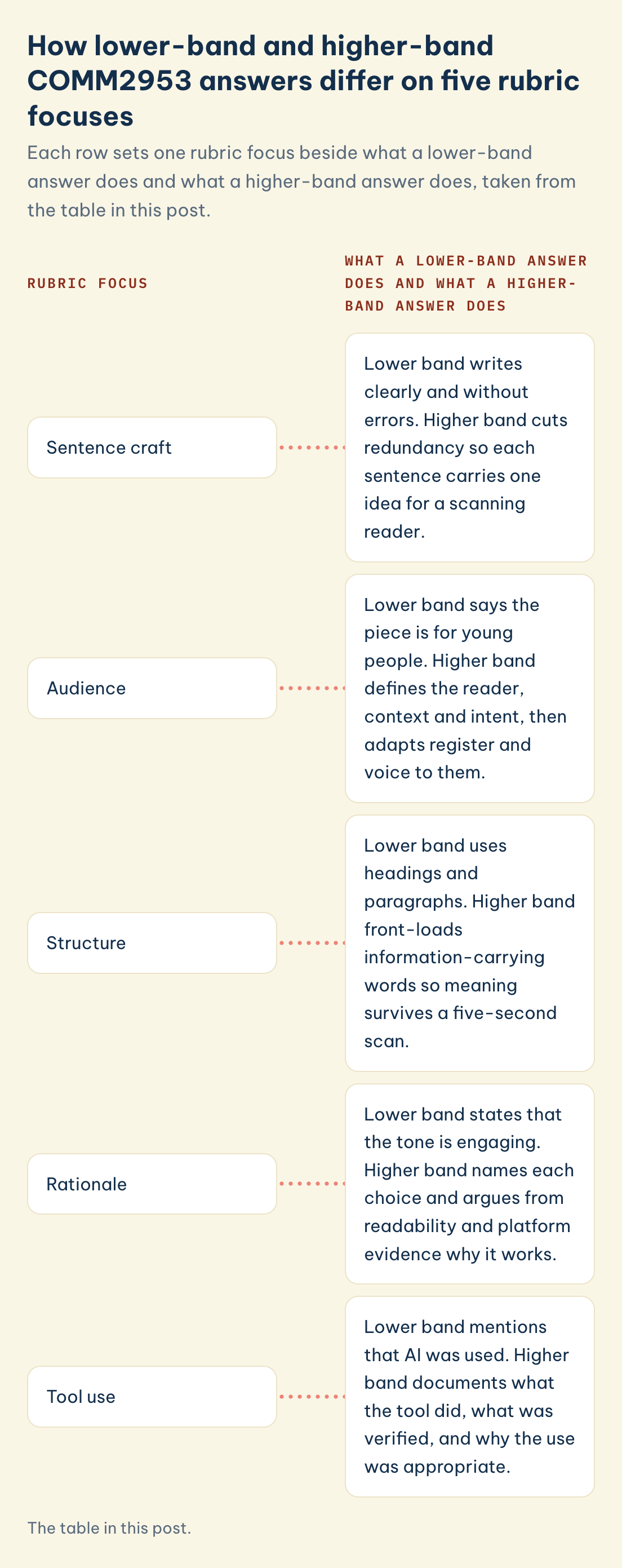
Evidence: RMIT communication rubrics use criterion bands (Pass, Credit, Distinction, High Distinction), and higher bands are defined by evaluative verbs: "critically applies", "justifies", "adapts for audience". A description of what you wrote sits in the lower bands by definition. An argument for why you wrote it that way, tied to readability and audience principles, is what the higher bands describe.
| Rubric focus | Describe (lower band) | Engineer and justify (higher band) |
|---|---|---|
| Sentence craft | Writes clearly and without errors | Cuts redundancy so each sentence carries one idea for a scanning reader |
| Audience | Says the piece is for young people | Defines the reader, context and intent, then adapts register and voice to them |
| Structure | Uses headings and paragraphs | Front-loads information-carrying words so meaning survives a five-second scan |
| Rationale | States that the tone is engaging | Names each choice and argues from readability and platform evidence why it works |
| Tool use | Mentions that AI was used | Documents what the tool did, what was verified, and why the use was appropriate |
Example: A MAAS mentor marked a student's own draft against this table before submission and highlighted every sentence in the rationale that described rather than justified. Two thirds of it was description. The student rewrote the rationale only, not the copy, and the mark moved a full band.
◆ Question 4 / 8 · Concepts
Which concepts and frameworks should you use in COMM2953?
Direct answer: Anchor the work in a small number of established concepts and apply them, rather than naming many. The most useful for COMM2953 are: online scanning behaviour and the resulting formatting principles; the inverted pyramid, putting the conclusion first; plain language and readability, including its documented limits; register, tone and voice as separable choices; front-loading, so that headings and links carry meaning in their first two words; and the ethics of generative AI in professional writing. Pick the two or three that your piece actually depends on and argue from them.
Evidence: These frameworks are examiner-recognised because they convert taste into argument. Morkes and Nielsen's (1997) classic web-writing experiments found that rewriting the same information concisely improved measured usability by 58%, formatting it for scanning by 47%, stripping promotional language by 27%, and combining all three by 124%. That is the difference between saying "shorter is better" and citing a mechanism with a number attached.
Use the readability evidence carefully, because it is genuinely two-sided, and plain language and readability, including its documented limits (Kerwer et al., 2021), is exactly the kind of nuance the higher bands reward. Mac et al. (2025), in a randomised trial published in the Journal of General Internal Medicine, found that lowering the grade reading level of health information on its own, without changing formatting or testing with readers, produced no improvement in knowledge, perceived ease, or trust. Readability formulas measure syllables and sentence length, not clarity of thought. A rationale that says "I lowered the reading level, and I also restructured and front-loaded, because reading level alone does not carry comprehension" is exactly the critical application the higher bands describe.
Example: A Vietnamese student wrote in her rationale that she had "made the text easier to read". Her mentor asked her to separate the two things she had actually done, simplifying vocabulary and restructuring for scanning, and to note which of them the evidence supports more strongly. The revised rationale was shorter and marked higher, because it argued rather than asserted.
◆ Question 5 / 8 · Word choice
How do word choice and structure interact with algorithms?
Direct answer: Digital text is read twice: once by a machine that decides whether it surfaces, and once by a person who decides whether to stay. The same principles largely serve both. Front-loaded headings, specific nouns instead of vague ones, one idea per paragraph, and descriptive link text help a search or feed system understand the topic, and help a scanning human find it. Where the two diverge, COMM2953 wants you to notice the tension and resolve it deliberately, not to stuff keywords and hope.
Evidence: Eyetracking research from Nielsen Norman Group, which first reported the F-pattern in 2006 and confirmed it again in Pernice (2019), shows people rarely read digital text linearly; they scan in patterns, and the least efficient of these, the F-pattern, appears precisely when text has no subheadings, bolding or bullets to guide the eye. Redish (2012), in Letting Go of the Words, makes the same point from the writer's side: web readers scan for the specific piece of information relevant to their task, so the writer's job is to put that information where a scanning eye will land, not to write a complete paragraph a scanning reader will skip. Pernice's own eyetracking data describe the mechanism directly: "In the absence of subheadings and bullets, users tend to fixate on the words toward the beginning of lines and toward the top of the page" (Pernice, 2019). The practical implication is directional: readers fixate on the first two words of headings and lines, so meaning that arrives late is meaning that is lost. Algorithms reward the same signals for the same reason, because both are trying to extract topic quickly from limited attention.
Example: A student's article heading read "Some things worth knowing before you go". Her mentor asked what a reader scanning the left edge would learn from the first two words. Nothing. Rewritten as "Visa steps before you travel", it worked for both the scanning reader and the search snippet, and the change cost one line of editing.
◆ Question 6 / 8 · Generative AI
How should you handle generative AI in a COMM2953 assignment?
Direct answer: COMM2953 explicitly includes the ethics and possibilities of emerging technologies as professional writing tools, so AI is a topic in the course, not just a rule around it. RMIT's position is that your course coordinator sets what is permitted for each assessment in Canvas, and that any permitted use must be acknowledged and referenced according to the university's guidelines.
The safe and mark-earning approach is the same one the research recommends: check the Canvas statement for that specific task first, use tools for supportive work only if permitted, verify everything they produce, and declare the use plainly.
Evidence: Non-disclosure is the documented failure mode, and it is usually driven by fear rather than intent to deceive. Gonsalves (2025), studying a King's Business School cohort, found that 74% of students did not declare their AI use on the mandatory coursework coversheet, with fear of penalties, ambiguous guidelines, inconsistent enforcement and peer influence all reported as barriers. Rentier (2025), writing in AI and Ethics, makes the underlying point for a writing course: generative models produce text rather than retrieve it, so they can output confident, unsourced, or fabricated material, which is why anything they suggest must be verified and acknowledged like any other tool in your method.
Example: A student asked a MAAS mentor whether using a tool to suggest headline variants would count against her. The mentor's answer was procedural, not moral: check the Canvas statement for that assessment, and if it is permitted, write one sentence in your rationale saying what the tool did and what you changed. She did, and the transparency read as professional judgement rather than as a confession.
◆ Question 7 / 8 · Common mistakes
What are the most common mistakes Vietnamese students make in COMM2953?
Direct answer: The recurring mistakes are: writing to sound academic in a course that rewards plain digital English; describing tone instead of justifying choices in the rationale; defining the audience as "everyone" or "young people"; burying the point in the third sentence when the reader leaves after the first; treating readability as a score to hit rather than a set of decisions; and leaving AI use undeclared out of anxiety. Each of these loses marks even when the writing itself is clean.
Evidence: Because the course is criterion-referenced and audience-led, the marker is looking for a defined reader and a defended choice. Writing that could have been addressed to anyone cannot demonstrate audience adaptation, which is a criterion in its own right. Students who learned to write formally for high-stakes exams often carry that register into digital tasks, where the same formality reads as distance and slows the reader down.
Example: A Vietnamese student's landing-page copy opened with two sentences of context before naming the offer. His mentor did not rewrite it. She asked him to delete the first two sentences and read what remained. The piece started at the point, and he could then explain the inverted pyramid in his rationale, because he had felt it work.
◆ Question 8 / 8 · MAAS mentor
How can a MAAS mentor help you approach COMM2953 without crossing the line?
Direct answer: A MAAS mentor works alongside you, not instead of you. The mentor helps you decode the brief and rubric, define a real audience rather than a vague one, apply readability and scanning principles to your own draft, and pressure-test your rationale for the difference between describing and justifying. You keep authorship of every word you submit; the mentor raises the ceiling of what you can defend on your own.
Evidence: Because COMM2953 is graded on justified writing choices rather than polish, the durable gain is the habit of naming what a sentence is engineered to do. That habit transfers directly into content, PR, marketing and UX writing roles, where you will be asked to defend copy to a client or a stakeholder. Coaching that builds the reasoning is what moves marks and, more importantly, what survives into your career.
Example: A Vietnamese RMIT student arrived able to write fluently but unable to explain any of it. Over a few sessions her MAAS mentor did nothing but ask "why this word, why here, for whom" until the answers came without prompting. She wrote and submitted every piece herself. The mark rose, and she now edits her colleagues' copy at a Ho Chi Minh City agency.
Frequently asked questions
Is COMM2953 hard for international students?
The writing itself is manageable. The difficulty is the rationale, where you must justify choices in course language rather than describe them. Students whose prior training rewarded formal, elaborate writing often need to unlearn that register before the digital tasks feel natural.
What is precision writing in COMM2953?
Precision writing means every word earns its place and each sentence carries one clear idea for a reader who is scanning, not reading. It is a discipline of removal and ordering, not of simplification for its own sake.
How long should the COMM2953 rationale be?
Follow your brief, but the useful rule is one justified choice per paragraph. A short rationale that names three choices and argues each from readability or audience principles beats a long one that describes the tone.
Does MAAS write the COMM2953 assignment for me?
No. MAAS provides mentoring and review. A mentor helps you decode the rubric, apply the concepts, and test your reasoning, but you remain the author of every piece and every rationale you submit.
Can I use AI tools in COMM2953?
Only if the Canvas statement for that specific assessment permits it, and only with acknowledgement in line with RMIT's referencing guidance. Course coordinators set the rule per task, so check there first rather than assuming a blanket policy.
How do I define an audience properly?
Name who they are, where they encounter the text, what they want in that moment, and what would make them leave. "Young Vietnamese jobseekers reading on a phone during a commute" is a brief you can write to. "Young people" is not.
How MAAS mentors support COMM2953 students
If you are approaching the COMM2953 Precision Writing for Digital Engagement assignment and want a clearer path, MAAS offers a free 20-minute consultation to review your brief and map your approach. Bring your assignment brief and we will match you with a subject mentor within 48 hours when our network already covers that field. If it does not, MAAS opens a dedicated recruitment round for your case, which usually takes about 2 weeks. Around 23% of MAAS experts hold a PhD, and our communication mentors are practising writers and editors who work with you to raise what you can defend on your own, never to write the work for you.
Related reading: see our guides to COMM2789 Digital Content Creation and COMM2381 Communication Strategy and Planning, and our academic support service for how mentoring works end to end.
References
Gonsalves, C. (2025). Addressing student non-compliance in AI use declarations: Implications for academic integrity and assessment in higher education. Assessment & Evaluation in Higher Education, 50(4), 592–606. https://doi.org/10.1080/02602938.2024.2415654
Kerwer, M., Stoll, M., Jonas, M., Benz, G., & Chasiotis, A. (2021). How to put it plainly? Findings from two randomized controlled studies on writing plain language summaries for psychological meta-analyses. Frontiers in Psychology, 12, Article 771399. https://doi.org/10.3389/fpsyg.2021.771399
Mac, O., Ayre, J., McCaffery, K., Bonner, C., & Muscat, D. M. (2025). The readability study: A randomised trial of health information written at different grade reading levels. Journal of General Internal Medicine, 40, 1820–1828. https://doi.org/10.1007/s11606-024-09200-z
Morkes, J., & Nielsen, J. (1997). Concise, SCANNABLE, and objective: How to write for the Web. Nielsen Norman Group.
Redish, J. C. (2012). Letting go of the words: Writing web content that works (2nd ed.). Morgan Kaufmann.
Rentier, E. S. (2025). To use or not to use: Exploring the ethical implications of using generative AI in academic writing. AI and Ethics, 5, 3421–3425. https://doi.org/10.1007/s43681-024-00649-6
Pernice, K. (2019). Text scanning patterns: Eyetracking evidence. Nielsen Norman Group. https://www.nngroup.com/articles/text-scanning-patterns-eyetracking/
Tools & resources
RMIT University. (2026). Precision Writing for Digital Engagement (055688), course guide. RMIT Handbook. https://handbook.rmit.edu.au
A free 20-minute consultation is a conversation about where you are with COMM2953.
Book a free consultation ▸